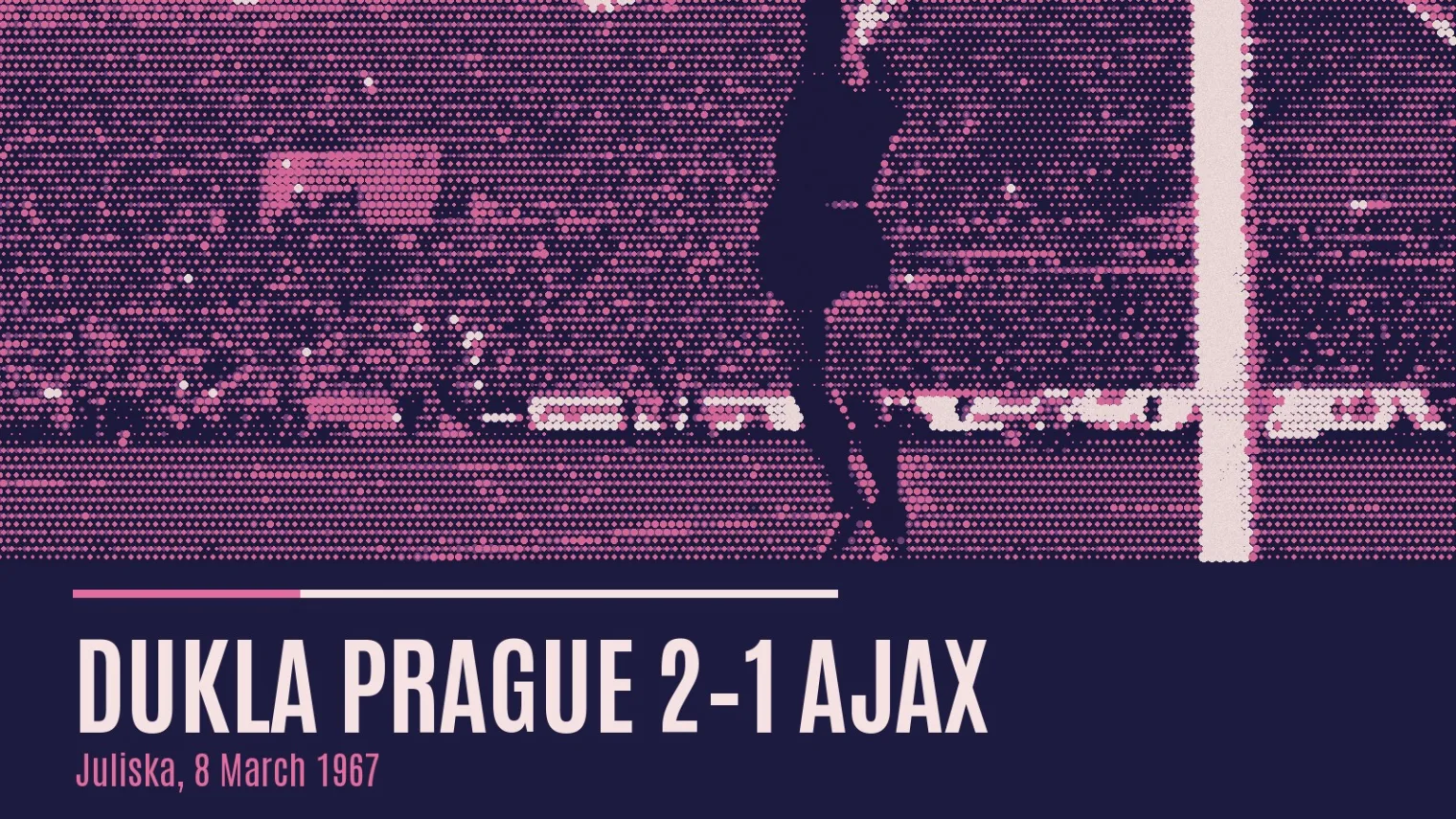
On 8 March 1967 the people of Dejvice ran out of seats, so they kept going up the hill. Stadion Juliska sits in a fold of Prague 6, with woods on one side and the city on the other, and in those years the main stand that now dominates the ground did not exist. Most of the crowd sat, or simply stood, on a grass slope along one of the touchlines. The official attendance that afternoon was 18,419. Czech accounts still call it a 20,000 sell-out, and hundreds more watched from the surrounding slopes. The photographs from the day, taken by Jac de Nijs of Anefo, show both: a terrace packed tight enough to hide the advertising boards, and a dark line of coats and hats dotted all the way up the grass behind the goal.
Ajax, who had arrived that week from Amsterdam as the side that had just taken Liverpool apart, went 1–0 up. Sjaak Swart scored, with Klaas Nuninga hovering at his shoulder, in the 65th minute. Twelve minutes from the end they were heading out. Stanislav Štrunc had equalised from the penalty spot, and Frits Soetekouw, the Ajax captain, had put the ball into his own net. Dukla Prague, army club, Czechoslovak champions, winners of the 1962 Ballon d’Or in midfield, had a European Cup semi-final. The visitors had the rest of the decade to come.
The fog, and a 19-year-old
Three months earlier almost nobody outside the Netherlands had needed to take Ajax seriously. Rinus Michels had been in the job a little over a year. He had turned a side that had been battling relegation into Dutch champions, and he was at the start of the idea that would later be called Total Football, but the European Cup was still a test they had not sat for five years. In the second round they drew Bill Shankly’s Liverpool, English champions, a club that had already been to a European Cup semi-final and a Cup Winners’ Cup final. The first leg was moved from De Meer to the Olympic Stadium to meet the demand, and on 7 December 1966 a fog came down so thick that the Italian referee, Antonio Sbardella, went ahead only because he could see both goals from the centre circle.
What happened in that murk has been told often enough, and it still sounds like a joke. Ajax were a goal up inside three minutes and 4–0 by half-time. Shankly walked onto the pitch to talk to his players when a Dutchman went down injured, and had to be ordered off. Sjaak Swart started to walk down the tunnel when he heard a whistle, and had to be told that it was a goal, not half-time. The final score was 5–1, the heaviest European defeat of Shankly’s Liverpool: Cees de Wolf, Johan Cruyff, Klaas Nuninga twice, and Henk Groot, with Chris Lawler getting one back. A 15-year-old on the club’s books, Louis van Gaal, later said he had sneaked in without a ticket. The Independent’s later reconstruction of the night has the crowd above 50,000, most of them learning about the goals by word of mouth, because only the people closest to the pitch could see the ball. “Everyone in Amsterdam seemed to claim to be present afterwards.” In the return at Anfield a week later, Cruyff scored twice in a 2–2 draw. More than 150 people needed treatment on a chaotic night on Merseyside, and Shankly’s belief that the tie could still be turned around lasted only as long as it took Cruyff to score the first of his two. The European champions-in-waiting, as they already seemed in Amsterdam, were in a quarter-final.
Cruyff was 19. Piet Keizer was 23, Wim Suurbier 22. Around them were the older heads — Gert Bals in goal, Bennie Muller, Swart, Soetekouw as captain — but the impression Europe had just been given was of a team arriving. “It was a fairytale, no one believed it actually happened,” Swart said of the fog game. The quarter-final was supposed to be the next chapter. Instead it was a meeting with a club that already knew what a European night felt like, and with a midfielder Europe had already decided was the best player on the continent.
A 1–1 in Amsterdam
The first leg was on 1 March 1967, back at the Olympic Stadium, kick-off a quarter past eight, in front of 55,765 people. Tofik Bahramov, of the Soviet Union, was the referee. Some of the Ajax support had already decided how the evening would end. Voetbal International later published a photograph of fans, before kick-off, lugging a European Cup around the concourse. A week later the team would be out. On the night itself the Dutch papers were less romantic. “Ajax’s dominance not rewarded, Dukla defence a mighty fortress,” the headlines ran, as VI recalled them.
It was goalless at half-time. Five minutes into the second half Swart scored again, from a tight angle, close in, the same right foot that would have its say in Prague. The explosion in the Olympic Stadium lasted ten minutes. Then Ivan Mráz finished a counter-attack, and the travelling support from Prague had their away goal, or what would have been called an away goal in a later tournament. In 1966–67 the European Cup still settled level ties with a play-off. A 1–1 draw in Amsterdam did not give Dukla a numerical edge. It gave them something more useful: proof that Michels’ side could be met, in their own stadium, a few months after Liverpool had been taken apart in the same ground. Bohumil Musil could take that back to Juliska and live with it.
Dukla had not arrived in Amsterdam by accident. In the first round they had beaten Esbjerg 2–0 and 4–0. In the second they had taken Anderlecht apart, 4–1 at Juliska and 2–1 in Brussels, Masopust opening the scoring in Prague. Musil had been around the club, on and off, since 1953; this latest spell, begun midway through the previous season when he replaced Jaroslav Vejvoda, had already delivered a league and cup double. Ajax were the younger, louder story. Dukla were the side that had been in this competition, on and off, for a decade, and had just put six past a Belgian champion. Michels’ team had not been found out, exactly. They had been held.
The army club, Masopust and Viktor
The man they had to meet most carefully was Josef Masopust, then 36, still the brain of the team he had led since the early 1950s. In December 1962 France Football had made him the European Footballer of the Year, the first player from the East to win the Ballon d’Or, after a World Cup in Chile in which he scored Czechoslovakia’s goal in the final against Brazil. Jean-Philippe Réthacker, writing in the magazine, called him a midfielder “capable of playing the violin, but also of doing the washing-up”: not a soloist in the style of Puskás or Sivori, but a constant, watchful presence “in front of the opposition’s assault and at the start of the Czechoslovak attacks.” He was not a goalscorer in the manner of the forwards who had won the award before him. What the journalists were rewarding, Réthacker thought, was the collector, the organiser, the man who knew when to carry the ball and when to give it. In the World Cup final in Santiago he had already shown the other half of that game: a run and a finish, in the 15th minute, that put Czechoslovakia in front against Brazil. He was still that player in 1967, a little older, in a claret-and-yellow shirt with a heart on the chest.
He had arrived at the club the way so many of its best players did. Dukla were an army side, founded after the war as ATK, the Army Club of Physical Training, later renamed ÚDA, and given the Dukla name in 1956 after the Slovak village that had stood in the way of a Nazi onslaught. Radio Prague’s later history is blunt about the privileges that followed. Other clubs were instructed, in the late 1940s, to let the army take their players. Radovan Jelínek, co-author of a cartographical history of Czech and Czechoslovak football, has described how that looked from the other side of the city: seven players from Slavia, five from Bohemians, and a club that could dominate the league because it had been handed the right to cherry-pick. Masopust, the eldest son of a miner from Most, had already joined Teplice at 18. When army service came, two years later, he was transferred to ATK and did his military service as a footballer.
By 1967 even that advantage had its limits. In his book Ten Golden Balls, published that year by the army press, Masopust complained about the loss of three attackers in 1963 to injury and to other Czechoslovak clubs. A western side, he observed, would simply have gone into the transfer market. Dukla had to wait for a promising youngster to be called up, or train a replacement from the ranks they already had. The resentment ran both ways. Rival supporters called the players lampasáci — soldiers with stripes on their trousers — and ordinary crowds never loved them the way they loved Sparta or Slavia. In 1965–66, Jelínek noted, Dukla won the league with an average gate of about 9,000, against 24,000 at the two big civilian clubs. European nights at Juliska were a different matter. The hill filled for Ajax, and it would fill for Celtic. The league, week to week, was another story.
Ivo Viktor had come in 1963, after his own army service in Brno, because Musil, then coaching the juniors, had pointed him out to Vejvoda. Vejvoda, the club still records, told him plainly that the first-choice goalkeeper was leaving and that Dukla had the best conditions in the country. Viktor listened, waited behind the older men, and eventually took the shirt. A few months before Ajax arrived, on 2 November 1966, he had kept a clean sheet for Czechoslovakia in a friendly at Wembley. England, then world champions, had 35 shots and scored none of them. The Times, as Dukla later quoted it, thought “the real winner of the match was in fact the Czechoslovak goalkeeper Viktor.” František Plánička, who knew a thing or two about the position, was simply delighted. The man who would face Swart and Cruyff at Juliska had already shown, in a more famous stadium, that he could fill an afternoon.
Years later, sitting in the same ground, Viktor was asked about the taunts. “We took it with humour,” he told Seznam Zprávy. “It was actually a sort of fraud. We were in the army, yes, but we played football.” The same, he said, was true of the Sparta and Slavia players who were listed as lathe operators at ČKD. Everybody was an amateur on paper. The difference, on a European afternoon, was that Dukla’s amateurs had Masopust in midfield, Viktor in goal, Ján Geleta beside them, and Štrunc, the man who would take the penalty, in attack. If the fog in Amsterdam had been a night for 19-year-olds, Juliska was a night for a midfielder who had already done his growing up in public, and for a goalkeeper who had just left England with a 0–0.
The shorter portrait of the club already on this site tells the longer story of the titles, the fade and the revival. What matters here is more particular. By the spring of 1967 they were no longer a novelty in the European Cup. They knew how to set a night up at Juliska, where, as StadiumDB later put it, even sides of the quality of Barcelona, Manchester United and Benfica “didn’t manage to conquer this ground.” Of 36 European ties there, the same account says, Dukla lost only three. Ajax, three months after the fog, were about to find out why.
A penalty, a captain, and a 2–1
Ajax’s supporters made the trip. Anefo photographed them leaving Schiphol in club caps and with banners, and again outside the ground in Prague, including a group of Volendammers at the entrance. How many of them got in is not a figure the contemporary records settle; the official 18,419 does not break the crowd down, and the Dutch papers of the day are no help on a precise headcount. What the pictures do show is that they were there, mixed into an afternoon that was otherwise a Prague occasion: packed terraces, army uniforms on the steps, and that line of spectators going on up the hill.
The return, on a Wednesday afternoon, was goalless at half-time. Kurt Tschenscher of West Germany was the referee. The Ajax eleven was the same one that had started in Amsterdam: Bals, Suurbier, Ton Pronk, Soetekouw, Theo van Duivenbode, Henk Groot, Muller, Swart, Cruyff, Nuninga and Keizer. Dukla’s was built around Viktor, Masopust, Geleta, Štrunc and Mráz. For an hour the tie sat at 1–1 on aggregate, which was of no use to the visitors.
Then Swart scored, Nuninga the provider, and for seven minutes Ajax were through. The photographs of that goal are chaotic in the way only a packed European afternoon is chaotic: Swart in white, on his right foot, two Dukla defenders already half-turned, the terrace a single dark mass behind them. In the 72nd minute Tschenscher pointed to the spot. Štrunc scored. The tie was level again, 2–2 on aggregate. In 1966–67 the European Cup had not yet adopted the away-goals rule; a third match, on neutral ground, would have been required, as it was in the other semi-final, when Internazionale and CSKA Sofia went to a play-off in Bologna after two 1–1 draws. They did not get that far. In the 87th minute Soetekouw put the ball into his own net. 2–1 on the night, 3–2 on aggregate. The European Cup, for Michels’ Ajax, was over.
There is a temptation, at this distance, to tidy the ending into a moral about inexperience, or about a captain’s mistake. The honest version is simpler, and the people who were there have always told it that way. Dukla scored twice in a quarter of an hour, once from the spot and once from an own goal, and a very good Ajax side could not find a third. “In this match too Ajax went 1–0 up, just as in the first leg, through Sjaak Swart,” AT5’s later retelling puts it. “But Dukla first scored a penalty and then Frits Soetekouw put the ball into his own goal.” No more myth is required. The hill did the rest.
When the whistle went the crowd came over the wall. De Nijs’s pictures of the pitch invasion are as revealing as the goal photographs: Czechoslovak flags, army greatcoats, a boy in the middle of it, and behind them the same slope, still dotted with people who had watched it from the grass. Another frame shows Masopust on the shoulders of the fans, the heart on his shirt visible, the flags filling the sky. Bohumil Paukner, later the club’s chairman, was 17 and on the hill that day. “The first goal was scored by Swart,” he told AT5 in 2024, still able to name Nuninga, Soetekouw, Pronk and Suurbier without a prompt. “Johan Cruyff was then almost twenty years old. He was magnificent.” Asked whether it was the greatest match in the club’s history, he did not hesitate for long. “It was a special day.”
Miloslav Jicha had already been the club’s secretary since 1955, and he was there too. The night mattered, he said, “partly because Ajax conquered Europe three years later. And many of the players from that Ajax team later became very important for the Dutch national side.” He was right about the second part, and almost right about the first. The Ajax that won the European Cup in 1971 still had Cruyff, Keizer and Suurbier in it. The education had been real.
A semi-final, then the Lisbon Lions
Dukla’s reward was Celtic, who were in the middle of the season that would end with the Lisbon Lions. Jock Stein, having squeezed past Vojvodina in the quarter-final, wanted a two-goal cushion to take to Prague, and he said so. The first leg, at Celtic Park on 12 April, finished 3–1 in front of 74,406 people. Geoffrey Green, writing in The Times, thought Dukla should have secured the night in the first quarter of an hour, “with studied, subtle, chessboard moves inspired by the master Masopust.” They did not. Ronnie Simpson had to make an early diving save from Štrunc, and Josef Nedorost missed another. Celtic were reprieved, and then they scored with their first real attack: a move begun by Bertie Auld and carried on by Willie Wallace, finished by Jimmy Johnstone, cutting in, just before the half hour. A header from Steve Chalmers, off Johnstone’s cross, had already been ruled out for a high foot. On 44 minutes the advantage was squandered. Mistackles by Billy McNeill and Bobby Murdoch, Green wrote, let Nedorost in, and Štrunc had a clear shot after the ball broke into his stride. 1–1 at the interval, and the tie was alive.
Wallace settled it after the break, in the space of six minutes, on his first European appearance for the club. In the 59th minute a long pass from Tommy Gemmell, “which caught the Czech defence moving forwards on their toes and left them on their heels,” was finished with the outside of the foot. In the 65th, after a cluster of free-kicks, Auld slipped the ball sideways on the edge of the area and Wallace hit a dipping shot from 20 yards. He almost had a third, off Chalmers, against the bar. Stein had his cushion, just about. Green called it a contrast in styles, “Czech technique overpowered by the work and ceaseless effort of a well-drilled Celtic team.” Forty-one years later Masopust would tell the Evening Times that the two second-half goals had been “quite lucky.” Auld, who had played against him, was having none of it. “We beat them 3–1 at our place but could have scored four or five that night,” he said.
The return, on 25 April at Juliska, was a different sort of afternoon to the Ajax game. There were no floodlights, so it was a daylight kick-off, in a bitter wind that later brought flurries of snow. The official attendance, in Green’s report, was 19,157. Stein named Bobby Lennox on the left instead of John Hughes, whose first-leg performance had been poor, and he came to defend a two-goal lead. Wallace was given Masopust to mark. Stein’s instruction, as Gemmell later remembered it, was to stick balls up to the corner flags and let Chalmers chase them. “He was marvellous,” Gemmell said. Green, who had admired Dukla’s technique at Parkhead, now saw a steel curtain. “However much Dukla held the ball it did them no good,” he wrote, “since their midfield build-up was far too lateral and easily read.” After half an hour Masopust went down in midfield and, Green thought, never quite recovered. Štrunc and Nedorost had their moments; Simpson dealt with them. The soldiers in the crowd sent up rockets, whether to keep their spirits up or to keep themselves warm, Green was not sure. The match finished 0–0.
When the whistle went Stein ran the length of the pitch to find Chalmers and threw his arms around him. “I was never one of his favourites,” Chalmers remembered, “but he went out of his way to thank me.” Celtic were the first British club to reach a European Cup final. On 25 May in Lisbon they beat Inter 2–1, and a team of players drawn from within 30 miles of Glasgow became European champions. Dukla had been the last side to have a serious go at stopping them. They had scored at Parkhead, they had not conceded at home, and it had not been enough. Masopust left the following year, at 37, to become player-manager of Molenbeek in Belgium. He had been to the edge of a European Cup final, and no further.
After Juliska
The usual way to file the Ajax result is as a stumble on the road to the 1970s. That is not wrong. It is often told, though, with a convenient mistake attached. Later accounts, some of them otherwise careful, have Michels responding to the defeat by going out to sign Velibor Vasović, the Partizan sweeper, as if the libero arrived in the summer as a direct consequence of Soetekouw’s own goal. The dates do not support that. Ajax had announced the transfer in October 1966 and completed it on 1 December, six days before the fog game. Vasović made his debut on Boxing Day, in an 8–0 league win over Elinkwijk, and had been in the side through January. He did not play in either leg against Dukla. Why he was left out of those two European matches is not a question the contemporary record, as it stands, answers cleanly, and it is better to leave it than to invent a reason. What can be said is what happened next.
Four days after Juliska, Vasović started in the league at DOS. Soetekouw, still the European captain, was on the bench and did not appear. He made one more outing, as a substitute against Feyenoord on 27 March, and then left for PSV. Voetbal International, looking back, wrote that Michels had drawn hard conclusions from the defeat, and that in his view Pronk and Soetekouw had not been “ruthless” enough. Pronk was not discarded. Two years later, in Lisbon, Michels would still have a use for him, as the man who marked Eusébio in a quarter-final. Soetekouw, though, was finished as an Ajax defender. Vasović became the libero, and then the captain, of the side that went back to the European Cup.
They did not walk straight into it. In 1967–68 Real Madrid put them out in the first round, 1–1 in Amsterdam and 2–1 after extra time in the Bernabéu, with Vasović on the pitch for both legs. The season after that, the education began to look like a team. Ajax came through Nuremberg and Fenerbahçe, then found themselves 3–1 down to Benfica after a snowy night at the Olympic Stadium. In the return at the Estádio da Luz they won 3–1, with Cruyff scoring twice and Pronk told to stay with Eusébio, and a play-off was required in Paris. Klaas Nuninga, by then no longer the first name on the teamsheet, was on the bus that rolled down the Champs-Élysées and saw “all those tens of thousands of Ajax supporters”. Schools closed early; more than 40,000 Dutch fans were said to have made the trip. Ajax won the replay 3–0 after extra time. In the semi-final they beat Spartak Trnava, another Czechoslovak side, 3–0 at home and survived a 2–0 fright in the return, Cruyff going off injured, Bals keeping them in a first European Cup final. On 28 May 1969, at the Bernabéu, Milan beat them 4–1. Pierino Prati scored a hat-trick. Vasović got the Ajax goal from the spot. The inexperience, on the biggest afternoon they had yet had, still showed.
The thing itself arrived two years later. By then the defence that had been found out on a slope in Dejvice had been rebuilt around Vasović’s sense of when to step out, and around a midfield that would follow Johan Neeskens when he went hunting. “I played the last man in defence, the libero,” Vasović later said. “Michels made this plan to play very offensive football. We discussed it. I was the architect, together with Michels, of the aggressive way of defending.” Michels, looking back, described the longer job as a search for guidelines that would surprise “those walls.” The hard part, he said, was not teaching a full-back to attack. “The most difficult thing is not to teach a full-back to participate in attacking — because he likes that — but to find somebody else who is covering up. In the end, when you see they have the mobility, the positional game of such a team makes everyone think: ‘I can participate too. It’s very easy.’ And then you have reached the top, the paramount of the development.” Swart, who had scored in both legs against Dukla, put the same idea more plainly. “When I saw Suurbier going forward, I knew I had to go back. I didn’t have to be told.”
In 1971 that side beat Celtic, of all clubs, in the quarter-final, 3–0 at home and 0–1 in Glasgow, then Atletico Madrid, and then Panathinaikos 2–0 in the final. Vasović, as captain, lifted the European Cup and retired. Michels left for Barcelona. Under Ștefan Kovács they won it again in 1972, 2–0 against Internazionale, and again in 1973, 1–0 against Juventus, the first hat-trick of titles since Real Madrid. Cruyff, asked about Kovács when the board had doubts, did not hesitate. “The results show that Kovács was not wrong,” he said. “Our team was ready to take part in making decisions.” The Ajax that could already beat Liverpool in the fog had not, in March 1967, yet learned how to close out a quarter-final on a slope in Dejvice. The side that had gone out in Prague had been, in the most precise sense, the night before.
Dukla never got that far again. AT5’s line is the clean one: “Never again would the club go so far in Europe, and in Czech football too Dukla slipped away.” They had more domestic football in them, and they would have other European nights at a rebuilt Juliska, but the quarter-final against Ajax and the semi-final against Celtic were the ceiling.
A stand on the hill, and a photograph
If you go to Juliska now you will not stand on the grass slope. In 1975 a vast main stand went up, raising the official capacity towards 29,000, a number the club rarely needed. The record attendance is still the one from 1967. The people who watched Ajax and Celtic from the hill are, as Paukner and Jicha have become, part of the museum of the afternoon. “These days it is mainly the photographs and the stories that, at Dukla, bring back that good old time,” AT5 concluded, after walking the ground with them.
The photographs are doing that work still. There is Ivo Viktor, off the ground, one arm thrown up, the packed terrace and the dotted hill behind him. There is Cruyff, in white, taking the ball away from two claret shirts, with the same slope full of coats in the background. There is Swart, just after he has scored. There is the pitch, full of flags. And there is Masopust, 36, on someone else’s shoulders, the last great image of a midfielder who had already been named the best player in Europe, on the day his club knocked out the best young team in Europe.
A provincial army club, in a ground that was as much a hillside as a stadium, beat a side that had just put five past Liverpool, and did it in front of people who had climbed a slope to see it. Paukner, who was one of them, did not reach for tactics or for fate. He reached for a 19-year-old in a white shirt, and for a first goal by Sjaak Swart, and for the fact that he could still name the Ajax defenders. “It was a special day.” At Juliska, they have not found a better one.