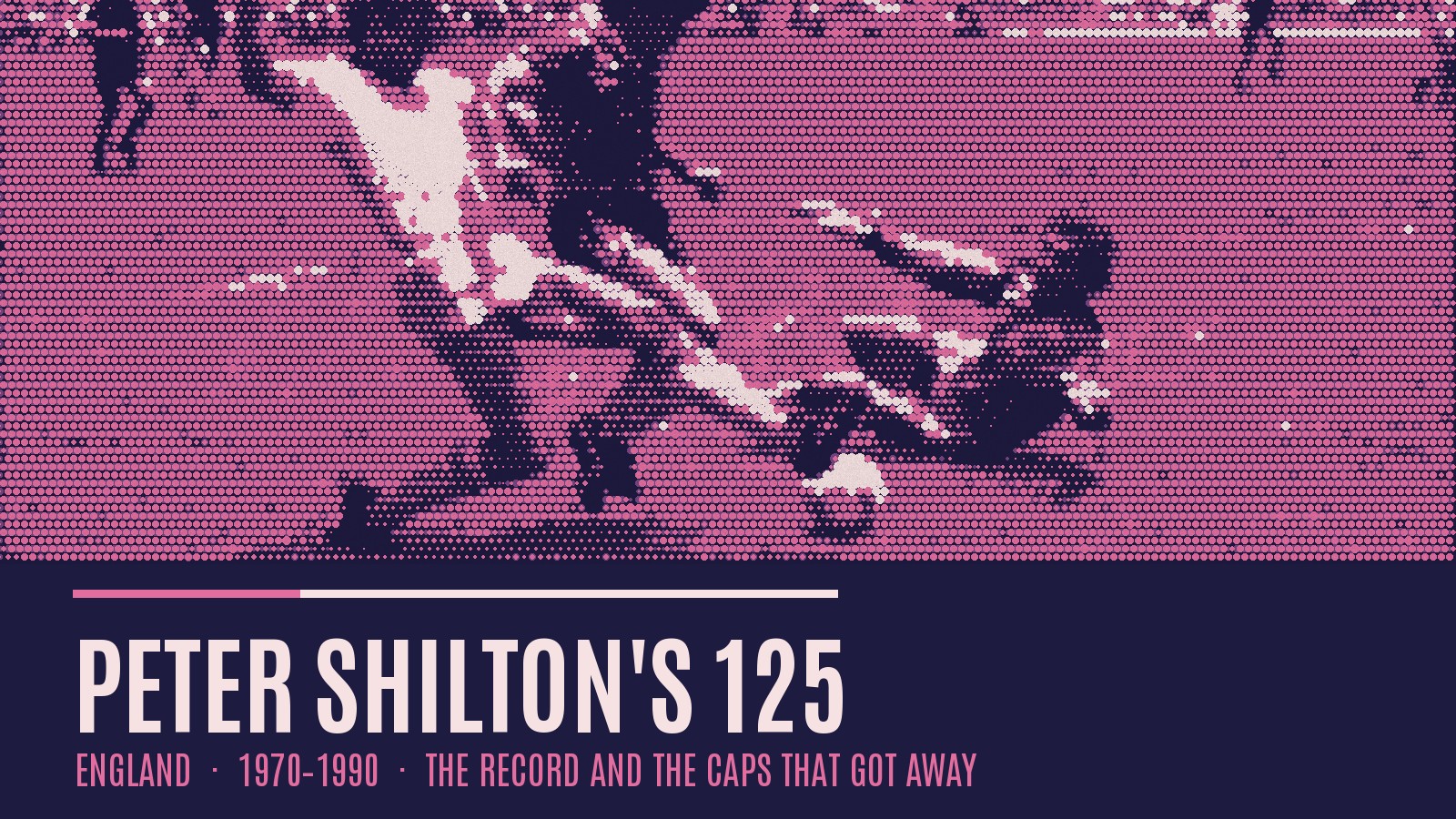
For 36 years England’s most-capped man was a goalkeeper. Harry Kane has caught him. But the number on Peter Shilton’s record was always the shortened version.
On 6 October 2026, Harry Kane walked out at Wembley against Czechia and made a record-equalling 125th appearance for England. He scored twice. Thomas Tuchel called it “this very special day for him”, and said that equalling Peter Shilton “puts him on this kind of level”.
Shilton, 77 now, recorded a video message. He said Kane could set a record that “might never be beaten”. “Because you’re still going strong, Harry,” he said. “You’re still playing well and scoring goals. And I know how much dedication and hard work you actually put into achieving this.”
It was a gracious thing to say, and it was also the right thing to say. The man who had held that record alone since a warm night in Bari in July 1990 knew what it took. Kane is a striker who has lasted more than a decade at the top in an age of 60-game seasons and fortnightly international windows, and that is its own kind of miracle.
But Shilton’s 125 was never quite the same kind of number. Kane’s caps are what happens when the best player in the country is picked whenever he’s fit. Shilton’s are what was left after ten years of England managers who couldn’t make their minds up. Ask the man himself and he’ll tell you. In 2010, asked about his proudest moment, he said: “I feel very proud to have played 125 times for England, and it could have been quite a few more if my old friend and rival Ray Clemence hadn’t been around.”
Quite a few more. So here’s the question. Where did they go?
The car park at Filbert Street
Start with the boy, because the boy explains the man.
Shilton was born in Leicester and joined Leicester City at ten, which, by his own account, he shouldn’t really have been allowed to do. “They said if you come straight from school we’ll give you an hour and half’s coaching every Tuesday and Thursday with the third-team trainer,” he told the FA’s goalkeeping conference in 2016. “I used to train on a car park outside of Filbert Street [Leicester City’s old ground]. I used to get padded up because it was concrete.”
The trainer was George Dewis. The other people on the car park were amateurs and semi-professionals coming in after work. “It toughened me up quite a bit because they’re big lads,” Shilton said.
The first-team goalkeeper at Filbert Street was Gordon Banks. “He was my hero, really,” Shilton told AS in 2017. Banks was also, as Shilton remembered it, the first keeper he ever saw stay behind after training. “Gordon was probably the first keeper to go back after training and do extra sessions,” he said. “Staying after training was unheard of in those days.”
Shilton watched, and learned the only lesson that matters about him: work harder than anyone thinks is sensible.
He played for England Schoolboys at Wembley in front of 90,000 at 15. Manchester United and Arsenal wanted him. His father, a greengrocer, had a view. “Let’s do it the right way,” he said, as Shilton told the Independent in 1996. “When you are 17, you will get a decent contract.” So he signed at Leicester for £8 a week.
He made his first-team debut at 16 against Everton, while Banks was away with England. He played a handful of games and did well, and Leicester had to make a decision nobody else in football has really had to make. “Either keep me as a youngster or let Gordon go,” Shilton said, “and Gordon moved to Stoke.”
Leicester sold a World Cup winner to keep a teenager. That’s how good he was.
Understudy, then a shock
Alf Ramsey took him to Mexico in 1970 as one of the extra players in the preliminary party. He didn’t make the final 22. He made his debut the following season and became Banks’s understudy, and the plan was obvious. Banks would go on until he couldn’t, and Shilton would be ready.
Then, in October 1972, Banks lost the sight in one eye in a car crash. “It was a massive shock,” Shilton said. “I was hoping I was putting some pressure on Gordon for the international team, but it came a bit sooner than I thought.”
It’s the first of the strange things about the 125. The man who might have been England’s number one for the next 18 years inherited the job in the worst possible way. And within a year, it went wrong.
One shot all night
On 17 October 1973 England needed to beat Poland at Wembley to reach the 1974 World Cup. It’s the most famous draw in English football, and Shilton was in goal for it.
“It was very strange to stand at one end of the pitch with nothing to do and watch wave after wave of England attacks on the Poland goal,” he told the Daily Mail in 2013. “It seemed only a matter of time before we would score.”
Then Norman Hunter, trying to keep the ball in rather than kick it out, was dispossessed, and Jan Domarski’s shot went under Shilton. “Peter Shilton, of course, should have thrown his cap on the ball,” Hunter said in the same piece, kindly enough. “He was a great keeper, a class keeper, but he dived over it.”
“I think that was the only shot I had to deal with all night,” said Shilton. “It was the first real setback in my career. It still hurts.”
At the other end, Jan Tomaszewski had the game of his life. Brian Clough had called him a clown. “He got that wrong,” Shilton said.
The goal changed him. “It led to me changing my style and helped me throughout the rest of my career,” he said. It also, in its way, changed who was picked. England didn’t qualify, Ramsey was sacked, and the next men in charge looked at the other great English keeper of the era.
Enter Clemence
Ray Clemence was a year older and played for Liverpool, which in the 1970s meant he played in a team that won almost everything. He was tall, athletic and unfussy, and he played almost as a sweeper, coming for crosses and off his line.
Clemence unseated Shilton during Joe Mercer’s short caretaker spell in 1974, and then Don Revie arrived from Leeds. “He preferred Ray Clemence to me,” Shilton said simply. For the rest of the decade, Clemence was the first choice, through Revie’s reign and the first years of Ron Greenwood’s.
This is where the caps go. Clemence won 61 caps between 1972 and 1983. Nearly every one of them came in Shilton’s twenties and early thirties, which for most goalkeepers is the prime. You can’t add them all to Shilton’s total, because England would have played some of those games with someone else anyway. But you don’t need a calculator to see that 125 might easily have been 150, perhaps more.
And it wasn’t as if Shilton spent those years in decline. In 1977 Clough, who’d wanted him at Derby and again at Leeds, finally signed him for Nottingham Forest. Clough paid top dollar for him, in the fee and in wages. “He’ll put you in the workhouse,” the Stoke chairman warned as he took the cheque, as Glenn Moore recalled in the Independent.
Clough had a number in mind. “A good goalkeeper can save you 18 points a season,” he wrote. “It can mean the difference between winning a title or missing out, between being relegated or surviving.”
Shilton, being a goalkeeper and therefore modest about these things, remembers a smaller figure. “Many years ago Brian Clough said I was worth 15 points a season to Nottingham Forest,” he wrote in 2019. Whatever the figure, he paid it back. Forest won the league in 1977-78. They won the European Cup in 1979 and again in 1980, the second in Madrid, which Shilton thought was one of his best games. “We went on to win two European Cups, two League Cups, a Super Cup and were unbeaten in 42 league games,” he said. Through some of the best seasons any English goalkeeper has had, a lot of the time he was England’s second-choice keeper.
The ballroom dancer
There’s a story from the Revie years that explains how the man in the shadows kept getting better.
“After one England game I remember a chap called Len Heppell writing to me,” Shilton told the FA conference. Heppell was a self-taught ballroom dancer and golfer. “Don Revie brought him into the England squad. He changed my attitude towards goalkeeping because he was very much about body movements and positions in terms of how you got best balanced.”
“I tended to be a bit upright and my hands were too rigid,” he said. Heppell’s instruction is the most wonderfully un-1970s piece of coaching imaginable. “He told me to feel as though I was in water and get looser and have my knees bent and my head forward,” Shilton said.
So the manager who preferred Clemence also found the man who made Shilton better. That’s the 1970s England set-up in one paragraph.
What Shilton and Clemence did next was arguably more important than either of them realised. The two of them were among the first goalkeepers in England to train on their own, working with each other rather than running laps with the outfield players. The rival for the shirt was also the only person in the squad who understood what you were doing.
Home and away
Greenwood’s answer to having two of the best goalkeepers in the world was not to choose. “For a period England manager Ron Greenwood used to rotate me and Ray,” Shilton wrote after Clemence’s death in 2020. “One game, I would play and the next it would be Ray.”
In the qualifiers for the 1982 World Cup, the alternation had a strange logic. Clemence got all four away games and Shilton all four at home. England lost three of the four on the road, including the famous night in Oslo. Even the bad results got shared out by venue.
Then Greenwood made a decision. “For the 1982 World Cup in Spain Ron decided that only one of us would play and he sat us down and told us that it was going to me,” Shilton said. “I know how I would have felt had I been Ray’s position but he never let that disappointment or upset show.”
Shilton was 32 when he played his first World Cup finals match. England were unbeaten in five games in Spain and let in one goal. “That was obviously a big turning point for me,” he said. Clemence played only twice more for England. Bobby Robson came in, and Shilton was the regular for the next eight years.
The strangest part of all of this is that the two men were friends. They roomed together for ten years on England duty. “And the thing is,” Shilton wrote, “we never talked about football.”
Years later, Shilton was on the touchline at an England game working for Sky. Clemence was on the pitch coaching Paul Robinson. Shilton realised he was using one of Shilton’s drills. “I shouted across to him. ‘Clem, you have nicked my drills mate!’. He just laughed. It was ‘Sorry Shilts!!’.”
The hand
You can’t write about Shilton’s caps without the one people still ask him about. Mexico City, 22 June 1986, quarter-final, Argentina.
“We thought we were ready for Maradona on that day,” he wrote when Maradona died in 2020. “There were no special plans for him, no man-marking. We just said we would watch his runs, try to cut him off and not let him get into his stride. For almost an hour it worked.”
Then the ball looped up, Shilton came out, and Maradona put his fist to it.
“People say I should have cleared the ball anyway and that I let a smaller man outjump me. That’s rubbish,” Shilton wrote. “He wouldn’t have punched it if he knew he could head it, would he? Of course not.”
In the dressing room afterwards Bobby Robson came in. “He just stood there and looked at us,” Shilton remembered. “‘He handled it, didn’t he lads?’ he said. ‘He did, didn’t he?’ We all just nodded and he shook his head, turned round and walked out.”
It’s the thing he has never let go. “What I don’t like is that he never apologised,” he wrote. “Never at any stage did he say he had cheated and that he would like to say sorry. Instead, he used his ‘Hand of God’ line. That wasn’t right. It seems he had greatness in him but sadly no sportsmanship.”
It cost him a record, too. Shilton holds the joint record for clean sheets at World Cup finals. “I probably would have had the record (outright) if Maradona hadn’t cheated against us,” he told EnglandFootball.org in 2019. Ask him about his World Cups more generally and he gives the goalkeeper’s answer. “I played for 30 years and was very proud of my World Cup record,” he told the Guardian. “I let in one every two games, which is what you want from a goalkeeper.”
Sweet revenge in Poland
The night that closes the circle came in Poland in October 1989. England needed a point in Poland to reach Italia 90, and for 45 minutes they were all over the place.
“I pulled off one of my best first-halves for England in my career,” Shilton said. “I made about four or five really good saves.” It finished 0-0. “A little bit of sweet revenge for me. I think I repaid the debt.”
Sixteen years after the goal that went under him at Wembley, he’d put England into a World Cup against the same opponents. It was one of his favourite games for England, and he liked to think “I played a massive part in us getting there.”
Italia 90 was the tournament that, in his words, “revitalised football in our country”. England reached the semi-final. They lost to West Germany on penalties and Shilton didn’t save any of them. “They all flew into the corner,” he said.
Forty years, 292 days
His last game for England was the third-place play-off against Italy in Bari, on 7 July 1990. He was captain. He was 40 years and 292 days old, and it was his 125th cap.
It wasn’t a fairy-tale ending. With 20 minutes left, Shilton was rolling the ball out casually when Roberto Baggio nicked it off him, played a one-two with Salvatore Schillaci and scored. Italy won 2-1. The last thing England’s most-capped player did with the ball in a major tournament was the sort of mistake he’d spent 20 years training out of himself.
That’s the thing about Shilton. The memories that stayed were the goals. When he played his 1,000th league game, for Leyton Orient against Brighton on 22 December 1996, the Independent’s reporter noticed that his recollections were “dominated by a kind of internal audit which recalls with peculiar sharpness goals conceded which should not have been”. The shot on his England debut that deflected off Bobby Moore. The goal he let in against Cologne in the European Cup semi-final.
He was 47. He kept a clean sheet. He said afterwards: “There’s still a bit more left.”
“When you are at the top, you take it for granted,” he told the Independent. “You think it’s going to go on for ever. But, when the time comes for you to stop, then it hits you. You realise that you don’t want to give up.”
So, the question
Back to Kane, and the record Shilton is no longer alone in holding.
There is no shame in being caught. Shilton himself saw it coming. Asked in 2019 whether anyone would beat 125, he named Kane, and then Jordan Pickford. “Especially Pickford, being a goalkeeper, he could play for another ten years,” he said. “So, it can definitely be beaten.”
But being the most-capped England player isn’t quite the same claim for both men. Kane’s caps are the career of a player picked whenever he’s fit, for 11 years and counting. Shilton’s are a 20-year international career with most of a decade torn out of the middle. Mercer, Revie and Greenwood looked at two of the best goalkeepers in the world and, often, chose the other one. Ramsey’s England didn’t make the 1974 World Cup. Revie’s didn’t make 1978. Shilton was 32 before he played a single World Cup finals game, and he still finished with 17 of them.
So the honest answer to the 125-cap question is that nobody can say how many it would have been. Some of Clemence’s 61 would have gone to Shilton, and some wouldn’t. What we can say is what the 125 hides. It’s the record of a boy who trained on a car park, sat behind Banks until the day Banks’s career ended, spent his best years at Forest sharing a shirt with his room-mate, and was still captaining England at 40.
He was never England’s number one for long enough to be bored of it. That might be why he never stopped trying to deserve it.