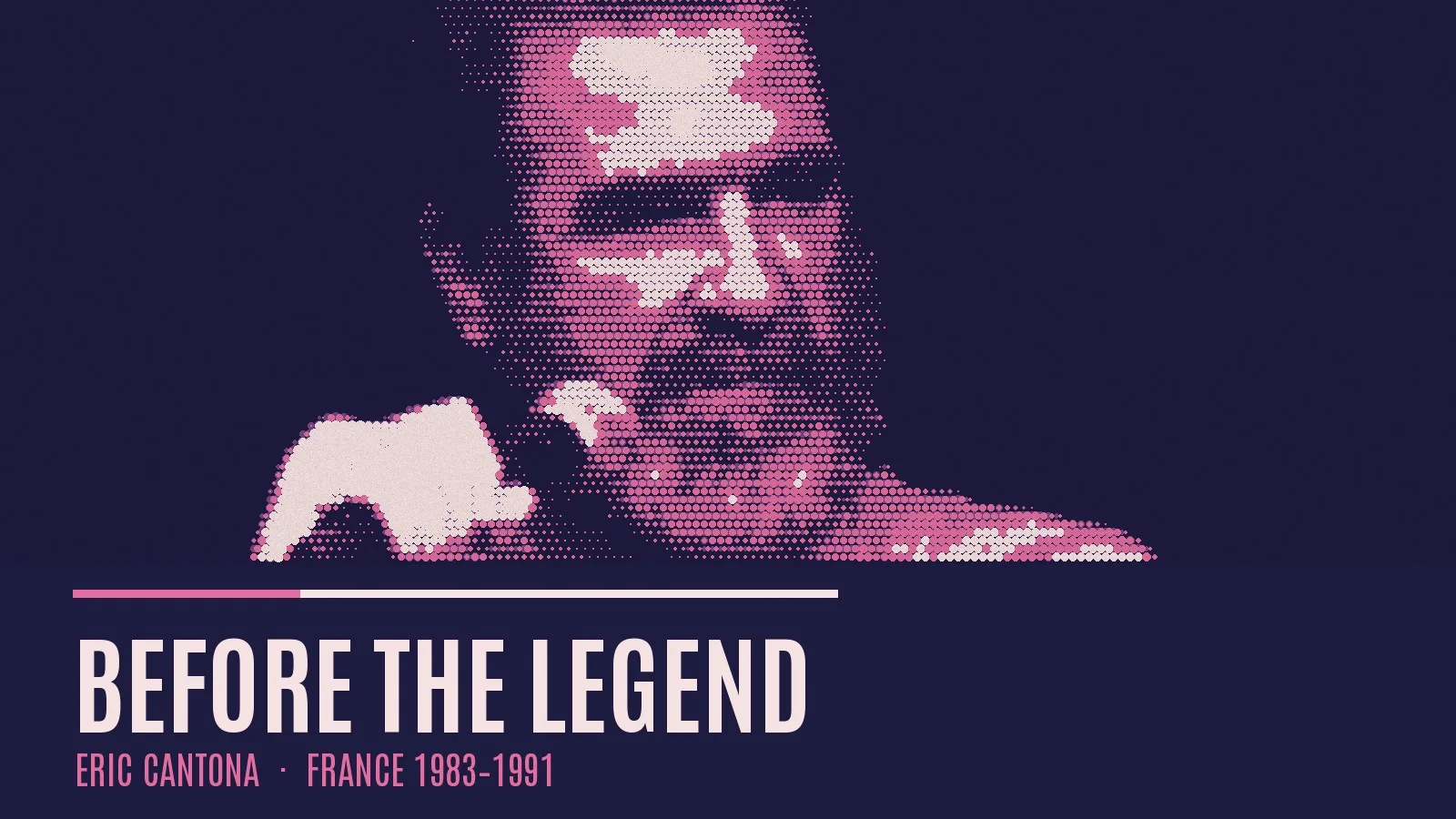
Long before Leeds and Old Trafford, Cantona spent eight years in French football being managed, indulged, loaned out, sacked, reinstated and banned. Plenty of people in France understood him. None of them could find him a place to live.
The windows had padlocks on them. That is the first thing Eric Cantona remembers about being a teenage footballer in Burgundy, and when he went on France Inter’s Totémic podcast this spring, more than four decades later, he still described it with something between a grin and a wince: “I had an adolescence with a padlock on the window from six in the evening. That was Guy Roux’s policy. We couldn’t go out, except on Mondays, because he’d given us a card for the cinema. But since he knew the people at the cinema, we had to actually be at the cinema. And we had to be back by eleven.”
The rest of the time, he said, the apprentices of AJ Auxerre killed the hours in the cafeteria of the local supermarket. It’s a gloriously unglamorous picture: the future King of Old Trafford, fifteen years old and a long way from Marseille, nursing a coffee under strip lighting in a small town on the Yonne while the manager phoned ahead to the cinema to check he’d turned up.
It is also the key to everything that followed in France. Cantona’s French career is usually told as the prologue of a redemption story, the troubled years before England saved him. Told that way it becomes a list of incidents: a punch, a shirt thrown down, boots in a team-mate’s face, a ball hurled at a referee, and a disciplinary panel called idiots one by one. All of those happened. But read the people who were there and a different shape comes through. Cantona in France is the story of a series of grown men, each with his own method, each trying to build a structure around a talent that kept breaking out of it. Roux tried padlocks. Bernard Tapie tried money and then loans. Louis Nicollin tried the sack. Michel Mézy tried friendship and the captain’s armband. Michel Platini, the last and cleverest of them, tried the Channel.
The phenomenon from Les Caillols
It began with a factory worker. Roux, who ran Auxerre for the best part of four decades on a mix of thrift, paranoia and genius, had a scout who spent his holidays travelling round France watching youth courses. As Roux told the story to the Auxerre history site Mémoire d’Auxerrois, the phone rang one Monday lunchtime. The man had spent his Sunday in Aix-en-Provence and he was certain: “There’s an extraordinary phenomenon, his name is Cantona.”
Roux asked for everything: the club president, the coach, the parents’ address and their jobs. “The following Sunday I was at Les Caillols to see Cantona’s parents. And I didn’t let go. A month later he was with us.” Monaco were interested and the boy was torn between Auxerre and Nice. The story Roux still tells with a smile is that when Cantona asked Nice for a shirt, he was told to go to the club shop and have his parents bring the chequebook. When he asked Roux, he had one in his hands fifteen minutes later.
The family were from the hills above Marseille. His father Albert was a nurse who painted in his spare time and had kept goal for the local club, which is why Eric started out between the posts too, before deciding that a goalkeeper in a dominant team never touched the ball and crossing to the other end of the pitch. By the time Auxerre found him he had played more than 200 games for SO Caillolais.
Auxerre in 1981 was a small-town club barely settled in the top flight and about to open its first formal academy, and Cantona was part of the first generation through it. The regime was strict even by the standards of the time. He fell out with the couple who ran the youth residence and was thrown out of it, an episode he now regrets: “I’m a bit impulsive. I regret it today because they were wonderful people, a bit like my parents,” he said on the same podcast. Roux, asked about him in 2022, didn’t soften it. “With him it was very difficult,” he told Ouest-France. “He knows it, he’s fully aware of it. He was a very, very turbulent adolescent. If I had to use one word to describe a kid like that, I’d say he was unbearable.” Then the line that tells you why he kept him: “We all liked him, but he made us suffer. On the night of his last game with us, I was completely drained.”
Szarmach, and the hat-trick he wasn’t allowed to score
The debut came on 5 November 1983, at the age of sixteen years and seven months, against Nancy. France Football’s record of the day has the detail that matters: Cantona started up front alongside Andrzej Szarmach, the Polish World Cup striker, and Szarmach scored all four in a 4-0 win. The boy played more than an hour and didn’t score. Six weeks later he played against Lens, Auxerre won 4-0 again, and Roux sent him back to the reserves.
That was the method, and it worked better than people remember. Cantona never forgot what the veteran gave him. “When the old pros see a young player, either they try to destroy him or they try to pass something on,” he said of Szarmach. “Andrzej Szarmach gave me an enormous amount. He was a great.” Roux was characteristically blunt about the arithmetic of it: if he’d kept Szarmach another year, would he have made room for Cantona at all? In the reserves the teenager scored 20 goals and won the third-division title. Then came national service, a week in barracks and the weekends back at Auxerre to play, with Roux hoping the army would do what the padlocks hadn’t. He reported “slight progress”.
The first senior goal arrived at Rouen on 14 May 1985 and was, France Football records with some relish, a bit of a farce: the Rouen keeper slipped and Cantona walked it into an empty net. A fortnight later he hit a proper one at the Meinau in Strasbourg that put Auxerre into the UEFA Cup. Then came the moment that tells you more about him than either goal.
On Wednesday 12 June 1985 the Auxerre juniors played Montpellier in the final of the Coupe Gambardella, France’s youth cup, at Bourges. Roux had told Cantona he couldn’t play, because he was now a first-team player. Cantona’s answer, as the story is told by the Auxerre historians and by his captain that day, Lionel Charbonnier, was that he would play, that Auxerre would win 3-0 and that he would score all three. He did exactly that: 25th minute, a penalty on 38 and the third on 84, in front of about 2,500 people, half of them schoolchildren. The prophecy is the kind of thing that grows in the retelling, but the scoresheet doesn’t. Montpellier’s Jacques Bonnet later called him “our executioner”.
Martigues, Martini and the first real season
Then he stalled. A viral infection wrecked the start of 1985-86, Roger Boli took his place and Cantona, who wanted to be nearer home and nearer Isabelle, the woman he would marry in 1987, grew restless. Roux’s answer was to send him away. In October 1985 he went on loan to Martigues, bottom of the second division. Away from the padlocks he was sent off twice, but he also scored four goals in 15 games and helped them stay up. “They were counting on me, every match, every match, every match,” he said later. “I was the one who had to make the difference, and I didn’t really make it.”
That’s an unusually modest verdict from a man not known for modesty, and it says something about how he processed responsibility: he wanted it, and he judged himself by it. Back at Auxerre for 1986-87 he got it. He scored 13 league goals and 17 in all competitions, Auxerre finished fourth and he was voted the revelation of the season in the first division.
The stories from that period are the stories that would follow him for the rest of his career, and the club historians don’t sanitise them. There was a youth match against Cournon after which a group of opponents waited for him outside the dressing room. Roux broke it up and then had all the combatants patched up together in the Auxerre dressing room, Cantona sitting among his enemies as if nothing had happened. There was an indoor tournament in Poland in the summer of 1986 where, after a penalty Charbonnier would call “imaginary”, Cantona dropped his shorts at the crowd, showered, changed and then went up into the stand to take them on. And there was a winter friendly against Bayern Munich when Roux had his players clear the snow off the pitch for a publicity photo. Bruno Martini, the goalkeeper, refused to play the fool and sat down, Cantona headbutted him, and Martini went to hospital. He still played that night. “On that one,” Charbonnier said drily, “Canto wasn’t entirely wrong.”
None of this stopped him becoming an international. On 12 August 1987 Henri Michel picked him to start in Berlin against West Germany, alongside Jean-Pierre Papin, and he scored on his debut in a 2-1 defeat. Michel called him “an attacker of international class”. With the under-21s he was even better, and in the 1988 European Championship campaign he scored twice against an England side containing Paul Gascoigne. In April 1988, in a French Cup tie against Nantes, he went through Michel Der Zakarian with a tackle that got him a red card and a three-match ban. Remember the name.
He left Auxerre that summer with 29 goals in 94 official matches. Roux used the money, a French record 22 million francs, to help pay for an indoor training hall at the academy so the boys could play through the Burgundy winter. In the end even Cantona’s exit was converted into infrastructure.
Home, and the sac à merde
He went home. Tapie’s Marseille were building the side that would dominate French football and win the European Cup in 1993, and Cantona was a Marseille boy. It went wrong almost immediately, and it went wrong because of France, not Marseille.
Michel left him out of a squad to play Czechoslovakia in August 1988. After a game against Racing Paris in which he’d scored, Cantona went on television and called the national manager a sac à merde, a phrase Sud Ouest’s archive prints in full and which can be translated, politely, as “bag of shit”. He was banned from all national teams until the end of June 1989. That’s why, when France’s under-21s won the European title at Besançon on 12 October 1988, Cantona was suspended for the final. He is in the record books as a European champion for a tournament whose decisive match he watched.
At Marseille things were no better. In January 1989, in a friendly against Torpedo Moscow at Sedan, he was substituted, took off his shirt and threw it on the ground. The club suspended him for a month and loaned him to Bordeaux for the rest of the season, where he scored six times. Marseille won the title on 31 May 1989 without him. He was technically a champion of France for a season he spent much of elsewhere, which was beginning to look like a pattern.
There is a version of this period in which Tapie is the villain, a president who bought a local hero and then couldn’t be bothered with him. The record is more mixed. Tapie went on finding Cantona clubs, and the next one was the most unlikely of the lot.
La Paillade: the president, the boots and the parking lot
Louis Nicollin ran Montpellier and a waste-collection business in much the same style: loud, loyal and impossible to predict. Midi Libre’s 50th-anniversary history of the club is frank about how the loan happened. Tapie “forced the hand” of his friend Loulou to find a home for an awkward asset. Nicollin thought he’d got a bargain. He signed Stéphane Paille at the same time and dreamed of rebuilding the attack of the 1988 under-21 champions alongside his own Laurent Blanc. The loan cost three million francs, and local councils put up real money to help pay for it.
At first, Cantona was the model professional. “You didn’t hear him, he was very professional, very rigorous,” the goalkeeper Pascal Baills told Midi Libre. “In training he came in a quarter of an hour before everyone else. He was demanding of himself, so he was demanding of the others.” Baills gave the best one-line description of what Cantona was like in a room: “I’ve only known three people in my life who made a room go silent when they walked in. Tapie, Nicollin and Canto.”
The goals didn’t come. Aimé Jacquet’s expensive new team, with Cantona, Paille, Blanc and Carlos Valderrama in it, didn’t work, and the season started to drift. Then came Lille away on 21 October 1989, a 1-0 defeat, and the tunnel afterwards. Jean-Claude Lemoult, one of Nicollin’s men, was talking to Der Zakarian, the same Der Zakarian Cantona had scythed down for Auxerre eighteen months earlier, who was now his team-mate. Lemoult’s account, given to L’Équipe in 2025, is the best version because it’s the least dramatic: “Canto throws something at us like ‘What have you got to say?’ He thought we were talking about him. I told him, ‘We’re not talking about you.’ And then he loses it with me, and I didn’t back down… Michel had to separate us.”
The other versions say Cantona swung his boots into Lemoult’s face. Either way, Nicollin was finished with him. On the flight home he told Cantona he was sacked; Midi Libre has the president’s sentence as “You will never wear the shirt of La Paillade again.” It became a national story because the 1992 European Championship was coming and France had a new manager, Michel Platini, who regarded Cantona as essential. The sports minister got involved. Six players wanted him gone, but Blanc and Valderrama spoke up for him, and Nicollin, who never admitted he’d gone too far, eventually gave in to pressure from the local councils, who wanted a return on their money. Midi Libre tells the reconciliation as a scene out of a western: an early-morning conversation between the two men in the car park of Nicollin’s waste company.
The part of this story that never makes the highlight reels is what happened next. Jacquet was sacked in February 1990 and replaced by Michel Mézy, a Montpellier man who managed Cantona “in his own very Paillade way”. Montpellier escaped relegation and went on a Coupe de France run in which Cantona scored a hat-trick against Louhans-Cuiseaux and a volley at Saint-Étienne in the semi-final that, in Midi Libre’s phrase, might on its own have justified the three million francs. In the final at the Parc des Princes on 2 June 1990 Montpellier beat Racing Paris 2-1 after extra time, and Blanc’s free-kick opener came from a foul on Cantona. He finished the season level with Blanc as the club’s top scorer on 14 goals.
And Lemoult? “At the end of the season we stayed up, with the best team I ever played in, and we won the Coupe de France together,” he said. “And when I signed for Nîmes, it was Canto who asked Michel Mézy to bring me there.” That’s the whole French decade in miniature: the explosion, the sacking, the reconciliation, the trophy and then, unexpectedly, the loyalty.
Beckenbauer, Goethals and the last French club
Marseille took him back for 1990-91. Franz Beckenbauer was briefly the coach and Cantona thrived, with eight goals in 16 games alongside Papin, until a knee injury and the arrival of Raymond Goethals put him on the bench. Marseille won the title again. He didn’t play in the European Cup final against Red Star Belgrade in Bari or in the Coupe de France final. Another championship medal earned largely by being there at the start.
Nîmes was the last stop. Mézy had become the club’s president, and he made Cantona captain, which was either a stroke of trust or a dare. Then, on 7 December 1991, at home to Saint-Étienne, Cantona lost his temper over a free-kick given against Nîmes and threw the ball at the referee, Monsieur Blouet. He was sent off, and on 11 December the league’s disciplinary committee banned him for four matches. What he did next is the moment the French career really ended. He walked up to each member of the panel in turn and called him an idiot. The ban was doubled to two months. On 12 December 1991, at the age of 25, he announced he was retiring from football. Sud Ouest’s front page the next morning read “Eric Cantona claque la porte”, Cantona slams the door, and the paper noted that less than two months earlier he had said he now knew how to keep his passion and his profession apart.
There is a detail that hardly anyone in England knows. On 6 November 1991, a month before the ball hit Monsieur Blouet, Auxerre lost 3-0 at Anfield in the UEFA Cup. According to the Auxerre historians, Platini used that evening to offer Cantona to Graeme Souness, then managing Liverpool. Souness later confirmed it himself. Platini, he said, told him: “I’ve got a player for you, he’s a real problem in France but he’s really talented and he’d be perfect for your club.” Souness’s answer: “Look, Michel, I’m fighting fires here at the moment… I’m fighting a dressing room here. The last thing I need is another controversial figure.” Anyone who has read Souness on Souness will enjoy the idea of him worrying about somebody else’s temperament.
The man who sent him away
Platini didn’t give up. He was the last of the guardians, and the first to accept that what Cantona needed was not another French structure. He persuaded him to un-retire. Gérard Houllier, Platini’s assistant, advised England. So, according to the Auxerre account, did Cantona’s psychoanalyst. Before signing him, the Leeds manager Howard Wilkinson rang Platini and Glenn Hoddle, who had played against Cantona in France, and both told him to forget what he’d heard about the disciplinary record.
The first English stop was nearly Sheffield Wednesday. Trevor Francis took him in as a favour in January 1992. “A former agent of mine asked if I’d do a favour to Platini, who was very keen to get Cantona back playing,” Francis told the Yorkshire Post, as quoted by FourFourTwo. The weather was so bad they trained on an artificial pitch, and Cantona’s only public appearance for Wednesday was an indoor six-a-side against the Baltimore Blast at the new Sheffield Arena. Francis asked him to stay on for a few more days so he could see him on grass. “I think his manager took that as an insult,” Francis said. Cantona’s own explanation, as the Independent reported it, was that he hadn’t played a trial since he was 15. He went to Leeds instead, and Leeds won the league. Wednesday finished third, with 21 goals from a young striker called David Hirst, but that’s another sliding door. FBH has told that story before, and the one after it too.
What’s striking in the English coverage of 1992 is how much of the French decade had already been flattened into a reputation. By August 1992 the Independent’s Matthew Sturgis was writing that Cantona had arrived “with a reputation of his own” and quoting him in his new home in Roundhay: “There is a camaraderie at the club such as you do not find in France.” And then, almost in passing, a line that every one of the guardians would have recognised: “I am sometimes unable to judge the effects of my actions.”
The padlock and the open door
So did France fail him? It’s the line every English retelling reaches for, and Midi Libre itself ends its history with the idea of “a French football that never knew how to understand him”. But the French witnesses don’t really support it. Roux understood him so well he could predict the hat-trick, or at least forgive it. “He also has a generosity, a heart that nobody ever talks about,” Roux told Paris Match. “I knew he had that generosity, and it was part of the balance when I had to weigh up a mistake.” Baills understood the silence he made in a room. Lemoult understood him well enough to end up as his team-mate again at Nîmes, on Cantona’s recommendation. Platini understood him best of all.
The problem was never comprehension. French football in the late 1980s was a small, intense, media-saturated world where the same few dozen people kept meeting each other. A player who called the national manager a bag of shit on television would sooner or later have to play for him, or for his friends, or in front of a disciplinary committee made up of people he’d already insulted. Every incident followed him to the next club because the next club was full of people who’d been at the last one. Der Zakarian is the perfect example: the man he scythed down at Auxerre was the man who had to pull him off Lemoult at Montpellier.
England in 1992 offered the opposite. Nobody at Elland Road had been insulted by him. Nobody knew who Henri Michel was. The press cared about a Frenchman with his collar up because he was different, not because of what he’d said about the selectors. Wilkinson, who didn’t mind “people having strong personalities”, could treat the reputation as a rumour. For the first time since he was fifteen, Cantona got a clean sheet.
The cafeteria in the Auxerre supermarket probably isn’t there any more. But it’s worth picturing him in it one more time: sixteen, bored, padlocked in after six and absolutely certain of his own talent. Roux built the walls because he loved him. Platini did the cleverer thing and opened the door.