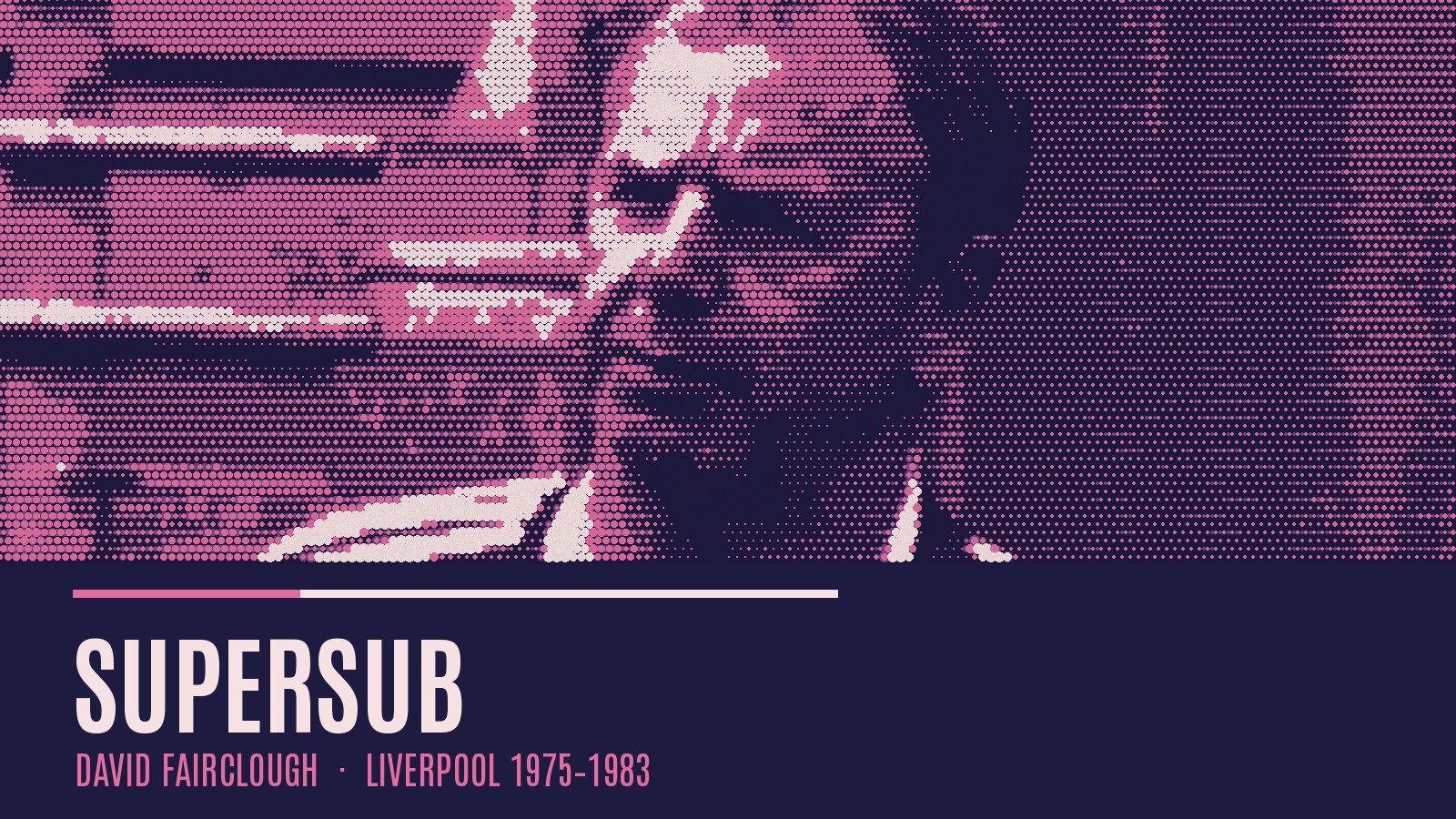
On 1 November 1975 a teenager from the streets around Anfield made his Liverpool debut at Middlesbrough. Within eighteen months he had scored the most famous goal the Kop had ever seen, and earned a nickname that followed him for the rest of his life.
Some footballers get the nickname they deserve. Others get the one that fits the story people want to tell. David Fairclough got “Supersub”, and spent the next forty years trying to explain, as politely as he could, that he would rather have been in the team.
It is easy to forget how he started. Not on the bench, but in the number nine shirt, at Ayresome Park, on Saturday 1 November 1975. He was 18, two months short of his nineteenth birthday, and the boy who had grown up within earshot of the Kop was playing up front alongside Kevin Keegan and John Toshack for the club that was about to become the best in Europe.
In the shadows of Anfield
Fairclough was about as local as a Liverpool player can be. “I grew up about half a mile from the ground and I went to school just 500-600 yards away from the stadium,” he told LFChistory.net. “Anfield was very much my patch. I played football in the streets. Comic book stuff really. I remember standing in the street where we lived listening to the crowd in the Inter Milan game in ’65. I was only eight and my dad didn’t allow me to go to that game. We knew obviously the game was going Liverpool’s way and you could hear them singing. We lived literally in the shadows of Anfield.”
Roger Hunt and Ian St John were his heroes. “I was indoctrinated, football was everything,” he told The42 in 2017. “The dream of actually playing for Liverpool never seemed to be a real one.” He was playing for Liverpool schoolboy representative sides from the age of 11, and at 13, as he put it, Liverpool approached him “completely out of the blue”. His dad, a Liverpudlian, did not have to think about it. “We moved from the inner city to a council estate and I’d go past the training ground on the bus going to school every day. You’d be looking over the walls and used to think, it’d be fantastic to do that. All of a sudden, you’re being invited in the doors. It was surreal to say the least.”
He signed professional forms in January 1974, at 17, in front of the television cameras with Bill Shankly beside him. That summer Shankly retired. It was Bob Paisley who would decide what kind of career David Fairclough had, and the relationship between the two of them is the real story here.
Ayresome Park, 1 November 1975
Liverpool travelled to Middlesbrough fifth in the First Division, two points behind leaders Manchester United, in Paisley’s second season. Jack Charlton’s Boro were tenth and were no fun to play against. Their midfield had Graeme Souness and Bobby Murdoch in it, the Celtic European Cup winner, and their defence had Stuart Boam and Willie Maddren. LFChistory’s match record has the crowd at 30,952.
Fairclough wore nine. Toshack was ten, Keegan seven and captain. Clemence, Neal, Joey Jones, Phil Thompson, Tommy Smith, Ray Kennedy, Brian Hall and Ian Callaghan made up the rest. It was not a comfortable afternoon. Hall went off after 18 minutes and was replaced by Terry McDermott, the only substitute the rules allowed, and in the 71st minute McDermott scored the only goal. Six minutes before the end Joey Jones was sent off for a challenge on John Hickton. The notes on the LFChistory page say, with three exclamation marks’ worth of disbelief, that Hickton “apparently lost FIVE teeth in the incident” and Jones got a one-match ban.
So the debut was a 1-0 away win, a red card and a dental emergency. Three days later, on 4 November, Fairclough scored his first Liverpool goal. It was a promising start. Nobody could have guessed what kind of career it would turn into.
Seven goals in eight games
The 1975-76 season came down to a race between Liverpool and Queens Park Rangers. FBH has written about that year more widely, but at Anfield the spring belonged to Fairclough. LFChistory’s profile describes him as having “exploded onto the football scene as a 19-year-old to add some fresh impetus to Liverpool’s neck-and-neck challenge”. He scored seven goals from two starts and six substitute appearances, and Liverpool overhauled QPR in the last match of the season.
The one people remember came on 3 April 1976, an early kick-off against Everton at Anfield on Grand National day. It was 0-0 with two minutes to go. Fairclough picked the ball up around the halfway line and ran. LFChistory calls it “a mazy, fantastic run” that turned a goalless derby into “a priceless victory”. One of his teammates offered the best explanation anyone has managed for the way he played: “He didn’t know himself what he was going to do, so how could we know?”
Tommy Smith, as only Tommy Smith could, put it another way. Fairclough recalled it in his autobiography, as the LFChistory review quotes: “Tommy Smith joked that I had two sets of legs, my Charlie Chaplin legs and my Stanley Matthews legs.”
This is where the trouble began. He was electric off the bench. He came on with a game tired and defenders tired and ran at them. And Paisley, being Paisley, noticed. The headline writers noticed too. “Supersub” was born.
Saint-Étienne
Every Liverpool supporter of a certain age has a story about 16 March 1977. It is the night most people who were there still describe as the greatest at Anfield.
Liverpool had lost the first leg of the European Cup quarter-final 1-0 in France. Saint-Étienne were the French champions and the previous season’s finalists, with Dominique Rocheteau, Jean-Michel Larqué, Christian Lopez and a goalkeeper, Ivan Ćurković, who would be remembered at Anfield for a long time. LFChistory gives the attendance as 55,043.
Keegan scored in the second minute. One supporter’s account on LFChistory, titled after a banner on the Kop that read “Joey Eats Frog’s Legs”, describes the cross drifting “on and on” over Ćurković. Then, early in the second half, Dominique Bathenay scored from long range and the tie swung back to France. Liverpool needed two more. Ray Kennedy got one just before the hour. Then Toshack, tired and battered, came off and Fairclough came on.
With six minutes left, Kennedy played the ball over the top. The legend is that Fairclough beat half the French team. LFChistory’s profile sets the record straight in a way that, if anything, makes it better: “the reality is that he kept his eye on the ball, brushed aside any challenge from a defender and then calmly tucked his right-foot shot under Curkovic into the Kop goal to bring about scenes which those who were there still talk about with a lump in their throat and a shiver down their spine!”
The supporter’s account captures the moment the ball crossed the line: “I’m certain the Kop sucked the ball into the net.” And then the celebration: “David Fairclough jumped higher into the air than any other player I have ever seen in all the years I have been following not just the Reds, but football itself.”
Liverpool won 3-2 on aggregate. “St Etienne is a special moment and I’m reminded about it every day of the week,” Fairclough said in 2017. “Liverpool fans have incredible memories of St Etienne.” If you ask an old Kopite about him, that is the goal they will tell you about. Maybe it is the only one. That, in a way, was the problem.
The promise in Rome
What happened in the next two months is the part of the story Fairclough has never quite got over. He played in both FA Cup semi-finals against Everton. Liverpool reached the final against Manchester United, and he expected to play. He did not. David Johnson started, and Ian Callaghan was the substitute. Liverpool lost 2-1.
“I was very disappointed,” he told LFChistory. “I played in the FA cup semi-finals against Everton, started both games and had all the celebrations to go to the cup final. Leading up to the FA Cup final day, Bob Paisley tells me I am going to play in the final. It never happened. ‘You’ll play next week in Rome, I’ll need you in Rome.’ Then in Rome I was sub.”
He sat on the bench as Liverpool beat Borussia Mönchengladbach 3-1 to win their first European Cup. FBH has told the story of that night in Rome and of the year as a whole. It is one of the great nights in the club’s history. For the man whose goal made it possible, it was also one of the most hollow.
“When you want to tell people the story, it’s much too big a thing to just have in a conversation,” he told The42, “so the book allowed me to go into detail — times when (Paisley) let me down and stuff like that, one or two big moments in a career.” He also explained why he said nothing at the time: “if you (express) your frustrations at the time about being left out of an FA Cup final team, that’s probably your parting shot. You put it in the paper and come Monday morning, you’ll find out you’re history.”
A real number nine, briefly
There was a moment when it looked like he had broken through. Keegan had been impressed. “Dave’s difficult to play with because you just can’t read him, that’s what makes him such a dangerous opponent,” he said in 1977, as LFChistory records. “The best is yet to come from him and in a couple of years time, he’ll be a force to be reckoned with. His best asset is his pace coupled with his control… He’s got ability you can’t coach into a player.”
Keegan left for Hamburg that summer, Kenny Dalglish arrived, and Toshack was fading. In 1977-78 Fairclough started 34 of his 42 games and scored 15 goals. In May 1978, at Wembley, he started the European Cup final against Club Brugge, and Liverpool won it again, 1-0. “Playing in the 1978 European Cup final in Wembley — that would have to be the highlight,” he said. “Starting off that night with number nine on my back, it was fantastic.”
Then came the summer, and another Paisley conversation. Steve Heighway would start as number nine. “Paisley said: ‘Heighway won’t last much longer. I’ll start him off this season and see how he goes. He’ll be burnt out after ten games and then you’ll come in. That’s your slot,'” Fairclough recalled. “The team got off like a house on fire and were beating everybody 4-0, 4-1, 5-0 and couldn’t stop scoring goals. Anybody could have played in that team, really, it was so good. I never got in for months.” His first league start that season came on Boxing Day, a 3-0 win at Old Trafford. He was then injured against Everton in March, and missed the end of a season in which Liverpool won the title and conceded 16 league goals.
Charlie Chaplin legs
The rest of his Liverpool career is a story of bad timing and worse luck. In 1979-80 he scored 13 goals in 12 starts and 14 substitute appearances. In the autumn of 1980 he started seven games in a row and scored seven times, which, as LFChistory notes, proved “he was just not an impact player”. Then he was injured. A knee injury finished his season in early February 1981, and he did not play for the first team again until October 1982.
While he was away, someone else had arrived. Ian Rush made the number nine shirt his own with 30 goals in 49 games in 1981-82. Fairclough scored 14 times in 29 games for the reserves. In 1982 he went to Toronto Blizzard for the summer to stay fit. He came back and scored 20 goals in 20 reserve games, but started only three first-team games that season. He signed off with three goals in his last four Liverpool matches in April 1983, and left that July for Luzern.
Paisley retired that summer too. Joe Fagan offered Fairclough a new contract, but it was for less money. “‘We want you to stay, but sign a reduced contract.’ It’s an indication that something’s changed,” he said. “Paisley told me if I wanted to, I could speak to a German club, and you think: ‘They must be in two minds (about wanting me to stay).'” He had lost his father, too. “One or two personal reasons came into play — losing my dad when I did, who knows how it would have panned out if I’d had a little more of a guiding hand in terms of making decisions.” Liverpool won the European Cup again the following May, in Rome. “I look back sometimes and regret it,” he said.
Hating the bench
The final numbers look like the career of a very good player. LFChistory has him at 154 appearances and 55 goals, 37 of them in 92 starts and 18 in 62 appearances off the bench. He won four league titles, three European Cups, the UEFA Cup, two League Cups and the Super Cup.
But read his own words in the autobiography he wrote with Mark Platt, as LFChistory quotes them, and you understand why the nickname stung.
“With the exception of my first few months as a first-team member I honestly hated being substitute. Worse than that was being an unused substitute, and there were a further 76 occasions when I was forced to keep the bench warm for the entire 90 minutes. That would leave me feeling totally hollow and in a state of limbo. If we’d won everyone would be congratulating each other but amid the handshakes and back-slapping I was left feeling like a phoney. I’d contributed nothing meaningful to the day. I was like an outsider at a party. Even getting a shower brought with it a sense of guilt. I wasn’t dirty. I hadn’t sweated. In my eyes I hadn’t earned the right to a shower.”
That is one of the most honest things a footballer has ever said about the bench. In 1970s English football, there was only one substitute, and the bench was a lonely place. “In our box, you’d have (coaches) Joe Fagan and Ronnie Moran,” he told The42. “Invariably, Paisley would be sat up in the stand. And they weren’t interested in me, they were only interested in the 11 out there. So it was a really lonely situation to find yourself in.” FBH has written about Ronnie Moran and the boot room, but this is the view from the other end of the bench.
Paisley
It is tempting to make Paisley the villain, and Fairclough comes close. “Down the years I’ve had lots of time to think about why I didn’t fulfil my potential,” he told LFChistory. “Obviously Paisley had to keep 14-16 people happy, but he made life difficult for me. I broke into the England squad and I was very much on Ron Greenwood’s list of players who were perhaps going to break in. I came back to Anfield and Bob Paisley decided to play me as sub or leave me out. I had a lot more to offer.”
He told The42 there “was more to him than has been sweepingly put out there”, and that the comfortable picture of a quiet, easy, approachable man without Shankly’s charisma was only part of it. The LFChistory reviewer of his book says Fairclough feels Paisley’s treatment of him was “cowardly”, and also makes the fair point that a manager with a quality player in every position cannot keep everyone happy. Paisley won six league titles and three European Cups. You can see it from both sides. Fairclough was a brilliant impact player in a team that already had Keegan, then Dalglish, then Rush. Paisley used him where he did the most damage. That he did the most damage from the bench was not entirely Fairclough’s fault, or Paisley’s.
The real thief was injury. LFChistory puts it bluntly: by 1981 his career at Liverpool and in the top flight “was effectively over at only 24 years of age”.
After Anfield
He went on to Luzern, Norwich briefly, Oldham, Beveren in Belgium, Tranmere and Wigan. He enjoyed being a big fish abroad. “I enjoyed the responsibility of being this big personality,” he said of Switzerland and Belgium. “There was a lot of emphasis put on me, a bit of pressure, but that was good.” Wigan, under Bryan Hamilton, was not so happy. “I went to Wigan and you think: ‘Jesus, what am I doing here?'”
Afterwards he took a journalism diploma and reported for the News of the World, until, in his words, “Piers Morgan arrived at the News of the World in 1994 and I became a casualty of his mass cull.” He became a regular on Liverpool’s own television channel. In 2010 he had a heart attack; months later his wife Jan collapsed and died of a brain haemorrhage. The final chapter of his book is about her. “I get into discussions about football and often say ‘it’s only a game’,” he said. “I know it was my way of life, but those type of things are totally different.”
He does not pretend to miss the dressing room. “You hear players afterwards say ‘it’s not playing football I miss, it’s the camaraderie of being in the dressing room’. I think that’s all nonsense,” he said. “I miss playing football.”
The number 12
Fairclough has thought hard about what the bench means now. “These days, you’re sitting there with seven or eight others,” he said. “You see them laughing, joking and eating sweets — doing all kinds of different things. It’s far easier because it’s now seen as a squad game.” His record of appearances from the bench at Liverpool has since been passed by Danny Murphy, Ryan Babel and Vladimír Šmicer. The42 calls that a record Fairclough says he was “not proud of”.
In the modern game, a player like him would be called a game-changer and paid accordingly. In 1977 he was a 20-year-old who had won the club a European Cup quarter-final and been left out of both finals. “I suppose I have to be flattered the way the ‘supersub’ tag was remembered,” he says.
He never really got to be anything else. But it all started on 1 November 1975, at Ayresome Park, when he was not a sub at all. He was the number nine, alongside Keegan and Toshack, the local boy who used to look over the training ground wall from the school bus. Whatever came later, nobody ever took that afternoon away from him.