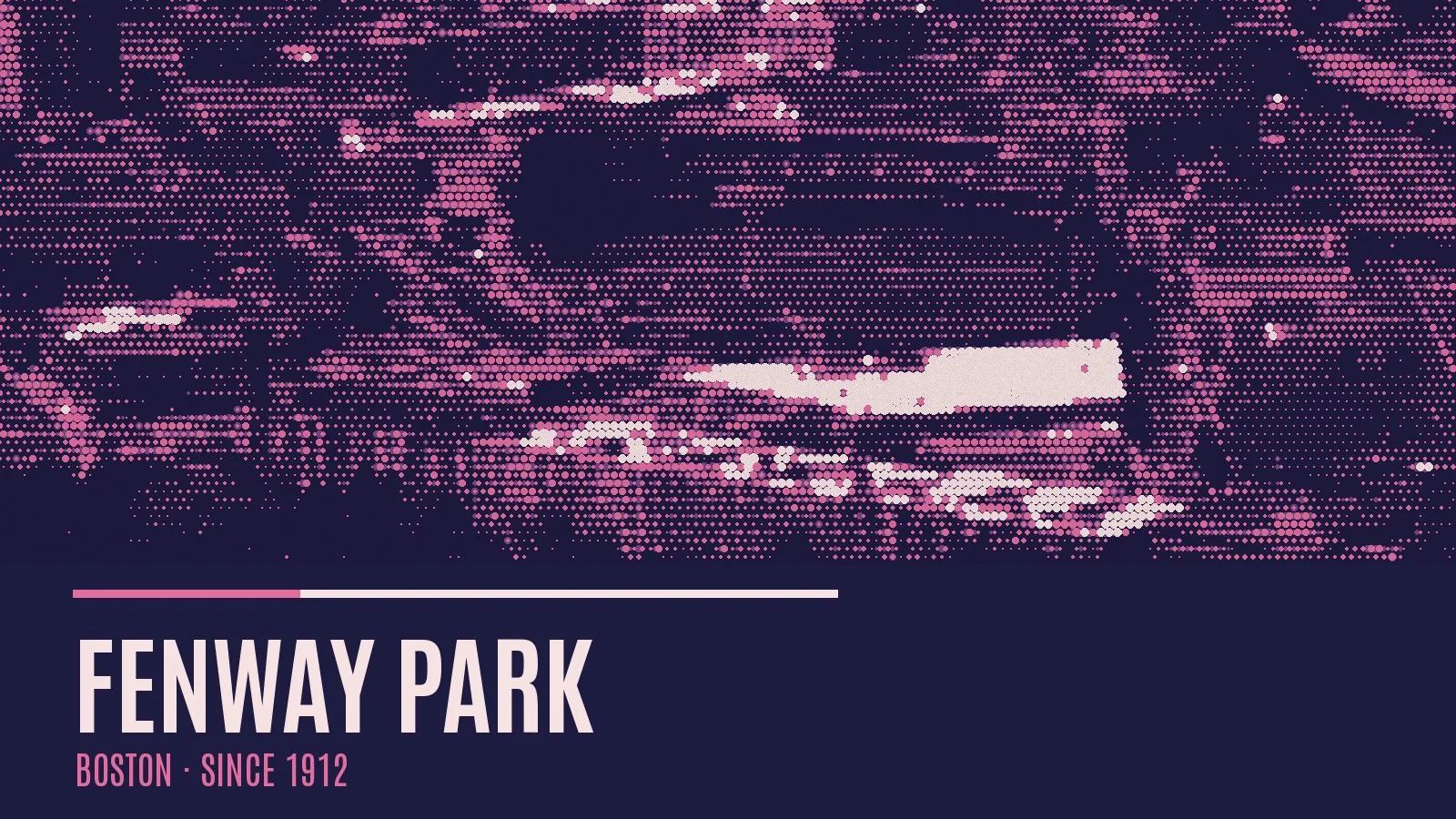
Fenway Park was built for baseball, and has never pretended otherwise. But every so often the Red Sox go on a road trip, somebody lays turf over the pitcher’s mound, and the oldest ballpark in the major leagues becomes, for one strange and sweaty night, a football ground.
A ballpark that got there first
There is a particular kind of sporting building that seems to have been there before the city grew up around it. Fenway Park is one of them. It opened in the spring of 1912, and the details of that first afternoon, gathered with loving pedantry by Bill Nowlin for the Society for American Baseball Research, already sound like an old ground’s founding myth. The first regular-season game was played on 20 April 1912 against the New York Highlanders, a side already often being called the Yankees. The park had been put up in a little over six months, at an estimated cost of $650,000, by General Charles Taylor and his son John I. Taylor, who owned both the Red Sox and the land. The groundskeeper, Jerome Kelley, brought some of the turf with him from the old Huntington Avenue Grounds, as if he were moving house and couldn’t bear to leave the garden behind.
The crowd was too big for the place. Somewhere between 24,000 and 27,000 people turned up, depending on which Boston paper you trust, and a couple of thousand of them stood in the outfield behind ropes. A ground rule declared that anything hit into them was a double. The mayor, John Fitzgerald, threw out the first pitch. The Red Sox committed something like seven errors, came back from 5-1 down, and won 7-6 in the eleventh inning, with only a few minutes of daylight left. The Boston American said nearly all of the 27,000 went without their dinner to see the finish. That season the team went 105-47 and won the World Series at home.
That’s the baseball story, and it is a lovely one, and this site is not going to compete with SABR on the subject of Steve Yerkes’s fielding. The football story is thinner, stranger and more episodic. It doesn’t run in a straight line from 1912 to the present. It turns up in bursts, roughly once a generation, and each time it does, the people involved seem slightly astonished that it’s working at all.
That astonishment is the subject of this piece. Fenway is not a football ground and never will be. But the handful of nights when it played at being one say something about what happens when the world’s game borrows a building that wasn’t made for it, and about the long, patient, often lonely history of football in Boston.
The awkward geometry of a ballpark
Anyone who has sat in a converted baseball stadium for a football match knows the feeling. The pitch never quite sits square. One end is miles from the nearest seat, the other is jammed against a stand, and the corner flags appear to have been placed by someone working from memory.
Fenway is worse than most, because it is so small and so lopsided. Dan Shaughnessy, the Boston Globe’s long-serving columnist, went to a Liverpool friendly there in 2014 and described the arrangement with a baseball writer’s bemused precision. “Fenway Futbol requires some interesting configurations,” he wrote. “It’s a tight space for soccer, sort of like the small ice surface at the Old Boston Garden. The pitcher’s mound — flattened and covered with sod — is part of the pitch.” One goal sat to the left of the third-base dugout, where the left-field grandstand juts out into fair territory. The other stood in front of the visitors’ bullpen, where, Shaughnessy noted, Gino Cappelletti once kicked field goals for the Boston Patriots in the early 1960s. His advice on where to sit was the Monster seats, or anything high on the first-base side.
In 2010, when the Red Sox first tried the experiment in the modern era, the Associated Press reported that the club “stretched a soccer field from the third-base line to right field, with sod covering the pitcher’s mound and most of the infield.” That is the geometry of compromise. Football is played across the diamond, at an angle to everything the building was designed to look at.
None of this is unusual in the United States, where for much of the twentieth century football had to make do with whatever venue would have it: baseball parks, gridiron bowls, college fields. The difference at Fenway is that the building is so particular, so full of its own quirks and rituals, that the football never quite drowns them out. You are always aware of where you are. That is half the point.
The Beacons and the summer of Pelé
The first proper professional football team to call Fenway home was the Boston Beacons, and they didn’t last long. Frank Dell’Apa, the Globe’s long-time football writer, has written their brief history on his own site. The club was named in 1967, “after consideration of thousands of suggestions from area sports fans”, and its investors included the Celtics’ Red Auerbach and the Red Sox executive Dick O’Connell. The Beacons played one season, 1968, in what became the North American Soccer League, and they played it at Fenway. Sixteen home matches drew an average of 4,004. Then the club folded.
Their first home game, Dell’Apa records, was a 3-0 win over the Detroit Cougars on 23 April 1968, in front of 4,406. A team spokesman had said beforehand that the club was “hoping for 5,000”. Tickets ran from $1 to $4.50. The Globe’s preview promised that Cardinal Cushing and Governor John A. Volpe would be in the crowd, and that the team would give a pre-game demonstration of the rules. I find that last detail almost unbearably touching: a professional football club, in its own stadium, explaining offside to its customers before kick-off.
The coach, Jack Mansell, was in no doubt about the significance of the occasion. “You have to say it was a historic moment for soccer in Boston,” he said afterwards. “I mean, you can always look back and say the first game at Fenway Park was a resounding win for the Boston Beacons.” John Milner scored twice and Erik Dyreborg once. Three days later the Beacons lost 4-0 to the Los Angeles Wolves, in a game delayed for 30 minutes by a light failure on Jersey Street. Glamour and farce, in the space of half a week, at the same address.
The one night when the Beacons really packed the place out was in July 1968, when Santos came to town with Pelé. The crowd was 18,431. Santos won 7-1. The Globe’s 2010 retrospective put it bluntly: “Actually, Pele brought in the fans.” It was, the paper said, the largest crowd for a soccer game in the region since the 1930s, and “might have been the first tangible indication in the modern era that big-time soccer could have an audience in the Boston area.”
Dell’Apa draws the obvious lesson, and draws it well. “Then, as now, the Beacons and Santos showed that interest in soccer is directly related to the quality of play.” Four thousand people will come to watch a new team learn its trade. Eighteen thousand will come to watch the best player in the world. That arithmetic has shaped American football for most of its history, and you can see it worked out in miniature at Fenway that summer.
Forty-two years of nothing much
After the Beacons folded, football left Fenway and didn’t come back for a very long time. The game didn’t leave Boston, but it moved around. The Globe’s 2010 piece lists the stations of the cross: the Minutemen, who arrived in 1974 and played at Nickerson Stadium; the Tea Men, who lasted three years at Foxborough; and then nothing professional until the New England Revolution arrived in 1996. There were also foreign clubs who visited places like Everett and Hudson, and Portuguese giants Benfica and Sporting who played in Foxborough in the early 1970s. “Crowds were substantial,” the Globe said, “but few records survive of those matches, which were not covered by the mainstream media.”
That sentence deserves to be underlined. Much of the history of football in the United States was made in front of large, enthusiastic immigrant crowds who were invisible to the papers. The game was played, loved and argued about, and almost nobody wrote it down. When people say football “arrived” in America in 1994, or 1975, or whenever, this is what they’re forgetting.
Jim Trecker, a consultant for the 2010 match, made the same point to the Globe. “There were a lot of days in the wilderness,” he said, “a lot of days when you were going out and trying to tell people it’s 11 men, it’s 90 minutes, some pretty basic information.” He traced a line back through the old American Soccer League, the New York Skyliners and the Beacons, and, in passing, claimed that “Celtic played here in 1931”. The Globe printed that as his recollection, and I’ll leave it as his.
One man in the crowd for that 2010 match connected the two eras in person. Rick Copland had been a ballboy at the Santos game. “Back in 1968 I thought they’d be coming back in 1969,” he told the Globe. He waited 42 years. He brought his family, and an autographed programme from 1968, and his verdict was generous: “This is a great crowd, better than the game in 1968.”
Celtic, Sporting and the scoreboard
The match that brought football back was the Fenway Football Challenge on 21 July 2010, between Celtic and Sporting. It was the Red Sox’s idea, and the reason was practical. As the Associated Press report explained, the baseball team was away on a ten-game road trip to the West Coast, and the ballpark would otherwise have been empty. So Red Sox management “imported the two European clubs for the exhibition game”.
An announced crowd of 32,162 turned up on a balmy night. Celtic went ahead when Georgios Samaras was tripped in the box by Daniel Carriço and scored the penalty himself. Sporting equalised in the 82nd minute, when Diogo Salomão’s header came back off the crossbar and Hélder Postiga headed the rebound in. Liedson nearly won it for Sporting four minutes later, heading wide of an unguarded net. It finished 1-1, and went to penalties.
Then came the moment that made the night. The shoot-out was recorded on the Green Monster’s hand-operated scoreboard, each successful kick marked with a tick in the slots normally reserved for innings. Ten kicks went in. In the sixth round, Liedson, who had played for Portugal at the World Cup that summer, put his over the bar. AP’s correspondent clearly enjoyed writing the next part. The ball “cleared the visitor’s bullpen and landed in the bleachers, just like so many other line drives in Fenway Park’s long history. But this was the wrong time — and the wrong sport — to go yard.” Liedson’s miss went up on the Monster as the first red X, in the sixth-inning slot. Paul McGowan scored, Celtic won 6-5 on penalties, and the loudspeakers played “Dirty Water”, the song that greets Red Sox wins.
The trophy, according to AP, was a crystal football mounted on a base shaped like home plate. The crowd sang “You’ll Never Walk Alone” and “Sweet Caroline”. The sausage vendors outside claimed, for the benefit of the Portuguese fans, to be selling chorizo. It is very hard not to like an evening like that.
Celtic’s manager, Neil Lennon, seemed to like it too. “It was different and we enjoyed it,” he said. “It’s one of the most famous stadiums in the world, and we played a football game in it.” Later he was more specific about what had struck him. “It’s not like a normal stadium, actually, with the Green Monster and so many people sitting on top of that. I liked the history and the tradition of the stadium.” His captain, Scott Brown, reported that the crowd had been loudest when Samaras went down in the box, which tells you that Boston had grasped at least one of football’s basic emotional truths very quickly.
The Red Sox chief operating officer, Sam Kennedy, was careful. The atmosphere had “absolutely exceeded our expectations”, he said, but the club hadn’t decided whether there would be more football. “Right now, we are enjoying the moment of this successful experiment.” Experiment is the right word. Fenway had hosted the NHL’s Winter Classic that January and was booked for an Aerosmith concert the following month. A football match was one more thing an old building could be persuaded to do.
Liverpool’s American living room
The experiment did continue, and for a specific reason. By 2012 the Red Sox’s owners, Fenway Sports Group, also owned Liverpool, as the AP report of that year’s match noted. From then on, a Liverpool friendly at Fenway wasn’t just a booking. It was a family occasion.
The first came on 25 July 2012, billed as “Football at Fenway 2012”, against Roma. The Associated Press report, carried by CBS Boston, caught the mood. The ballpark, which had just turned 100, was full of red shirts, but not Red Sox ones: “Gerrard 8” and “Suárez 7” had replaced “Ortiz 34” and “Pedroia 15”. Fans came through gates under a sign reading “You’ll Never Walk Alone”. An “LFC Tour 2012” banner hung from the middle of the Green Monster. The media meal was fish and chips. Before kick-off, John Henry, the controlling partner of Fenway Sports Group, walked out of the home dugout, along the edge of the pitch and down the right-field warning track towards the Pesky Pole, shaking hands with fans who recognised him.
The football was a pre-season friendly, but it had a local hero. Michael Bradley, son of the former United States coach Bob Bradley and then a Roma player, scored in the 63rd minute with a shot that went in off the post, and the crowd of 37,169 chanted “USA! USA!” Alessandro Florenzi added a second from a rebound six minutes later, two minutes after coming on. Charlie Adam got one back for Liverpool. Roma won 2-1. One small, perfectly ballpark detail: Liverpool’s goalkeeper, Péter Gulácsi, spent the first eight minutes or so looking into a bright sun, with the back of his goal near the edge of the right-field track.
Brendan Rodgers, then Liverpool’s manager, said the right thing and seemed to mean it. “It was incredible. I told them before, ‘You’ll be able to tell your grandkids you played football at Fenway Park.'”
Two years later Liverpool came back, and so did Roma. The game on 23 July 2014 was, by the Guardian’s account, “a tepid affair”. Fabio Borini hurt his shoulder colliding with Seydou Keïta in the ninth minute, which put a question mark over his planned move to Sunderland. Francesco Totti bundled Ashley Cole’s cross wide. Then, as time ran out, Marco Borriello volleyed in from a corner, and Roma won 1-0. LFChistory.net, the club’s indispensable amateur archive, puts the attendance at 38,000 and the goal in the 90th minute.
The Guardian noted that for the second time in three years, Fenway “was transformed into a second home” for Liverpool, “with the majority of the crowd clad in red”. There was a neat symmetry about the opposition, too. Roma was owned by Jim Pallotta, a minority owner of the Boston Celtics. The 2014 friendly was, in a sense, a Boston derby played between an English club and an Italian one.
Shaughnessy, writing for a paper that Henry also owned, couldn’t resist the joke. “We had John Henry’s Premier League soccer team playing at John Henry’s Fenway Park, covered by multiple representatives of John Henry’s newspaper.” He also noted something more interesting. Walking through the stands an hour before kick-off, he saw nobody from Red Sox Nation. “This was not a baseball crossover crowd.” The people who came to Fenway to see Liverpool were not baseball fans having a night off. They were football fans, many in winter scarves on a sweltering July night, who had found their way to a baseball park.
Shaughnessy quoted Henry, too, on why he had bought the club, from a speech to the Boston Chamber of Commerce. “What the hell is the connection between Liverpool and Boston, between baseball and soccer?” Henry asked, and answered himself with a list: a large Irish Catholic population, a seaport on a famous river, two cities of about 45 square miles and around 600,000 people, both college towns, both playing “in the most historical cathedrals of sport”. You can argue with the comparison, and Liverpudlians probably will, but it’s a better explanation than most owners give for anything.
The battle of Fenway
Liverpool’s third visit, against Sevilla on 21 July 2019, was the least friendly of the lot. Anfield Online, a fans’ site, called it a match “that can barely be described as friendly”. It was played in a heatwave, with temperatures in the 30s, and it was Liverpool’s second game in 46 hours since landing in the United States.
Sevilla went ahead in the 39th minute through Nolito, whose shot into the top corner followed a cross that deflected off Nat Phillips. Divock Origi equalised just before half-time, bundling in a Trent Alexander-Arnold corner. Both teams changed completely at the interval, but, as Anfield Online put it, “the attitude didn’t”. In the second half, Joris Gnagnon was sent off for a wild challenge on Yasser Larouci, Liverpool’s 18-year-old left-back, who was stretchered off. With Sevilla down to ten men, their substitute Alejandro Pozo ran on to a pass from Munir El Haddadi, rounded Simon Mignolet and scored the winner in the 90th minute. Jürgen Klopp was furious enough to go and speak to Sevilla’s coaching staff at half-time. Virgil van Dijk went to have a word with Gnagnon at the end.
It wasn’t the sort of night the Fenway friendlies were supposed to produce. But there was something almost reassuring about it. For two hours in a baseball park, under a Boston heatwave, two European clubs reminded everyone that pre-season football doesn’t always mean much, but it always means something.
Other codes, same grass
Football isn’t the only foreign game Fenway has lent its grass to. In November 2015 the ballpark hosted the AIG Fenway Hurling Classic between Dublin and Galway, part of a weekend of Irish-themed sport in what the Irish site The42 called “this Irish-American city”. Capacity was reduced from 37,000 to 31,000 for the match, and more than 25,000 came. The day before, the same field had been marked out for American football, for Notre Dame against Boston College.
The hurling was played in a modified format, with four 15-minute quarters, unlimited substitutions and a sin bin. There was a second-quarter brawl in front of the Dublin goal, with players “throwing punches, wrestling on the ground and generally getting stuck in”. Galway came from five points behind in the final quarter to win by five, and then, according to The42, celebrated “like they’d won an All-Ireland on the pitch afterwards”.
This matters to a football story because it shows what Fenway has become, a little to its own surprise. Because it is so old and so famous, playing there is an event in its own right. A team that would barely register on an American sports page at an ordinary ground makes the news at Fenway, and a good part of that is that the building itself is one of the attractions.
Why it works, when it shouldn’t
There is a respectable argument that football has no business in baseball parks at all. The pitch is too narrow, the sightlines are wrong, and the turf laid over the infield is never quite as good as real grass. Stadium people have been making that argument for decades, and the rise of purpose-built football grounds in the United States has largely proved them right. If you want to see a match properly, a baseball park is not where you go.
And yet the nights at Fenway kept working. Part of the reason is simply scarcity. These were one-off events, not a weekly grind, and the people who came were there because they wanted to be part of something unusual. Part of it is the ballpark’s genius for ritual. Within a couple of hours, football crowds had grasped the songs, the scoreboard and the street names, and joined in.
And part of it, I think, is that Fenway carries its age openly. Like the Vélodrome in Marseille, built for one sport and gradually claimed by another, or the Maracanã, which has been remodelled almost out of recognition and still feels haunted, Fenway is a building in which time is visible. The manual scoreboard is the giveaway. Anywhere else, the penalty shoot-out in 2010 would have flashed up on a screen and vanished. At Fenway somebody had to hang the marks up on the Monster by hand.
That isn’t nostalgia, or not only. It’s a reminder that grounds are made by the people who use them, and that a building designed for one game can learn to love another, at least for an evening. The football at Fenway was never going to replace the baseball. It was never meant to. But for a few summers it let a very old American ballpark try on the world’s game, and the world’s game, mostly, looked good in it.
A footnote for the purists
For readers who want something more solid underfoot, it is worth remembering how much of football’s American history happened on borrowed ground, or on surfaces nobody would choose today. FBH has written before about the long and mostly unhappy history of plastic pitches, and the turf laid over the Fenway infield belongs, loosely, to the same family of compromises. Football in the United States was often played on whatever surface a promoter could get, in whatever building would rent it, in front of whoever could be persuaded to come.
The Beacons’ organisers, demonstrating the rules before their first game, would have understood that perfectly. So would the immigrant crowds in Everett and Hudson, whose matches nobody recorded. When the crowd at Fenway sang “You’ll Never Walk Alone” in 2010, under a scoreboard that was marking penalties in the innings slots, they were, knowingly or not, standing on top of that history.
So Fenway’s football record is short: one dead club, a visit from Pelé, a handful of friendlies, a brawl in someone else’s code. It hardly amounts to a tradition. But traditions have to start somewhere, and they often start like this, with an empty building on a summer night, a road trip out west, and somebody in an office asking whether they could get a football match in instead.