


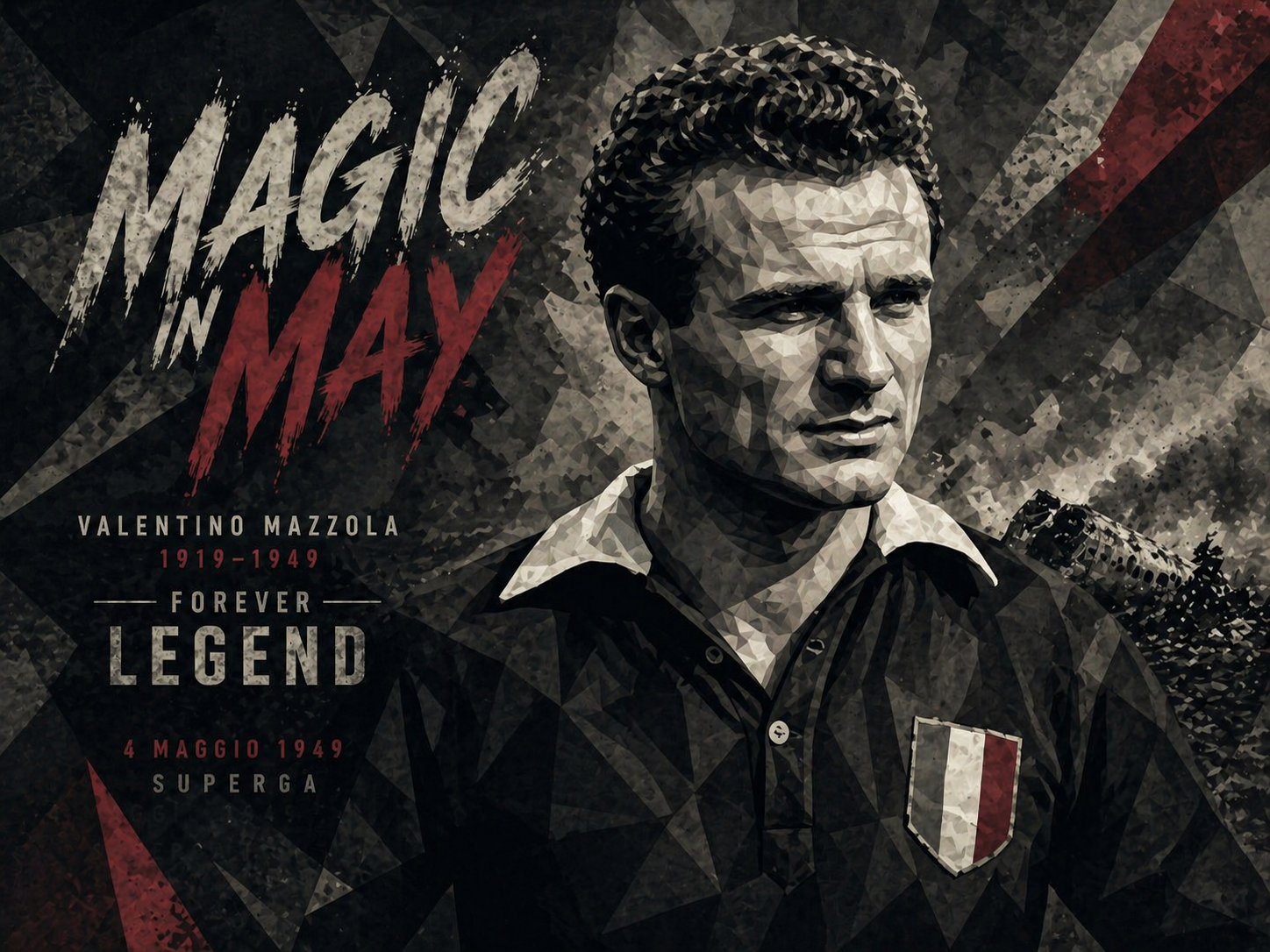
On 4 May 1949, almost the entire squad of Il Grande Torino was killed in the Superga air disaster. Yet Valentino Mazzola and his team should not be remembered only for the tragedy that ended them, but for the football future they had already begun to build.
Key Takeaways
- Il Grande Torino were not simply a great Italian side, but one of the most tactically advanced teams of the 1940s.
- Valentino Mazzola was the team’s captain, emotional centre and prototype of the modern complete attacking midfielder.
- The Superga air disaster on 4 May 1949 killed 31 people and effectively ended one of football’s most important dynasties.
- The tragedy has often overshadowed Torino’s tactical innovation, cultural power and influence on the future of the game.
The Silence Before Impact
At 17:05 on 4 May 1949, the sky above Turin had dropped so low it seemed to be pressing against the earth.
The Fiat G.212 carrying the players, staff and officials of Il Grande Torino was returning from Lisbon, where the Italian champions had played Benfica in a testimonial match for Francisco Ferreira. The flight should have been routine. Torino were used to being received abroad as sporting royalty. They had become more than a club side. They were envoys for an Italian game trying to restore pride after war, dictatorship and national ruin.
But as the aircraft approached Turin, the conditions worsened. Fog and rain swallowed the hills. Visibility was almost gone. The Basilica of Superga, standing high above the city, disappeared into the grey.
Then came the impact.
The plane struck the rear embankment of the Basilica of Superga. There was no escape, no meaningful warning, no time for the great Torino side to become aware of its own ending. Thirty-one people were killed. Among them were eighteen footballers, coaches, journalists and crew.
Among the dead was Valentino Mazzola.
Captain. Inside-forward. Leader. Goalscorer. Midfielder before the modern midfielder existed. The man whose rolled-up sleeves could change the emotional temperature of a match.
What died on that hill was not merely a football team. It was a way of seeing the game before most of Europe was ready to understand it.
More Than a Tragedy
The story of Il Grande Torino is often told backwards, from the wreckage to the legend. That is understandable, but it is also limiting.
Superga is so overwhelming that it can flatten everything that came before it. Torino become a team of ghosts. Mazzola becomes a doomed captain. The maroon shirt becomes a relic. The football itself, the living thing, is too often treated as prelude.
That is the mistake.
Before they became a tragedy, Torino were a revolution.
They won five league titles in the 1940s, including the 1942-43 championship before the interruption of war and four consecutive Serie A titles after it. They were the backbone of the Italian national team. In one famous post-war international against Hungary, Italy’s side was effectively Torino in blue.
But even those facts do not fully explain them.
They were not just stronger than everyone else. They were playing a different version of football. Their movement was sharper, their tempo higher, their positional exchanges more sophisticated. They attacked with numbers, defended with collective aggression and treated the pitch as something fluid rather than fixed.
At the centre of it all was Mazzola.
He was not simply a No.10 in the romantic sense. Nor was he a forward who drifted deep for touches. He was closer to a footballer from another age: a player capable of defending, carrying, creating and finishing inside the same passage of play.
Long before Johan Cruyff became the symbol of positional intelligence, long before Alfredo Di Stéfano was celebrated as the complete footballer, Mazzola was already showing what could happen when a team’s best player refused to be contained by one role.
Steel and Scarcity
Mazzola was born in Cassano d’Adda in 1919, in an Italy shaped by poverty, political control and the long shadow of war.
There is no need to sentimentalise his beginnings. The important point is simpler. He was formed in an environment that demanded hardness. Football was not a polished academy pathway. It was rough ground, physical confrontation and survival through talent sharpened by necessity.
That background mattered because Mazzola’s greatness always carried two qualities at once. He had the technique of a creator and the force of a labourer. He could glide through midfield, then throw himself into a challenge. He could play the delicate pass, then arrive in the box with the authority of a centre-forward.
He was not fragile genius. He was working-class authority with imagination attached.
That combination made him unusually hard to classify. Italian football had space for specialists. Mazzola did not behave like one.
The Venetian Ambush
The moment that changed his career came in 1942.
Torino, ambitious and well-run under president Ferruccio Novo, were trying to build a side capable of challenging the established powers of Italian football. Then they met Venezia, and Mazzola changed the direction of their future.
Alongside Ezio Loik, Mazzola helped Venezia damage Torino’s title hopes. He did not merely play well. He revealed what Torino lacked. Drive. Imagination. Ruthlessness. A player who could bend a match from midfield without needing the game arranged around him.
Novo understood what he had seen.
He signed both Mazzola and Loik.
It was one of the most important acts of recruitment in Italian football history. In 1942-43, Torino won the league and the Coppa Italia, becoming the first Italian club to complete the domestic double. Mazzola had not joined a great team. He had helped turn one into something close to unstoppable.
The System and the Sleeves
Torino’s greatness was not accidental. It was built.
Novo gave the club unusual organisational strength. Ernő Egri Erbstein, the brilliant Hungarian coach and thinker, helped refine the tactical structure. The side moved away from older Italian habits and towards a more flexible system influenced by the WM formation.
What mattered was not the chalkboard shape alone. It was the behaviour inside it.
Torino compressed space. They moved in relation to one another. They attacked with speed but not chaos. They could overwhelm opponents because their players understood when to rotate, when to hold, when to surge.
Mazzola was the essential figure because he connected everything.
In defensive phases, he could drop into midfield and help Torino win the ball back. In transition, he carried possession forward with power. Around the penalty area, he had the timing and finish of a striker. In 1946-47, he finished as Serie A’s top scorer with 29 goals, an extraordinary return for a player whose influence reached far beyond the box.
That is why the easy labels fail him.
Calling him an inside-forward is historically accurate but emotionally insufficient. Calling him a No.10 makes sense to modern readers but still narrows him. Mazzola was closer to a complete attacking midfielder before the role had a settled language.
His most famous gesture captured the whole thing.
When Torino needed to raise the tempo, when a match drifted or resistance hardened, the signal would come. The trumpet would sound at the Stadio Filadelfia. Mazzola would look around, roll up the sleeves of his maroon shirt and the mood would change.
The Quarto d’ora granata, Torino’s maroon quarter-hour, was not folklore invented after death. It was a real psychological weapon. Opponents knew what it meant. The pressure was coming. The tackles would sharpen. The passing would quicken. The crowd would rise. Torino would turn a football match into a siege.
UEFA’s own historical profile of Torino notes Mazzola’s fame for rolling up his sleeves before inspiring the side’s decisive surges, a detail that has endured because it explains something statistics cannot: his authority was visible before it became measurable.
Timing Against the World
The central tension of Mazzola’s career was timing.
He was a footballer built for the largest stages, yet history denied him many of them. The World Cups of 1942 and 1946 did not happen because the world was at war. By the time international football began to rebuild, Mazzola was already carrying the weight of a country that had seen too much collapse.
Italy had won World Cups in 1934 and 1938 under Vittorio Pozzo, but the post-war nation was different. Damaged. Divided. Trying to recover not just sporting pride, but moral confidence.
Torino became a kind of national refuge.
The team’s dominance offered continuity in a broken country. Their style suggested energy rather than retreat. Their players were admired not simply because they won, but because they seemed to represent a possible future.
That burden was heavy.
There was another tension too: system against instinct.
Erbstein’s Torino were advanced because they had structure. Mazzola was great because he could exceed structure without destroying it. That is not easy. Many gifted players unbalance teams. Mazzola gave Torino unpredictability without costing them coherence.
He was free, but not detached. Disciplined, but not reduced.
That was the trick.
Lisbon and the Last Match
By spring 1949, Torino were still the standard of Italian football.
They had been champions so often that dominance had begun to look routine, which is always dangerous for memory. Repetition can dull the eye. What was extraordinary becomes expected.
The trip to Lisbon came because Benfica captain Francisco Ferreira wanted Torino as the opposition for his testimonial. It was a mark of respect. Benfica were not inviting an ordinary club. They were inviting the team by which others measured themselves.
On 3 May 1949, Benfica beat Torino 4-3.
It was a friendly, but not meaningless. These matches carried prestige. They were part diplomacy, part theatre, part proof of status. Torino’s presence in Lisbon showed how far their name travelled.
The next morning, the squad began the journey home.
Some decisions become historic only because of what follows. The boarding of that aircraft was one of them. Routine turned fatal. A return journey became an ending.
Silence on the Hill
The crash did not merely shock Turin. It wounded Italy.
The official Torino history records that Grande Torino’s run was interrupted on 4 May 1949 at 17:05, as the players returned from Lisbon after the Benfica friendly. The bluntness of that fact is almost unbearable. A dynasty ended in a timestamp.
The aftermath was grim beyond imagination. Bodies had to be identified. Vittorio Pozzo, who had led Italy to two World Cups and knew many of the players closely, was involved in recognising the dead.
At the funeral, Turin stopped.
Hundreds of thousands filled the streets. Rivalry lost meaning. Juventus, Inter, Milan and the rest of Italian football understood that this was not only Torino’s loss.
Ottorino Barassi, president of the Italian football federation, is remembered for addressing Mazzola in words that still carry unbearable tenderness:
“Captain Valentino, this is the cup, the fifth cup. Smile. It is a great cup. Torino’s cup.”
Torino were declared champions of the 1948-49 season. For their remaining fixtures, they fielded their youth team. Their opponents did the same in an act of sporting respect. The boys in maroon won the remaining matches, but nobody mistook that for consolation.
Some victories are too sad to celebrate.
The Shadow That Changed Italian Football
The honest legacy of Superga is harsher than the romantic version.
Torino did not recover their place at the summit. How could they? A club can replace players. It cannot replace an entire generation, an entire tactical culture, an entire emotional centre.
Italy suffered too.
At the 1950 World Cup in Brazil, the national team travelled by ship because of the trauma associated with flying. The journey was draining, and Italy exited early. It would be too simple to say Superga alone caused that decline, but it clearly removed the core of the country’s best team at the worst possible moment.
The tactical consequences are harder to prove but impossible to ignore.
Italian football later became associated with defensive caution, control and Catenaccio. That tradition produced greatness of its own, and it would be lazy to reduce it to negativity. But the loss of Mazzola, Erbstein and Torino removed a powerful alternative path: proactive, intense, attacking, collective football built around positional flexibility.
That is the tragedy beneath the tragedy.
Not only that men died. Not only that families were destroyed. But that football lost a living experiment before it could fully influence the world.
What Mazzola Really Changed
Valentino Mazzola is often remembered as a symbol. He deserves to be remembered as a football idea.
He changed what a leading player could be.
He was not the luxury creator who waited for the ball. He was not the pure striker who lived for service. He was not the defensive worker praised for sacrifice but limited in imagination.
He was all of those things in motion.
That is why comparisons with later complete footballers make sense, even when they risk flattening history. Di Stéfano, Cruyff, Ruud Gullit, Steven Gerrard, Frank Lampard, Kevin De Bruyne: none is a direct copy, and football changed enormously across those eras. But the principle is familiar. A player who refuses to let the game divide responsibility into neat compartments.
Mazzola embodied that principle before the modern game had a name for it.
His son, Sandro Mazzola, would later become a great player for Inter and Italy, but even that remarkable career unfolded under a shadow few sons could bear. Valentino had died young enough to remain permanent. No decline. No late-career compromise. No managerial failure. Just the captain, forever thirty, forever rolling up his sleeves.
That makes memory dangerous.
It can turn a footballer into a saint and, in doing so, make him less human.
Mazzola was not great because he was doomed. He was great because he imposed himself on matches with rare completeness. Because he gave Torino force and imagination. Because his leadership had tactical value, not just emotional theatre.
The misunderstanding is simple.
Superga did not make Valentino Mazzola important.
It stopped the world from seeing how important he might yet have become.
The Sound That Remains
Every year, on 4 May, Torino remember.
The club captain climbs to Superga and reads the names of the dead. It is a quiet ritual for a team that once played with thunder in its blood.
That contrast is almost too much. The silence of the hill. The memory of the trumpet. The cold stone of the basilica. The heat of the Stadio Filadelfia.
Yet the true story of Il Grande Torino does not belong only to mourning.
It belongs to the football they played before the fog came down.
To the movement. To the pressure. To the sleeves rolled up when the match needed changing.
Valentino Mazzola should not be left as a ghost on a hillside. He should be seen where he was most alive: in the middle of the pitch, sensing the moment before anyone else, turning ordinary minutes into something opponents feared.
The sky fell on 4 May 1949.
But before it did, Il Grande Torino had already shown football a glimpse of tomorrow.
