


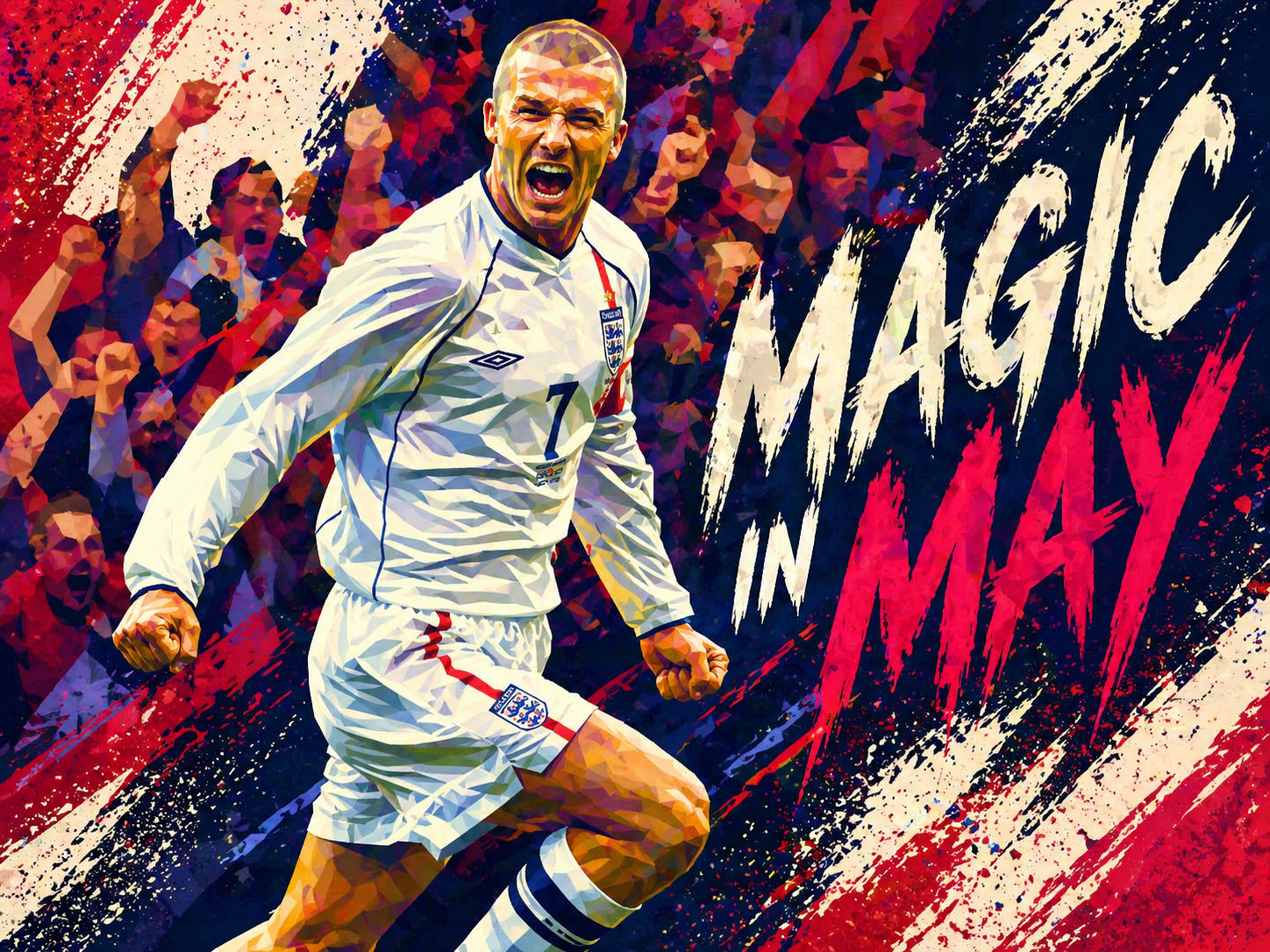
David Beckham was born on May 2, 1975. For Magic in May, that date is the entry point, not the story. The story is Old Trafford in 2001, Greece, stoppage time, and the moment Beckham stopped being defined by 1998.
Key Takeaways
- David Beckham was born on May 2, 1975, in Leytonstone, London.
- England’s 2-2 draw with Greece at Old Trafford on October 6, 2001 secured automatic qualification for the 2002 World Cup.
- Beckham’s stoppage-time free kick mattered because it answered the doubts that had followed him since his red card against Argentina in 1998.
- The moment transformed Beckham’s England story from scrutiny and risk to trust, responsibility, and certainty.
The Exorcism at Old Trafford
It should never have come to this.
Old Trafford had entered stoppage time with the air of a stadium trying to bargain with itself. England were level at 2-2 against Greece, but level did not yet feel safe. The afternoon had been too jagged, too nervous, too strangely resistant to the script England had prepared for themselves. A campaign that had seemed to turn in Munich, where Sven-Göran Eriksson’s side had beaten Germany 5-1, had narrowed to one last piece of execution.
England needed a point to qualify automatically for the 2002 World Cup. Germany’s draw with Finland had opened the door. All England had to do was avoid defeat. Instead, they had spent the afternoon flirting with the play-offs.
The details were awkward. Greece had taken the lead through Angelos Charisteas. Teddy Sheringham had equalised. Demis Nikolaidis had put Greece ahead again almost immediately. England were not being outclassed, but they were being unsettled. They had possession, territory, pressure, but not command. They were playing like a team that knew what the result meant and could not quite make that knowledge useful.
Then, deep into stoppage time, a foul. A free kick. Around 30 yards from goal, slightly right of centre, close enough for hope and far enough for doubt.
David Beckham stood over the ball.
By then, he had already carried much of England’s afternoon on his own legs. He had crossed, chased, pressed, passed and urged. He had taken free kicks before this one and missed. He had tried to drag shape and conviction out of a performance that kept threatening to collapse into anxiety.
Teddy Sheringham moved towards the ball. Beckham did not yield.
The exchange has become part of the memory of the goal. Sheringham, the senior forward, fancied it. Beckham, the captain, refused him. According to later retellings, Beckham told him it was too far out and that he had it. The precise wording matters less than the authority of the act. In that moment, Beckham did not ask for permission to carry England. He simply carried them.
He stepped back. The stadium tightened.
The run-up was familiar, almost ritualised. The plant of the left foot. The body opening. The right boot wrapping around the ball. It rose over the wall, bent away from Antonis Nikopolidis, and dropped into the top corner.
Alan Green’s call for BBC Radio 5 Live caught the release of the moment with the line that has stayed with it: “It had to be Beckham.”
That was the truth of it. Not because Beckham was the only player on the pitch capable of striking a free kick. Because he was the only player on the pitch carrying quite that story.
The goal secured England’s place at the World Cup. But that was only the formal outcome. Its deeper meaning sat somewhere else. It was the moment Beckham took back control of a narrative that had been taken from him three years earlier.
The Blue-Collar Superstar
To understand why the Greece free kick still carries such force, the first task is to strip away the easiest version of Beckham.
The lazy version begins with celebrity. The haircuts, the sarong, the marriage to Victoria Adams, the flashbulbs, the adverts, the idea of Beckham as the first fully global English footballer-brand. It is all part of the story, but it has also obscured the footballer. At times, it has almost swallowed him.
The contradiction of Beckham is that one of the most photographed players of his generation was also one of its least indulgent workers.
He was not a luxury player. He was not a winger in the traditional English sense. He did not rely on raw pace, stepovers or one-against-one domination. He built his game on repetition, endurance, timing and delivery. The celebrity image suggested glamour. The footballer beneath it was closer to a tradesman: precise, tireless, obsessive about the same movement until it became dependable under pressure.
Sir Alex Ferguson once captured that distinction when he said Beckham was Britain’s finest striker of a football not because of natural gift alone, but because of the relentless application behind it. That sentence matters because it punctures the myth. Beckham’s right foot looked romantic from the stands. Up close, it was the result of labour.
That is why the Greece free kick cannot be treated as a piece of isolated magic. It was not a flash of genius detached from the rest of him. It was the public expression of private repetition. The free kick looked like theatre because of the stakes, but the act itself was mechanical, trained, almost stubborn.
That is where Beckham’s football identity sits. He made precision feel dramatic.
The Making of the Right Foot
David Robert Joseph Beckham was born on May 2, 1975, in Leytonstone, London. His parents, Ted and Sandra, were Manchester United supporters, and the club became part of his life before he could have chosen it for himself. The family travelled north to watch United. The allegiance was not casual. It became inheritance.
That early detail is important because Beckham’s career is often framed as a journey into spectacle. In truth, its roots were unusually fixed. He was not a floating prodigy shopping for destiny. He wanted Manchester United. He wanted the shirt his family revered. He wanted one thing with a clarity that can sound almost childish until it becomes professional discipline.
As a boy, he played for Ridgeway Rovers, coached in part by his father. He was not physically imposing. He was not the most obviously explosive child footballer. His advantage was technical concentration. At 11, he won the Bobby Charlton Soccer Schools National Skills competition, a result that helped bring him closer to the Manchester United scouting world.
On his 14th birthday, May 2, 1989, he signed schoolboy forms with United. It is a neat piece of symmetry, almost too neat, that the date that begins this Magic in May story also marked one of the first formal steps in Beckham’s football life.
By 1992, he was part of the FA Youth Cup-winning side that would become known as the Class of ’92. Ryan Giggs, Paul Scholes, Nicky Butt, Gary Neville, Phil Neville and Beckham would later be folded into mythology, but at the time the significance was still being built. What separated Beckham was not that he looked destined to become the most famous of them. It was that he gave himself a repeatable edge.
He would not become the quickest. He would not become the strongest. He would become the most precise.
Selhurst Park and the Announcement
The wider football public first understood that precision on August 17, 1996.
Manchester United were away to Wimbledon at Selhurst Park on the opening day of the Premier League season. The match was almost done. United were leading 2-0. Beckham, still only 21, received the ball inside his own half and looked up. Neil Sullivan, the Wimbledon goalkeeper, was off his line.
Most players would have seen the position and admired the possibility. Beckham acted on it.
The strike travelled from inside his own half, high and controlled, not blasted but guided. Sullivan backpedalled, then stumbled into helplessness. The ball dropped beneath the bar, and Beckham turned away with a smile that carried disbelief and calculation at the same time. A life had changed in front of everyone.
In his autobiography, Beckham later wrote that when his foot struck that ball, it “kicked open the door to the rest of my life”. UEFA’s profile of Beckham uses the line for good reason. The Wimbledon goal did not simply announce a player. It announced a way of being seen.
From that point, Beckham would rarely belong entirely to football again. The attention widened. The fame accelerated. The cameras multiplied.
Yet the goal also revealed something purely footballing. Beckham had noticed a goalkeeper’s position, judged distance and flight in an instant, and executed the strike with the calm of someone passing the ball into a zone. It was audacious, yes, but not reckless. Even his boldness had method.
That would become the pattern. The world often focused on the image. The game kept returning to the foot.
The Wide Regista
Beckham’s defining football gift was not that he could cross a ball. Plenty of players can cross a ball. His gift was that he could turn crossing into a form of playmaking.
In the tactical language of the 1990s, he was usually described as a right midfielder. That is accurate, but incomplete. He was not a touchline winger in the old sense. He did not live to isolate the full-back and beat him on the outside. He was not Ryan Giggs on the opposite flank. His game was less explosive, more measured, more architectural.
Beckham was closer to a wide regista: a playmaker stationed on the right, using angles, timing and delivery rather than central possession control. He could receive wide, drift inside, strike early, or deliver from areas that did not yet look dangerous. His crossing was not only accurate. It was early. That made it brutal to defend.
A late cross allows defenders to set themselves. Beckham’s best deliveries arrived before defensive lines had completed their adjustments. They bent behind centre-backs and away from goalkeepers. They invited strikers to attack space rather than wrestle for it.
At Manchester United, this made his relationship with Gary Neville essential. Neville overlapped to provide width, allowing Beckham to move into pockets where his right foot could control the next phase. Their partnership worked because it was not ornamental. It had a practical logic. Neville created the lane. Beckham delivered into the wound.
This is where the celebrity version of Beckham becomes actively misleading. A player remembered by casual audiences for free kicks and fame was, in weekly football terms, a systems player of immense reliability. He gave United territory. He gave strikers service. He gave the side a repeatable route from pressure into threat.
His set pieces were the obvious expression of that gift, but open play was where the full scale of it could be seen. A Beckham cross was often less a hopeful ball than a pass into a future movement. He knew where the run should be before it fully existed.
That is why he mattered tactically. He did not need to dominate the ball to bend a match towards his team. He needed only a yard, a glance, and the time to shape his body.
The Scapegoat
Every Beckham story eventually returns to Saint-Étienne.
England against Argentina, June 30, 1998. A World Cup round-of-16 tie already carrying the burden of history. Michael Owen had scored one of the great English World Cup goals. The match was alive with tension. Early in the second half, Diego Simeone fouled Beckham. Beckham, lying on the turf, flicked out a leg.
It was not a violent act in any meaningful sense. It was petulant, visible and foolish. That was enough. Referee Kim Milton Nielsen showed the red card. England played the remainder of the match with ten men and eventually lost on penalties.
What followed was ugly even by the standards of English football’s punishment culture.
Beckham was not merely criticised. He was made into an object. The headlines were vicious. The image of him as the player who had cost England became simple, portable and cruel. An effigy of Beckham was hung outside a pub. He received abuse at grounds around the country. He was cast less as a young player who had made a mistake than as a symbol of national betrayal.
It was absurd, but absurdity does not make damage unreal.
For Beckham, the significance was not only that he had been blamed. It was that the blame attached itself to the very thing he would later need to prove: trust. Could he be relied upon when the emotional temperature rose? Could he be controlled when control mattered most?
That question followed him even after his club form answered almost everything else.
The Treble Season and the Proof of Work
Beckham’s response to 1998 was the strongest season of his club career.
The 1998-99 campaign could have swallowed him. Instead, he became central to one of the greatest seasons in English club history. Manchester United won the Premier League, FA Cup and Champions League. Beckham did not hide inside that team. He shaped it.
There was a defiance in the consistency. Away grounds booed him. Opponents targeted him. The noise around him remained hostile. Yet week after week, his level held. That matters because redemption in football is rarely a single moment, however much storytelling prefers one. It is usually built through repetition before it is recognised in an instant.
The Champions League final against Bayern Munich gave one form of proof. With Roy Keane and Paul Scholes suspended, Beckham played centrally at the Camp Nou. It was not his natural role, but it revealed the seriousness of his football intelligence. United trailed 1-0 heading into stoppage time. Then came the corners.
First, Beckham delivered the set piece that led to Sheringham’s equaliser. Then, moments later, another Beckham corner was flicked on by Sheringham and turned in by Ole Gunnar Solskjaer. United had completed the impossible. Beckham had not scored, but his right foot had again been involved at the point where pressure became history.
That season did not erase France 1998. It proved something different. Beckham could keep working while the country jeered. He could keep producing while being reduced to a caricature. He could be wounded without becoming unreliable.
Still, England was a separate court. Club forgiveness did not automatically become national trust.
Captaincy Without Consensus
When Sven-Göran Eriksson made Beckham England captain, the decision felt both logical and exposed.
Logical, because Beckham was one of England’s most dependable players. He was physically committed, tactically disciplined and technically exceptional. He cared visibly, sometimes too visibly, but he did not drift. If anything, he was prone to carrying too much.
Exposed, because the English idea of captaincy has often been narrow. The captain is expected to shout, confront, cajole, impose himself through presence. Beckham did not naturally fit that mould. He was not Bryan Robson. He was not Tony Adams. He was not the dressing-room general of old English imagination.
His leadership came through standards.
That is why Emile Heskey’s later reflection on Beckham’s captaincy is so useful. Speaking to FourFourTwo, Heskey said Beckham was not the loudest and did not bark at teammates, but that watching him made others feel they had to work harder. On Greece specifically, Heskey called his energy “ridiculous”.
That is Beckham’s captaincy in one observation. Not command through volume. Command through example.
Even so, the armband did not settle the argument by itself. It intensified it. Beckham had been given responsibility, but not universal belief. The memory of 1998 had not disappeared. It had merely moved to the edge of the picture, waiting for the kind of moment that would either revive it or finally reduce its power.
Old Trafford supplied that moment.
England Lose Control
England’s final qualifier against Greece on October 6, 2001 was supposed to be a confirmation, not a crisis.
It became a crisis because Greece refused to behave like scenery. Otto Rehhagel’s side were compact, awkward and increasingly confident. They were not dominant in the way elite teams dominate, but they were disruptive in the way dangerous underdogs can be. They broke rhythm. They made England impatient. They forced the match into uncomfortable areas.
The official England match record shows the blunt facts: Charisteas scored after 36 minutes, Sheringham equalised after 68, Nikolaidis restored Greece’s lead within a minute, and Beckham scored in the third minute of stoppage time. Those facts do not quite capture the mood, but they explain the stress.
England kept finding a way back only to lose security again.
That is the emotional shape of the match. Not collapse, exactly. Something more irritating and more dangerous: recurring failure to settle. Every time England seemed to have found the next foothold, Greece removed it. Every attack carried urgency, but not enough clarity. Every passing move seemed to know where it wanted to end without quite knowing how to get there.
Beckham was the exception, not because everything he tried worked, but because he kept accepting the burden of trying. He covered ground relentlessly. He demanded the ball. He supplied crosses, took set pieces and drove England forward from the right. His performance had the feel of a player refusing to let the match reach its natural conclusion.
The Guardian’s original report from the day, published after England’s 2-2 draw with Greece, caught the essential fact of the afternoon: Beckham’s late goal had rescued England. That word matters. Rescue implies danger. England were not cruising towards qualification. They were being dragged there.
By the final seconds, the game had become brutally simple.
One kick, or the play-offs.
The Free Kick That Settled the Argument
The free kick was not in perfect range. That is part of its power.
It was far enough to require more than placement, close enough to punish overhit force, central enough to tempt several options and awkward enough to make the goalkeeper believe he had a chance. Beckham had already failed with earlier attempts. The pressure was not clean. It was layered.
Sheringham’s presence over the ball briefly introduced the possibility of doubt. Beckham removed it. That small moment before the kick may be as revealing as the strike itself. He had been cast as reckless in 1998. Here, under greater pressure and with greater responsibility, he was decisive without being rash.
He chose the moment because the moment belonged to the skill he had spent his life refining.
The strike itself was pure Beckham. The angled approach. The open body. The contact slightly across the ball. The shape was familiar, but familiarity did not lessen the difficulty. In fact, it increased the tension. Everyone knew what he wanted to do. Greece knew. Nikopolidis knew. Old Trafford knew.
He still did it.
The ball cleared the wall, drifted with pace, then dipped late. It did not look hit in anger. It looked struck with command. That was the difference. There was violence in the movement of the ball, but not in Beckham’s action. His body looked trained into calm.
By the time it found the top corner, the goal felt less like improvisation than conclusion.
This was the moment Beckham became England’s certainty.
Not because one free kick can explain a whole career. It cannot. Not because 1998 should have required forgiveness on that scale. It should not. But because football narratives are rarely fair. They attach themselves to images. Beckham had been trapped inside one image for three years: the kick at Simeone, the red card, the long walk, the blame.
At Old Trafford, he supplied another image.
One carried anger. The other carried control.
What Changed
It is tempting to call the Greece free kick redemption, and in one sense it was. Beckham himself has described it in those terms, saying the goal felt like the moment England supporters forgave him for what had happened a few years earlier. That reading is emotionally true, even if it simplifies the years of work that came before it.
What changed at Old Trafford was not Beckham’s quality. That had already been established. It was not his fame. That was already unavoidable. It was trust.
Before Greece, Beckham was admired and doubted at the same time. He could be praised for his delivery, his work rate, his set pieces, his resilience, while still carrying the unresolved question of whether he could be relied upon when pressure became personal. After Greece, that question became harder to ask with any force.
He had not only played well. He had accepted the decisive responsibility.
That distinction is important. Plenty of players produce strong performances. Fewer step into the moment everyone will remember if it goes wrong. Fewer still do so with the old failure still visible behind them.
Beckham’s response was not loud. It was exact.
He did not argue with the past. He answered it.
The Ferguson Tension
There is another reason Beckham’s story resists simple romance. Even after his national rehabilitation, the tension between footballer and celebrity did not disappear. At Manchester United, it sharpened.
Ferguson valued discipline, hierarchy and control. Beckham’s life had become increasingly public and increasingly difficult for any manager to contain. The marriage to Victoria Adams did not make Beckham less committed as a player, but it did change the environment around him. The cameras followed him in a way they did not follow others. The brand expanded. The noise grew.
Ferguson later said Beckham was never a problem until he got married, a line that has often been repeated because it reduces a complicated relationship to one blunt judgement. The deeper tension was not simply marriage or fame. It was control. Ferguson had built United on the principle that no individual could become larger than the club’s authority. Beckham, whether he wanted to or not, began to represent a different age.
The famous dressing-room boot incident in 2003, after an FA Cup defeat to Arsenal, became the symbolic end. Ferguson kicked a boot that struck Beckham above the eye. The cut was physical, but the meaning was structural. Their relationship had reached the point where repair no longer seemed useful.
Beckham left for Real Madrid that summer.
That move often gets folded into the celebrity version of his life: Beckham joins the Galácticos, becomes part of football’s grandest showroom, stands beside Zidane, Ronaldo, Figo and Roberto Carlos. But there was a football test inside it too. Madrid did not need another star name. They needed balance in a team overloaded with attacking prestige.
Beckham’s years in Spain were not always smooth, but they again revealed the part of him that celebrity coverage missed. He worked. He adapted. He played deeper when required. He accepted less glamorous responsibilities. In his final season, after being frozen out following the announcement of his move to LA Galaxy, he fought his way back into Fabio Capello’s side and helped Madrid win La Liga in 2007.
That chapter matters here because it repeats the pattern. Beckham’s image created assumptions. His work kept complicating them.
The Legacy Beneath the Image
Beckham’s legacy is unusually difficult to hold steady because it exists in two registers at once.
Culturally, he changed the idea of what an English footballer could become. He widened the commercial possibilities of the sport. He made footballer as global brand feel not only possible, but inevitable. His move to Major League Soccer later accelerated American football’s modern visibility, and the league’s Designated Player Rule became widely known as the Beckham Rule.
That side of his story is real. It should not be dismissed.
But it should not be allowed to obscure the footballer.
Beckham was not England’s most naturally gifted player of his generation. Paul Gascoigne had more imagination. Paul Scholes had more subtlety in central areas. Steven Gerrard had more force. Wayne Rooney had more explosive talent. Beckham’s greatness was different.
He became England’s most certain player.
That certainty came from a narrow but devastating set of qualities: stamina, delivery, repetition, nerve, and a right foot that could alter the emotional state of a match. He was not easy to categorise because he did not fit the pure winger model, the central playmaker model or the old captaincy model. He sat between ideas, which is often where misunderstood players live.
His influence can be seen less in players who copy his position than in players who share his method. The deep cross as a weapon. The early delivery before a defence is set. The set piece as a repeatable form of pressure. The understanding that ball-striking can be tactical, not just spectacular.
That is why the “Goldenballs” shorthand is so inadequate. It makes him sound ornamental. Beckham was never ornamental. He was functional in the most dangerous way.
Why This Belongs in Magic in May
May 2 gives the series its doorway. Beckham’s birthday is the reason this story belongs here. But the birthday itself is not the point.
The point is what his career asks us to remember.
Not the fame first. Not the clothes. Not the celebrity machinery that grew around him. Not even the full sweep from Leytonstone to Manchester, Madrid, Los Angeles and beyond.
The point is Old Trafford, October 2001.
A free kick. A country holding its breath. A captain who had once been treated as England’s great liability standing over the ball with qualification, reputation and memory all pressing down on the same piece of turf.
He had been given responsibility before.
That afternoon, he justified it.
Some players are remembered for what they win. Others for how they play. Beckham’s place rests on something slightly different: the moment when the question followed him into the game, and he resolved it on his own terms.
After that, the story did not need defending.
It had been answered.
Further Reading
- Read more from the Magic in May series
- More David Beckham stories
- Explore more World Cup features
- David Beckham biography at Britannica
- England 2-2 Greece match record at EnglandStats
- The Guardian’s original match report from England 2-2 Greece
- Emile Heskey on Beckham’s England leadership at FourFourTwo
