


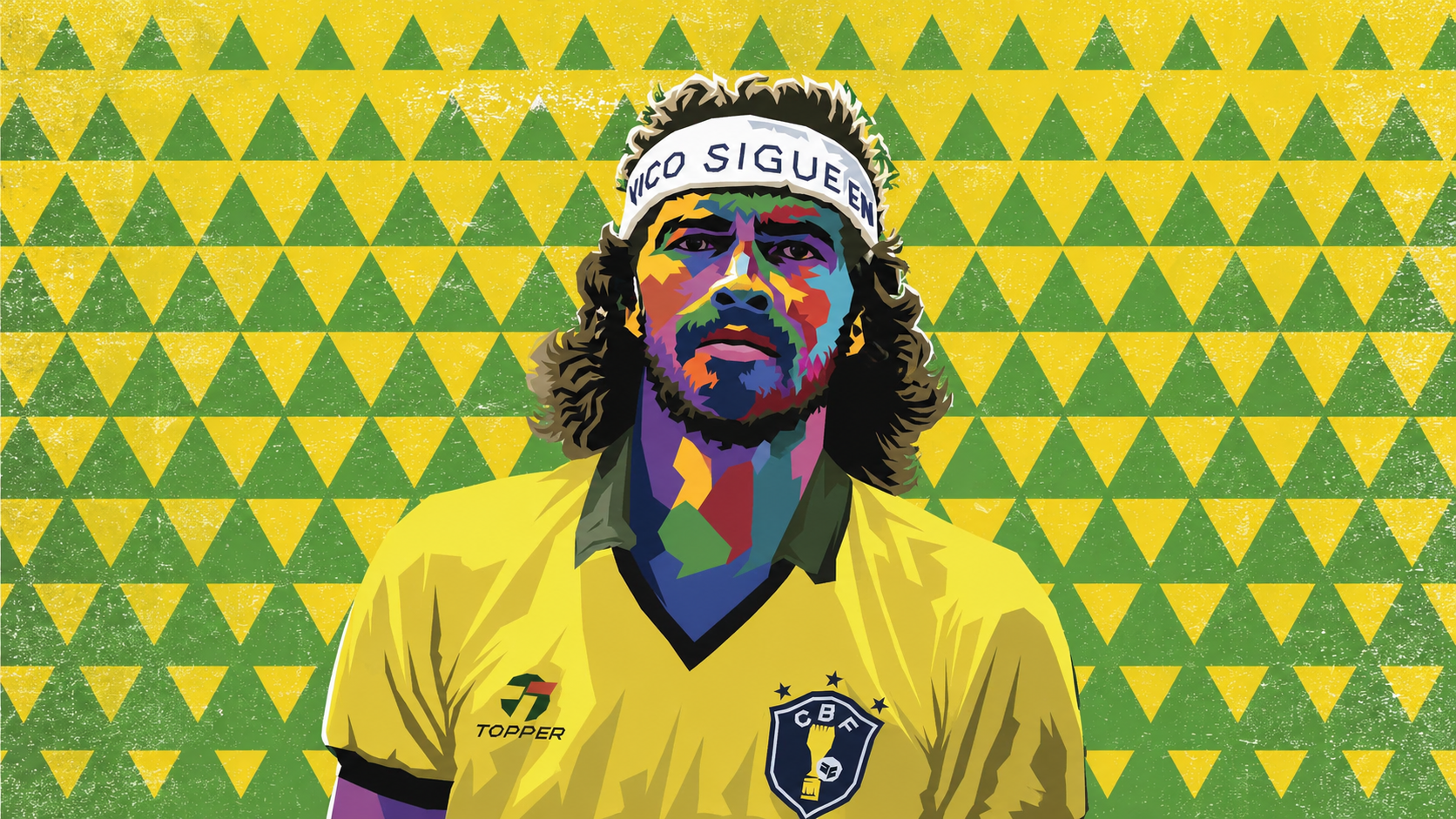
The moment that defined him
The air in Seville did not move. It hung over the Ramón Sánchez Pizjuán Stadium, thick and unmoving, as if even the evening had chosen to watch rather than breathe.
Brazil were behind.
Fifteen minutes remained against the Soviet Union in their opening match at the 1982 FIFA World Cup, and the rhythm that usually carried them forward had begun to stall. Passes were still played with care, still shaped with intent, but something had tightened. The Soviets had drawn their lines, narrowed the space, forced the game into straight edges and hard decisions.
Then the ball broke loose and found Sócrates.
He did not look like a man built for urgency. Tall, narrow, almost fragile in frame, he moved with a looseness that felt out of step with the moment. There was no burst, no rush to impose himself. He received the ball thirty yards from goal and stopped.
Not fully, not obviously. Just enough.
It was a pause that shifted everything. Defenders stepped toward him, uncertain whether to close or contain. Time stretched. The pitch opened by a fraction.
Tengiz Sulakvelidze committed first, driving forward to close the space. Sócrates did not accelerate away from him. He slid across his path instead, one small movement, almost dismissive, and the challenge was gone.
Now there was room. Not much. Enough.
He struck through the ball with his right foot, clean and rising. It travelled with a kind of inevitability, lifting beyond reach, beyond reaction, beyond the outstretched hands of Rinat Dasayev. For a second, there was silence. Then the net moved, and the stadium broke.
You can still see the strike in official FIFA footage, the goal that settled Brazil and restored their belief.
But the moment is not the strike.
It is what followed.
Sócrates did not run. He did not shout. He did not turn to the crowd or his teammates. He raised his right fist, held it there, and stood still.
In that gesture, the goal became something else entirely.
Not just an equaliser. Not just a piece of brilliance.
A statement.
It was a moment that still sits at the centre of how we remember that Brazil 1982 side, a team that shaped how football wanted to see itself, even as the game began to move in a different direction.
This is where the story is usually wrong
For decades, Sócrates has been framed as a beautiful failure. The captain of a Brazil side that dazzled, inspired, and ultimately fell short. The thinking man’s footballer who could not bend the game to his will when it mattered most.
It is a version of the story that has endured because it is easy to tell. The image of Brazil losing to Italy in Barcelona fits neatly into a wider narrative about romance giving way to realism.
But it misses the point.
Sócrates was not undone by football’s shift toward structure and control. He rejected it. There is a difference between failing to adapt and refusing to comply, and in his case, that distinction matters more than any result.
In a later reflection republished by The Guardian, he spoke about Brazil representing fantasy and joy while Italy represented caution and efficiency.
That was not an excuse. It was a worldview.
To understand Sócrates only through the lens of what he did not win is to flatten him into something manageable. A cautionary tale. A romantic relic. A great player caught on the wrong side of football’s future.
In reality, he was something far more difficult to place. A qualified doctor who resisted the discipline of elite sport. A leader who distrusted authority. A footballer who used the game not just to express himself, but to challenge the systems around him.
The tension that defined his career was never simply about style versus substance. It was about control. Who had it, who demanded it, and who refused to accept it.
That is where his story begins, and where most versions of it go wrong.
Origins that explain the man
Sócrates was shaped long before he became a footballer.
He was born in 1954 in Belém, in northern Brazil, but it was in Ribeirão Preto, in the state of São Paulo, where his character began to take form. His father, Raimundo, was not part of the football world. He was a self-taught intellectual who believed in education as a way out, and he built a home around books, debate, and ideas.
It was an environment that set Sócrates apart from many of his contemporaries. While others saw football as escape, he saw it as one part of a wider life.
Then came 1964.
Following the military coup in Brazil, the atmosphere in the country shifted quickly. Political expression became dangerous. Intellectual life became something to hide.
One moment stayed with him. He watched his father gather books from their shelves and burn them, fearing the consequences of being associated with the ideas they contained.
Years later, in a widely referenced Guardian interview, Sócrates recalled the scene with clarity. The destruction of that library was not just an act of fear. It was a lesson in how power operates, and what it demands from those who live under it.
That experience did not turn him toward football. If anything, it pushed him in another direction.
He chose medicine.
While playing for Botafogo-SP, he studied at the University of São Paulo, balancing training with lectures, exams, and hospital work. It was an unusual path then, and it remains one now. By the time he moved into the national spotlight, he was already a qualified doctor.
That mattered.
It meant he never depended entirely on football. He was not shaped by it in the same way as those who needed the game to define their future. He could step outside it, question it, resist it.
That independence would become central to everything that followed, from how he played to how he led, and ultimately to how he challenged both his club and his country.
To understand his career without that foundation is to miss the point entirely, because the player was always secondary to the man.
Becoming unavoidable
Sócrates did not arrive in Brazilian football with momentum behind him. He forced his way into it.
At Botafogo-SP, he was already an anomaly. A midfielder who moved at his own pace, who trained around a university schedule, who seemed as comfortable discussing politics as he did dictating a match. Coaches tolerated it because they had little choice. Even then, his understanding of space set him apart.
The move to Corinthians in 1978 changed the scale of everything.
This was not just a bigger club. It was a different environment. Corinthians carried weight. It was a club tied to working-class identity, pressure, and expectation. It demanded presence as much as performance.
Sócrates provided both, quickly.
By the end of his first full season, he was not just a starter but the reference point. Attacks ran through him. Tempo followed him. Teammates adjusted to his rhythm rather than the other way around.
The numbers began to reflect the influence. In the early 1980s, he consistently delivered double figures from midfield, combining late runs into the box with a finishing composure more typical of a forward. But it was not just output. It was control.
One of the defining stages of that rise came in the Campeonato Paulista, where his ability to dictate games against aggressive opponents made him impossible to ignore. He slowed matches when they threatened to accelerate, and accelerated them when space appeared. It was not reactive football. It was imposed.
That influence carried into the national side.
By the time Brazil began building toward the 1982 World Cup, Sócrates was no longer competing for a place. He was defining the structure of the team. When Telê Santana handed him the captaincy, it was not symbolic. It was practical.
Brazil had more explosive players. Zico offered incision, movement, and goals. But Sócrates offered something else. He gave the team shape without restricting it, a rare balance that allowed freedom to exist without chaos.
Zico later described him as “one of the best who ever played”, a tribute reported by Sky Sports after Sócrates’ death. It was not empty praise from a distant admirer. It came from someone who had shared the centre of Brazil’s most mythologised midfield.
By 1982, Sócrates was not simply one of Brazil’s best players.
He was the point around which everything else made sense.
How he actually played
To watch Sócrates without context was to misunderstand him.
He did not move like an elite footballer. There was no urgency in his stride, no visible effort to dominate physically. At 6ft 4in, he carried himself upright, almost detached, as if he were observing the game from within it rather than being consumed by it.
But that stillness was not passivity. It was control.
He operated in the space between midfield and attack, nominally a second striker but in reality something harder to define. He drifted, paused, repositioned. He allowed the game to come to him, then redirected it with minimal intervention.
In the Brazil side built by Telê Santana, that role became essential. With Zico driving forward, Falcão adding rhythm and authority, and Toninho Cerezo giving midfield its legs, Sócrates provided the connection point. He did not merely accelerate attacks. He shaped them.
What set him apart was his relationship with time.
Where most players reacted, he delayed. Where others sped the game up, he slowed it just enough to see the next movement before it happened. It created the impression that he had more space than anyone else on the pitch, when in reality he had simply recognised it earlier.
His use of the backheel became the clearest expression of that thinking. It was often dismissed, particularly outside Brazil, as unnecessary flair. In practice, it was a solution to a physical problem. Turning his frame cost time. The backheel allowed him to release the ball instantly, maintaining the flow of the move without resetting his body.
It was not about style. It was about efficiency.
That is why the trick never felt detached from the move. It was not exhibition football. It was decision-making at unusual angles. Sócrates could receive with his back to goal, draw pressure, and change the direction of the attack without the obvious warning signs defenders were trained to read.
He was also more direct than his reputation suggests. His late runs into the penalty area, combined with a composed, almost casual finishing style, made him a consistent goal threat. He did not chase chances. He arrived for them.
The goal against the Soviet Union showed one side of that directness. The finish against Italy showed another. In both cases, the action was sudden because everything before it had been controlled.
Within that 1982 side, often described as one of the most expressive teams in World Cup history, Sócrates was the structure that made expression possible. Without him, the movement becomes loose. With him, it holds together.
It is why comparisons often fail.
He was not a classic No.10. He was not a conventional forward. He did not fit the emerging mould of the modern attacking midfielder.
He occupied his own space entirely, one built on anticipation, restraint, and the quiet authority to dictate a game without ever appearing to force it.
That is also why his career remains such useful reading for any discussion of football’s greatest midfielders. Sócrates was not great because he could do everything. He was great because he could make the game bend to the few things he did better than almost anyone else.
The tension that defined everything
For all his control on the pitch, Sócrates existed in constant resistance to the structures around him.
By the early 1980s, football was changing. The game was becoming faster, more physically demanding, more tightly organised. Training intensified. Diets were controlled. Players were expected to submit to systems designed to maximise efficiency.
Sócrates rejected almost all of it.
“I am an anti-athlete,” he said, a line that has followed him ever since.
It was not a joke. It was a description.
He drank heavily. He smoked. He resisted the routines that defined elite preparation. Teammates trained to meet the demands of the modern game. Sócrates trained just enough to remain within it.
And yet he remained central.
This was the contradiction that unsettled coaches and fascinated teammates. He did not meet the standards expected of a player at his level, but he performed at a level that made those standards seem negotiable.
It created a quiet friction that ran through every stage of his career. Managers wanted structure. He wanted autonomy. The game demanded intensity. He preferred clarity.
That tension was not confined to football.
His refusal to accept authority extended beyond the pitch, shaped by the political environment he had grown up in and the experiences that followed. Where others adapted, he questioned. Where others complied, he pushed back.
It is tempting to frame this as freedom versus discipline, or creativity versus control.
But it was more specific than that.
It was about ownership.
Who decided how a player lived, trained, and performed. Who defined success. Who held the right to impose order.
Sócrates never accepted that those answers should come from the system itself.
And that refusal, more than any technical quality, is what shaped everything that followed.
The chapter that mattered most
If Sócrates had done nothing beyond play football at an elite level, his place in the game would still be secure. What happened at Corinthians ensured his story would extend far beyond it.
In the early 1980s, Brazil was still under the shadow of military rule. Authority was centralised. Dissent was controlled. Football clubs, like much of society, reflected that structure. Decisions were made from above. Players followed.
At Corinthians, that began to change.
Alongside teammates such as Wladimir and Walter Casagrande, and supported by the sociologist Adilson Monteiro Alves, Sócrates helped establish what became known as Democracia Corintiana. It was not a slogan. It was a functioning system.
Every significant decision within the club was put to a vote. Players, staff, and employees all had a voice. Training schedules, signings, financial bonuses, even the continuation of pre-match confinement were debated and decided collectively.
It was a direct rejection of the traditional model of control.
One of the most symbolic changes was the end of the concentração, the practice of isolating players in hotels before matches to regulate their behaviour. Under Sócrates and his teammates, that system was dismantled. Players were trusted to manage themselves.
The impact did not stop at the training ground.
Corinthians used their visibility to engage directly with the political moment. In 1982, the team took to the field wearing shirts that urged supporters to vote in local elections, part of a wider movement pushing against the restrictions of the regime. It was a small message with national reach.
By 1984, that involvement had deepened. As the Diretas Já movement gathered momentum, calling for direct presidential elections, Sócrates stepped forward as a public figure, not just a player.
Standing in front of vast crowds alongside political leaders such as Luiz Inácio Lula da Silva, he made a personal commitment. If democratic reforms were not passed, he would leave Brazil.
It was not a gesture. It was leverage.
When the amendment failed, he followed through, departing for Europe. In doing so, he tied his career directly to a political cause, using his value as a footballer as a bargaining tool in a national debate.
Within the game, Corinthians won. They lifted the Campeonato Paulista in 1982 and 1983, proving that collective control did not undermine performance.
But the results, while important, were secondary.
What mattered was the example.
For a brief period, a major football club operated as a democratic institution within an authoritarian state. Players governed themselves. Decisions were shared. Authority was questioned openly.
It did not last. Few systems like that do, especially under pressure from both football and politics.
But it did not need to last to matter.
It showed that the structures surrounding football were not fixed. That players could demand more than participation. That the game, even at its highest level, could be used to challenge the society that shaped it.
For Sócrates, this was not separate from his football.
It was the point of it.
Why Europe rejected him
When Sócrates left Brazil in 1984 to join Fiorentina, it was framed as the natural next step. Europe was the proving ground. Serie A was the most demanding league in the world. If he succeeded there, his status would be unquestioned.
Instead, the move revealed the limits of everything he stood for.
Italian football in the mid-1980s was defined by control. Tactical discipline was absolute. Physical preparation was non-negotiable. The game was structured, rehearsed, and managed in ways that left little room for improvisation.
Sócrates arrived with no intention of adapting.
He approached the experience on his own terms, as he had always done. In one early press interaction, widely reported at the time, he admitted he had come to Italy as much to study the writings of Antonio Gramsci as to play football. It was not the answer Fiorentina expected.
On the pitch, the disconnect was immediate. Managers demanded positional discipline. Sócrates drifted. The system required constant movement without the ball. He conserved energy, waiting for the moment to act rather than chasing it.
The rhythm did not match.
There were flashes. His technical ability remained clear, his awareness unchanged. But influence requires alignment, and that never came.
Within the dressing room, the contrast was just as sharp. Teammates such as Daniel Passarella represented a different model of professionalism. Relentless, demanding, uncompromising. Where Passarella imposed standards, Sócrates questioned them.
It was not simply a clash of personalities. It was a clash of beliefs.
After a single season, the experiment ended. Twenty-five appearances, a handful of goals, and a growing sense that the environment could not accommodate him.
It is often described as a failure to translate his talent to Europe.
That is too simple.
Europe did not misunderstand Sócrates. It rejected the conditions that allowed him to exist. The structure of Serie A left no space for a player who operated outside its demands, no matter how gifted he was.
And Sócrates, consistent to the end, refused to change in order to fit it.
He returned to Brazil not diminished, but unchanged.
Which, in that context, meant he could not stay.
The defining moment, properly understood
The match that defines Sócrates’ career was never about a single goal.
It was about a choice.
On 5 July 1982, at the Estadi de Sarrià in Barcelona, Brazil faced Italy in a game that would come to represent a shift in how football understood itself.
Brazil needed only a draw to progress. The logic was simple. Control the game, manage the risk, avoid the mistake.
They ignored it.
From the opening exchanges, Brazil played as they always had. Full-backs pushed forward. Midfield rotated freely. Space was left behind, not by accident, but as a consequence of the way they believed the game should be played.
Italy waited.
Paolo Rossi scored. Brazil responded. The pattern repeated, tension building with each exchange. It was not chaotic. It was exposed.
Sócrates’ goal, driven in at the near post past Dino Zoff, remains one of the defining images of that tournament. The angle was tight, the finish was direct, and the moment was controlled.
It should have been enough.
It was not.
Rossi scored again. And again. Italy won 3-2. Brazil were out.
The result has been used ever since as evidence of a wider truth. That expression without structure is fragile. That beauty without control is incomplete. That the game, at its highest level, rewards those who minimise risk rather than embrace it.
But that reading depends on the idea that Brazil were trying to win in the same way as their opponents.
They were not.
“Brazil represented fantasy and joy,” Sócrates later said. “Italy represented caution and efficiency.”
He understood the trade-off.
Brazil could have changed. They had the players to do it. They could have controlled the tempo, protected space, played for the draw that would take them through.
They chose not to.
That decision is often framed as naivety.
In reality, it was consistency.
The same principles that shaped how Sócrates played, how he trained, and how he led at Corinthians were present in that match. Freedom over restriction. Expression over control. Responsibility placed on the individual rather than imposed from above.
Italy did not expose a flaw in that philosophy. They demonstrated its cost.
And Sócrates, more than anyone, was willing to accept it.
That is why the match still matters in any serious discussion of the greatest World Cup teams never to win. Brazil did not merely lose a game. They lost an argument about what football was becoming.
Legacy without illusion
It is tempting to measure Sócrates against what he did not win.
No World Cup. No defining European success. A career that, on paper, falls short of the standards applied to the greatest players of his era.
But that framework does not fit him, and forcing it into place misses the point.
Sócrates did not change how football is played. The game did not move toward him. If anything, it moved further away, becoming more structured, more physical, more tightly controlled with each passing decade.
There is no modern equivalent of the player he was.
That absence is part of his legacy.
What he did change was the idea of what a footballer could be.
At a time when players were expected to exist within the boundaries set by clubs, managers, and federations, he stepped outside them. He was openly political in a way that few high-profile players had been before, using his platform at Corinthians to support a democratic movement that extended beyond the sport.
He did not separate his football from his beliefs. He integrated them.
That model remains rare.
Modern players operate within systems that are more controlled and more commercialised than anything Sócrates experienced. Expression is managed. Messaging is filtered. Risk is reduced wherever possible.
In that environment, his career feels distant, almost incompatible with the present.
But the questions he raised remain current.
Who controls the game. Who speaks for the players. What responsibility comes with visibility.
Those questions have not been resolved. They have simply been managed more carefully.
There is also a tendency to simplify him into a symbol, to smooth over the contradictions that made him difficult. His lifestyle, his relationships, the choices that shaped his life away from the pitch are often softened in retrospect.
They should not be.
He was not a model professional. He was not a consistent figure in his personal life. He did not fit easily into the structures around him, and that carried consequences.
Ignoring those aspects makes the story easier to tell, but less accurate.
Sócrates’ legacy is not clean.
It is complex, uneven, and at times uncomfortable.
Which is precisely why it endures.
Closing reflection
In the end, Sócrates was never trying to fit into football.
He used it.
Not as an escape, and not as a stage for personal acclaim, but as a space where ideas could be tested in public. How a team could function. How individuals could take responsibility. How authority could be challenged rather than accepted.
That is why his career resists easy judgement.
Measured by results, it feels incomplete. Measured by influence, it sits in a different category entirely.
The modern game has moved on from the conditions that allowed him to exist. Players are faster, stronger, more controlled. Systems are tighter. Margins are smaller.
There is less room now for someone who refuses to adapt.
And yet the image remains.
The goal in Seville. The raised fist. The stillness in a moment that demanded noise.
It is still referenced whenever that 1982 Brazil side is discussed, still held up as a symbol of what the game once allowed itself to be.
Sócrates did not change the direction football took.
He showed that it could have been different.
