


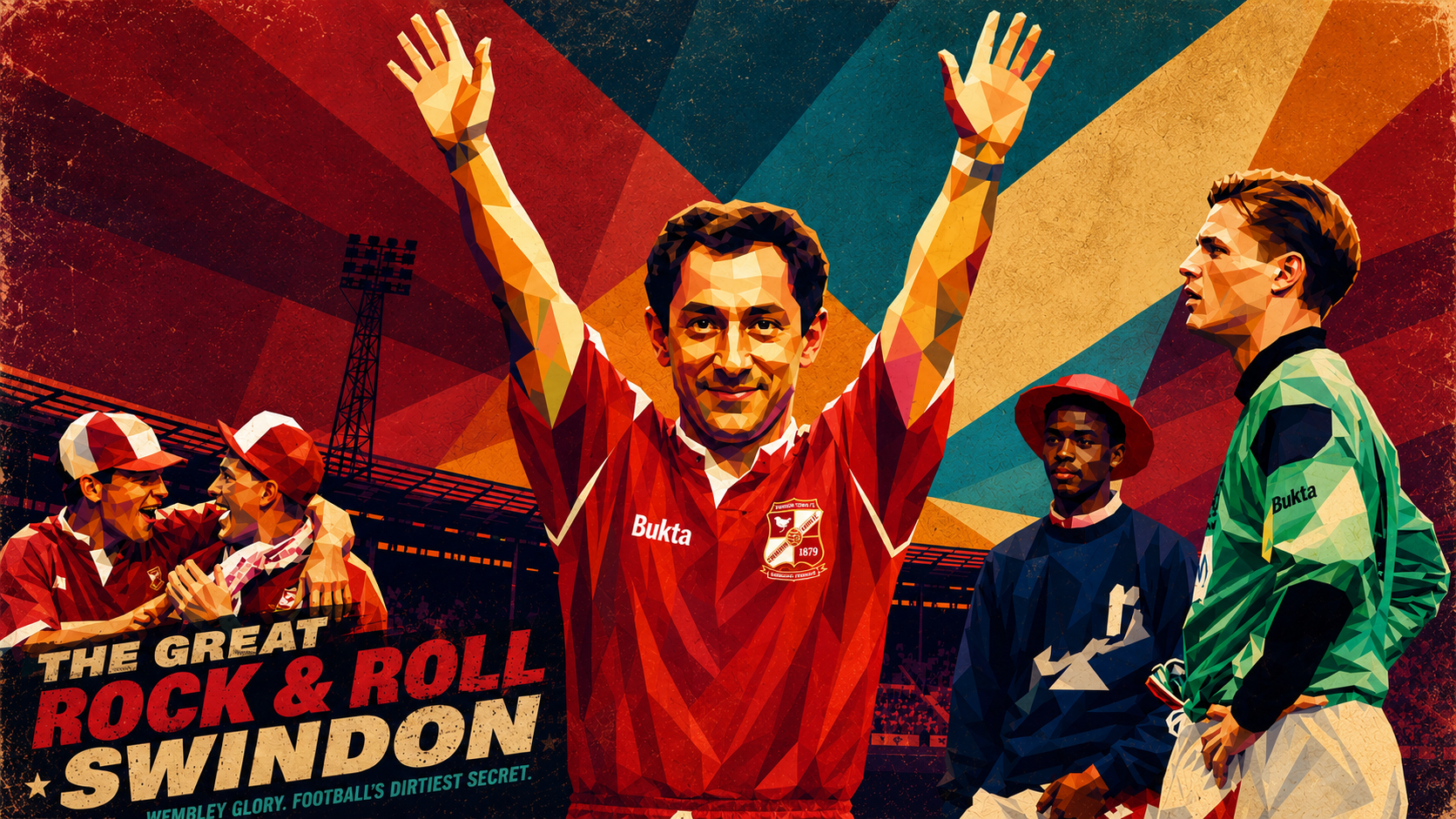
Swindon Town won promotion to the First Division at Wembley in 1990, then were denied their place and punished for illegal payments. This is the story of ambition, brilliance, fraud and one of English football’s strangest lost futures.
Key Takeaways
- Swindon Town beat Sunderland 1-0 in the 1990 Second Division play-off final to reach the top flight for the first time.
- Ten days later, the Football League punished the club over illegal payments, initially demoting them two divisions.
- The punishment was reduced on appeal, but Swindon still lost their place in the First Division.
- The scandal exposed the murky financial culture of English football before the Premier League era.
- Swindon eventually reached the Premier League in 1993 under Glenn Hoddle, but their top-flight stay lasted one season.
When Wembley Became a Hearing Room
On 7 June 1990, the men from Swindon Town walked into a hearing room knowing Wembley might already belong to somebody else.
Ten days earlier, beneath the twin towers, they had beaten Sunderland 1-0 in the Second Division play-off final. Almost 73,000 people had watched a club from Wiltshire reach the top division of English football for the first time in its history. There were red shirts on the turf, supporters leaning over barriers, and the strange stunned happiness that comes when a football club enters territory its people had spent generations imagining from a distance.
Now there were no scarves, no noise, no flood of bodies down Wembley Way.
Just documents, lawyers, administrators and the cold language of football regulation.
English football was on the edge of change. Italia 90 was days away. The game was beginning to imagine itself differently after years of violence, neglect and reputational damage. Television money was starting to gather on the horizon. New stadium thinking, corporate language and commercial ambition were about to reshape the sport.
Inside that hearing room sat something older and dirtier.
Hidden payments. False accounting. Cash diverted from gate receipts, programme sales, sponsorship and supporters’ club funds. Signing-on fees and wage top-ups kept away from the Football League and the Inland Revenue. A small club had reached the threshold of the elite, but the route there had become part of the charge sheet.
Swindon Town had won at Wembley.
The Football League believed they had cheated to get there.
Not Just a Quirky Football Story
For years, Swindon’s 1990 story has been told as a football oddity.
The club that won promotion and got relegated instead.
A pub-quiz answer from the final years before the Premier League. A strange tale of shell suits, dodgy money and grainy highlights. But that version is too small. It makes the story sound amusing when it was really about power, ambition and the way English football worked before it learned to package itself for the world.
Swindon were guilty. That cannot be softened. But they were not simply a rogue institution dropped into an otherwise clean sport. Their scandal exposed a culture in which local chairmen carried enormous power, oversight was patchy, and cash moved around football in ways that were often understood without being officially acknowledged.
What made Swindon different was visibility.
They had climbed too quickly. They had won too much. They had drawn too much attention.
By 1990, they were no longer a quiet lower-division club trying to survive. They had appointed Lou Macari, then Ossie Ardiles. They had moved from the Fourth Division to the edge of the First. They had become one of the most watchable and ambitious sides outside the top flight. Their rise made people look more closely.
And when people looked, they found the old football world underneath.
The Old Dream at the County Ground
Swindon Town joined the Football League in 1920 and spent most of the next seven decades looking upward.
The club’s great isolated moment had come in 1969, when Danny Williams’ Third Division side beat Arsenal 3-1 after extra time in the League Cup final at Wembley. Don Rogers scored twice. Arsenal were humiliated. Swindon had their day in the sun.
But it did not become a permanent transformation.
Their highest league finish came in 1969-70, when they ended the season fifth in the Second Division. The top flight remained untouched. Over time, the glow faded. By 1982, Swindon had fallen into the Fourth Division for the first time. Two years later, they finished 17th, 85th out of 92 Football League clubs.
That was the club Brian Hillier inherited as chairman in 1984.
Hillier was not an absentee owner looking for prestige. He was local, emotional and deeply attached to Swindon Town. That mattered. He saw the club not only as a business, but as a civic expression of what the town might become if somebody forced the issue hard enough.
He wanted Swindon to stop behaving like a Fourth Division club.
The first step was commercial. Insurance firm Lowndes Lambert were prepared to sponsor the club, but wanted a recognisable name in the dugout. Ken Beamish, respected though he was, did not offer that. Nor did the old lower-league rhythm around the County Ground.
Swindon needed glamour.
They found it in Manchester United and Scotland forward Lou Macari.
Lou Macari and the First Surge
Macari’s appointment was startling in context.
He had played for Celtic, Manchester United and Scotland. He had won the FA Cup in 1977 and carried the aura of bigger football into Wiltshire. One Swindon board line from the time captured the shift perfectly: “We didn’t interview him, he interviewed us.”
Macari arrived as player-manager and brought former Manchester United goalkeeper Harry Gregg with him. The culture changed quickly. Training intensified. Fitness mattered. Standards rose. The football became direct, demanding and physically hard.
It was not elegant football, but it was clear football.
After a difficult start to the 1985-86 season, Macari made a crucial decision. He stopped picking himself. Swindon immediately looked sharper. Charlie Henry was pushed from full-back into midfield and scored 18 league goals. Colin Gordon added 17. Dave Bamber and Chris Kamara gave the side experience and bite.
The results became ridiculous.
Swindon finished the season 21 games unbeaten and won the Fourth Division title with 102 points. Chester City, in second, were 18 points behind. The County Ground, with its damp concrete, old floodlights and local sponsorship boards, suddenly felt like a place something was happening again.
Macari strengthened again. Fraser Digby arrived from Manchester United. Steve White came in from Bristol Rovers. In 1986-87, Swindon finished third in the Third Division and entered the newly introduced play-offs.
Against Wigan Athletic, they came from 2-0 down in the first leg to win 3-2. Against Gillingham, they lost the first leg, trailed again in the second, then recovered and won the replay at Selhurst Park through two Steve White goals.
Back-to-back promotions.
From the Fourth Division to the Second in two seasons.
Swindon had momentum, but momentum can become dangerous. The club had started climbing and nobody seemed willing to ask how quickly was too quickly.
Ossie Ardiles and the Samba Years
Macari eventually left for West Ham United in 1989. Many clubs would have retreated into caution after losing the manager who had dragged them upward. Swindon did the opposite.
They appointed Tottenham Hotspur and Argentina World Cup winner Ossie Ardiles.
If Macari had given Swindon force, Ardiles gave them imagination.
The change was immediate. Macari’s direct football gave way to what became known locally as “samba style”, a slightly odd phrase for an Argentine manager, but one that captured the thrill supporters felt. Ardiles introduced a diamond midfield, with clearer passing angles, attacking full-backs and more faith in technical play.
This was not common in English second-tier football in 1989. Most teams still trusted directness, width and physical pressure. Ardiles asked lower-league footballers to take risks on the ball. He wanted rhythm. Rotation. Courage.
It could have failed badly.
Instead, Swindon became one of the most attractive sides outside the First Division.
They finished fourth in 1989-90, then beat Blackburn Rovers 2-1 in both legs of the play-off semi-final. The final brought Sunderland to Wembley on 28 May 1990. It was the first single-match Second Division play-off final, and it gave the occasion the scale of a national ceremony.
Sunderland carried experience. Paul Bracewell had won titles with Everton. Eric Gates had been part of Bobby Robson’s excellent Ipswich Town side. But Swindon played without inferiority.
The winning goal came through Alan McLoughlin. His shot deflected off Gary Bennett and beat the Sunderland goalkeeper. It was not beautiful, but it was enough.
The final whistle seemed to confirm the impossible.
Swindon Town were going to the First Division.
The Best Week in the Club’s History
For a few days, Swindon lived inside the future.
Supporters talked about Anfield, Old Trafford and Highbury as if the fixtures were already printed. Local papers treated the victory as civic transformation. A club that had been 85th in the Football League six years earlier had reached the top table.
The players had earned that feeling on the pitch.
That distinction matters. The Wembley win was not imaginary. Sunderland had been beaten. Ardiles’ football had survived pressure. The supporters’ joy was real and deserved.
But football joy does not exist outside institutions. And Swindon’s institution was already in deep trouble.
The hearing was scheduled for 7 June.
Football’s Dirtiest Secret
The charges against Swindon were severe.
The club faced allegations relating to illegal payments made between 1985 and 1989. The system, according to reports from the later court case, involved diverting cash from gate receipts, programme sales, sponsorship money and supporters’ club funds. Money was used for signing-on fees, wage top-ups and other payments without proper declaration.
This was not a paperwork technicality.
The Inland Revenue became involved. Arrests were made. Players would later give evidence under immunity. Brian Hillier, former accountant Vince Farrar and Lou Macari were committed for trial, though Macari was later cleared.
There were betting allegations too. Hillier had been accused of placing a bet on Swindon to win the Third Division title in 1986-87, which he described as a way of funding player bonuses. More damaging was the allegation that he had bet £6,500 on Swindon to lose an FA Cup tie against Newcastle United in January 1988. Swindon lost 5-0.
By January 1990, Hillier and Macari had already been punished by the FA over the Newcastle bet. Hillier received a suspension. Macari was fined. Swindon were fined too.
But the illegal payments case was the bigger danger.
On 7 June 1990, Swindon pleaded guilty to dozens of breaches of Football League rules. The punishment was brutal. They were denied promotion and demoted two divisions. Sunderland, who had lost at Wembley, were promoted in their place.
The decision caused anger far beyond Wiltshire.
Newcastle United had finished third in the Second Division and felt aggrieved. Sheffield Wednesday had been relegated from the First Division and could argue that they, rather than Sunderland, should stay up if Swindon were removed. Tranmere Rovers, losing finalists in the Third Division play-offs, were briefly promoted because Swindon’s double demotion created space below.
The pyramid had been knocked sideways.
Swindon appealed. The punishment was reduced from a two-division demotion to one. Tranmere’s unexpected promotion was revoked. Swindon stayed in the Second Division.
It was still devastating.
They had won promotion and lost the reward.
Being Made an Example
There is no serious defence of what Swindon did.
The court case later made that clear. In July 1992, Hillier was jailed for his role in the tax fraud. Farrar received a suspended sentence. Macari was cleared. The Independent reported Judge Ian Starforth-Hill telling Hillier he had been convicted on “the most overwhelming evidence” and that he had put into practice a scheme to pay “substantial sums of cash to players” without the knowledge of the Football League and to avoid tax.
That is damning language.
But the wider question has always lingered. Were Swindon uniquely corrupt, or simply the club that got caught most publicly at the worst possible time?
Hillier argued that similar practices existed elsewhere. The judge was unmoved. Somebody, he suggested, had to be punished. That response matters because it hints at the story’s deeper meaning.
English football was changing. It needed visible accountability. It needed to look cleaner, more professional, more commercially serious. Swindon had arrived at the top-flight doorway carrying the smell of the old game on their clothes.
Cash economies. Chairman power. Informal deals. A club run through personality rather than governance.
They were guilty, but they were also useful.
They became the warning.
Ossie Leaves, Hoddle Arrives
The punishment damaged Swindon badly.
Ardiles was told players had to be sold to balance the books. The momentum disappeared. By early 1991, the club were fighting relegation. Ardiles left for Newcastle United in February.
Then Swindon made another extraordinary appointment.
Glenn Hoddle became player-manager.
It is easy now to forget how strange that was. One of England’s most gifted footballers, a player of rare technical imagination, chose a scandal-hit second-tier club as his first managerial job. Swindon had already been Macari’s launchpad and Ardiles’ laboratory. Now they became Hoddle’s too.
That sequence gives the story another layer.
Macari represented industrial ambition: hard running, direct football, elite dressing-room standards.
Ardiles represented imported tactical modernity: the diamond, possession, attacking full-backs, creative midfield structure.
Hoddle represented something closer to the coming Premier League age: technical control, sweeper systems, tactical experimentation and the belief that English players could be trusted with more sophisticated ideas.
Swindon were not merely climbing divisions. They were absorbing three different football futures in less than a decade.
Hoddle kept them up in 1990-91 by goal difference. In 1991-92, they finished eighth. Then, in 1992-93, they reached the play-offs again.
The semi-final brought Tranmere Rovers, the club briefly promoted because of Swindon’s 1990 punishment. Swindon beat them. The final brought Leicester City, the club Swindon had edged out in the 1991 relegation fight.
Football rarely writes neat circles, but this one was hard to miss.
Redemption at Wembley
The 1993 play-off final against Leicester was chaos of a different kind.
Swindon led 3-0. Hoddle scored before half-time. Craig Maskell and Shaun Taylor added two more early in the second half. It should have been finished.
Then Leicester came back.
Julian Joachim scored. Steve Walsh made it 3-2. Steve Thompson equalised. Swindon, who had spent three years carrying the emotional damage of one lost promotion, suddenly looked ready to lose another.
With six minutes left, David Elleray awarded a penalty.
Paul Bodin scored.
Swindon won 4-3 and reached the top flight properly, this time with no hearing waiting in the background. The club that had been denied in 1990 had finally arrived.
Then Hoddle left for Chelsea within days.
Even Swindon’s redemption could not stay still.
The Premier League and the Cruelty of Timing
Swindon’s Premier League season in 1993-94 was brief, open and often painful.
John Gorman took charge after Hoddle’s departure. The club tried to play football, but the division punished them. They won only five matches, finished bottom and conceded 100 goals, a Premier League record.
In one sense, they had arrived too late.
The First Division Swindon were denied in 1990 was not yet the fully commercialised Premier League machine. By the time they reached the top in 1993, the game had moved. Money mattered more. Squad depth mattered more. Infrastructure mattered more.
Swindon had spent years chasing the future, only to find that the future had become more expensive while they were still trying to reach it.
What Swindon Changed
Swindon did not change English football in the clean way great teams or visionary managers sometimes do.
They changed it by exposure.
Their scandal forced the game to confront practices many suspected existed below the surface. It showed what could happen when local ambition, weak governance and financial desperation collided. It made the Football League act visibly at a moment when English football wanted to become more respectable.
But their footballing legacy is real too.
Macari made Swindon believe differently about themselves. Ardiles gave the club a style that supporters still remember with affection. Hoddle turned the remains of a damaged institution into a Premier League club.
For a short period, Swindon Town were one of the most interesting football clubs in England.
Not the biggest.
Not the cleanest.
Not the most successful.
But alive in a way modern football rarely allows. Volatile, ambitious, imaginative and reckless. A club of first-time managers, bold football and dangerous momentum.
The Defining Moment Revisited
So what is the true defining moment?
Not Alan McLoughlin’s deflected shot, although that remains the image supporters treasure.
Not the Football League hearing, although that decided the club’s immediate fate.
Not Bodin’s penalty in 1993, although that finally delivered what 1990 had promised.
The defining moment is the gap between them.
The space between the dream and the punishment. Between what supporters saw happen and what administrators later allowed to stand. Between old football and new football. Between ambition and legitimacy.
That is where Swindon’s story lives.
Closing Reflection
Years later, the Wembley footage still feels slightly unreal.
The red shirts. The old towers. Ardiles smiling into the noise. Supporters believing, for one glorious afternoon, that football had changed their lives.
And in a way, it had.
The Football League could take away the place in the First Division. It could rewrite the consequence. It could punish the club, demote the club and warn the rest of the game.
But it could not make the moment disappear.
Swindon Town were guilty, brilliant, reckless and unlucky all at once. They were a football club trying to outrun their own structure at the exact moment English football decided structure suddenly mattered.
They were one of the last great old football stories inside a game that was about to stop creating them.
