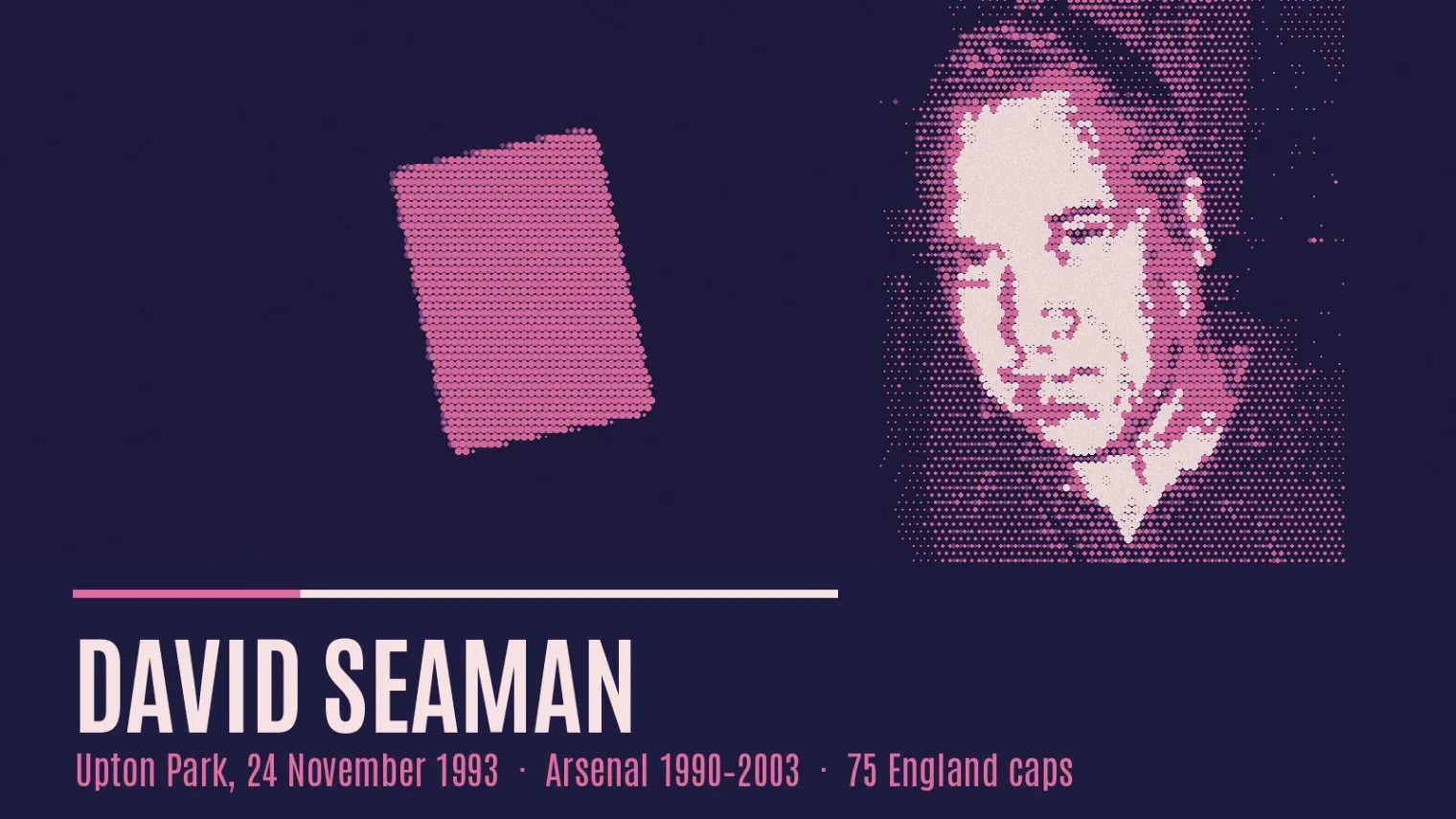
There is a particular kind of foul that only a goalkeeper can commit. An outfield player who brings down a forward on the halfway line is being cynical. A goalkeeper who does it out on the edge of his territory, with nobody behind him but the net, is making a public confession: I have been beaten, I know I have been beaten, and I would rather go for an early bath than see it finished.
David Seaman made that confession at Upton Park on the evening of Wednesday 24 November 1993, 33 years ago today. The score was 0-0. The Independent’s Clive White put it in the 83rd minute; the 11v11 match record logs it in the 84th. Either way there were only a handful of minutes left when Mike Marsh, who had been running the game from West Ham’s midfield, hit an early ball over the top of the Arsenal back four. Trevor Morley went through, and Seaman came out to meet him. White’s report says he “hauled down Trevor Morley as he broke through the last line of defence”, and that the England goalkeeper “was sent off for his flagrant cynicism”.
The clip doing the rounds again this morning calls it “the most blatant foul imaginable”, and it is hard to argue. It also remembers it as the one and only red card of Seaman’s career, which is why it keeps coming back every 24 November. Seaman played for twenty years, almost all of them as the most reliable man on the pitch, and the only lasting image of him losing his head is this: a big Yorkshireman taking out a centre-forward on a midweek night in east London, at nil-nil, because nil-nil was worth protecting.
That is the joke, and it is also the point. If you want to understand what made Seaman so valuable to George Graham, it is all in that foul.
Upton Park, nil-nil
Arsenal in November 1993 were the side that had won both domestic cups at Wembley six months earlier, and FBH has told that story before. They were not, however, a side that scored freely, and they arrived at Upton Park without much in midfield. Steve Morrow, the man Tony Adams had famously dropped in the League Cup final celebrations, was making his first start since that injury, alongside Martin Keown in the middle. Per the Independent, the pair were “no match for the invention of Marsh, Ian Bishop and Peter Butler”.
West Ham were Billy Bonds’s side, beaten only once in seven, with Lee Chapman, David Burrows and Marsh all recently signed. They were the better team. Morley had the chances to win it. After 35 minutes Marsh sent him “scampering past the frozen defenders”, in White’s phrase, only for him to pull the shot wide. Burrows stung Seaman’s palms with a free-kick. Another Bishop pass gave Morley the chance to lay one on a plate for a team-mate, and he played it behind the advancing line of claret and blue instead.
So by the time the decisive ball came over, the night had been building to it. White, to be fair to Seaman, thought Morley “looked more than a shade offside” when the pass was played, and suggested that “in this profligate mood he would probably have missed the open goal” anyway. That is a lovely piece of sports-desk sarcasm and probably a little harsh on Morley. Seaman was not inclined to find out.
The referee was Paul Durkin, from Portland in Dorset, and he did not have a difficult decision to make. With no substitute keeper on the pitch, Graham took Ian Wright off and sent on Alan Miller, his reserve goalkeeper, to face the free-kick. Burrows took it. Nigel Winterburn hacked it off the line. The match ended 0-0 in front of 20,279.
“Cheats sometimes prosper,” White wrote. George Graham, who rarely saw any upside in conceding, said afterwards that he had no complaints about the decision, and White judged that a one-match ban was “a very reasonable exchange for one extra point”. He was in no doubt about the side he had watched. “Arsenal are nothing if not the most obstinate team in the country,” the report began. It was one defeat in 15 for them, with one away defeat in 12 all season: “championship form in most other seasons but this one.”
Whatever the suspension, it did not take effect straight away. Three days later he was in goal at Highbury as Arsenal beat Newcastle 2-1, Wright and Alan Smith scoring before Peter Beardsley pulled one back (11v11). He played in the League Cup defeat by Aston Villa three days after that, and at Coventry the following Saturday.
The obstinate team
“Championship form in most other seasons but this one” turned out to be about right. Arsenal finished the 1993-94 Premier League fourth, on 71 points from 42 games, 21 behind Manchester United. They also conceded 28 goals, the fewest in the division by a distance; Blackburn, second, let in 36 (11v11 final table). Arsenal drew 17 league games that season. You can see the shape of the team in those numbers. The defence was champion class. The attack was mostly Ian Wright.
That is the context for the foul at Upton Park. Graham’s Arsenal were built on the idea that a point was a point and a clean sheet was the foundation of everything, and Seaman was the last line of that idea. He was not a showman. When the Independent assessed his career on the day he retired, Jason Burt wrote that he had “never been a showy goalkeeper, or one for the spectacular but technically he is well-regarded, covering his angles well – and he has a presence.” Steve Bould, interviewed in 1995 and quoted by Arsenal News Review, said much the same thing: “Dave doesn’t really catch the eye because he doesn’t usually make spectacular saves. He’s always in a position to make the save look straightforward. He just calms everybody down, that’s the main thing I like about him. You know that he will never panic.”
Which makes Upton Park even funnier. The calmest man in English football did panic, once, and he panicked in the most Arsenal way imaginable: to keep a clean sheet.
Leeds, Peterborough and Ron Saunders
None of it was preordained. Seaman was a Rotherham boy and a Leeds fan who got his apprenticeship at Elland Road and was then let go by one of his heroes. He told the Peterborough club press officer, Phil Adlam, in an interview published by the Peterborough Telegraph, that Eddie Gray “just told me straight he wanted a more experienced back-up goalkeeper and that he was letting me go. I was devastated to be told that by one of my heroes. I went home and cried my eyes out not knowing what I was going to do.”
A week later Martin Wilkinson, Allan Clarke’s old assistant at Leeds and by then manager of Peterborough, rang. “The first thing I did was turn to my dad and ask ‘where’s Peterborough?’ I had no clue.” Posh were in the Fourth Division and paid £4,000 for him, according to Seaman’s own site and the Independent’s career timeline. He had no goalkeeping coach, a rented house on a new estate for £25 a week, and a body that was not yet built for lower-league centre-forwards. “I was wafer thin and every time I came out for a cross I got hit. Once at Bury I got knocked spark out. Bill Harvey threw some water on my face to wake me up and told me to get up as we had to defend a corner!”
He was player of the year in his second season, and in 1984 Birmingham City bought him for £100,000. Their manager was Ron Saunders, and Seaman has always credited him. Asked by FourFourTwo why Saunders was the only manager he had worked with who properly understood goalkeeping, he said: “somehow – I don’t know why – Ron Saunders just knew about goalkeeping and positioning. I was totally blown away by how much he knew and how much he taught me. I use the drills he taught me to this day and even now they still work.” Birmingham went up from the Second Division in his first season.
In 1986 QPR paid £225,000 for him, and at Loftus Road two things happened that shaped the rest of his career. He won his first England cap, against Saudi Arabia in 1988, and he started working with Bob Wilson, the goalkeeping coach who would work with him for 15 years and be best man at his wedding. Seaman also spent four seasons playing home games on the Loftus Road plastic, which is the sort of apprenticeship that either breaks a goalkeeper’s knees or makes him very good at reading a bounce.
The record fee and the back four
The move to Arsenal is a story in itself. Graham went for Seaman in the spring of 1990, near the transfer deadline, but the deal depended on John Lukic moving the other way, to QPR or Birmingham, and Lukic did not want to go. “I was there with all my cards on the table, saying I want to sign for Arsenal, then I had to go back to QPR,” Seaman told FourFourTwo. “You get fans calling you Judas and all that.” He also had an alternative. In a 2026 interview with arsenal.com he said Alex Ferguson had told him Manchester United were coming in for him, and that he asked Ray Wilkins for advice: “If you go to United, you won’t win trophies straight away because they’re rebuilding. But if you go to Arsenal, you’ll win trophies straight away.”
The Highbury crowd were not convinced either. Arsenal’s own profile remembers the chant “We all agree… Lukic is better than Seaman!”, and Graham’s reply: “I still think John Lukic is one of the top three keepers in the country. I just think David Seaman is the best.” The deal was completed that summer for £1.3 million, then a British record for a goalkeeper.
Then came 1990-91, which is one of the great debut seasons by any English footballer. Seaman played every league game. Arsenal won the title, lost one league match all season and conceded 18 goals. “To concede only 18 goals that season, losing only one game in the league – it was everything I could have dreamt of,” he told arsenal.com.
The back four in front of him were Lee Dixon, Nigel Winterburn, Steve Bould and Tony Adams, and there is a long-running debate about whether the goalkeeper made the defence or the defence made the goalkeeper. Seaman’s own answer to FourFourTwo was characteristically dry: “they only played well because I organised them well! As a back five, including me, we knew each other very well, and we knew where somebody was gonna be at a certain time. That’s why it was so good. There was a great understanding.” The fair answer is that it was genuinely a unit of five. The offside line that the back four pushed up so aggressively only worked because there was a goalkeeper behind it who would come and sweep. That is exactly what Seaman was doing at Upton Park when Morley got the wrong side of him, and what he would be doing in Paris eighteen months later.
There was one complication. In 1992 the back-pass rule arrived, and a goalkeeper who had spent a decade picking up anything his defenders rolled back to him had to unlearn it mid-career. “The backpass rule was really tough to get used to though,” Seaman told arsenal.com. “I had to adjust my whole game for the backpass rule… I gave away so many free kicks when that came in, because I was just doing what naturally comes to you, it was instinct.” Seaman was one of the first generation of keepers who had to work it out in public, on a Saturday, with the crowd watching.
Copenhagen, with a rib injury
Five months after Upton Park, the obstinate team got its reward. On 4 May 1994 Arsenal played Parma in the Cup Winners’ Cup final at the Parken Stadium in Copenhagen. They were without Ian Wright, suspended after a booking in the semi-final against Paris Saint-Germain, and John Jensen, who was injured. Martin Keown failed a fitness test on the morning of the game. According to arsenal.com’s account of the final, Seaman “was just about fit to play after pain-killing injections to numb his rib injury”. Parma had Tomas Brolin, Faustino Asprilla and Gianfranco Zola, and early on Brolin hit the post and Asprilla forced what the club calls “a world-class save”.
Alan Smith scored after 20 minutes, and then Arsenal defended for 70. In the Guardian’s later account, Jacob Steinberg describes how Graham “packed the midfield, played Alan Smith as a lone forward and trusted in that famous back five – Seaman, Dixon, Adams, Bould and Winterburn, the names roll off the tongue – to smother the Parma attack.” It was the club’s first European trophy since the Fairs Cup in 1970. Graham later named it one of his two most satisfying games as Arsenal manager, alongside Anfield in 1989.
If Upton Park was the obstinate team at its most cynical, Copenhagen was the same team at its best. It is the same philosophy, the one that ends up as “one-nil to the Arsenal”, and Seaman is the man holding it together on both nights.
Paris, and the man from Zaragoza
The following season was a mess. Graham was sacked on 21 February 1995, after a Premier League inquiry found that he had received payments from the transfers of John Jensen and Pal Lydersen. FBH has covered the bung affair in full. Arsenal finished 12th in the league, but under Stewart Houston they went all the way back to the Cup Winners’ Cup final, mostly thanks to Seaman.
In the semi-final second leg in Genoa, Sampdoria led 3-1 on the night until Stefan Schwarz’s late free-kick forced extra time. In the shoot-out Seaman saved from Sinisa Mihajlovic, Vladimir Jugovic and Attilio Lombardo. It is one of the great individual performances by an English keeper in Europe, and almost nobody remembers it, because of what happened next.
The final was against Real Zaragoza at the Parc des Princes on 10 May 1995. Juan Esnáider scored, John Hartson equalised, and the match went to extra time. Then, in the last minute of extra time, Nayim, the former Tottenham midfielder, looked up from out near the right touchline. “I had played against Arsenal for five years with Tottenham and remembered they always played with a high defensive line, with the goalkeeper acting like a sweeper,” he told the Guardian. “I saw Seaman coming out so I just kicked it.”
The Spurs fans’ song says it was from the halfway line. The Guardian, more precisely, makes it 45 yards. Seaman scrambled back and could only claw at it as it dropped over him. “I was in the right position to sweep up,” he said afterwards. “It was the worst moment of my career. As soon as he hit it I knew I was in trouble. You don’t expect someone to shoot from there but he meant it.” FBH’s Gus Poyet piece tells that night from the Zaragoza bench.
The irony is hard to miss. The habit that drew Seaman out of his goal against Morley, the sweeper-keeper positioning that made Graham’s high line work, is the same habit Nayim had been watching for five years. The defensive system that won Arsenal a European trophy in 1994 lost them one in 1995, from the same starting position.
Euro 96, and the man the country decided to like
What happened next has its own FBH piece, Euro 96 and the Safe Hands of David Seaman, so we will not do the McAllister penalty or the Spain shoot-out again here. The short version is that the summer of 1996 changed how Seaman was seen. Before it, he was a very good club goalkeeper whom most of the country associated with Arsenal, and therefore did not much care for. After it, he was a national figure. He told FourFourTwo that he thought he was “probably at my peak during Euro 96”.
It also made the mistakes bigger. A goalkeeper whom the whole country trusts is remembered for the moments that trust failed, and Burt’s 2004 assessment lists them almost like a charge sheet: Gascoigne’s free-kick in the 1991 FA Cup semi-final, Nayim, Ronald Koeman’s free-kick that helped keep England out of the 1994 World Cup, Dietmar Hamann at the last game at the old Wembley. “Goalkeepers are, unfortunately, remembered for their mistakes,” he wrote. Seaman himself said of Gazza’s free-kick that “he hasn’t stopped since… but I say that’s the only one he’s scored against me.”
Wenger’s goalkeeper
Arsène Wenger arrived in 1996 and did not touch the defence. “The fact that he didn’t make many signings there meant we knew he wasn’t going to change it, and it worked,” Seaman told arsenal.com. “That back four we had, it wasn’t by fluke that it was successful.” Arsenal won the double in 1998. The following season they conceded 17 league goals and still finished a point behind Manchester United, a personal best that, per Seaman’s site, beat the 18 of his first season. There was another European final, against Galatasaray in the UEFA Cup in 2000, lost on penalties, and another double in 2002.
He outlasted rivals as well as eras. When Arsenal paid big money for Richard Wright, Seaman read it as a threat and raised his game. He tells the story of Wenger watching a training session and asking him: “David, why does the goal look so small when you are in it and so big when Richard is in it?”
Shizuoka and St Mary’s
On 21 June 2002, in a World Cup quarter-final in Shizuoka, England led Brazil through Michael Owen and were pegged back by Rivaldo just before half-time. Five minutes after the break, Brazil won a free-kick, which the BBC’s report placed 42 yards from goal. “Everyone expected Ronaldinho to chip the ball into the middle – but instead his curling cross-shot fooled Seaman and somehow found the top corner of the net.” Ronaldinho was sent off eight minutes later. England, with an extra man for more than half an hour, did not create much.
Afterwards Seaman, who had not given newspaper interviews during the tournament, met the media in tears. “I just want to say sorry to all the fans. I feel as if I have let people down,” he said, according to the BBC. “I thought he mis-kicked the free-kick and I misjudged it.” David Beckham said anyone who made a scapegoat of him would be “an absolute disgrace”. The Independent later reported that he received 5,000 letters of sympathy. Eight months on, Juninho told the Independent that Ronaldinho had admitted it was a mishit: “He mishit it. In the end it was lucky,” as the BBC reported. Seaman’s own view, when a reader asked FourFourTwo which of Nayim, Ronaldinho and Sakiri was the worst, was that the first two “were just flukes, one-offs. Sometimes you look up to the sky and think: ‘Why me?'”
Sakiri was the one he blamed himself for. On 16 October 2002, at St Mary’s, Artim Sakiri scored direct from an inswinging corner as Macedonia drew 2-2 in a Euro 2004 qualifier, and the BBC wrote that his international career hung by a thread. It was his 75th and final cap. “It was a hell of a ball in, but it was still a corner,” he said.
It is worth noting what does not appear on the charge sheet. In 75 caps Seaman was never sent off for England. That record lasted until Robert Green, described by the Evening Standard as “the first England goalkeeper to be sent off”, was dismissed for a foul on Artem Milevskiy in Ukraine in 2009.
Six minutes left at Old Trafford
The best ending to the Upton Park story came nearly ten years later. On 13 April 2003 Arsenal led Sheffield United 1-0 in the FA Cup semi-final at Old Trafford. Seaman was 39 and had been criticised all season, much of it for his age. With six minutes left, the BBC report says, the substitute Paul Peschisolido “looked certain to score when he diverted Carl Asaba’s shot towards goal, but Seaman defied the years and Sheffield United with a one-handed save.”
So: the 84th minute again, a 1-0 lead to protect, and Seaman stranded. This time he did not have to commit a foul. He threw himself backwards across his line and clawed the ball out. It was the 1,000th senior game of his career. Peter Schmeichel told Match of the Day: “I think it’s the best save I’ve ever seen… He must have shovels on his hands,” the BBC reported. Seaman was more matter-of-fact: “To be truthful I thought it was in. I just flung my hand out and managed to get something on and behind it to stop it travelling any further over the line. I was pleased with that one. Not bad for 39 is it?”
A month later, on 17 May 2003, he captained Arsenal to a 1-0 win over Southampton in the FA Cup final at the Millennium Stadium in Cardiff, standing in for the injured Patrick Vieira. It was his last game for the club. The Independent noted that at 39 years and 238 days he was the third-oldest player to appear in an FA Cup final.
A year too far, and what came after
Wenger offered him a coaching role. “He said he wanted me to be goalkeeping coach and No.2 goalkeeper at best. He said I definitely wouldn’t be No.1, so the decision to leave was made for me, really,” Seaman told FourFourTwo. He signed a one-year deal at Manchester City under Kevin Keegan instead. It did not go well. Burt’s Independent piece, written the day after he announced his retirement on 13 January 2004, described the shoulder injury he suffered in a collision with Yakubu at Fratton Park and summed up the City spell as “a year too far”. His last act at City, according to his own site, was to help Keegan pick David James as his successor.
He went into television, quiz panels included, before coming back to football. Arsenal say he is still a regular at the club’s training centre, where he often coaches academy goalkeepers. In the club’s reckoning he is sixth on Arsenal’s all-time appearance list and has kept more clean sheets, 234, than any other goalkeeper in the club’s history (arsenal.com).
Thou shalt not pass
It would be easy to make the red card the punchline, the one night Safe Hands lost his cool. It works better as a summary. Seaman spent 13 years at Arsenal standing behind a defensive line that pushed up, and his job was to own the space behind it. Most nights that meant nobody noticed him. On the nights it went wrong, it went wrong in public: Nayim from 45 yards, Ronaldinho from 42, and Morley at Upton Park with nobody between him and the net but a goalkeeper who had already decided he was not getting past.
George Graham had no complaints. Nigel Winterburn cleared the free-kick off the line. Arsenal got the point. And for 33 years, every 24 November, somebody posts the clip.