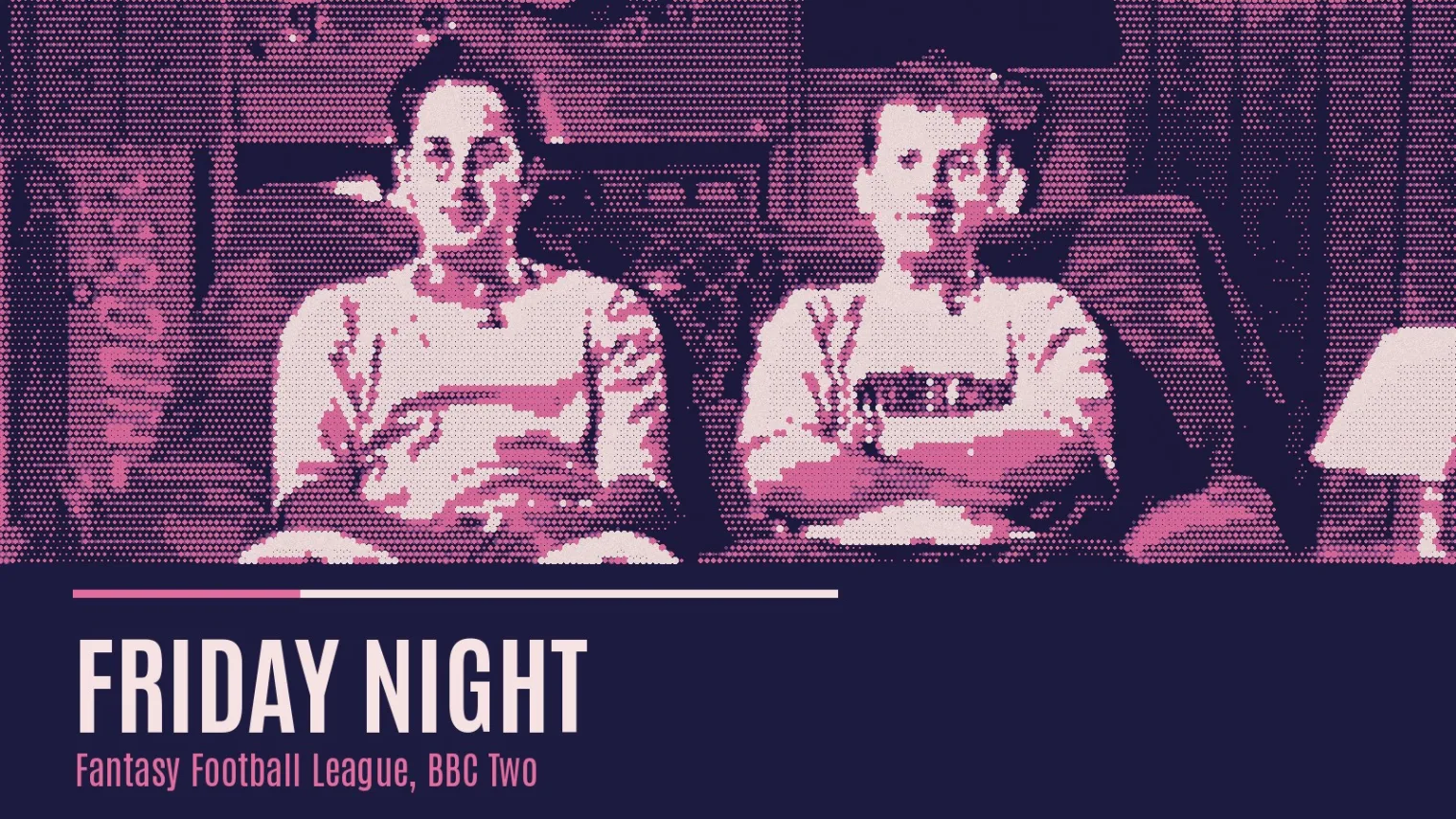
It started late, and it started quietly. On Friday 14 January 1994, at 11.15pm, Fantasy Football League arrived on BBC Two, a new comedy with David Baddiel and Frank Skinner on a sofa, and with almost no fanfare to speak of. The British Comedy Guide’s schedule for that night still has the official voice for it: a programme that had already worked on Radio 5, now on television, with celebrities from politics, sport and showbusiness taking on the role of football managers. The first guests were Peter Cook and Mandy Smith. The hosts sat in something that was supposed to look like a flat.
That last detail mattered more than the league. “Today it’s not unusual to have a set like someone’s front room, but it was revolutionary then,” the producer Andy Jacobs later told FourFourTwo. Baddiel’s explanation was simpler. “We said, ‘Let’s build a set that’s like our house.'” It was, in a slightly tidied way, their house. Skinner had been thrown out of his London flat, could not go back to Birmingham, and had ended up in Baddiel’s spare room. He stayed for years. “Over the course of the entire time I lived with him, I never put Frank’s rent up,” Baddiel said. “He became a TV star, started doing huge tours, earned loads of money, and it was always £40 a week.”
They had met properly, as the same interview tells it, in a dressing room at Jongleurs in Battersea, arguing about the Ireland team during a group game that has since been called one of the dreariest of its summer. Baddiel thought they were dull. Skinner thought they shouldn’t be trying to play like Brazil. Each man went away with the useful discovery that the other one knew what he was talking about. Skinner, Baddiel recalled, also thought he had just met “a posh bloke who knows about football.” “I’m not posh,” Baddiel said, “so that shows how working-class Frank is.”
By the time the cameras arrived, the friendship had already become a double act in a shared flat, and the flat had become the joke’s architecture. Giles Smith, reviewing a Friday night edition for the Independent in March 1995, caught the trick exactly, and then refused to over-explain it. Television theorists, he wrote, would want to call the show “an after-the-pubs-shut, Friday entertainment which simply holds a mirror up to its audience.” You sit on the sofa at home with a beer, “and the camera cuts to David Baddiel doing exactly the same.” Then Smith pulled the rug: “To speak personally, it’s not often in my house that the doorbell goes and Jimmy Tarbuck comes in.”
That is the show, if you had to point at it. A sofa that looked like yours. A Friday that started after the pubs had done their work. And then, because it was television, and because it was this television, Tarby, or Nick Hornby, or whoever had been booked that week, walking into the room as if this were a normal way to spend an evening.
The league that was never really the point
The original excuse for all this was the game in the title. Andrew Weinstein, who had seen fantasy sports take off in America, had launched the idea in England in 1991. Baddiel and Skinner had already appeared on a short-lived BBC Radio 5 programme, picking teams. Then Weinstein rang Baddiel and asked whether there was a television show in it. “I said, ‘I’m not sure… it’d have to be more than that,'” Baddiel told FourFourTwo. “I talked to Frank. We said, ‘Maybe the game could be the basis of a comedy show about football.’ We did a pilot and Michael Jackson — the head of BBC Two, not the pop star — really went for it. He didn’t give us six shows; he gave us 22.”
The first series put celebrity managers into a league. Jacobs remembered Bob Mortimer, Karren Brady, Eddie Large and Roy Hattersley among them, and an auction to pick the teams that “was some sort of cocktail party.” Baddiel, still pleased about it years later, won the league one season. He also knew what the league was actually for. “The league was just a structure for the show, on which to hang jokes about football.” Later, FourFourTwo notes, the fantasy competition was phased out entirely. People had stopped pretending they were tuning in for the table.
The Comedy Guide, recording the life of the programme, still files the official shape: BBC Two, then ITV specials, first broadcast at 11.15pm on that Friday in January 1994, a run it counts as 83 episodes across five series, plus a highlights special, produced by Avalon. It also records the number that, if true, explains why a late show on the minority channel became a national habit: ratings that “reached 6 million — a record for comedy on BBC Two.” Whether or not every accountant would still sign that sentence off, the direction of travel is not in dispute. A cult slot became a crowded one.
Baddiel had come from The Mary Whitehouse Experience and from the Newman and Baddiel tours that sold out Wembley Arena and briefly convinced people that comedy might be the new rock and roll. The BBC, looking back at the pair at the end of the decade, noted that the partnership with Rob Newman had already split after that Arena show in 1993, and that Skinner’s own early television, Packet of Three and Blue Heaven, had not worked. Fantasy Football did. The BBC’s 1999 piece, which slightly misdates the launch to 1995, is still useful for the atmosphere around it: a hit that “capitalis[ed] on the duo’s mainstream comedy appeal and the popularity of irreverent football fanzines,” and that got lumped, not always fairly, with the rise of Loaded and the new lad.
Smith, in 1995, was already pushing back on that last bit. Cultural commentators, he wrote, had “sometimes lumped Fantasy Football League in with other manifestations of the contemporary form of young, male behaviour known as ‘new lad-ism.'” This, he thought, “misrepresent[ed] and diminish[ed] the programme,” not least because one of the heroes at its heart spent the entire show in a dressing gown and pyjamas. “Statto is about as laddish as the late Arthur Marshall,” he wrote, “and the way in which the programme harbours a warm place for him is indicative of a broad, imaginative scope.”
The third man in the dressing gown
Statto was Angus Loughran, and the dressing gown was the job. Steve Boggan’s Independent profile, published in June 1996, puts him “sitting behind the breakfast bar in the lads’ fantasy flat, wearing his dressing gown and pyjamas,” summoned to recall, as the brief had it, how many goals Frank McLintock scored in 1971, or how many beers George Best had during lunch on 7 September 1969. The audience chanted “STAT-TOHH, STAT-TOHH.” He usually got it right.
He was not, in the beginning, the obvious third man. Weinstein had played Statto in the pilot. The BBC, Jacobs told FourFourTwo, “felt he wasn’t quite right — they wanted a boffin.” Jacobs found the boffin on a gantry. “I was on the gantry for Spurs against Leeds and my eye was taken by this very strange guy, making funny head movements. We chatted and I thought, ‘He’d be good for the role.'” The Independent version of the same discovery is set at White Hart Lane, Jacobs looking for “an anorak type as the third, nerdy, member of the Fantasy Football League household.” Janet Street-Porter, then the BBC’s head of independent commissioning and a supporter of the show, was not immediately convinced. “Janet said, ‘Statto’s terrible; he needs f**king acting lessons!'” Jacobs remembered. “I said, ‘No, that’s the point: he’s meant to be terrible!'”
Loughran took the part only after checking it would not wreck the day job. He was commentating for Eurosport, and he went to Simon Reed to ask whether he should turn it down. Reed told him to take it, and that he could still do Eurogoals. The two lives then ran in parallel, sometimes on the same date. “Sometimes, I did two jobs on the same day: Royal Ascot for the BBC during the day, in top hat and tails, then I was in pyjamas and dressing gown for Fantasy Football at night. Trying to do those two on the same day, your head was screwed up a bit.”
The pyjamas were a costume. The knowledge was not. Boggan’s profile is full of the other Loughran: the son of James Loughran, a conductor of the Hallé Orchestra, still living with his mother in Altrincham when he was not on a plane; a schoolboy at Ampleforth who ran books on how many monks would turn up for morning mass; the 15-year-old who once marched onto the outfield at the Oval and handed Chris Tavaré a stool during a long innings, having first had “a quiet word on the boundary with” Kapil Dev to make sure he would not be stopped, and having offered his friends 10-1 that he would do it. He made £300, found himself on the Nine O’Clock News, and was offered life membership of the Oval. Jacobs, asked to separate the man from the character, drew a line and then admitted it was a fine one. “We couldn’t use an actor, but we needed someone who could perform. And it is a performance. Statto is not Angus. Statto is an infinitely sad character, totally pathetic and a bit unsavoury. Angus isn’t, though I’ll admit it is a fine line.”
Skinner, in the same piece, was no kinder, and rather fond. “Angus has, in fact, got thousands of friends from all walks of life. And they all take the piss out of him. He’s doomed to have that relationship with the world.” Loughran’s friend Paul Austin said the deal, on the show, was that he did not hit back. “He’s a bit like a sponge. He soaks it up with a smile and people love him for it.”
The show made the soaking increasingly baroque. Loughran told FourFourTwo about being asked to stand there while David Attenborough, in the premise at least, pelted him with onion bhajis; about going out on stilts, live, dressed as a woman, convinced he was going to fall on the guests; about getting stuck in a lion suit and singing a duet with Basil Brush. Jacobs’s Basil Brush story is the one that has no business being true and somehow is: the puppeteer insisted the audience could not know it was a glove puppet, hid under the counter where Statto stood before they arrived, and, being in his late sixties, was so stiff by the time the recording ended that “it took him about two hours to straighten his legs.”
By 1996, the Independent could call the whole thing “BBC2’s Friday night apres-pub show” without having to explain what that meant. The third man in the dressing gown had become the saint of sporting statistics, and the flat had a hierarchy: two men on the sofa, one at the breakfast bar, and a country shouting his name.
Jeff Astle sings
The other regular arrived, as the best television accidents do, because somebody wanted to recreate a goal. Frank Skinner, a West Bromwich Albion supporter to his bones, wanted a Phoenix From The Flames on what “some cynics call the ‘offside goal’ against Leeds United.” He would call it, he said, the “perfectly legitimate goal” himself. It was a strike Albion fans and Leeds fans remembered “but probably nobody else,” and, better still, “it was a chance to meet Jeff Astle, who had been my hero since I could remember.” The name had been on Skinner’s rough book at school. He had had badges, and “a plastic cap — which was pretty horrible — that had Jeff’s name on there too.”
That account comes from a question-and-answer with Skinner later carried on West Brom’s official site and quoted at length by Football and Music. They drove up to Astle’s house “with this mixture of excitement and fear,” because of the old warning about meeting your heroes. Astle was friendly, and, more usefully for a programme that had already discovered how wooden a former footballer can be in front of a camera, “he was actually very good at what we asked him to do.” He even recruited his wife. “He got Laraine involved playing Gary Sprake — ‘Laraine… she’ll be Gary Sprake’ — and he was brilliant.” Skinner, back in the car, “couldn’t speak to anyone — I was so excited. It was like being in shock.” Astle had a single out called Sweet Water. The programme asked him to be the singer each week. He said yes.
From then on, Friday night had a closing ritual that no one would have commissioned in a pitch meeting. Astle arrived, often in costume, and sang. Smith’s Independent review of the March 1995 episode opens with him “dressed as the Statue of Liberty and singing ‘My Way,'” which, after a winter of bungs, arrests and Cantona at Crystal Palace, Smith found “suddenly strangely reassuring.” The same show was bracketed by “his murderous, scat-karaoke version of the Lambada,” which “threaten[ed] to close down not just the programme but the entire network.” FourFourTwo, years later, remembered another costume change: after Cantona’s seagulls speech, Astle dressed as a trawler, while Baddiel and Skinner danced behind him with pictures of Steven Seagal.
It is easy, from a distance, to reduce Astle to the joke, and the show never pretended the singing was a second career in the accepted sense. It was better than that. It was a West Brom centre-forward, Skinner’s boyhood hero, being given a weekly place in the flat and using it. The voice was the point, and so was the willingness. Former footballers, Skinner said, “aren’t trained to be actors or comics,” and many of them struggled. Astle did not. That is why he lasted, and why, for a generation of people who were not at the Hawthorns in the 1960s, the first Astle they met was the man in the costume at the end of the show.
Phoenix From The Flames
If the sofa was the show’s idea of a living room, Phoenix From The Flames was its idea of history. Each week a player, often a genuine one, was asked to recreate a famous moment, usually after being handed a script that had very little interest in dignity. “Convincing players to go along with it all wasn’t always easy,” FourFourTwo noted, which may be the understatement of the entire enterprise.
The list is a kind of folklore of its own. Eusébio, at Hendon’s ground, played the trombone, talked about former West Brom man Bobby Hope opening a sandwich bar, and dribbled past a team of six-year-olds. Patrick Battiston, whose most famous moment had involved Harald Schumacher, ended up being run over by a racing car. Yordan Letchkov danced with a Womble. George Best was required to punch Baddiel in the face, and obliged. Mario Kempes came from Argentina to revisit a 6-0 against Peru, objected when he understood the script, and was eventually talked into it by Jacobs invoking “Jairzinho, Carlos Alberto, Eusébio” and “this great tradition.” “By the end,” Jacobs said, “he was dressed as Super Mario, scoring obviously fixed goals.”
Some of the pieces that have lasted are the ones that were not, strictly, the funniest. Baddiel has said that a few of his favourites were simply the shock of the company. “I was standing at Hendon’s ground, thinking: ‘I can’t believe I am doing this with Eusébio.'” Before they shot Charlie George’s 1971 goal, George arrived, “a quiet, shy bloke,” and said he could not actually kick the ball because of arthritis. They knocked a ball about anyway while the cameras were set up, the way they always did. The ball ran towards George. “With his toe he flicked it up in the air and just trapped it. Then he said, ‘Oh, I suppose you never lose it.’ It was just really beautiful.”
FourFourTwo later went back and tried to pick nine. Tommy Gemmell, asked to recreate not the European Cup final but the afternoon he had booted Helmut Haller up the backside, protested that the final had been one of the greatest moments of his career and the Haller incident one of the lowest. “Well yeah, but it was a lot funnier,” Skinner told him. Gemmell then booted both hosts, who later admitted they had been genuinely hurt. Peter Beardsley, revisiting four goals against Aylesbury, was required to sing “All By Myself” and to explain that England’s other warm-up games that summer had been against “Hendon, Hartlepool Under-fives, a blind ladies team and Scotland.” “We lost every game,” he says, in the sketch. “It turns out that when we got to the European Championship, we had to play big international teams — no-one from the Beazer Homes League at all.” Ilunga Mwepu was flown in to recreate the afternoon he had charged out of a defensive wall and hoofed a free-kick upfield. The venue, naturally, was Hendon again.
A lot of this would not be commissioned now, and some of it should not have been commissioned then. The show’s most uncomfortable afterlife is not a Phoenix at all. Nottingham Forest’s Jason Lee became a national punchline, and in one sketch Baddiel blacked up and wore a pineapple on his head. Baddiel, talking to FourFourTwo, has not hidden from that. “Being made up like that was wrong — I own that and I’m happy to apologise for it.” He still wanted to separate the makeup from the older, colder business of laughing at a footballer who was not scoring. Jacobs, in the same interview, admitted that “there are things we did then that we could never have done now. Comedy has changed.” He also said that once they heard Lee was not happy, “you don’t want to do it any more, because you don’t want to upset somebody.” The invitation to come on the show was declined. The sketch remains part of the history, and it would be dishonest to write about the flat as if the laughter in it had always been harmless.
The better angels of the same impulse are why Phoenix From The Flames is still the segment people argue about in pubs. It was a way of getting Eusébio, Best, Kempes, Battiston, Beardsley, Charlie George and a parade of others to walk into a joke without quite surrendering the thing that had made them worth inviting. Sometimes the joke won. Sometimes, as with George’s trap, the game did.
The song, the move, and the sofa that came first
By the mid-1990s the late-night sofa had become something larger than a BBC Two slot. The same partnership would, when Euro 96 arrived, write the unofficial anthem that is a story of its own. The song is not this piece, and it should not be allowed to swallow the show that preceded it. The flat came first. The Friday habit came first. If the summer of 1996 still feels, in the English imagination, like the moment football became a different kind of popular culture, the Britpop version of that summer had already been rehearsed, week by week, on a set with a breakfast bar.
The show eventually left the safety of a recorded Friday. It went to ITV as a live programme during the 1998 tournament, and the BBC later reported that the commercial network had paid £3 million for a month of it. Baddiel, looking back, thought some of those programmes were brilliant and that the thing had also “become much more like event television.” It “had elements of The Word about it, because it was live and always off the back of a big game, so the mood in the studio was often crackling and crazy.” Then Brigitte Nielsen arrived, “didn’t know much about the show or about football,” and at one point attacked him with a Danish pastry. “There was an element of, ‘What’s happening to us? Our little football show seems to have gone a bit mad.'” It came back once more, for Euro 2004, and then it stopped.
There is a temptation, writing about any of this, to lean too hard on the big tournaments, as if a Friday night show only counted when a summer was coming. The truth is closer to Smith’s view from March 1995, in the middle of an ordinary season, with Astle dressed as the Statue of Liberty and Malcolm Macdonald in a back garden, recreating goals against Cyprus and being ribbed about Superstars. The programme had even built a cult around old Tom Webster clips, “to the point where just saying his name gets a laugh.” That is a late-night show doing its job: making a shared language out of odds and ends, and trusting that the people on the sofa at home already cared enough to come in on the joke.
It belongs, in that sense, with the other 1990s English habits that treated football as something you could live inside when you were not at the ground. Two brothers in a Shropshire bedroom were already teaching a generation to scout from a hard drive. Fantasy Football League did the public version. It put the argument, the statistic, the old goal and the bad impression of a seagull speech into a flat, and then invited the country to sit down.
Baddiel, asked in 2020 whether the programme might return, was cautious in a way that now reads as a kind of love. “I’m not totally against it, but I think both myself and Frank — possibly Frank a bit more than me — are very keen on not tarnishing the memory of a show that lots of people love.” He reached for a line of Julian Barratt’s: “To make fun of something, you have to love it. That was very true of us and football.”
The memory does not need a reunion to stay intact. It needs the things that were actually on the screen: the sofa, the dressing gown, the song at the end, and a former footballer in a park in Hendon, doing something undignified because Frank and David had asked nicely. If you watched it, you already have a favourite. If you had to pick one, pick it now. Statto in the dressing gown, Astle in whatever he had been talked into that week, or a single Phoenix From The Flames. The comments are open. Friday night was always better when other people were in the room.