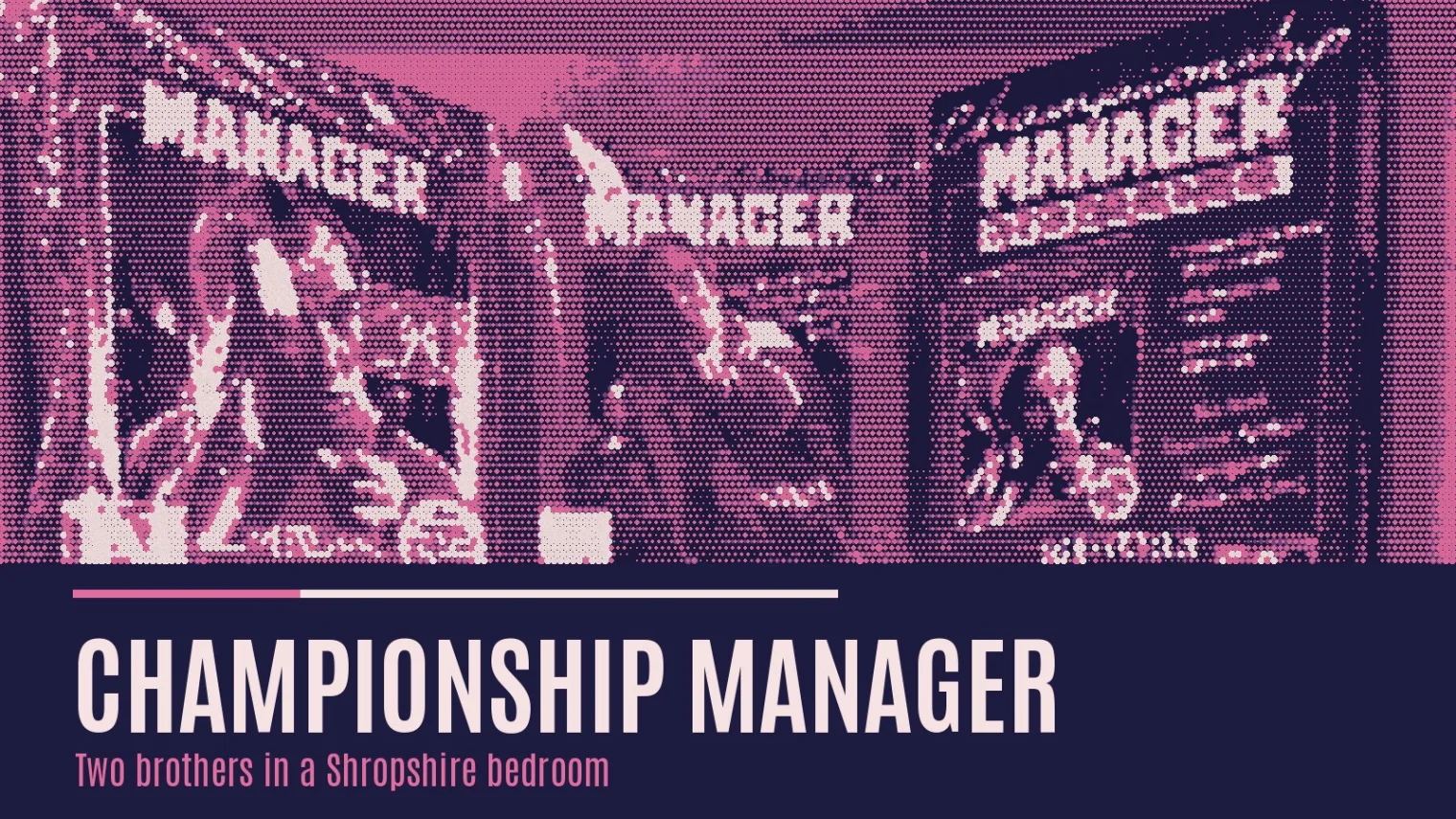
The television signal at Strefford, a smallholding near Church Stretton, was so poor that Teletext never arrived. Paul Collyer, an Everton supporter in rural Shropshire, listened to the football results on the radio instead. In 1983, on a BBC Micro, he typed them in, and the machine updated the league tables on the screen. “That was my first venture into football programming,” he told the Shropshire Star in 2018.
There was a cow, sheep, ducks, chickens, and a goat with a talent for swallowing computer equipment. “Fortunately he didn’t eat the game’s code,” Paul said. He and his younger brother, Oliver, known as Ov, were not building a studio then. They were two schoolboys at Church Stretton School, and not much use in the local side. Paul turned out for The Magpies and, as he put it, they would “end up with a minus goal difference of 150 at the end of the season.” In the winter, they had time. In 1985 they began turning what they knew of code into a football management game, “winging it,” as Paul put it, and “only really for us.”
They had played the games the magazines recommended. League Division One. Mexico ’86. Football Manager. “[We were] checking out all the other games of the time, and deciding we didn’t like them very much so, in our arrogance, deciding that we might be able to do it better,” Ov told Retro Gamer in 2018. It took six years. School and college kept getting in the way. “There were times when maybe six months would go by when we didn’t do anything on it. The other side of it was when we’d spend our holidays locked in the attic just trying to make it better.”
Isolation helped. “If we’d been out smoking fags and riding BMXs in the town nothing would have happened,” Paul said. “The circumstances were very open to that kind of obsession.” Friends came at weekends. Oliver started splitting players into qualities as basic as skill and pace. Then he went to Leeds to read mathematics, quit after the first year, and came home. That summer they polished the game and sent it out. Most of the publishers said no.
What they had made would spend the 1990s and the early 2000s in student houses, in bedrooms, and on office machines after everyone else had gone home. It taught a generation of supporters to talk about players they had never seen as if they had been watching them all season: potential, hidden attributes, a cheap signing from a third division club in a country you could barely place on a map. Clubs would later license the database. Managers would later admit they had used the game as a reference. None of that was in the attic. In the attic there were two brothers, a machine, and a goat that very nearly ate the evidence.
“Bolt some graphics on there”
Electronic Arts turned it down for not featuring enough “live action.” Another publisher was blunter. “The ‘no graphics’ thing was a big thing,” Ov recalled. “I remember ‘bolt some graphics on there’ was the exact phrase used.” Domark, a London house already known for film licences and quiz games, took it on. Championship Manager came out in 1992 on the Amiga and the Atari ST, and shortly afterwards on the PC.
The contract, looked at later, was not a triumph. “Looking back it was a pretty awful publishing deal, but at the time we thought it was amazing they were giving us any money,” Oliver told the Shropshire Star. They ran it past a lawyer in the village. “Suddenly he’s got this contract from a publisher in London. He said yeah, the terms are ok, but basically he hadn’t got a clue — we don’t blame him for that.”
The first game sold 20,000 copies. The brothers started a development company, Sports Interactive. The original Championship Manager, as a game, was almost immediately left behind. Championship Manager ’93 brought real player names, typed in from the Rothmans Football Yearbook, and that was when serious football supporters started to take notice. The critics split. “The good reviews made us happy — the shit reviews made us miserable,” Ov said. “It was kind of depressing to read something really bad — you’d feel angry because we knew people were enjoying the game.” PC Zone got on board. Others never did.
Then they went to Italy. Channel 4’s coverage had made Italian football the league a lot of people were watching, and the brothers thought those sides would sell. Domark did not. “We took it to Domark and they didn’t want to do it,” Ov said. “So we ended up sort of half-publishing it ourselves, in the end they got on board and carried it on.” Championship Manager Italia, with CM 93/94, took the typed Rothmans data and sold 90,000. Two brothers without an office had forced a publisher’s hand and found a public that wanted names, not sprites.
A living, breathing world
Championship Manager 2 arrived late in 1995, hungry for processor time and RAM, and it dropped the machines the first game had been built for. “For us to turn around and say, ‘We’ve just written a sequel and it doesn’t work on the same platforms as the first one,’ it’s a little bit controversial,” Ov admitted. They had tried to make it run on the Amiga and decided the specification was not enough. A later Amiga 1200 port appeared without Sports Interactive; the brothers have said it should never have been released.
What CM2 added was depth, and, for the first time, players whose abilities had been “scouted” rather than lifted from a book of statistics. The Bosman ruling went in because accuracy demanded it. The work was still being done in a house share, with Doom as the official break. “When you were working on the game and you needed a break, you’d just get Doom loaded up,” Ov said. The pressure was new. “It wasn’t like when we first wrote it in Shropshire when it was just a bit of fun for us. This was something we knew people liked.”
Miles Jacobson, who had come in as a tester and researcher and would later run the studio, remembered the brief that stuck. The Collyers were not trying to make another football game that reset at the end of the year and offered you a transfer once a week. “[They] didn’t care whether a human was playing or a computer manager was playing — the game would carry on because it would be a living, breathing world,” he told Retro Gamer. “That’s what we’ve always tried to do ever since then.”
Around CM2 the data changed as well. The first releases had leaned on Rothmans. Now the team started ringing fanzine writers and asking who to watch at their clubs. It was uneven, and sometimes it was wrong, but it was closer to the lower leagues than any yearbook compiled from a desk in London. The 96/97 and 97/98 updates turned the game into a habit. You did not dip in for twenty minutes. You loaded a save at ten o’clock, told yourself one more match, and surfaced with the central heating ticking and a left-back from Sweden in the side because the numbers had looked right. People talked about those players the next day as if they were real. In a way, that was the point.
The game that never left the hard drive
By Championship Manager 3, Domark had become Eidos after a merger, and the relationship was more like a conventional publisher and developer. The work was no longer “bedroom code,” as Paul later put it. People stayed up for three days before a submission. Jacobson remembered a contest to see who could last the longest, and, because he was not programming, “hallucinating dinosaurs.” The official diversion that year was Duke Nukem 3D. “I visualise a darkened office with everybody peering into their screens, sound coming out of their little speakers and explosions ringing out of the whole office,” Ov said. “It was the perfect way to relax after half an hour of coding. Then six hours of Duke Nukem, followed by a phonecall to explain why the game’s late.”
Championship Manager 01/02, released after a 00/01 refinement of CM3, is the edition that refused to leave. Jacobson called it “probably what CM3 should have been in the first place,” and added, dryly, that less Duke Nukem was played that year. He had been asked to run the business side, which neither brother wanted, and had done unglamorous things like hiring more programmers and putting a QA team in the building. People still play 01/02 now. Asked about that, Jacobson said: “By a lot less people than you imagine.”
That is probably true, and also beside the point. 01/02 became the version you kept on a machine, then on another machine, then in a window on a laptop that was supposed to be for something else. It is the edition in which a particular set of names became a shared language. Some of those names were real footballers whose ratings ran ahead of their careers. One of them was not a footballer at all.
Better on the screen
The joke of Championship Manager, as anyone who stuck with a mid-table side will tell you, was never signing the best players in the world. It was finding the ones you could actually afford. António Lopes, a civil engineering student in Coimbra and a Sporting supporter, understood that better than most, because he had put one of them in the game himself.
Lopes was a volunteer researcher, answering a call from Sports Interactive for people who could fill in lower-division squads. He offered to do C.D. Gouveia, then in the Portuguese third tier, the club from his hometown. In 2000/01, as a “tribute” for the work, he added himself and two friends to the squad at ordinary levels. Nobody noticed. He had played for Gouveia only as a child. The following season, with his degree exams in the way, he did not have time for a serious update. “The solution I found was to put myself, my friends and all my cousins in the squad, keeping most of the ages,” he told Público in 2014. “I exaggerated the attributes I gave each of the players, of course, but I always thought there would be some kind of algorithm to check the database.” There was not, or not quickly enough.
He gave his alter ego — Tó Madeira, a childhood nickname — a high potential, and made him, by default, the taker of free-kicks and penalties. In his own saves he signed him every time, “a bargain,” with values he later compared to the sort now reserved for a Cristiano Ronaldo. The Peralta brothers, another cult pairing in the same squad, were cousins of his; unlike Tó, they had genuinely come through at Sporting. Forums in Portugal and then abroad started talking about the Gouveia striker who would not stop scoring. An update early in 2002 removed him. Asked, later, why such a career had been so short, Lopes would laugh and say it was a very serious knee injury. Sports Interactive did not email him again.
“It was madness,” he said, sitting in Coimbra, still refusing to be photographed because he thought a face would “perpetuate the myth a bit.” He was not even much of a footballer. He had played basketball for years. He had, however, once spent two days and two nights playing the game in shifts with university friends, which is as close to a typical Championship Manager weekend as any official history has managed. He also pointed out the obvious: in an age when the internet was still clumsy, a joke like Tó Madeira could run for months. “These days it would only take two days for Tó Madeira to be found out.”
Other names in 01/02 were not jokes. They were teenagers whose ratings had escaped the people who had filed them.
Cherno Samba was born in the Gambia, moved to England at six, and grew up in Peckham. At 13, according to an account he later gave the Guardian, he scored 132 goals in 30 school games. He played for England schoolboys at 14, and later kept Wayne Rooney out of an England Under-17 side. In Championship Manager 01/02 he was a cheap, extraordinary centre-forward, the sort of signing that spread by word of mouth in computer rooms. In real life a move from Millwall to Liverpool collapsed — Samba has said Liverpool would have paid £2 million, with £1 million up front, and Millwall wanted the fee all at once — and he never made a first-team appearance for the club that had raised him. “It crushed my world,” he told David Hytner in 2018.
What followed was a difficult career: a spell at Cádiz that he called “living hell,” later stops at Málaga B, Plymouth, Wrexham, Haka, Panetolikos and Tønsberg, and retirement at 29. At Cádiz he went through a period of depression so deep that, as he later described it, he tried to take his own life. A teammate found him and he was taken to hospital. “I have got to sort myself out,” he said. Opposition fans taunted him with the game. For a long time he told interviewers he had never played it; in 2015, on the day news of his retirement circulated, he said exactly that. Later he admitted that he had, and that he would be Manchester United, and that he would sign himself. “I’d be Manchester United, I’d sign myself… I was great in it!” By 2018 he had made a kind of peace with the discrepancy. “I love it, it’s part of me.”
Tonton Zola Moukoko’s story is different again, and sadder in another way, because the talent was real and the interruption was not a rating. Born in Kinshasa, he lost both parents as a child and moved to Sweden to live with his older brother, Fedo. He played at Djurgårdens, represented Sweden at under-16 level, had trials in Italy, and, at 15, chose Derby County, where the care of young players, and some family in London, counted for more than a move to Italy. He trained among men like Georgi Kinkladze and Stefano Eranio, and he never made the first team.
He did not even know the game existed until a teammate, Ian Evatt, showed him. After a match at Rushden & Diamonds, people queued for his autograph. “I didn’t really know what was going on, there were so many people,” he told BBC Sport in 2017. “Then one of my friends, Ian Evatt, said: ‘You don’t know that you are one of the biggest players in this computer game?'” Fedo died while Moukoko was at Derby. He was 18. “When he died everything came out of me,” he told Planet Football in 2019. “I didn’t have anything left in my body to play football.” The club terminated his contract by mutual consent in August 2002. He later played in Sweden’s lower leagues and in Finland and Norway, and in 2013 he founded Kongo United in Stockholm. Sports Interactive named a meeting room after him. “It’s odd,” he said. “The way I was in the computer game is how people were waiting for me to be in real life.”
Maxim Tsigalko — the spelling the game used for a Belarusian striker who had come through at Dinamo Minsk — was the other name you signed if you got there early enough. He was a real player. He was not, in the end, the player the numbers had promised. In 2018 he gave a long interview to the Greek paper Gazzetta, in which he said that once he had stopped playing, nobody rang, and that he wanted to work in football and could not get a meeting. “Tell the world that I need help. Please.” On 25 December 2020, Gazzetta reported that he had died, at 38, of a heart attack, according to the reports it had seen. He had asked, two years earlier, only to get back on his feet.
Jacobson, looking back in 2017, was blunt about some of the early cult heroes. “I know players like Cherno Samba became legends because of how good they were on the game but didn’t end up making it. For me, those players were data errors.” The studio, he said, now has far more checks. Moukoko’s story he called “incredibly sad,” and he admitted the mental side of a career was something the game had not modelled well. Data errors are a developer’s phrase. For Samba, standing on a pitch while a crowd shouted the name of a better version of himself, and for Tsigalko, asking a newspaper to tell the world he needed work, they were something else.
Not every legend was a teenager. The other great 01/02 habit was the free transfer: a famous footballer whom the database had left without a club, costing nothing but wages. Taribo West was the first name on everybody’s list. Planet Football remembers that he “was available on a free transfer whenever you started a new game on CM 01/02”, and one fan’s guide to the original database lists him among the best unattached players, alongside a 30-year-old Pep Guardiola, newly gone from Barcelona.
Patrick Mboma belongs to a later version of the same trick. In the original 2001 data he is at Parma. The final official patch, 3.9.68, moved every squad on to 2002/03 but kept the July 2001 start date, and in that database CM Reborn’s profile has him as a free agent, with 16 for heading, jumping and strength and squad number 70. The real Mboma, born in Douala on 15 November 1970, had been African Footballer of the Year for 2000 after winning the Africa Cup of Nations and Olympic gold in Sydney with Cameroon. In February 2002 he joined Sunderland on loan from Parma, having been joint top scorer at that year’s Nations Cup. According to Planet Football, he asked for the No. 70 shirt in honour of the year he was born, and the Premier League said no. He scored on his full debut against Tottenham, cancelling out a Gus Poyet opener. Then the injuries came, Sunderland declined their option to buy him, and he later signed for Al-Ittihad in Tripoli. So the game simply did what the paperwork said, and left him unattached and waiting by the phone.
Name or content
Championship Manager 4, released in 2003, was supposed to be the leap: a 2D match engine for the first time, a huge overhaul, a fevered public. Paul later admitted they “totally overreached.” The game was buggy and unfinished. Jacobson has said they were too close to see it, and that some 10/10 reviews arrived because journalists had been told the bugs they were finding days before release would be gone from the finished disc. GameSpot, that September, noted that CM4 had become the UK’s fastest-selling PC game when it launched in March, and that the series had sold more than four million copies. Sales and quality had parted company.
On 4 September 2003, Eidos and Sports Interactive announced that they were ending a long relationship. Championship Manager Season 03/04, then still in development and due late that year, would be the last game they made together. Eidos would keep the Championship Manager name. Sports Interactive would keep the player database and the source code. “If this were the music industry, we would be talking about a classic case of musical differences,” Jacobson said, in the official register of polite break-ups. “After that, I expect that we will become the friendliest of rivals.” Jonathan Kemp, Eidos’s European managing director, thanked the studio and said future Championship Manager games would be developed internally. A 2004/05 update was already planned.
03/04, which Jacobson later called “the game CM4 should have been,” did at least leave the studio with a decent last word under the old name. The worry was what came next. “It was a contest to show which was important: was it the content of the game, or is it the name of the game?” Ov said. “There was a worry that they would produce some kind of average game and it would be called Championship Manager, and everyone would buy that, whereas we might produce something we think is a really good game, but it would be called something else and nobody would buy it because nobody would have heard of it.”
On 12 February 2004 Sports Interactive announced a five-year exclusive deal with Sega, and a new title, Football Manager, for PC and Mac before Christmas. “Obviously, losing the brand which we helped develop wasn’t ideal, but we’re looking forward to a friendly rivalry going forward,” Jacobson told GamesIndustry. “It’s going to be a slow process of education.” In the end, as Ov put it, “it went a lot better than expected.” The name stayed with Eidos. The living world went with the people who had built it.
It was homework
By then the game had already become a way of life for a particular kind of supporter, the sort who could tell you about a midfielder at a Swedish second-tier club and mean it. The Shropshire Star recorded, in 2018, that the series had been cited in divorce proceedings, and Paul recalled a young man who invited his new girlfriend’s parents for Sunday dinner and never sat down to the food, because he could not put the game down. The relationship, unsurprisingly, did not last. Oliver laughed about a player who set fire to a waste bin “to simulate an away match at Galatasaray in the Turkish cup.” Some people, the paper noted, claimed they dressed in suits for their own cup final days. “We love hearing these stories,” Paul said.
He no longer plays. He works on the match engine and has “self banned” himself, because he spots too many things he wants to change. His favourite old save, on the 93/94 game, was Burnley, dragged from “the Division Three doldrums.” He went ten games without a win, turned the side negative to collect draws, finished mid-table, and eventually got them to the top division. “It’s funny when you look back on playing the game like that. You start to understand why real managers act the way they do. I was stubbornly determined to prove myself right, and it’s just like that in real life.”
The line between the game and the job has, in places, actually blurred. Danny and Nicky Cowley, who took Lincoln City to the FA Cup quarter-finals in 2016-17, grew up on Championship Manager. Their mother used to tell them to stop playing and do their homework. “Nicky said to mum the other day: ‘It was my homework!'” Danny recalled, in a line Jacobson was happy to repeat. André Villas-Boas, when he was José Mourinho’s chief scout at Chelsea, admitted to using the game as a reference. In 2008 Everton licensed the Football Manager database. Jacobson has described the company thinking of itself as a football firm as much as a games studio, and Ov, asked by the BBC about that second life, went back to the beginning: “It was just a hobby for two slightly bored brothers living in the Shropshire countryside who liked football and were discovering home computers were more appealing than feeding the goat.”
That is the right scale for it. Championship Manager did not invent scouting, and it did not replace going to watch a player on a wet Tuesday. What it did, for a couple of decades of British supporting life, was change the conversation. Before most fans had highlight reels in their pocket, they had a database on a beige machine, a list of attributes, and a superstition about which unknown 17-year-old would “do it.” Some of those 17-year-olds were Messi and Aimar, spotted early. Some were Tó Madeira. Some were Samba and Moukoko and Tsigalko, who had to live with a version of themselves that the rest of us had already promoted to the Premier League.
The Collyers never claimed to be building a scouting tool. They were trying, in an attic, to make a football universe that would keep going if you closed the game and went to bed. They did. People stayed up anyway. Asked, years later, whether he would ever want to manage for real, Ov laughed. “I wouldn’t want to be a football manager. I’d probably be too scared of upsetting people.”