On the night of 29 October 2008 it had been snowing in north London. The clocks had just gone back, and Arsenal’s own match report noted, with the faint smugness of a club that had been winning this fixture for years, that it was now officially winter. Tottenham were bottom of the Premier League, six days into Harry Redknapp’s reign and, as the Independent put it, already in “the most entertaining relegation fight in living memory”. At 4–2 down with two minutes of normal time left at the Emirates, the visiting fans with any sense were already on the Holloway Road. Then Jermaine Jenas curled one in. Then, with seconds of the four added minutes left, Luka Modrić’s shot came back off a post and Aaron Lennon, on as a substitute, tapped in the rebound.
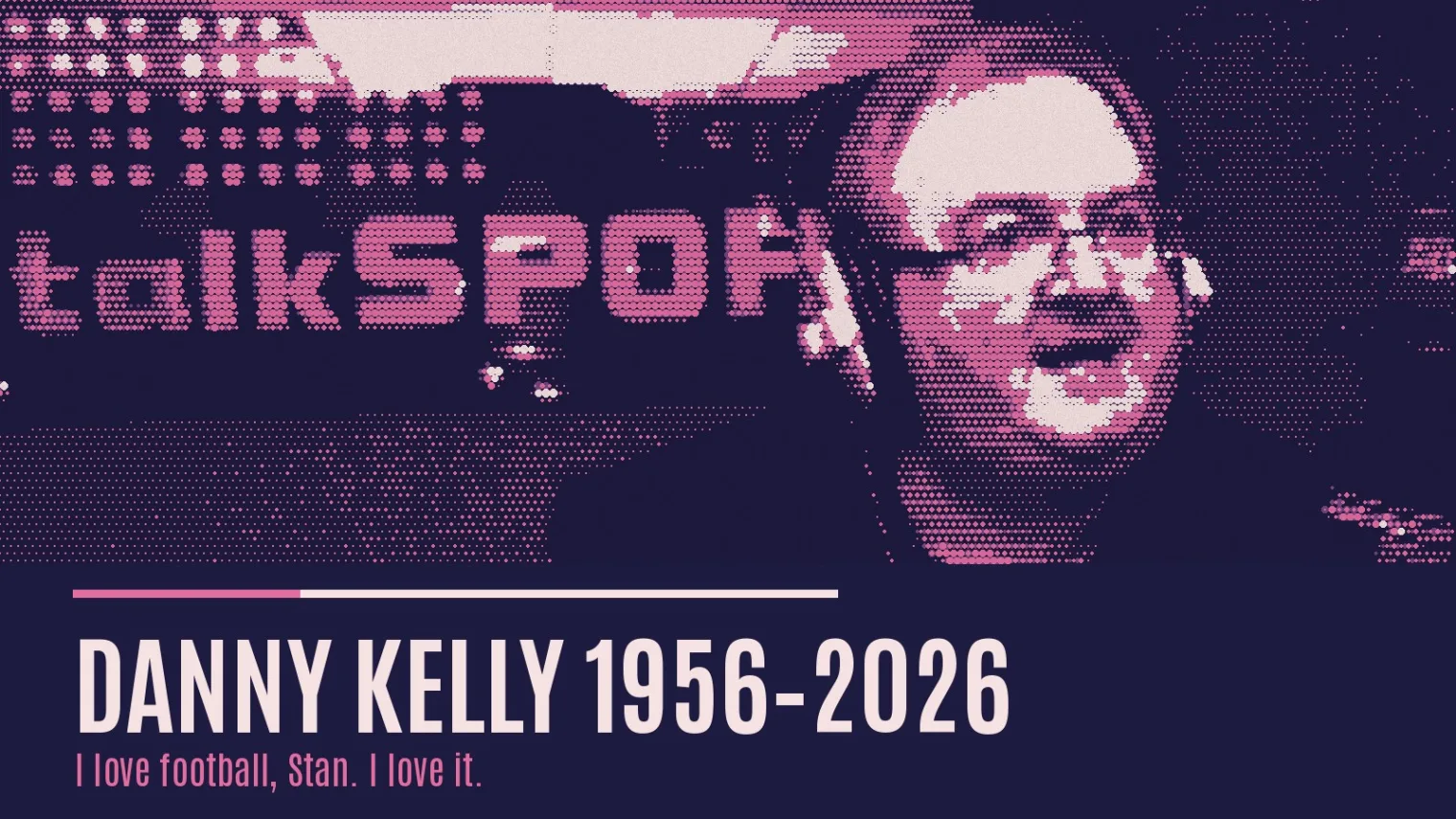
On talkSPORT a large man from Islington, who had edited the NME and Q and had spent twenty years being the cleverest, funniest and most sceptical voice in any room he talked football in, simply came apart. “I love football, Stan,” Danny Kelly roared at Stan Collymore. “I love it!”
It became the line everybody quoted this week. talkSPORT quoted it in its tribute, Rolling Stone opened with it, and Collymore signed off his own long farewell with it. It deserves to be quoted, but there is a catch. The man who said it also said, and meant, that “football is, at best, the third thing a football phone-in should be about”. That line comes from the Telegraph’s obituary, which called him “the master of the football phone-in”. Both lines are true, and the space between them is where Danny Kelly did his work.
Kelly died on the afternoon of Tuesday 10 November, aged 69. He had been receiving treatment for oesophageal cancer since the spring. “My great friend, supreme broadcaster and funniest man I ever knew, Danny Kelly, died yesterday afternoon,” Danny Baker wrote the next morning. “I cannot believe I will never hear his voice again.”
In the shadow of the wrong ground
Daniel Kelly was born on 23 December 1956, one of six children of Irish parents, in Islington. He grew up, as he told the Athletic in 2022, “literally in the shadow of the old Highbury stadium”. You can guess the rest. “Everybody I cherish supports Arsenal: my brothers and sisters, my wife.” He did not. He grew up a Tottenham fan in a house full of Gooners, and anybody who has spent a derby day as the only one in the family wearing the other colours will understand how a boy turns into a man who can argue anything with anyone and still be laughing at the end.
The other half of the childhood was in Ireland. In a 2023 interview with The42 he described “the classic six weeks home over the summer”, spent on family land among the cattle, and going back to England every autumn “with an Irish accent”. His father’s people were from the Wexford side of the Kilkenny border. His summers ran from the FA Cup final at one end to the All-Ireland hurling final at the other, and if the hurling was late he would happily stay on for an extra week and miss school. It is a nice image of a sporting education: Wembley in May and Croke Park in September, with a boy in the middle learning that every sport is really about the people who argue over it.
He was, by his own account, no player. “I played football until an ankle injury retired me in my early 30s at a really pathetic level on Hackney Marshes on a Sunday morning,” he told the Athletic. What he could do was organise. “Every other team on the Marshes played their best player up front. I played our best player, Mickey Donnelly, behind us as a sweeper. Nowadays, I wonder whether Mickey enjoyed it as much as he should…” There, at a park pitch in east London, is the whole Kelly method in miniature. He saw what everyone else did, did the opposite, and then wondered on air, with a grin, whether he’d been right.
His route into journalism was a lovely accident. According to the Telegraph, he worked for British Rail as a station announcer at London Victoria. As a shop steward he used the photocopied union newsletter as a fanzine, slipping his own gig reviews in among the branch business. The NME’s jazz critic Richard Cook read a copy at the TUC annual conference and got him on board. So a man whose voice would fill the football airwaves for thirty years started out reading departures to commuters at Victoria, and his first published criticism went out on the union’s paper.
The paper where you couldn’t mention football
What Kelly found at the NME in the early 1980s was, he said, “incredible”. “We were like kids let loose in a sweet shop,” he told the Athletic. “I was slightly older when I got into NME, so I was the responsible one.” He added that, as editor, he was more than once “dragged to the top of the 27-storey building that we worked in to explain to the managing directors what was going on in the cleaning cupboard below them”, and he left the rest to the reader’s imagination.
He went on to edit the paper at the end of the decade, staying until 1992, and he was one of the Pogues’ most ardent early champions. When the Manic Street Preachers paid tribute this week, they did it as a band that had been given its first break on his watch. “Danny was editor of the NME when we first started getting press,” Nicky Wire wrote. “A wonderful man, his musical knowledge was vast and deep.” Conor McNicholas, a later editor of the paper, said “he had music running through his veins and his page craft was superb. But it was the joy and laughter he brought to the job that won him so much loyalty and love.” Suede’s Mat Osman remembered him as “evangelical about the music he loved and very funny about the stuff he didn’t”. Chuck D of Public Enemy posted a cartoon and two words, “thanks man”.
In 1992 he moved to Q and was named magazine editor of the year. When the magazine published its 100th issue in 1994, Tony Parsons wrote in the Telegraph that under Kelly it had “grown into what it always promised to be – the best music publication in the world”. The Guardian’s John Harris called him “a master of magazines… a real seer of where pop culture was headed”.
All of that would be a fine career on its own, and this is a football site. It matters here because of something Kelly said about that world which most of us, too young or too far away from the music press, never knew. “People find this hard to remember,” he told the Athletic, “but during the 1980s, hooliganism reduced the game to just a hardcore of supporters. It had also become almost anathema to talk about football in polite society. Nobody liked it. When I worked in the music press, alongside people who would now be called hipsters, you just couldn’t mention football without people thinking you’re a Neanderthal.”
Think of the NME of the mid-1980s, then. It was the paper of the Smiths and of cassette compilations like the Greensleeves reggae tape Kelly was still playing from a hospital bed this year, and somewhere in it was the future editor, keeping quiet about how Spurs had got on. Kelly sat at the point where two British cultures had stopped speaking to each other. When they started speaking again, in the years of Italia 90, Fever Pitch and Euro 96, he already knew both languages fluently. “I would never try to separate music and football,” he said, “because in my mind they are the same thing.”
Two Dannys, hoopla, voodoo and toasters
Kelly always said he became a sports broadcaster by accident. “I started off at Radio 5 Live,” he recalled. “They had an early morning breakfast show in which they needed someone to review the papers. I did it for a few months and they liked it. Then the host got shoved out the door and Danny Baker turned up!” The two had never met. “We got along like a house on fire. Gradually we got taken off the morning show, 606 happened, and I became a sports broadcaster almost by accident.”
Baker remembered the newspaper reviews this week with the fondness of a man still not sure what had been going on. When the pair “washed up at Radio 1 in the 90s”, he wrote, Kelly “came up with this thing where instead of reviewing papers he would just tear out pics and write either TURMOIL or WE FEAR CHANGE on them then pass them to me. It was breathlessly helplessly funny. Nobody knew why.”
What the two Dannys built over the next decade was a football phone-in, first on the BBC, then on Talk Radio, then back at the BBC. Every phone-in since has been measured against it, and most have come off badly. Ian King, who worked for Kelly at Football365 and now writes the Unexpected Delirium newsletter, put the case for it better than anyone this week. “It can be difficult to believe now,” King wrote, “but the BBC phone-in 606 wasn’t always a honk-a-thon of conspiracy theories and grievances that didn’t matter in the slightest. There was a time when it tapped into something about the game which had never really been spoken about before and which hasn’t been properly since.”
His explanation is so simple that it is almost a shock. “Think for a moment about the last time you went on an away day. Did you spend much time getting angry about refereeing decisions, or indeed talking about the match in any way whatsoever? Of course you didn’t. You spent the day telling stories… or just making each other laugh.” So the show was built out of stories. King remembers the three English lads who bought Standard Liège club ties in the shop in Belgium and then spent at least a season getting into matches free by claiming to be scouts for the Belgian club, with the ties as their only proof. He remembers “Joanne”, who rang in with tales of her romantic adventures with the players of an unnamed club “based in the Midlands”. Nobody checked whether any of it was true. That was not the point.
On Talk Radio the show settled into Saturday afternoons, and Kelly once described its format perfectly to the Observer: “two hours sober before the game, two hours pissed afterwards”. The Telegraph’s radio critic Gillian Reynolds called the pair “pure Ionesco on the hoof, a theatre of the absurd writ live on lunchtime airwaves”. When the BBC brought them back to Radio 5 Live in January 2002 for a ten-week run of Baker and Kelly Upfront, Saturdays from 11am, Baker supplied a mission statement that might as well go on both their headstones. “It is high time,” he told the Guardian, “radio coverage of our national game was rested from earnestness and placed back in the peculiar, which as any football fan knows, is its rightful bed.”
This is where Kelly’s “third thing” comes from. It sounds like a joke, and like most of his jokes it was also a theory. Talk only about the football and a phone-in turns into a queue of men, and it nearly always is men, who are angry about a penalty. Talk about the pub, the coach trip, the ties from the club shop and the bloke who sits behind you, and you get the football back, because those things are what football actually is for the people who follow it. It is the same thing the music papers knew at their best. Nobody ever read the NME for the chord changes.
Baker put it best this week, with the rueful pride of a man whose side had lost the argument. “Danny Kelly and I tried to forge another path for football punditry,” he wrote. “One based in hoopla, voodoo and toasters. Sadly a more sober way won out. 10,000 gruff podcasts. But at least we tried.”
Under the Moon, in a boxing glove
If the radio shows were Kelly’s theory, Under the Moon was the experiment that went gloriously wrong. Channel 4 ran it on Wednesday nights from midnight until three in the morning in 1997 and 1998, live from a basement studio on Horseferry Road. It was commissioned by Stuart Cosgrove, an old NME colleague. “Channel 4 asked me what I wanted to do,” Kelly told the Observer’s John Naughton in 2008. “I said lots of guests, live for hours on end, plenty of hoopla, do some comedy things and talk to people just as they talk to each other in pubs. Not broadcasting punditry, which you don’t need.”
That last sentence is the 606 idea again, put on screen. What came out was, in Naughton’s lovely phrase, an “anarchic, haphazard, accident-prone, profanity-strewn, nocturnal live television phone-in programme”. Kelly began the run sitting in a giant catcher’s mitt. “Two great things happened at this time,” he said later. “Tim left and I got promoted to a boxing glove… I was never comfortable with [the mitt]. I know nothing about baseball.” The show had to have a Premiership footballer on every week, for about a grand in appearance money, and the researchers managed it from every club except Arsenal. During the 1998 World Cup Nigel Winterburn finally broke ranks and explained that Ian Wright had told the Arsenal players not to go on “bad television programmes”. Kelly’s reply, given what Wright went on to present, was “I’d say that’s rich.”
The best-known moment did not involve a footballer at all. David Vine, the BBC’s veteran voice of snooker, was told on air by his host that the game had gone downhill “since they’ve all stopped taking mountains of cocaine”. Vine ripped off his microphone and walked out. Kelly told that one with relish, and he was just as frank about the audience. “Whenever people stop me and say, ‘Oh I loved Under The Moon,'” he said, “I always say, ‘In that case you were either a taxi driver, a student or a junkie.'”
The critics were divided, which is to say some of them were savage. An early Independent review decided that Kelly’s “broadcasting style is based on barely restrained panic”. Later the paper’s Sport on TV column printed an apology for its earlier verdict, after the show had tracked down and questioned the athletics administrator Peter Radford when the papers had failed to. “If Paxman is a rottweiler,” the paper decided, “Kelly is the Andrex puppy.” Both reviews were right, and the gap between them is the show.
It is worth noticing what Kelly was doing in the rest of his week. In 1995 he had left Q to found Total Sport, a monthly sports magazine that the Telegraph remembers as “lively, funny and provocative – much like Kelly himself”, and which closed after four years. Kelly’s own claim, made to the Observer, was that it had been “the template for OSM”, the Observer Sport Monthly. He was editing a magazine, doing a Saturday phone-in with Baker and presenting three live hours of television in the middle of the night, and he was about to start a fourth thing that would outlast all of them.
The Football365 love letter to the show described him perfectly, “beaming happily like some sort of sporting Buddha, the emperor penguin of the chaos that was all around”. It also records one of the less flattering things about it. Callers often slipped past the switchboard just to tell the host he was fat. Kelly once stood up, walked to the camera, gave out the studio address and invited the caller outside for after the show, once he’d had a drink. He went out at four o’clock and waited. Nobody turned up.
Eating paper, drinking ink
The story of Football365 begins, appropriately, with Kelly arguing the wrong side brilliantly. In 1997, he told The42’s Behind the Lines podcast, his employer IPC asked him to defend print in front of Britain’s magazine editors against “two guys coming from America” with a presentation on “something called the internet”. “I made this speech, and God forgive me for this, I ended it with a frankly blasphemous reproduction of the Catholic consecration ceremony. I ate paper and drank ink to prove how attached we were.” Then he watched the presentation. “I distinctly remember thinking after that: ‘I won the showbiz battle but they won the argument.'”
Somebody he’d never met offered him the chance to own his own work online, and in the summer of 1997 he and three others launched Football365 “from a single room in Islington… we had no windows, we were literally in a box room”. Twenty months later, “such was the insanity of that wave of the internet, we had 1,200 employees… we bought a telephone company”. To the UK Press Gazette, the Telegraph notes, he explained that it combined “the two most important things sweeping the country at the moment – football and electronic publishing”.
It is easy to forget, and anyone under 35 never knew, how strange and how funny early Football365 was. For the 1998 World Cup it ran a daily “World Cup talk-in with Doctor Stephen Hawking”, which, Kelly admitted, “was a voice put through a voice processor”. After Beckham’s red card in Saint-Étienne the site made a version of the children’s game Buckaroo and called it Beckaroo. Harry Harris of the Daily Mirror reacted on the back page, as Kelly remembered it, with “What is this filth? What is Football365? Who thinks it can treat our national hero in such a way?” “Little did he know,” said Kelly, “that every word he wrote was putting another 10,000 users onto 365… I can think about the Israelites leaving Egypt, but the single greatest migration was caused by Harry Harris slagging off Football365 on the back page of the Daily Mirror.”
This site owes a lot to that box room in Islington, as does nearly every football site that has tried to be funny and knowledgeable at once. We wrote earlier this year about the old gatekeepers of football coverage in the summer of Euro 96. Within twelve months Kelly was one of the people quietly taking the gate off its hinges. “My job was to make sure the concept was good,” he said, “and that hasn’t changed… regardless of what you do.” Football365, as he liked to point out, was eventually floated on the stock exchange and ended up with Rupert Murdoch, and it is still going.
He got to podcasting early too. In the noughties he launched The Game, a weekly football podcast for the Times, years before every club, pundit and ex-pro had one. Baker’s photos this week included the pair at the 2006 World Cup in Germany, when, he recalled, “the BBC/Times laid on a courtesy car to get us to different stadiums”. One listener posted that in his season fronting it “Danny Kelly made that, for one season only, THE football pod”. It is a fan’s verdict rather than a fact, but plenty of people this week shared it.
“I love football, Stan”
Kelly joined talkSPORT in 2007, after presenting a sports show on BBC London, and stayed for nearly two decades. He fronted Kick Off, My Sporting Life and finally Trans Euro Express (Independent). Rolling Stone’s description of his early talkSPORT years is a good one: “something of an oasis of calm in that station’s often anarchic programming. Unless he was talking about Tottenham, of course.”
The best way into those years is through the people he brought with him. Stan Collymore’s tribute, posted on X on the morning after Kelly died, is the most moving thing written about him, and it is not really about football at all. “By 2008 I was a mess. I would sleep 18 hours a day, the other 6 mostly wanting to die,” Collymore wrote. While driving home from a psychiatrist he heard Kelly on BBC London, reviewing books with a guest, and heard his own name come up. He phoned in. “We hit it off straight away, talked about football for what seemed like forever but was probably a standard 10-12 minute section.” When Kelly took the 7–10pm weeknight slot on talkSPORT, “he told me he was offered a few co-presenters but he remembered that conversation we had and he wanted me to do it. A lifeline of work, passionately talking about our sport, having fun and feeling a value as a human again. Something lost for 7 long years. Danny gifted me that. Without that I know I wouldn’t be writing this today.”
Collymore called him “Dad” on air, “because I wished he was”. The two of them greeted each other until the end with “Always fresh, never frozen”, the tagline from a Domino’s advert they had to read on the show. It is exactly the sort of daft in-joke that a Baker and Kelly listener would recognise. Listeners still remember the Monday night show. “Your show with Danny Kelly on a Monday night 7-10pm, was must listen radio,” one replied to Collymore. “It still remains my favourite talksport show.”
The same story keeps turning up. “The reason I’m able to broadcast is because of Danny, it started with Danny, he nurtured me,” Simon Jordan said. “He was an ideas factory.” Laura Woods described production meetings “sitting around Danny, it was like kids at school, great stories… I credit him with my early development.” George Cummins, now at 5 Live, told the BBC that “colleagues would often remark that his brain was like an encyclopaedia”, and that “he always took an interest in colleagues’ lives away from work”. Danny Murphy remembered trying to catch him out with an obscure song from the 60s or 70s, and Kelly answering every time, “I met him.” The station’s own statement called him “a broadcasting titan” who “had time for everyone and went out of his way to be kind”.
Which brings us back to the Emirates. One reason “I love football, Stan” is so lovely is that it was so unusual. This was a man who had deliberately trained himself out of that kind of feeling. “I got so involved with Spurs in my late 20s, early 30s that I realised it was making me miserable,” he told the Athletic. “We’d lose and I’d be miserable for the rest of the week. And so I took real extreme measures. I stopped going for three years. I weaned myself off the need for the adrenaline rush; it’s just too much like a heroin addiction.” Even in later life, his wife reported, when Spurs went behind he would leave the room. “Often I can be found in the car. If Spurs have equalised, she’s empty-handed, telling me it’s time to come in and watch the television again. If things have got worse, she brings me a cup of tea as a comfort.”
Ian King’s favourite Kelly memory is a smaller one, his description of his season-ticket years at White Hart Lane as mostly “sitting in his seat, muttering, ‘That’s rubbish, Spurs’, under his breath to himself for 90 minutes”. Every Spurs fan, and every fan of any club, knows that man. So the Lennon equaliser was not a broadcaster losing his professionalism. It was the cup of tea, the car on the drive and the three lost years all arriving at once, live on national radio, in the 94th minute. It was also a moment when even the man who knew football was the third thing had to admit that, now and again, it was the first.
He kept his grudges as light as his joy was heavy. On My Sporting Life, which he said was the first non-BBC programme to win Sports Radio Programme of the Year, he interviewed his Spurs heroes Glenn Hoddle, Ossie Ardiles and Graham Roberts. He also interviewed Sol Campbell, having once told Campbell’s agent he would “never, ever forgive Sol” for crossing north London. “But time passes and human beings make mistakes… I don’t really hold grudges.” Spurs fans gave him grief for the photograph. He talked to Campbell for three hours anyway.
Kilkenny, and the Trans Euro Express
In 2018 Kelly moved to Ireland with Alex Clark, the journalist, then his partner and later his wife. The42 tells a lovely story about the move. While family and friends carried the boxes in, Danny found the best corner of the living room for his vintage jukebox, put on Desmond Dekker’s “Israelites”, sat down on his mother’s garden furniture and knew he was going to be all right.
He lived on the lower slopes of Mount Leinster and became, in The42’s phrase, “an unabashed Kilkenny hurling snob”. “If a great hurling story happens, I bore the people of England on my TalkSport radio show,” he said. When Mount Leinster Rangers reached the All-Ireland club final in 2014, “every second day I was bringing news of it”. His description of hurling is the best short piece of sports writing in any of the interviews: “There is no downtime in hurling. It’s fighting or art, the whole time.” He went to a championship game in Thomastown with around 2,000 people at it and did the sum. “The population of the town is 2,000. So that’s like 11 million turning up for a football match in London!” What stayed with him was not the match but what came after: the pitch “covered, and I mean covered, with kids, some as young as 3 or 4 with a hurley in their hand”.
From Kilkenny he broadcast the last of his long list of shows, Trans Euro Express, which the Telegraph describes as combining “European football and his favourite music”. The name is a Kraftwerk joke, of course. In a sense it was the show he had been working towards since his NME days: no more pretending the two halves of his life belonged in different rooms. The Manics, in their tribute, said it “became essential”.
Then there was The View From The Lane, the Athletic’s Tottenham podcast, which he hosted from 2021. “I also insist that football does not exist in a vacuum,” he said at the hundredth episode. “It is part of society, part of our lives, part of history. And I’ll try to drag that into it as well.” His co-host Jack Pitt-Brooke had a comparison ready. “Danny was to VFTL what Frank Reynolds was to Always Sunny,” he wrote this week. “He only arrived in the second season, and even though he was older than everyone else he instantly made the whole thing make sense.” James Maw joked in 2022 that “once he’d remembered our names, which only took four or five months”, Kelly was able to “take the show to the next level”.
He was as funny about Spurs as ever. When Ange Postecoglou arrived, he told The42 that after the Conte and Mourinho years it was “like being a hostage for three years, chained to a radiator. And then suddenly you are allowed out. The sun hits your face for the first time. The wind goes through what’s left of your hair…” He added that “his rigid ideal will be severely tested in the Premier League” and that “he might need a bit more tactical flexibility”. He was funny and he was right, which was usual for him.
He also gave the shortest and best advice on broadcasting anybody has managed. “Be a version of yourself, but add an extra 15 per cent of personality. And don’t be st. Try not to be st and you’ll be OK.”
The Kelly Cancer Kronikles
In March this year Kelly stepped away from broadcasting after being diagnosed with oesophageal cancer, and he urged listeners to get checked. Then, because he was who he was, he wrote about it, honestly and with very good jokes, on X. On the morning his treatment began he posted that he was wearing his Disraeli Gears hoodie, a multicoloured Donegal tweed cap and an acid green shirt. Psychedelia, he explained, was helping the drugs. A week in, he wrote one of the truest things anyone has said about illness: “we endure, not cos we’re ‘brave’ or ‘tough’, but cos we told our loved ones we would do our best”.
He never stopped being a football man. Bewildered, between chemo cycles, that Italy had failed to qualify for a 48-team World Cup, he wrote: “I grew up among (N London) Italians… And to me Italian football IS football.” As Spurs sank towards a relegation fight in the spring he kept presenting View From The Lane episodes and posting about them, and a few days into chemotherapy he delivered his verdict on the run-in: “NOBODY is coming to ‘save’ Spurs. Managers aren’t wizards… in the end, for better or worse, Spurs’ fate is now in the hands (feet, minds) of the players.”
The summer was hard. In June he described internal bleeding, emergency surgery and a nurse calling it “life and death”. In August, after seven hospitalisations and a week in intensive care, he still had a joke ready: a doctor had told him he had “the constitution of an ox”, “which made me feel very sad for an ox, alone and weedy in a field somewhere, with MY constitution”. He kept a list of the names of the ICU nurses, “half locals, half from the south Indian seaside state of Kerala”, and promised never to forget them. In the same thread he thanked the musicians who had sent good wishes: members of “Dexys, the Waterboys, The Fall, Primal Scream, The Loft, The Coral and the mighty Manics”. “Note; only great bands; I’m humbled.” More than thirty years after leaving the NME, he was still marking the bands out of ten.
The tributes this week came from every part of his life, which is the point. Tottenham Hotspur said “the entire Tottenham family mourns the loss of one of our own”. talkSPORT said that “his passion for football, music and life was infectious, and his kindness touched everyone around him”. Richard Keys called him “warm, witty and knowledgeable”. The View From The Lane said simply: “We all loved him as much as he loved Spurs.” Alex Clark wrote that the thousands of messages had “brought light into the darkest day… He was just remarkable, and I was the luckiest woman to have had him for so long.”
The third thing
So which was it: football first, or football third? The honest answer, and the one Kelly spent his career demonstrating, is that the question is wrong. Football was the third thing a phone-in should be about because the first two, the people and the stories, were what made the football matter. The ties from the Standard Liège club shop, the cup of tea on the drive, the jukebox in the corner in Kilkenny and Mickey Donnelly at sweeper on Hackney Marshes are the game as it is actually lived by the people who pay for it. Kelly understood that before anyone else in the British media did. He learned it in a music press that wouldn’t let him talk about football, and he spent the rest of his life making up for lost time.
And then, every so often, on a snowy night in October with your team bottom of the league and two goals down in the 89th minute, the football stops being the third thing and becomes the only thing. In 2008 Danny Kelly said so, at the top of his voice, on national radio. Nobody who heard him has forgotten it.
On the night he died Danny Baker had a suggestion for anyone who wanted to mark it. “You might want to listen to one of his favourite albums,” he wrote, “King Crimson’s ‘Red’. Although I wouldn’t because its a fucking racket. Try another of his faves instead, Culture’s Two Sevens Clash.” Kelly would have argued with him about it for two hours, sober, and then for two more afterwards.