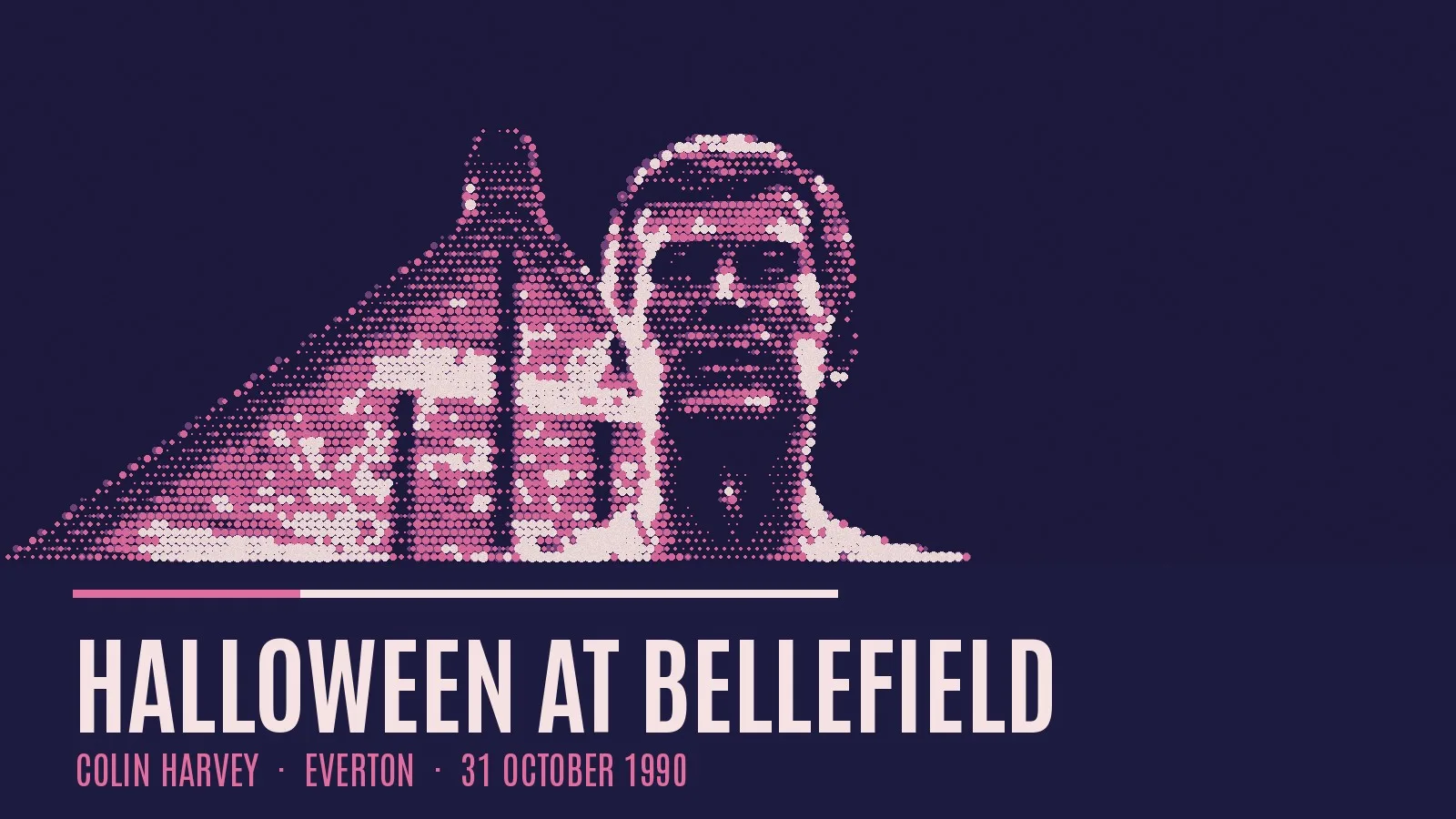
On 31 October 1990 Everton sacked the one man who loved the club more than anyone in the building. Six days later he was back, standing at Howard Kendall’s right hand, where he had always been best.
There is a particular cruelty reserved for football managers who are also supporters. Everyone else in the job gets to be a professional. They take a post, do their best, get sacked, collect their compensation and go and look at the next vacancy. A supporter-manager cannot do that. When it goes wrong he is not just losing a job. He is letting down his own family, and he knows exactly what the people in the stands are saying because, for most of his life, he has been one of them.
Colin Harvey was that sort of manager, maybe more completely than anyone in the English game. On the club’s official history video, made in 1988 while he was in charge, he looked into the camera and said, as the Liverpool Echo later recalled, “Basically you’re talking about Everton being my life really.” Two years later, on the morning of Wednesday 31 October 1990, he was called to Goodison Park for a meeting with the chairman. It lasted half an hour. When he came out, the job was gone.
The White Pelé
To understand why this hurt so much, you have to go back nearly thirty years, to the San Siro.
In September 1963 Harvey was an 18-year-old reserve, a player, as the Echo put it at the time, “who fans of the club have scarcely heard of”. He travelled with the Everton team to Milan for a European Cup tie against Internazionale assuming he was there to carry bags. Then Jimmy Gabriel was injured, and Harvey, who had never played in front of more than a few thousand people in the Central League, made his senior debut in front of 80,000 Italians. The Echo said he “fought hard, played at times with a veteran coolness and could have been a scorer”. James Corbett’s entry in the Everton Encyclopedia points out that Evertonians at home then had to wait six months to see him in the first team, in a 2-1 win at Blackburn.
He had been an Evertonian since childhood, standing in the Boys’ Pen through the 1950s. By 21 he was one of the most important players at the club. In the 1966 FA Cup semi-final against Manchester United at Burnden Park, he scored the only goal twelve minutes from the end with a bobbling shot. “It was every supporter’s dream to score the goal that puts you through to the final,” he said. Three weeks later Everton beat Sheffield Wednesday 3-2 at Wembley. Gabriel, the man whose injury had given him his debut, was in the same side.
Then came Alan Ball and Howard Kendall, and the midfield Evertonians still call the Holy Trinity. Ball the goals and the noise, Kendall the tackles and the passing, Harvey the running and the vision. Alex Young called him “a buzz-bomb of a footballer”, and said: “Play and run, play and run – that was Colin. He was unselfish, recklessly brave and incredibly skilful.” The supporters called him the White Pelé. Terry Darracott remembered that “He would always put in that extra half hour after training, no matter what he had done in the morning.”
In the 1969-70 season he lost the sight in his right eye after an infection and was out for two months. He came back in January and, on 1 April 1970, scored the goal against West Brom that won Everton the league. Horace Yates described it in the Daily Post: “First he moved towards goal, changed his mind and veered out, as though to bring Morrissey into play. Seeing Morrissey was covered he doubled back to the edge of the penalty area and while on the run sent a crashing drive soaring into the net.” FBH has written about what came after that title, and it was not much. Injury, mostly to his hip, wore him down. In 1974 Billy Bingham sold him to Sheffield Wednesday for £70,000 to help pay for Martin Dobson. “I cried when I went out of the gate, I’ll be honest with you,” Harvey said in 2003. “I thought it was the end. I thought the next time I come back it would be to watch a game.”
It was not the end. He was back in 1976 as a coach, bringing through Gary Stevens, Kevin Ratcliffe and Kevin Richardson. In 1981 Kendall, now manager, made him reserve team manager, and in 1983 his assistant.
Kendall’s right hand
The timing matters. When Harvey became assistant, Everton were in a dreadful state, with supporters campaigning for Kendall’s sacking. By the end of that season they had won the FA Cup. Then came two league titles and the Cup Winners’ Cup, the greatest years in the club’s history. FBH readers know that team well, and the Goodison it played in.
Harvey’s account of how it worked is generous to Kendall and probably too modest about himself. “Howard’s strength was that he was very shrewd in judging a player I brought to him,” he told Bluekipper. “I was very passionate when it came to the training side of things, and was very passionate about video work as well. It was Howard who pulled it all together.”
In June 1987, a month after Everton won the league again, Kendall left for Athletic Bilbao. Harvey was the obvious successor. “Everyone at the club, and I really mean everyone, had the utmost respect for Colin,” Graeme Sharp said. “Although he had no top level management experience, he did seem to be the logical choice because he’d had such an influence on the success we’d enjoyed under Howard.”
Fourth, eighth, sixth
It is often said that Harvey dismantled a title-winning team. ToffeeWeb’s concise club history is fairer than that. He inherited champions, it says, “but it had started to show signs of tiredness”, and “no team can stay at the top forever”. He only bought one player, Ian Wilson, in that first season, and Everton finished fourth.
The squad needed rebuilding, and in the summer of 1988 Harvey spent nearly £5 million on Pat Nevin, Neil McDonald, Stuart McCall and Tony Cottee, the last at £2.2 million. Cottee scored a hat-trick on his debut against Newcastle, the first after 34 seconds. Everton reached the 1989 FA Cup final, the one that came weeks after Hillsborough, and lost 3-2 to Liverpool after extra time. McCall scored twice; Ian Rush came off the bench and scored twice. Everton finished eighth.
In 1989 the old guard had largely gone: Stevens, Pat Van den Hauwe, Trevor Steven, Peter Reid, Adrian Heath, Paul Bracewell. Harvey brought in Mike Newell, Norman Whiteside, Martin Keown and the Swede Stefan Rehn, whose time at Goodison the Encyclopedia describes as “farcical”. Everton were near the top in November. Then they lost 6-2 at Aston Villa and, in Corbett’s words, “the dressing room splits became public”. A team-building night out at a Chinese restaurant ended in a brawl between Keown and Kevin Sheedy. Everton finished sixth.
Those three finishes, fourth, eighth and sixth, are, as ToffeeWeb puts it, “the kind of finishes Everton would have killed for during most of the following decade”. But Everton in 1990 did not measure themselves against the following decade. They measured themselves against 1985 and 1987, and against Liverpool, who had just won another title.
The autumn of 1990
The summer of 1990 brought Andy Hinchcliffe from Manchester City and Mike Milligan from Oldham for £1 million. Neville Southall wanted a transfer and did not get one, so on the opening day of the season he staged a one-man sit-down protest on the pitch. It set the tone. Everton did not win until the seventh match. By the start of November they had won just one league game and were 18th.
The final straw was a Rumbelows Cup third-round tie at Bramall Lane on Tuesday 30 October. Sheffield United, managed by Dave Bassett, were bottom of the First Division. Everton lost 2-1. Transfermarkt’s match record has Carl Bradshaw and Brian Deane scoring for United, Everton’s goal an own goal by John Pemberton, and a crowd of 15,042. Everton’s team that night had Southall, Ratcliffe, Dave Watson, Keown, McCall, Cottee, Newell and Sharp in it. These were not bad players.
The last night
Ken Rogers’ account in the Echo, written that week, is one of the saddest pieces of football reporting you will ever read, and the Echo republished it in 2024.
“Colin Harvey spent his final night as Everton manager at Bellefield, pondering his future until the early hours before snatching a few hours of uneasy sleep,” he wrote. “It was as if he couldn’t bear to leave the training ground he loved. Maybe he had an inkling about the bullet that was flying his way, not at the speed of sound, but at the speed it takes for a chairman to decide that enough is enough.”
And then: “Despite this sense of foreboding after the shock Rumbelows Cup defeat at Sheffield United, Harvey woke up full of defiance. He was determined to ride the storm and optimistic that he could inspire a startling royal blue revival, hadn’t his old sparring partner Howard Kendall conjured up a similar miracle back in 1984?”
“It wasn’t to be. The manager was summoned to Goodison Park for a 1pm meeting with Philip Carter and emerged half an hour later, relieved of the job that wasn’t so much as his pride and joy as his life.”
Think about the picture there. A man of 45 who has been at the club, on and off, since he was a boy, sleeping at the training ground because he cannot bear to go home. Waking up still believing. Driving to Goodison for one o’clock. Rogers called it a Halloween horror show, and that is exactly what it was.
Another paper, quoted in the Encyclopedia, likened his departure to the death of a terminally ill friend: “The sense of loss at the demise of a manager they idolised as a player and respected as a person was tempered by acceptance that the departure was the only way to end the suffering.” It is a terrible thing to write about a man, and it was probably true.
Whose fault?
Not everyone blamed Harvey. Tommy Docherty, writing in his Birmingham Weekly Mercury column that weekend, was furious with the players. “Everton’s players should hold their heads in shame after the sacking of Colin Harvey,” he wrote. “It wasn’t Goodison chairman Philip Carter who got Harvey the sack – it was the disgraceful behaviour of some of his players.” He listed Southall’s sit-in, Cottee refusing to play in the reserves after being dropped, and the Sheedy-Keown fight. “When he needed the support of his players they made clear he was out on his own and incidents like those made Harvey’s job impossible.”
There is something in that. Harvey was a coach’s coach, a training-ground man, and the late-80s Everton dressing room needed someone who would scare it. Years later Harvey said as much himself, in an interview with the Everton Heritage Society. “When I was manager, I didn’t really enjoy it. I had reasonable success, but I didn’t enjoy everything that went with the job. I wasn’t one for the politics and everything – I wasn’t interested in that. I was just interested in the field, the balls and coaching.” And then: “I didn’t manage it particularly well in terms of myself; it was a burden and it got to me. Maybe for other people it would have been a breeze, but it wasn’t for me. I was in charge of my own club, and everything got too much for me, I do admit. I would bring it home to Maureen, so it wasn’t a good time.”
“I was in charge of my own club.” That is the whole thing, in six words.
But Harvey would not take Docherty’s way out. “I’m a believer that your fate is in your own hands,” he said later. “If players don’t play as well as they should do, or they don’t turn out as you thought they were going to, that’s your fault isn’t it? I’m a great believer in that you are responsible for everything that you did yourself so if we didn’t win anything, I was the only one to blame.” He called the period “probably the most frustrating time of my career”. “Every other period during my Everton career we had always won things, I’ve always been involved with winning teams. I wasn’t then… I really didn’t enjoy being manager… I have got to consider that time as a failure due to the simple fact that we didn’t win anything.”
That is harsh. It is also typical of the man.
Six days
What followed was one of the strangest weeks Everton have had. On 1 November Jimmy Gabriel, Harvey’s old teammate from 1966, took over as caretaker. “Some managers can get by without winning trophies but an Everton manager cannot,” Gabriel said. “Colin believed we were not far away from being a great side and I felt we were one or two victories away from being a really good one.” On 2 November the Echo reported that local bookmakers regarded Oldham’s Joe Royle as such a certainty that they would not even run a book. On 3 November Everton beat QPR 3-0 at Goodison, with goals from Newell, Nevin and McDonald, and climbed out of the relegation places. On 5 November the Echo was still expecting an approach for Royle.
And then on 6 November, Kendall walked out from behind a screen in one of Goodison’s lounges. He had been at Manchester City for less than a year. “There was a cloak of secrecy to the moves to rehire me that seem completely unconceivable in today’s world of rolling news, social media and internet,” Kendall wrote in his autobiography. “When I stepped from behind a screen… there was a touch of theatre to proceedings, almost like a new Pontiff being unveiled before St Peter’s Square.” He gave the line every Evertonian knows: “When you talk about Manchester City you talk about a love affair. But when you talk about Everton you are talking about a marriage.”
Standing at Kendall’s right, as he had for so many years, was Colin Harvey, back at the club as assistant manager barely a week after being sacked.
It says a great deal about both men. Kendall knew who he wanted next to him, and was not embarrassed to ask. Harvey, who had every right to feel humiliated, came straight back. The Everton website says that the fans greeted his appointment “with wild enthusiasm”, and that it “spoke volumes for the softly-spoken Scouser”. It is hard to think of another English club that sacked a manager and rehired him as number two within a week, with the crowd delighted both times.
The magic did not come back
It would be lovely to report that the old partnership worked its magic again. It did not. ToffeeWeb says the rest of the season “went pretty much as it had started”. Everton finished ninth. Money got tight. Kendall resigned in December 1993, Mike Walker came in, and Harvey left. FBH has told the Everton story of 1995, when Royle finally did arrive and won the FA Cup, without either of them.
But Harvey kept coming back. He went to Oldham as Sharp’s assistant in 1994, and in 1997 he returned to Everton yet again, reunited with Kendall, as director of youth coaching. Within a year his youth side, which included Francis Jeffers, Richard Dunne, Danny Cadamarteri, Leon Osman and Tony Hibbert, won the FA Youth Cup. He called it “the best footballing side I have ever worked with”. A few years later he was the man who first picked a 14-year-old Wayne Rooney for the under-19s. When he retired in 2003, because of the hip that had ended his playing career, he was given a testimonial against Bologna.
Asked on the eve of that testimonial how he would like to be remembered, he answered: “To have played for Everton and been an Evertonian myself.”
The supporter in the dugout
Every club has had a Colin Harvey: the local boy, the legend, the coach who was brilliant as the number two and found the top job a weight he could not carry. Some of them, like him, are sacked by the clubs they love. Very few are given back to those clubs a week later.
So on Halloween, spare a thought for the man asleep at Bellefield on the night of 30 October 1990, waking up full of defiance, driving to Goodison for one o’clock. The job was taken away from him in half an hour. The club never was. He went to watch them as an old man with his granddaughter. “Grandad, have you got two tickets for the next home game?” she asked him once, as he told the Heritage Society. “You know I always have,” he said.