


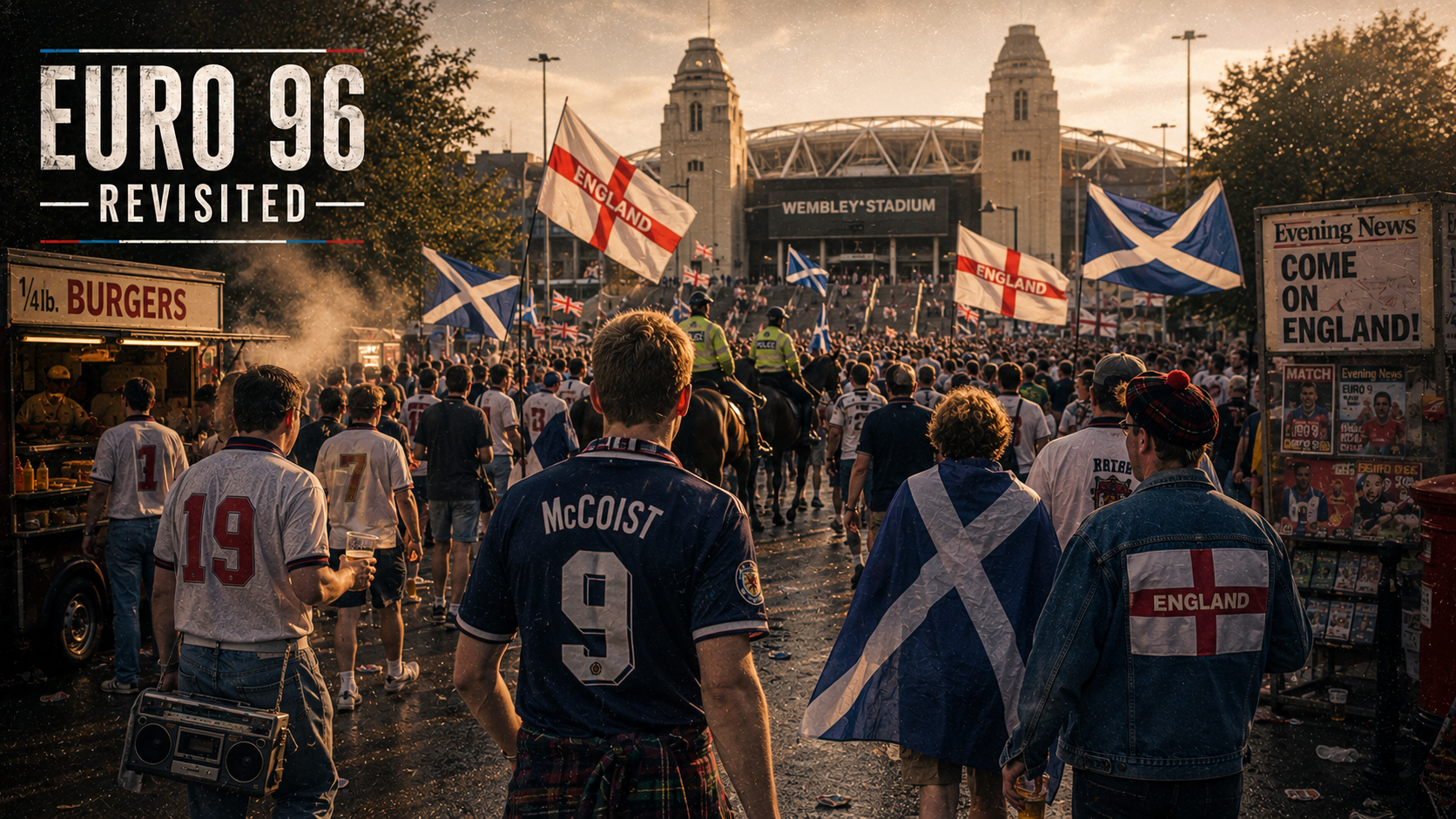
A football match wrapped in sunshine, beer and Britpop that revealed something deeper beneath the noise: England and Scotland were no longer imagining Britain in quite the same way.
Key Takeaways
- England’s 2-0 win over Scotland at Euro 96 was not just a rivalry match, but a public performance of changing British identity.
- The fixture exposed the growing separation between Englishness and Britishness during the devolution-era 1990s.
- The ninety seconds between David Seaman’s penalty save and Paul Gascoigne’s goal turned the match from tension into mythology.
- For England, it became revival. For Scotland, it became another reminder of how easily shared British events became English stories.
Wembley, Summer, and the Performance of a Happy Country
The approach to Wembley in June 1996 felt like Britain trying on a new version of itself.
Flags hung from pub windows and minicab offices. Burger vans hissed at the roadside. Police horses moved slowly through crowds that did not yet fully trust one another but wanted, desperately, to believe the old reputations had been left behind. Portable radios crackled with pre-match build-up while lager slopped onto pavements already sticky in the heat. Everywhere, there were St George’s Crosses. Not hidden. Not apologetic. Not angry either. Just present.
That alone felt new.
For decades the English flag had carried uncomfortable associations. It belonged either to football hooligans, the far right, or men photographed shirtless beside trouble abroad. The England of Euro 96 wanted something different from it. Softer. More relaxed. More ordinary. Families wore it. Children painted it on their cheeks. Shopkeepers hung it beside hanging baskets and cigarette adverts as though it had always belonged there.
The country hosting Euro 96 was attempting a public reinvention in real time.
Only eleven years earlier, English football had been internationally disgraced after Heysel. Six years earlier, supporters had still been climbing fences at Italia 90 while English police forces treated football crowds as potential riots waiting to happen. Yet by the summer of 1996, England wanted to present itself as modern, humorous and welcoming. Football had become the stage on which the nation rehearsed its own rehabilitation.
Wembley mattered because Wembley was theatre.
The old stadium, with its twin towers and long concrete approaches, had always carried a sense of ceremony. Cup finals felt national there. England matches felt historic before a ball had even been kicked. But Euro 96 transformed the place into something else. The stadium no longer represented only football tradition. It became a backdrop for the country’s attempt to project stability, confidence and cultural relevance during a decade that often felt politically uncertain underneath the surface.
By kick-off against Scotland on 15 June, the tournament had already begun to alter the national mood. England’s opening draw against Switzerland had created anxiety, but the wider atmosphere around Euro 96 remained euphoric. The country had spent years talking itself into decline. Suddenly there were signs, however fragile, that Britain could still produce something vibrant enough to command attention.
Yet almost every part of that optimism contained tension underneath it.
The Conservative government was exhausted and internally divided over Europe. Scottish devolution had moved from abstract constitutional debate into something emotionally real. The IRA bombing campaign still hung over English cities. The tabloids oscillated between celebratory patriotism and outright xenophobia. Cool Britannia had not yet fully arrived, but the machinery around it was already visible in the overlap between football, music, fashion and politics.
Even the flags outside Wembley told a more complicated story than people realised at the time.
For much of the twentieth century, English football culture had wrapped itself in Britishness. The Union Jack had traditionally carried the emotional weight of international tournaments. But Euro 96 marked the moment when the St George’s Cross truly replaced it as the dominant symbol of support. England were still representing the United Kingdom in the eyes of much of the world. Increasingly, however, England itself was imagining something narrower, more specifically English, more detached from the broader idea of Britain.
Scotland noticed this before England did.
The Tartan Army arrived in London not simply as visiting supporters, but as a travelling expression of a different national identity. Their humour, self-awareness and carnival atmosphere stood in deliberate contrast to the darker reputation attached to English football culture during the 1970s and 1980s. They drank heavily, sang constantly and occupied public spaces noisily, but they also understood the political performance involved. Scotland wanted to be seen differently from England. Euro 96 gave them the perfect audience.
That was what made England versus Scotland impossible to reduce to sport alone.
The fixture carried centuries of history, but in the summer of 1996 it also carried something more contemporary and unstable. This was not simply the oldest rivalry in international football. It was a match played between two nations beginning to imagine themselves differently inside the same state.
Under the warm Wembley sunlight, with the smell of beer and onions hanging in the air and “Football’s Coming Home” leaking from nearby pubs, Britain looked united enough for television.
The reality underneath was already beginning to fracture.
“Football’s Coming Home” and Who “Home” Belonged To
The slogan of Euro 96 sounded simple enough to fit on a beer mat.
“Football’s Coming Home” appeared on television trailers, newspaper back pages, car windows and hastily painted bedsheets hanging from semi-detached houses across England. By the middle of June it had escaped the tournament entirely and entered the language of everyday life. People who barely watched football knew the chorus. Children sang it in school playgrounds. Taxi drivers repeated it at traffic lights. It became less a song than a national reflex.
What made it powerful was not triumphalism, but vulnerability.
For decades English football culture had often projected entitlement, a lingering belief that the self-declared inventors of the modern game possessed some natural right to international success. Three Lions inverted that completely. The song acknowledged failure openly. Thirty years of hurt. All those near misses. The weight of memory rather than the expectation of glory. England fans embraced it because it sounded emotionally honest in a way football songs rarely did.
But the phrase itself carried another implication, one that sounded very different north of the border.
Football was “coming home” to England. Not Britain.
That distinction mattered more than many English supporters realised at the time.
For much of the twentieth century, English sporting identity had comfortably overlapped with British identity. The Union Jack dominated major tournaments. English success was frequently presented abroad as British success. Even politically, England had rarely needed to define itself separately because England effectively operated as the centre of British power. Britishness often functioned as Englishness enlarged.
Euro 96 quietly disrupted that arrangement.
The St George’s Cross became the visual language of the tournament. It hung from tower blocks, market stalls and pub ceilings in quantities that would have felt startling even six years earlier. Italia 90 had still largely belonged to the Union Jack. By 1996 the English flag had become mainstream, domesticated and strangely depoliticised. Families waved it. Pop stars wore it. Broadcasters framed it as cheerful rather than confrontational.
England was rediscovering itself as England.
That did not automatically feel inclusive to Scotland.
From an English perspective, Euro 96 often resembled a national celebration generously opened to visitors. From a Scottish perspective, parts of the tournament could feel like England staging its own emotional revival while continuing to speak in the language of collective Britishness whenever convenient. The tension was subtle but important. England increasingly saw itself through the lens of English culture, English optimism and English nostalgia. Scotland, meanwhile, had already begun drifting toward a more self-conscious national identity of its own.
The rivalry therefore existed on unequal emotional terrain.
For England supporters, Scotland represented history, familiarity and local rivalry. For Scotland supporters, England represented proximity to power itself. Westminster. London media. British broadcasting. The assumption that English experience naturally sat at the centre of national life. The football rivalry carried those tensions into public view without always naming them directly.
That was why the atmosphere around the fixture felt emotionally heavier than many England fans expected.
At Wembley and across London, Scotland supporters often treated the tournament with ironic distance. There was humour in the songs, humour in the drinking, humour even in defeat before a ball had been kicked. But underneath that humour sat something sharper: the pleasure of resisting absorption into England’s story of itself.
The English media did not fully understand this dynamic because most of the national conversation still flowed through London.
Much of the coverage framed Euro 96 as a celebration of British renewal. Yet the symbols on display increasingly belonged to England alone. The soundtrack was English. The iconography was English. The emotional memory being created was English. Scotland participated in the occasion while simultaneously remaining outside the central mythology being constructed around it.
Even the phrase “Football’s Coming Home” revealed a contradiction hiding in plain sight.
If football truly belonged to everyone in the United Kingdom, why did the emotional ownership of the tournament feel so specifically English?
That question lingered quietly beneath the sunshine and the carnival atmosphere as supporters moved toward Wembley. Most people inside the stadium would not have articulated it politically. But they could feel it instinctively. Euro 96 was becoming a defining moment in modern English identity at the exact moment the idea of a unified British identity was beginning to weaken.
The match that afternoon would expose that tension far more clearly than anyone expected.
The Tartan Army Occupies London
If England approached Euro 96 as hosts rediscovering confidence, Scotland arrived as guests entirely comfortable with who they already were.
By the morning of the match, central London had effectively become Scottish territory.
Trafalgar Square filled early. Saltire flags draped across fountains and statues. Bagpipes echoed through streets usually dominated by traffic noise and tourist chatter. Beer cans rolled across paving stones while supporters climbed onto lampposts and sang folk songs into the summer air. Police officers largely stood back and watched. The atmosphere was loud, chaotic and alcohol-soaked, but it rarely felt threatening.
That distinction mattered enormously.
For years, British football culture had been internationally associated with violence, disorder and fear. English hooliganism during the 1970s and 1980s had stained the reputation of the entire game. Every major tournament involving British teams carried the expectation of trouble somewhere nearby. Yet the Tartan Army consciously presented itself as the opposite of that image. Their identity rested not on intimidation, but on performance.
Humour became a form of national branding.
Scotland supporters mocked themselves constantly. They sang about inevitable defeat before kick-off. They posed for photographs with police officers and opposing fans. They treated public drunkenness less as aggression than theatre. Even when chanting against England, there was usually a wink somewhere underneath it. The point was not domination. The point was visibility.
This was nationalism performed through self-awareness rather than menace.
English observers often romanticised the Tartan Army during the 1990s because they seemed to offer a safer, friendlier alternative to the tribal violence that had previously dominated terrace culture. But that friendliness also carried a subtle edge. Scotland supporters enjoyed presenting themselves as morally superior to England’s football past. Their carnival atmosphere became an implicit criticism of the darker reputation English fans had spent years trying to escape.
In many ways, the Tartan Army understood the politics of image before English football did.
The Scotland support recognised that modern football crowds were now part of a televised global spectacle. Behaviour mattered. Optics mattered. National stereotypes could be reshaped publicly through visibility and repetition. By Euro 96, Scotland fans had developed a reputation across Europe for heavy drinking, relentless singing and surprisingly low levels of violence. They became folk heroes of tournament culture precisely because they appeared capable of separating nationalism from hostility.
That did not mean the rivalry lacked bitterness.
The chants drifting through central London still carried centuries of irritation underneath them. Many Scotland supporters genuinely despised the English media’s self-importance and the assumption that England represented the natural centre of British football life. “Anyone But England” was not yet the fully commercialised slogan it would later become, but the emotional instinct behind it already existed.
Yet there was also something strangely affectionate about the entire spectacle.
England and Scotland supporters drank together in pubs before the match. Tourists stopped to photograph mixed groups singing at each other across streets. The rivalry felt deeply emotional without fully tipping into hatred. That balance gave the occasion its unique atmosphere. Wembley was preparing to host one of international football’s oldest fixtures, but the mood around London often resembled a travelling carnival more than a security operation.
Euro 96 needed that image.
The British state, broadcasters and football authorities all understood the symbolic importance of the tournament running peacefully. England was attempting to prove itself rehabilitated after decades of embarrassment. Every cheerful crowd shot, every singing supporter and every image of cross-border drinking fed into the wider idea that football culture had matured into something more civilised.
The Tartan Army became central characters in that story.
But beneath the humour and sunshine sat another reality. Scotland’s supporters could celebrate alongside England while still feeling emotionally separate from the national narrative forming around the tournament. They could occupy London joyfully without ever fully buying into the story England was telling about itself.
That contradiction gave the entire day its strange emotional texture.
On the surface, Britain appeared united by football, beer and shared nostalgia.
Underneath, different nations were already imagining different futures.
The Bomb in Manchester
At 11:17am on 15 June 1996, only a few hours before kick-off at Wembley, the IRA detonated a massive bomb in central Manchester.
The explosion tore through Corporation Street with extraordinary force. Glass and debris rained across the city centre. Shop fronts collapsed. Buildings shook. Smoke drifted above streets that, only moments earlier, had been crowded with Saturday shoppers. More than 200 people were injured. Miraculously, nobody was killed, largely because of a rapid evacuation after coded warnings had been issued beforehand.
For a brief moment, the illusion of a carefree national summer disappeared.
Euro 96 is often remembered through sunlight and nostalgia. Gazza’s goal. “Three Lions.” Flags hanging from pub windows. But the tournament unfolded inside a country still carrying deep political and constitutional fractures. The Manchester bomb forced that reality violently back into view on the very day England played Scotland at Wembley.
The contrast was almost surreal.
One part of Britain prepared to stage a football spectacle designed to present the nation as modern, relaxed and culturally renewed. Another part remained trapped inside a conflict that had defined British and Irish political life for decades. Television coverage struggled to reconcile the two moods. News bulletins shifted abruptly between scenes of wreckage in Manchester and supporters drinking outside Wembley in replica shirts and sunglasses.
The emotional dissonance lingered throughout the afternoon.
For the British government, Euro 96 represented more than a football tournament. It was a demonstration that Britain remained stable, outward-looking and capable of hosting a major international event with confidence. The timing of the bombing therefore felt especially destabilising. Behind the smiling tournament branding and celebratory media coverage sat a state still dealing with terrorism, constitutional uncertainty and unresolved national tensions.
Even geographically, the bombing carried symbolic weight.
Manchester in the mid-1990s stood at the centre of a different version of modern Britain. This was the city of Oasis, Hacienda mythology, regenerated industry and post-industrial reinvention. Cool Britannia often borrowed heavily from Manchester’s cultural energy while simultaneously turning it into a marketable national mood. The IRA attack shattered that atmosphere for a few hours and reminded the country that optimism did not erase political reality.
Yet Euro 96 carried on almost uninterrupted.
Supporters still travelled to Wembley. Broadcasters still built toward kick-off with swelling music and tournament montages. Beer still flowed through pubs around north-west London. The football machine kept moving because major sporting events are designed to absorb disruption and convert uncertainty into spectacle.
But the bombing changed the emotional reading of the day in hindsight.
What looked at the time like a celebration of British togetherness now feels more complicated. England versus Scotland was already exposing questions around identity and belonging inside the United Kingdom. The Manchester bomb added another layer entirely: the reminder that Britain itself remained politically unsettled beneath the carnival atmosphere.
That tension gave Euro 96 much of its strange emotional power.
The tournament projected warmth, humour and collective optimism at the exact moment the structures holding the United Kingdom together were beginning to feel increasingly fragile. Most supporters walking toward Wembley that afternoon would not have framed it in those terms. They were thinking about line-ups, songs, beer and rivalry. Yet the wider context shaped the emotional landscape whether they recognised it or not.
The old Britain had not disappeared.
It had simply learned, for a while, how to hide its anxieties behind football.
The Match That Turned on Ninety Seconds
For more than an hour, England versus Scotland felt trapped between tension and inertia.
Wembley was loud long before kick-off, but not carefree. The emotional weight surrounding the fixture sat heavily on both teams. England carried the pressure of hosting the tournament and the anxiety of underperforming against Switzerland in the opening match. Scotland carried something different: the burden of trying to disrupt England’s national revival while knowing defeat would become part of somebody else’s mythology.
The football reflected that nervousness.
England began brightly enough, but the game soon became compressed and uneasy. Scotland’s midfield shape caused persistent problems, particularly through Gary McAllister’s composure and John Collins drifting intelligently between lines. Steve McManaman struggled to influence the match centrally, while England’s attacks often felt rushed, emotional and slightly disconnected from one another.
Scotland, by contrast, looked comfortable inside the tension.
That mattered because England had spent much of the early 1990s trying to modernise the image of the national side without always modernising the football itself. Terry Venables wanted a more fluid England. More technical. Less predictable. But in the first half the old anxieties remained visible. The crowd became restless whenever moves broke down. Every misplaced pass seemed to carry the weight of the occasion with it.
At half-time, Venables made the adjustment that subtly changed the emotional direction of the match.
Jamie Redknapp replaced McManaman and immediately altered England’s rhythm. The passing became calmer and cleaner. Possession moved quicker through midfield. Scotland were pushed slightly deeper. Most importantly, Paul Gascoigne suddenly found more freedom higher up the pitch instead of constantly dropping into crowded areas searching for the ball. UEFA’s own retrospective noted that Redknapp’s introduction changed the complexion of the contest.
England’s emotional transformation began with a tactical one.
The breakthrough arrived quickly. Gary Neville delivered from the right and Alan Shearer rose to power a header beyond Andy Goram. Wembley exploded, though the reaction felt closer to relief than pure celebration. England had needed the goal desperately. Not simply to win the match, but to restore momentum to the entire tournament narrative building around the team.
Yet the game still felt fragile.
Scotland refused to collapse. McAllister continued to dictate possession intelligently and every English mistake generated fresh anxiety around the stadium. The atmosphere swung constantly between confidence and fear, the crowd never entirely trusting what it was seeing in front of it.
Then came the moment that altered everything.
In the 76th minute, Scotland won a penalty.
Tony Adams pulled Gordon Durie inside the area and suddenly the emotional direction of the entire tournament hung in the balance. Wembley, deafening seconds earlier, tightened into near silence. Gary McAllister placed the ball on the spot while England supporters stared toward the goal with the familiar dread of a nation trained by football disappointment.
Had Scotland equalised there, the emotional history of Euro 96 might have changed completely.
Instead, David Seaman threw himself low to his right and pushed the penalty away.
The save produced an explosion of relief unlike anything England had experienced in the tournament so far. Wembley did not celebrate immediately so much as convulse. Supporters screamed not with triumph, but with survival instinct. The match, the atmosphere, perhaps even the optimism surrounding the entire summer, suddenly felt rescued.
And then, barely ninety seconds later, came the image that would define the championship.
Gascoigne drifted toward the Scottish penalty area and received the ball near the edge of the box. Colin Hendry lunged to intercept. Gascoigne lifted the ball delicately over him with the outside of his boot before volleying past Goram in one fluid movement.
The stadium lost emotional control.
Even now, the goal feels strangely detached from normal football logic, as though it arrived from a different emotional register entirely. Gascoigne’s touch carried improvisational freedom at the exact moment everybody else seemed paralysed by pressure. The finish was brilliant technically, but what transformed it into mythology was timing. England had spent decades fearing collapse. In less than two minutes, they had moved from possible humiliation to euphoric release.
Scotland’s devastation became part of the same emotional picture.
The rivalry’s asymmetry revealed itself instantly in the reactions. For England supporters, the goal felt redemptive and transformative, confirmation that Euro 96 had finally burst into life. For Scotland supporters, it carried a familiar cruelty. Once again, England occupied the centre of the football story while Scotland became supporting cast in somebody else’s national memory.
That imbalance would shape how both countries remembered the afternoon for decades afterward.
Yet in the moment itself, the emotion inside Wembley overwhelmed everything else. Beer flew through the air. Strangers grabbed each other. Flags whipped above heads in every direction. “Three Lions” echoed around the old stadium with renewed force. England suddenly looked not just alive in the tournament, but culturally unstoppable.
The entire country seemed to tilt emotionally within the space of ninety seconds.
And Paul Gascoigne stood directly at the centre of it.
The Dentist’s Chair and the Rise of Lad England
The goal alone would have guaranteed immortality.
What happened afterward transformed it into something larger than football.
As Gascoigne sprinted toward the touchline, he threw himself backward onto the Wembley turf while teammates crowded around him pretending to squirt drinks into his open mouth. Millions watching instantly understood the reference. Only weeks earlier, photographs from England’s pre-tournament trip to Hong Kong had triggered tabloid outrage after players were pictured in a nightclub carrying out the so-called “dentist’s chair” drinking game.
Before Euro 96, the episode had been framed as evidence of irresponsibility and national embarrassment.
After Gascoigne’s goal, it became mythology.
That reversal mattered because it captured the strange cultural mood of mid-1990s England perfectly. Footballers were no longer distant athletes separated from supporters by formality and discipline. They were becoming celebrities shaped by tabloid culture, advertising, nightlife and laddish humour. The England team at Euro 96 looked less like representatives of the old Football Association establishment and more like recognisable extensions of the young male culture forming around pubs, magazines and Britpop.
The celebration worked because it felt rebellious without becoming dangerous.
For much of the 1980s, English football’s public image had been dominated by genuine menace: violence, disorder, tribal aggression and moral panic. By contrast, the dentist’s chair carried a softer form of transgression. It was cheeky rather than threatening. The humour sat in its refusal to apologise. Gascoigne and the England players effectively turned tabloid condemnation into a national in-joke at the exact moment the country wanted footballers who felt emotionally accessible rather than remote.
This was lad culture entering the centre of English sporting identity.
Not in the exaggerated caricature it would later become, but in its original mid-90s form: ironic, performative, heavy-drinking, emotionally open beneath layers of humour. The England team embodied that shift almost accidentally. They laughed publicly, cried publicly and celebrated publicly in ways previous generations of England footballers rarely had. Even their imperfections became part of their appeal.
Gascoigne stood at the heart of that transformation.
He did not look manufactured. He did not sound media-trained. He appeared vulnerable, impulsive and emotionally combustible, qualities supporters often trusted more than professionalism. England’s relationship with him was unusually protective because fans sensed both his genius and his fragility simultaneously. The dentist-chair celebration intensified that bond. It suggested a player refusing to let public shame define him during the biggest moment of his career.
For Scotland supporters, however, the image carried a different emotional meaning.
The celebration instantly became part of England’s national folklore while Scotland were left once again occupying the role of backdrop to English catharsis. That asymmetry mattered. The mythology of Euro 96 increasingly centred on England’s emotional journey, England’s humour and England’s release. Scotland’s role in the story became reduced to opposition, pain and frustration despite how competitive the match itself had been.
Yet the wider cultural significance of the moment extended beyond the rivalry.
The dentist’s chair marked one of the clearest moments where English football stopped feeling ashamed of itself. The game had spent years trying to rehabilitate its image after hooliganism, Heysel and Hillsborough. Euro 96 did not erase those histories, but it reframed football culturally. Suddenly the national team looked marketable, fashionable and emotionally magnetic. Footballers became central figures in the broader entertainment culture emerging around Britain during the decade.
Even the tabloids shifted tone almost instantly.
Players who had been criticised as irresponsible in Hong Kong became lovable rogues once England started winning. That flexibility revealed how badly the country wanted heroes who reflected the looseness and optimism of the era. Gazza’s celebration captured that mood in a single image: laddish, funny, slightly chaotic and emotionally sincere underneath the performance.
For England supporters, it felt like freedom.
Not political freedom or even sporting freedom exactly, but emotional freedom. The freedom to enjoy the national team again without embarrassment. The freedom to wave the St George’s Cross without immediately associating it with violence or extremism. The freedom to believe football could belong to ordinary people rather than fear, shame or failure.
For a few minutes after Gascoigne’s goal, Wembley felt less like a stadium than a release valve for an entire decade of accumulated tension.
Why Scotland Remembered the Match Differently
In England, the match became a national memory almost immediately.
In Scotland, it became something far more complicated.
That difference revealed the true emotional imbalance at the centre of the rivalry.
For England supporters, victory over Scotland at Wembley formed part of a broader national narrative. Gascoigne’s goal, Seaman’s save and the dentist-chair celebration all fed into the feeling that Euro 96 had finally ignited. The match sat inside a larger story about optimism, revival and England reconnecting emotionally with football after years of disappointment and embarrassment.
For Scotland supporters, the experience carried no such release.
Instead, the afternoon often reinforced an old frustration: England’s ability to turn shared British events into specifically English mythology. Scotland had contributed hugely to the atmosphere of the tournament. The Tartan Army had become one of Euro 96’s defining visual and cultural presences. Yet once the match ended, Scottish identity within the wider media narrative quickly narrowed into familiar stereotypes of gallant defeat and comic heartbreak.
England remained the emotional centre of the story.
That imbalance shaped how the rivalry evolved during the modern era.
For much of the twentieth century, England versus Scotland had operated as one of world football’s fiercest and most meaningful fixtures. But by the 1990s the relationship had subtly changed. England increasingly viewed Germany, Argentina and major tournament football as the defining emotional theatres of the national game. Scotland, meanwhile, still experienced England as the central reference point in footballing identity.
The rivalry no longer weighed equally on both sides.
Many England supporters still cared deeply about beating Scotland, particularly older generations raised on the British Home Championship. But for Scotland supporters, defeating England retained a broader symbolic significance tied to culture, media, politics and national self-definition. England often represented more than football opposition. It represented proximity to dominance itself.
That emotional asymmetry frustrated many Scottish observers during Euro 96.
London-based broadcasters and newspapers frequently framed the fixture through an English lens, treating Scotland simultaneously as fierce rivals and supporting cast within England’s larger tournament narrative. Even the language around the match often revealed unconscious assumptions. England’s story carried the emotional weight. Scotland’s role was disruption, irritation or obstacle.
This partly explains why “Anyone But England” developed such lasting cultural power north of the border.
In England, the phrase was often interpreted as bitterness. In Scotland, it frequently functioned as resistance to absorption into England’s emotional universe. Supporting whoever played England became a way of preserving distinctiveness inside a media culture overwhelmingly dominated by English perspectives and priorities.
Euro 96 intensified those feelings because the tournament itself became so strongly associated with modern English identity.
The St George’s Cross. “Three Lions.” Wembley. Gazza. Lad culture. Britpop aesthetics. Everything about the event increasingly pointed toward England rediscovering itself publicly. Scotland participated fully in the occasion while simultaneously remaining outside the central mythology being created around it.
And yet Scottish memory of the match often carries a strange affection alongside the pain.
Many Scotland supporters still speak warmly about the atmosphere surrounding Euro 96 despite the result. The Tartan Army’s occupation of London became part of Scottish football folklore in its own right. The humour, drinking and carnival atmosphere mattered because they reinforced a self-image Scotland preferred: passionate but not menacing, tribal but not violent, emotionally intense without fully surrendering to aggression.
That distinction became an important point of national pride.
England’s football culture during the 1980s had often been associated internationally with fear. Scotland supporters believed Euro 96 demonstrated an alternative version of British football fandom, one built around irony, performance and collective humour rather than confrontation. In that sense, many Scottish fans left Wembley believing they had lost the match but won the cultural argument.
England, naturally, saw it differently.
From an English perspective, Euro 96 represented rehabilitation, warmth and emotional reconnection with the national team. The tournament felt inclusive because England itself felt newly comfortable expressing national identity publicly. Most England supporters did not experience the atmosphere as exclusionary or politically loaded. They experienced it as joyous.
That gap in perception mattered.
Because by the summer of 1996, England and Scotland were no longer interpreting the same symbols in quite the same way.
And football exposed that reality more clearly than politics had managed to yet.
The Last Summer Before the Split
For a few weeks in the summer of 1996, Britain managed to look comfortable with itself again.
The memory survives in fragments now. Flags hanging from pub windows. Portable televisions in beer gardens. Children recreating Gascoigne’s goal in parks long after sunset. Newspapers filled with football rather than scandal or recession. “Three Lions” pouring from radios and car stereos as though hope itself had become commercially available.
Euro 96 felt warm in every sense.
That warmth explains why the tournament still occupies such a powerful place in English cultural memory. It represented more than football success. England did not even reach the final. What supporters remember instead is emotional possibility. The sense that the country had briefly rediscovered a version of itself that felt optimistic, humorous and connected rather than anxious or divided.
But hindsight changes the shape of the story.
What looked at the time like a celebration of British togetherness increasingly resembles something else: the moment the United Kingdom’s separate identities became impossible to fully fold back into one another. Euro 96 did not create those tensions. Scotland, Wales and England had always carried different political and cultural instincts beneath the surface of Britishness. Yet the tournament illuminated those differences publicly through football, symbolism and atmosphere in ways people only partially understood at the time.
England’s rediscovery of the St George’s Cross was central to that shift.
For generations, English national identity had often hidden comfortably inside broader British identity. By 1996 that arrangement was beginning to change. The Union Jack receded while the English flag moved into the mainstream. Football accelerated the process because football provided emotional rituals powerful enough to reshape public symbolism quickly. Supporters who might once have described themselves instinctively as British increasingly experienced major tournaments through the language of Englishness instead.
Scotland was already emotionally somewhere else.
The devolution referendum would arrive only a year later. The Scottish Parliament would follow in 1999. None of that emerged directly from Euro 96, of course, but the tournament revealed how differently the nations increasingly imagined themselves. England saw a national revival. Scotland often saw England rediscovering confidence specifically as England.
That distinction became one of the defining political and cultural fault lines of the next three decades.
Even the atmosphere around Wembley now feels revealing in retrospect. The carnival mood, the beer-soaked humour, the flags and songs all projected unity on television screens across the country. Yet beneath the shared spectacle sat entirely different emotional experiences depending on where you stood, which flag you waved and how you interpreted the meaning of “home.”
England versus Scotland at Euro 96 therefore became more than a football match and more than a rivalry.
It became a public negotiation over identity taking place before millions of viewers who mostly believed they were simply watching sport. The fixture exposed how football could operate simultaneously as entertainment, nationalism, memory, theatre and political symbolism without fully declaring itself as any of those things outright.
That was the genius of Euro 96.
The tournament rarely explained itself directly. Instead it allowed atmosphere to carry meaning. Supporters sensed something important was happening long before they possessed the language to describe it properly. The old Wembley, with its twin towers and heavy summer air, became the stage where those emotions briefly converged.
For England, the afternoon against Scotland became one of the defining images of modern national optimism.
For Scotland, it became another reminder of the complicated relationship between participation and ownership inside British public life.
For Britain itself, the match now feels strangely transitional. Not the end of the United Kingdom. Not the beginning of separation. But perhaps the last great sporting moment before the identities inside the union stopped pretending they all meant exactly the same thing.
At the time, almost nobody saw it that way.
They were too busy singing.
