


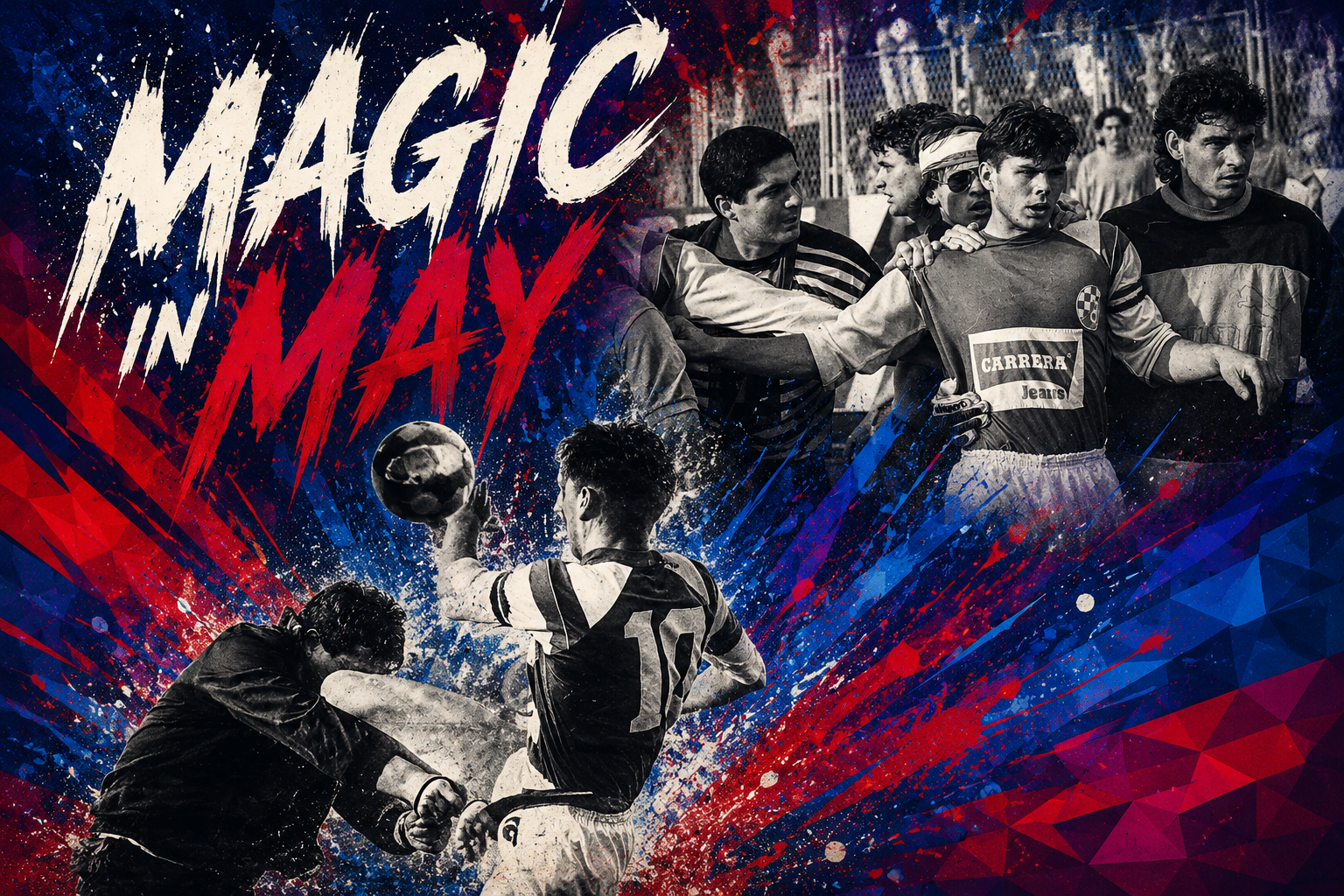
One kick at Maksimir Stadium turned Zvonimir Boban into a political symbol. But behind the image was one of the most intelligent midfielders of his generation.
The Fence Broke First
The first thing to break was the fencing.
Not the state. Not Yugoslavia. Not even the football match itself.
Just the rusted metal barrier behind the southern goal at Maksimir Stadium, where the supporters of Red Star Belgrade had begun tearing through the segregation line hours before kick-off.
It was supposed to be the biggest match of the Yugoslav season. Dinamo Zagreb against Red Star Belgrade on 13 May 1990. Top against top. A title race wrapped inside one of the fiercest rivalries in European football.
Instead, it became something else entirely.
By early afternoon, Maksimir no longer resembled a football stadium. The air hung thick with smoke and chemical residue from tear gas. Plastic seats rained from the terraces. Glass shattered somewhere beneath the din of nationalist chanting. Police sirens dissolved into the noise. Thousands of supporters surged violently against one another while lines of riot police struggled to contain a collapse that now felt larger than sport.
In the southern enclosure, Red Star’s ultras, the Delije, had arrived in force from Belgrade. Many were led by Željko Ražnatović, known as Arkan, the paramilitary figure who would later become one of the most notorious names of the Balkan wars. Witnesses later claimed acid had been used to weaken sections of fencing before the visiting supporters burst through towards Dinamo fans.
The response from the Bad Blue Boys was immediate.
Dinamo’s ultras stormed barriers from the northern stand and flooded onto the pitch. Police batons swung indiscriminately. Water cannons blasted across the grass. What began as crowd disorder rapidly mutated into open street violence inside a football stadium. Players disappeared down tunnels. The Red Star squad were hurried away from danger as the situation deteriorated beyond control.
Yet several Dinamo players stayed on the field.
Among them was their captain, Zvonimir Boban.
Only 21 years old, Boban stood near the centre circle watching riot police clash with Dinamo supporters scattered across the turf. Then, through the chaos, he saw one officer striking a fan who had fallen to the ground.
What happened next lasted seconds.
Boban sprinted forward, launched himself into the air, and drove a flying kick into the policeman’s chest.
The image froze almost instantly into history. Boban suspended mid-air. The officer falling backwards. Dinamo supporters swarming around their captain to shield him from retaliation.
Within hours, the footage was travelling across a country already beginning to fracture beyond repair.
“Here I was, a public figure prepared to risk his life, career, and everything fame could bring, for one ideal. For the Croatian cause.”
It became one of the defining images of the end of Yugoslavia.
But it also became a trap.
Because from that day forward, much of the world remembered Zvonimir Boban not as one of the finest midfielders of his generation, nor as the cerebral heartbeat of AC Milan and Croatia’s golden era, but as a footballer forever frozen in a moment of political violence.
The riot made him immortal.
It also threatened to consume everything else he was.
The Man Behind the Myth
For more than three decades, that image has followed Boban everywhere.
The kick. The riot. The policeman collapsing backwards at Maksimir. The grainy footage replayed whenever Yugoslavia’s collapse is discussed. In Croatia, the moment was elevated into national folklore. Outside the Balkans, it became shorthand for football’s power to mirror political catastrophe.
The mythology grew so large that eventually it swallowed the footballer whole.
Boban became remembered less as a midfielder than as a symbol. Less as an athlete than as a historical image. Depending on perspective, he was cast either as a nationalist hero who stood against oppression or as an emotionally reckless footballer whose violence became romanticised by a generation desperate for symbols.
Both readings flatten him.
Because the truth about Boban is more complicated, and far more interesting.
Long before the riot, he was regarded as one of the outstanding young playmakers in Europe. Long after it, he evolved into one of the defining midfield orchestrators of 1990s Serie A, operating inside perhaps the most tactically demanding environment club football has ever known.
At AC Milan, he was not protected as a luxury No.10. He survived because he could think, adapt, and work. Under Fabio Capello, sentiment meant nothing. Reputation meant little more. Boban earned trust because he understood rhythm, positioning, and responsibility at elite level.
This matters because history has a habit of simplifying footballers who become politically useful.
The riot at Maksimir eventually came to overshadow almost everything else in Boban’s career: four Serie A titles, a Champions League triumph in 1994, captaining Croatia to third place at the 1998 World Cup, and later becoming one of the more thoughtful figures in European football administration.
Even discussions of Croatian football history often reduce him to the man who “started the war”, an absurd simplification of a conflict shaped by collapsing federal power, economic crisis, aggressive nationalism, and political manipulation far beyond the control of any athlete.
What made Boban fascinating was not that he became a symbol.
It was that he spent much of his life trying to remain a footballer while the world insisted on turning him into one.
That tension defined everything.
A Croatian Talent in a Yugoslav Fault Line
Boban was born on 8 October 1968 in Imotski, a small town in the Dalmatian hinterland of what was then socialist Yugoslavia, but his footballing identity was shaped in Zagreb.
To understand the pressure surrounding him from such a young age, it is important to understand what football represented inside Yugoslavia during the 1970s and 1980s. Clubs were never merely clubs. They were cultural fault lines disguised as sporting institutions.
Under Josip Broz Tito, the Yugoslav state had aggressively promoted the idea of “Brotherhood and Unity”, an attempt to suppress ethnic nationalism beneath a broader Yugoslav identity. Football became one of the regime’s most visible tools. Success on the pitch projected stability abroad and solidarity at home.
But beneath the surface, the old tensions never disappeared.
In Croatia especially, Dinamo Zagreb evolved into something larger than sport. The club represented a distinctly Croatian urban identity that often existed uneasily alongside the centralised political power centred in Belgrade. The stadium became one of the few places where nationalist sentiment could still be expressed semi-openly, particularly after Tito’s death in 1980 weakened the cohesion of the federation.
Boban entered that environment as an unusually gifted teenager.
Even before he reached the first team, coaches spoke about his intelligence as much as his talent. He was technically outstanding, but also deeply articulate, serious, and fiercely self-assured. Former teammates would later describe him less like a typical academy prodigy and more like a university student who happened to dominate football matches.
That intellectual edge became part of both his appeal and his difficulty.
Boban did not behave like a deferential young footballer. He questioned things. He argued. He carried himself with a confidence that could drift into arrogance depending on who was judging him. Yet inside Dinamo’s youth system, his authority on the pitch was impossible to ignore. He saw passes before others recognised spaces. He controlled tempo naturally.
By the mid-1980s, Yugoslavia itself was beginning to fracture economically and politically. Hyperinflation surged. Nationalist rhetoric intensified. Football terraces became increasingly militant. Matches involving the major clubs from Croatia and Serbia carried an atmosphere that often felt closer to political confrontation than sport.
And in the middle of it all stood Dinamo’s emerging captain.
Boban was still barely out of adolescence when supporters began projecting far larger meanings onto him. He was educated, Croatian, confrontational, technically brilliant, and emotionally fearless. To many Dinamo supporters, he represented the kind of modern Croatian identity they believed the Yugoslav system had spent decades suppressing.
That burden arrived long before the riot ever did.
The Young Captain Who Became Unavoidable
By the end of the 1980s, Boban was no longer merely a gifted young midfielder emerging from Dinamo’s academy.
He had become unavoidable.
Yugoslav football at the time was one of the richest talent environments in Europe. The league combined technical sophistication with genuine hostility. Away matches were vicious. Midfields were overcrowded and physical. Stadiums pulsed with political aggression. Yet the standard of football remained remarkably high.
This was the ecosystem that produced Boban, alongside Robert Prosinečki, Dragan Stojković, Davor Šuker and Dejan Savićević.
Within that generation, Boban stood apart for one reason above all others.
Control.
He was not the most flamboyant. Prosinečki possessed softer improvisational magic. Savićević could destabilise entire defensive structures through chaos alone. But Boban played with a colder authority. Even as a young player, he seemed to understand the emotional temperature of matches instinctively. He knew when to accelerate attacks and when to slow them. He absorbed pressure rather than rushing away from it.
That maturity made him captain of Dinamo at just 21 years old during the 1989-90 season, a staggering responsibility in the context of Yugoslav football.
And the timing could hardly have been more combustible.
The country was disintegrating politically. Nationalist parties were rising across the republics. Economic collapse deepened social anger. Every major fixture between Croatian and Serbian clubs now carried enormous symbolic weight.
Yet amidst the noise, Boban’s football continued evolving rapidly.
Tactically, he operated as a hybrid creator rather than a traditional static No.10. He dropped deep into midfield build-up phases to escape markers, often receiving possession on the half-turn before driving forward through central channels. Unlike many attacking midfielders of the era, he did not wait for games to come to him. He imposed himself physically and psychologically.
Former Yugoslav defenders often spoke about how difficult he was to press because he rarely received the ball square. His body orientation constantly opened passing lanes before challenges arrived. One touch repositioned the entire phase of play. Then came the vertical pass.
Just as importantly, he competed.
That mattered enormously inside Yugoslav football culture. Technical elegance alone earned little protection. Midfielders were expected to survive contact, intimidation, and tactical cynicism. Boban embraced confrontation rather than avoiding it. He tackled aggressively, argued constantly, and played with visible fury whenever matches descended into hostility.
It was this emotional intensity that made him both magnetic and dangerous.
Federal Yugoslav selectors recognised his quality early. Despite the increasingly hostile political environment, Boban became part of a hugely talented Yugoslavia national side preparing for the 1990 World Cup. On pure football ability, his place was unquestionable.
But while Yugoslavia viewed him as one of its brightest footballing exports, many Dinamo supporters increasingly viewed him as something else entirely.
A representative.
A symbol.
A captain carrying not just a football club, but an emerging national consciousness.
That distinction became impossible to separate by the spring of 1990.
The Midfielder Who Put Order Inside Fire
The easiest way to misunderstand Boban as a footballer is to imagine him as a romantic, free-floating Balkan No.10 untethered from tactical responsibility.
He was far more sophisticated than that.
At his peak, particularly during his years with Milan in the 1990s, Boban became one of the most intellectually complete midfielders in European football. He possessed the technical imagination associated with classic playmakers, but he fused it with the positional discipline demanded by the most ruthless tactical era the modern game has known.
That combination was rare.
Serie A in the 1990s was not built to protect artists. It was designed to expose them. Defensive structures were compact, deeply organised, and relentlessly cynical. Space disappeared instantly. Midfielders were hunted physically and tactically. Many gifted creators arriving in Italy struggled because they could not process the game quickly enough under pressure.
Boban could.
That was his defining quality.
His greatest weapon was not flair, although he had plenty of it. Nor was it athleticism. It was cognitive speed. He interpreted situations faster than most players around him, which allowed him to appear calmer than everyone else on the pitch. While others reacted to pressure, Boban anticipated it.
Watch him closely during his Milan years and several patterns emerge repeatedly.
He constantly adjusted his body shape before receiving possession, opening passing lanes with subtle half-turns that gave him access to multiple vertical options immediately. Rather than dribbling excessively, he manipulated opponents through timing and orientation. A slight pause drew midfield lines forward. A disguised touch shifted defensive weight. Then came the pass through the gap that had briefly existed before anyone else recognised it.
In many ways, he anticipated the modern complete midfielder before football fully demanded one.
Under Fabio Capello, this adaptability became essential.
Capello distrusted passengers. Milan’s system demanded collective discipline above individuality, particularly after the decline of the great Dutch era built around Marco van Basten, Ruud Gullit and Frank Rijkaard. Creative players who refused tactical structure simply did not survive long under Capello.
Boban survived because he learned how to embed creativity inside order.
Rather than operating as a pure trequartista detached from defensive work, he often drifted deeper into midfield zones, linking phases of possession and helping Milan progress through pressure. At times he resembled a modern mezzala more than a classic No.10, particularly in European matches where Milan prioritised territorial control over attacking spectacle.
This was where Boban became truly elite.
He understood tempo.
Not simply passing tempo, but emotional tempo. He recognised when matches threatened to become chaotic and slowed them deliberately. He recognised when defensive structures briefly lost balance and accelerated instantly. Milan’s great sides of the mid-1990s often played with cold strategic patience, waiting for moments rather than forcing them. Boban became central to that rhythm.
The 1994 Champions League final in Athens remains the clearest club example. Johan Cruyff’s Barcelona arrived with the glamour of the Dream Team, but Milan dismantled them 4-0. Boban later recalled that comments about Milan lacking talent became motivation, but the more telling point was tactical. Milan suffocated Barcelona’s sources of play, especially Ronald Koeman and Pep Guardiola, before the game could open into the kind of contest Cruyff wanted.
Boban’s role that night was not to decorate the occasion. It was to help control it.
He pressed intelligently, chose when to release possession quickly, and gave Milan one more calm technical mind in a match many expected Barcelona to dominate aesthetically. The goals belonged to others. The structure belonged to Milan. Boban was one of the players who made that structure breathe.
His relationship with Savićević captured this perfectly.
Savićević was improvisation and disruption, capable of turning matches surreal through instinct alone. Boban balanced him. Where Savićević destabilised games, Boban organised them. One created disorder. The other gave Milan control over it.
And yet, for all his intelligence, Boban never became emotionally detached from football.
That tension remained central to him.
He still argued with referees. Still played with visible fury. Still carried himself like a man permanently resisting authority. There were matches where emotion sharpened him into brilliance and others where it dragged him towards recklessness. Capello admired his intelligence but occasionally grew frustrated with his volatility. Boban could follow tactical instruction for 88 minutes, then suddenly chase a confrontation or attempt a pass that ignored the entire geometry of the system.
But perhaps that contradiction was precisely what made him special.
Because Boban proved something many coaches of that era struggled to accept.
A footballer could be emotionally combustible and tactically disciplined at the same time.
He could carry fire inside him and still control a match with ice in his head.
The Cost of Becoming a Symbol
The central tension of Boban’s career was not simply political.
It was personal.
He spent much of his adult life caught between incompatible identities, each demanding something different from him. The deeper his country projected meaning onto him, the harder it became for the footballer underneath to exist freely.
At Dinamo, supporters wanted defiance. With Croatia, the public demanded leadership and dignity. At Milan, coaches demanded emotional control and tactical obedience. Inside himself, Boban wanted something more complicated than all of them.
He wanted autonomy.
That conflict surfaced everywhere.
Following the riot at Maksimir in May 1990, the Football Association of Yugoslavia suspended Boban for six months. Criminal proceedings followed. The punishment effectively removed him from contention for the 1990 World Cup in Italy, depriving one of Europe’s most gifted young midfielders of the tournament that should have introduced him globally.
It remains one of the great lost footballing stories of that era.
That Yugoslavia squad, coached by Ivica Osim, was overflowing with extraordinary talent. Stojković was magnificent in Italy. Prosinečki announced himself internationally. The team reached the quarter-finals before losing to Argentina on penalties.
Boban should have been there.
Yugoslavia’s collapse did not simply destroy a country. It also destroyed what might have become one of the great international football dynasties.
Psychologically, Boban’s absence mattered.
While the riot elevated him symbolically inside Croatia, it also interrupted his football development at the most delicate moment possible. Instead of arriving at Italia ’90 as one of Europe’s great emerging midfielders, he became internationally associated with political violence before many outside Yugoslavia had properly watched him play.
The symbolism followed him everywhere afterwards.
Even after Croatia achieved independence, football remained deeply entangled with national identity. President Franjo Tuđman understood the emotional power of sport instinctively. He viewed football victories as instruments of state-building, evidence that Croatia belonged among established European nations. Athletes became diplomatic symbols as much as competitors.
No Croatian footballer carried that burden more heavily than Boban.
He was educated, articulate, multilingual, and already immortalised by the Maksimir image. He became the perfect embodiment of modern Croatian self-perception: cultured yet resistant, European yet fiercely national, sophisticated yet emotionally scarred by conflict.
But symbolic status comes at a cost.
Every mistake carried disproportionate meaning. Every public appearance became politically loaded. Every defeat threatened to become national disappointment rather than sporting failure. The football itself could no longer exist independently.
That pressure occasionally bled into his club career too.
At Milan, Boban entered one of the most demanding dressing rooms in world football. Capello built teams around structure, hierarchy, and ruthless professionalism. Emotional volatility was tolerated only if accompanied by relentless tactical contribution. Boban earned respect because he worked, adapted, and understood space at elite level, but friction still surfaced periodically.
Capello admired intelligence. Boban had plenty of it.
What Capello trusted less was emotional unpredictability.
There were moments where Boban’s intensity tipped into confrontation. He could become consumed by refereeing decisions or emotionally overinvested in matches drifting towards chaos. Teammates often described him as deeply sensitive beneath the confidence, someone who internalised defeats and criticism far more heavily than he appeared externally.
That sensitivity became particularly visible with Croatia.
France 1998 and the Proof Beyond Politics
If the riot at Maksimir became the defining image of Boban’s life, then the summer of 1998 became the defining proof of his footballing greatness.
The timing mattered enormously.
Only a few years earlier, Croatia had still been fighting for survival as an independent state. Cities had been shelled. Families displaced. Thousands killed. The psychological wounds of the war remained raw across the country. Yet suddenly, at the 1998 World Cup in France, this newly independent nation of fewer than five million people was standing among football’s elite.
And at the centre of it stood Boban.
Not as a symbol this time.
As a footballer.
Croatia’s squad was extraordinary technically. Davor Šuker would finish as the tournament’s Golden Boot winner. Robert Prosinečki still possessed moments of outrageous creative clarity. Slaven Bilić brought aggression and leadership. But Boban held the entire structure together emotionally and tactically.
He was the captain, but more importantly, he was the rhythm.
Playing from central midfield, Boban controlled Croatia’s emotional temperature throughout the tournament. That quality became vital because Croatia often played with overwhelming intensity. The emotional stakes attached to every match were impossible to separate from the country’s recent history. Left unchecked, that energy could easily have become reckless.
Boban prevented that.
Against Germany in the quarter-final, Croatia produced one of the great performances in World Cup history. Germany were reigning European champions and still carried the aura of inevitability that had defined international football for decades. Croatia dismantled them 3-0.
The scoreline alone does not fully capture the control Croatia exerted.
Boban repeatedly drifted into spaces between Germany’s midfield and defensive lines, forcing their shape to collapse inward before releasing wide runners into open territory. Croatia played with remarkable composure considering the magnitude of the occasion. Every transition looked rehearsed. Every counterattack carried precision rather than panic.
And at the centre of almost every attacking phase was Boban.
There is one sequence midway through the second half that captures him perfectly.
Croatia lead 1-0. Germany attempt to increase pressure through midfield. Boban receives possession facing his own goal with two players closing aggressively from either side. Instead of releasing the ball immediately, he pauses. One touch. Half-turn. Suddenly both German midfielders are behind him. The entire geometry of the pitch changes in seconds. Croatia break forward into open grass. Germany retreat. The pressure vanishes.
It was not spectacular in the conventional sense.
It was mastery through intelligence.
That was Boban’s gift.
Yet the semi-final against France also revealed the emotional burden he carried. Croatia took the lead through Šuker early in the second half and briefly stood on the edge of the impossible. Then came the moment Boban would replay endlessly in his own mind.
Attempting to progress possession through midfield, he lost the ball in transition. France attacked quickly. Lilian Thuram equalised.
Thuram would score again later, improbably sending the hosts into the final.
Boban was devastated.
Not publicly. Never theatrically. But those close to the Croatian camp later described how deeply he internalised responsibility for the defeat. For most footballers, a World Cup semi-final loss would still represent the pinnacle of a career. For Boban, the emotional equation felt different because Croatia’s journey had become tied so tightly to national identity.
Even victory carried emotional exhaustion.
And yet his response in the third-place play-off against the Netherlands perhaps revealed more about his leadership than any triumph could have done. Croatia were physically drained and psychologically crushed after the semi-final. Lesser teams would have emotionally collapsed.
Instead, Boban dragged them forward one final time.
His assist for Šuker’s winning goal was quintessential Boban. Calm under pressure. Precise without extravagance. Perfectly weighted. Croatia won 2-1 and secured third place in their first ever World Cup appearance as an independent nation.
The achievement instantly entered Croatian national mythology.
But what made that tournament remarkable was not simply the symbolism.
It was the football.
Because beneath all the politics, grief, expectation, and historical significance, Boban spent that summer doing what he had always done best.
Making elite football feel calmer than it really was.
What Maksimir Really Meant
Three decades later, the riot at Maksimir still exists in public memory somewhere between history and mythology.
In Croatia, the date carries near-sacred status for many Dinamo supporters. Outside the stadium stands a memorial dedicated to fans “for whom the war started on 13 May 1990”. The image of Boban striking the police officer remains woven into the country’s post-independence identity, replayed endlessly in documentaries, newspaper retrospectives, and political storytelling.
But history becomes dangerous when symbols grow cleaner than reality.
The riot did not start the war.
The collapse of Yugoslavia had already been accelerating through political extremism, economic breakdown, nationalist mobilisation, and institutional decay long before Dinamo faced Red Star that afternoon. What happened at Maksimir was not the beginning of the conflict so much as the moment millions could finally see that coexistence inside the federation was collapsing publicly.
Football merely provided the stage.
And even within the mythology itself, the details resist simplification.
The police officer Boban kicked was not Serbian, despite the incident later being framed as symbolic resistance against Serbian repression. His name was Refik Ahmetović, a Bosniak from Tuzla, another citizen trapped inside the violent fragmentation of a country already tearing itself apart.
Years later, Ahmetović spoke publicly about the moment without bitterness.
“I looked over my shoulder and saw he was already in the air.”
The quote strips away much of the mythology because it restores human scale to an event repeatedly transformed into political theatre.
Boban himself has always occupied an uneasy space within the story. He never apologised for intervening, maintaining that he reacted instinctively to police brutality against Dinamo supporters. Given the atmosphere inside Maksimir that afternoon, many Croatians still view his actions as morally justified resistance against a federal system they believed had already turned violently hostile towards Croatian identity.
But the deeper truth is more uncomfortable than either heroism or condemnation allows.
Boban was not acting as a strategist, revolutionary, or nationalist architect that day. He was a 21-year-old footballer caught in an atmosphere of mass emotional collapse, responding viscerally to violence unfolding in front of him. The moment became historically enormous partly because the country surrounding it was already primed to explode.
And perhaps that is what makes the image endure.
Not because it “started” anything.
But because it captured, in a single frame, the terrifying instant when football stopped being able to contain the political emotions surrounding it.
The tragedy for Boban was that the image became too powerful.
It followed him into every stadium afterwards. Into every discussion about Croatia. Into every retelling of Yugoslavia’s collapse. No matter how elegantly he controlled a midfield, no matter how intelligently he adapted at Milan, no matter how brilliantly he captained Croatia in 1998, part of the world continued seeing him first as the young man suspended mid-air inside a riot.
History had chosen his most famous touch.
And it was not with a football.
The Croatian Midfield Before Modrić
The easiest way to reduce Boban’s legacy is to treat him purely as a political symbol.
The easiest way to romanticise it is to treat him purely as a footballing martyr.
Neither version fully survives scrutiny.
Boban’s true legacy sits somewhere more complicated, and ultimately more significant, than either mythology comfortably allows.
As a footballer, he helped redefine what a Croatian midfielder could look like at elite level. Before Croatia became associated with technically supreme central players capable of controlling major international matches, Boban established the template. The intelligence, emotional resilience, tactical adaptability, and technical authority later embodied by players such as Luka Modrić, Ivan Rakitić and Mateo Kovačić can be traced back towards the generation Boban captained in the 1990s.
Not stylistically in every detail.
But psychologically.
Croatia’s enduring ability to produce midfielders who remain composed under enormous pressure owes something to the standards set by Boban’s generation, where football frequently carried emotional weight beyond sport itself.
At Milan, his importance has arguably become slightly underrated outside Italy because he lacked the statistical explosiveness modern football increasingly demands from attacking midfielders. Boban was not built around numbers. He was built around control. His value emerged through rhythm, transitions, positioning, and emotional management within elite matches.
Coaches understood this even if highlight reels sometimes did not.
Within Serie A circles, Boban earned deep respect because he proved that technically expressive footballers from the Balkans could survive and thrive inside the most tactically unforgiving league in the world. He adapted without losing himself completely. That balance mattered.
Yet perhaps the most revealing part of Boban’s legacy arrived after retirement.
Many former players who become consumed by political symbolism eventually retreat deeper into it. Boban moved in the opposite direction. He studied history seriously, became highly influential within football administration, worked for FIFA and later UEFA, and developed a reputation as one of the sharper football intellects in the game’s governing structures.
In 2024, he resigned from his role as UEFA’s chief of football in protest over proposed statute changes that could have allowed Aleksander Čeferin to extend his presidency, writing that he could not accept a decision he considered “fatal”. It was a very Boban act: principled, confrontational, and rooted in an instinctive suspicion of power overstaying its welcome.
That evolution surprised people who knew him only through the Maksimir image.
But in truth, it made perfect sense.
Even as a player, Boban had always been unusually analytical. Teammates frequently described him as someone capable of discussing politics, literature, and tactical theory with equal intensity. He was emotional, certainly, but never simplistic.
Which is precisely why his public image remains so frustratingly incomplete.
To some critics, particularly outside Croatia, Boban still represents nationalism dressed up as sporting heroism. To some Croatian supporters, he remains frozen permanently in the role of patriotic rebel. Both interpretations flatten the contradictions that made him compelling in the first place.
Because Boban’s life was never tidy enough for ideological purity.
He was capable of brilliance and recklessness. Elegance and confrontation. Tactical discipline and emotional volatility. He became a symbol while often seeming uncomfortable with symbolic reduction itself.
And perhaps that is the most honest way to understand him now.
Not as the man who started a war.
Not as a flawless national hero.
Not even solely as one of the great midfielders of his era.
But as a footballer whose career became entangled with history so completely that separating the athlete from the nation eventually became impossible.
The Touch History Forgot
There is an irony at the centre of Zvonimir Boban’s life that football history still struggles to resolve.
He spent his career trying to control matches.
Tempo. Space. Emotion. Risk. He understood football as something that could be organised, slowed down, reshaped through intelligence and precision. At his best, he played with remarkable calm, as though chaos itself could be negotiated through thought.
Yet the image that came to define him emerged from the exact opposite.
Noise. Violence. Instinct. Collapse.
A single uncontrolled moment inside Maksimir Stadium followed him further than every pass he played for Milan or Croatia combined.
That is partly because football loves mythology more than nuance. History does too.
The photograph of Boban suspended in mid-air offered a perfect symbol for a country preparing to tear itself apart and rebuild itself again. Symbols survive because they simplify. Real people rarely do.
And perhaps that is why Boban still feels strangely unresolved even now.
He was sophisticated enough to understand the dangers of nationalism, yet emotionally tied to the Croatian cause. He thrived inside the rigid tactical structures of elite Italian football while remaining temperamentally incapable of becoming fully detached. He carried himself like an intellectual but played with the fury of someone permanently resisting authority.
Those contradictions never disappeared.
They made him.
In another era, perhaps Boban would simply have been remembered as one of Europe’s finest midfielders, a technically magnificent orchestrator who helped define an important period in Milan’s history and captained Croatia’s first great footballing generation.
Instead, history asked something else of him.
And long after the politics fades, after the slogans disappear and the myths soften around the edges, one truth remains difficult to escape.
Behind the riot, behind the symbolism, behind the frozen image replayed endlessly through Balkan history, there was a footballer of extraordinary intelligence and elegance who deserved to be remembered for far more than one violent afternoon in May.
