


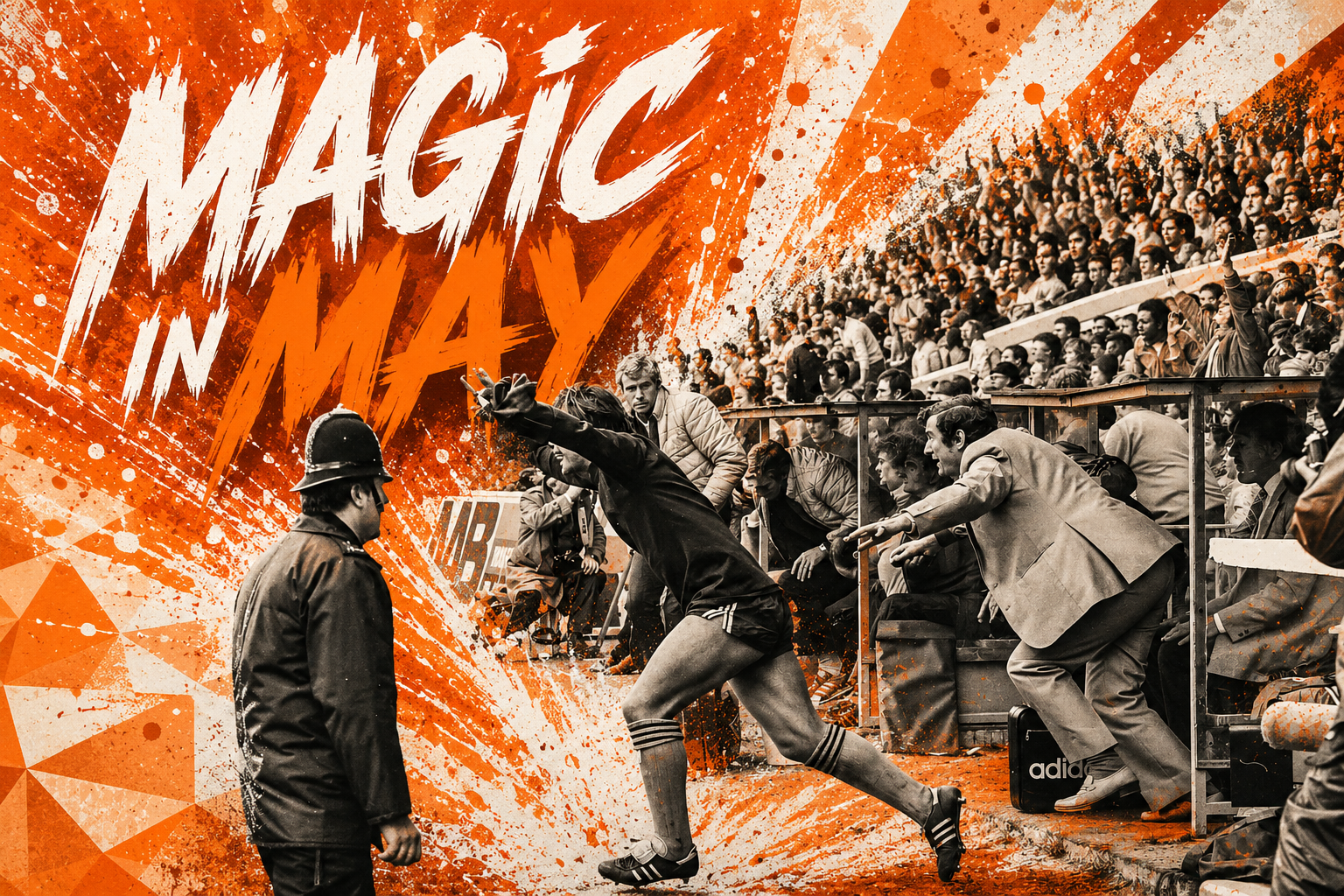
Radomir Antić is often remembered in England as the man who made David Pleat dance. That is only the beginning of the story. From 10th May, 1983 at Maine Road to Atlético Madrid’s historic Double, he became one of football’s great emotional managers: a coach who understood fear, identity and belonging before the modern game had fashionable words for them.
The Rain, the Volley and the Silence of Maine Road
The rain arrived first.
Cold, slanting, relentless rain swept across Maine Road and settled into the concrete terraces like a warning. By the second half, the old stadium felt less like a football ground than a place waiting for bad news. Scarves were pulled tighter. Cigarette smoke drifted beneath the floodlights. Every misplaced pass drew a sharper groan than the one before it.
Manchester City only needed a point.
That was the simplicity, and the cruelty, of it. A draw against Luton Town on 14 May 1983 would keep them in the First Division. Luton needed to win or disappear into the Second Division. One club was trying to survive embarrassment. The other was trying to survive altogether.
The fear inside Maine Road became visible as the afternoon wore on.
City stopped playing forward. Midfielders took extra touches. Defenders cleared balls into touch rather than risk possession. The game drifted toward stalemate, but not calm. There was panic beneath everything. You could hear it every time Alex Williams delayed over a goal kick. You could feel it every time a Luton player crossed halfway with space in front of him.
Radomir Antić watched much of it from the bench.
At 34, the Yugoslav defender was in the final stretch of his career, a thoughtful footballer operating inside a game that increasingly valued force over subtlety. David Pleat trusted him, though not always from the start. Antić had become the cultured substitute, the player sent on when matches lost shape and needed intelligence more than energy.
He entered with around twenty minutes remaining.
By then, the tension had hardened. Luton were throwing bodies forward. City were retreating deeper and deeper toward their own penalty area, trying not to become the team that threw away safety in front of more than 42,000 people.
Then came the cross.
Brian Stein, playing through the pain of a broken foot, found space on the right and lifted the ball into the area. Williams rushed from his line and punched desperately under pressure. The clearance travelled only as far as the edge of the box.
Antić was waiting.
The ball dropped out of the Manchester rain and onto his right foot almost perfectly. He did not snatch at it. He did not rush. His body stayed balanced as the volley cut through a crowd of players and skipped low beyond Williams toward the corner.
For a split second, Maine Road fell silent before the sound arrived.
Not noise. Shock.
Luton’s supporters exploded behind the goal. City defenders stood frozen. Ray Ranson lunged too late on the line. Williams turned and stared into the net as though trying to understand how the afternoon had slipped away from him in a single touch.
When the final whistle came, the stadium fractured.
Manchester City players collapsed into the soaked turf. Supporters spilled onto the pitch. In the middle of the chaos, Pleat sprinted across the grass in his beige suit, arms aloft, legs kicking wildly in celebration, producing one of the most enduring images in English football history.
Yet the image also narrowed the story.
For Antić, the afternoon was not only about the goal. It was an education in football at its rawest. He had seen a stadium gripped by fear, a team paralysed by survival, a crowd moving from hope to humiliation in minutes.
He had seen what football does to people when the result feels larger than the game itself.
The Man Behind Someone Else’s Famous Photograph
For many English supporters, Radomir Antić exists as a single image.
A late volley. David Pleat dancing. Manchester City relegated.
That is the version football history kept because it is easy to package. It fits neatly into nostalgia television and pub quizzes. Antić became part of the scenery of somebody else’s story, remembered less as an individual than as the man who happened to score the goal.
But the truth is far more interesting than the myth.
Long before elite football became obsessed with emotional intelligence, dressing-room culture and collective identity, Antić understood that management was psychological before it was tactical. He believed footballers needed structure, but he also believed they needed belonging. His greatest teams were never simply organised. They were emotionally convinced.
That distinction mattered.
Antić would go on to become the only manager in history to lead Real Madrid, Barcelona and Atlético Madrid, three institutions powerful enough to consume most coaches whole. Yet he succeeded at each of them in different circumstances. At Madrid, he stabilised chaos and built a title contender before politics destroyed him. At Barcelona, he rescued a collapsing season and helped clear the runway for a new generation. At Atlético, he produced one of the most emotionally resonant title-winning sides in modern Spanish football history.
And still, he remains strangely under-discussed.
Part of that is stylistic. Antić never built a philosophical brand around himself in the way Johan Cruyff did. He was not treated as a revolutionary theorist like Arrigo Sacchi. His football could be pragmatic. His teams were often built from damaged players, undervalued players and players who needed rebuilding emotionally as much as tactically.
There was another reason too.
Antić belonged to a generation of Yugoslav football thinkers whose influence on the European game is often acknowledged privately and overlooked publicly. That football culture produced technically educated defenders, adaptable midfielders and coaches who could move between systems without turning football into doctrine. Antić arrived in Spain not as a celebrated intellectual, but as an outsider who had to earn legitimacy repeatedly.
He did so by understanding clubs at their emotional core.
He understood that Atlético supporters did not want to imitate Real Madrid. They wanted to resist them. He understood that Barcelona in crisis needed calm before ideology. He understood that struggling dressing rooms rarely needed grand speeches. They needed clarity, trust and responsibility.
Players followed him because he made them feel part of something coherent.
That is why Maine Road matters differently when viewed properly. It was not the defining achievement of Radomir Antić’s life. It was the first public glimpse of the environment in which he would become most dangerous: pressure, disorder, fear and the emotional edge where football stops being entertainment and starts feeling personal.
A Yugoslav Education in Thinking Before Tackling
Radomir Antić was born in 1948 in Žitište, but the emotional architecture of his life was shaped in Titovo Užice, a hard industrial town in western Yugoslavia where memory, sacrifice and collective identity carried enormous weight.
His family history mattered.
His father had fought with the Yugoslav Partisans during the Second World War. His maternal uncle, Radomir Brkić, had been celebrated as a war hero after resisting occupying forces. Antić was named after him, and in many ways the inheritance was larger than football. The values around him were rooted in discipline, solidarity and suspicion of vanity. Nobody in that world romanticised individual stardom.
That perspective stayed with him throughout his life.
Even at the height of his managerial career in Spain, when presidents demanded spectacle and supporters demanded celebrity, Antić retained something austere about him. He was sociable and warm with players, but he had little interest in self-mythology. He distrusted football narcissism instinctively. Teams mattered more than personalities. Collective suffering mattered more than image.
As a player, he developed inside the highly educated tactical culture of Yugoslav football during the 1960s and 1970s. Players were expected to think. Defenders were not only there to destroy attacks. They read angles, adjusted distances and began moves from deep.
Antić did exactly that.
At Partizan Belgrade, he became an elegant sweeper rather than a traditional stopper. He preferred anticipation to aggression, angles to collisions. Teammates often spoke about how calm he remained under pressure. He looked less like a defender surviving matches than a man trying to solve them.
That distinction became important later.
As a coach, Antić rarely viewed football in purely physical terms. He understood tempo emotionally. He understood when players were frightened, when teams became anxious, when crowds transferred panic onto the pitch. Those instincts were not learned in tactical seminars alone. They were absorbed through years of reading unstable matches from the back line.
His playing career itself was respectable rather than legendary. After helping Partizan win the Yugoslav title in 1976, he spent time in Turkey with Fenerbahçe before moving to Spain with Real Zaragoza. Spain left a deep impression on him. The football was tactical but theatrical. Clubs were political institutions as much as sporting ones. Identity mattered there in ways that fascinated him.
By the time he moved to England with Luton Town in 1980, he was already thinking beyond his playing career.
He had enrolled in coaching education back in Belgrade and carried notebooks obsessively. Former teammates recalled him asking detailed questions about training structure, recovery, dressing-room dynamics and crowd behaviour. He studied managers constantly, not just systems.
David Pleat would become one of the most important influences of all.
Antić admired Pleat’s intelligence immediately, but what fascinated him most was not tactical innovation. It was the relationship between club and community. Pleat understood that smaller clubs survived emotionally before financially. Supporters had to recognise themselves in the team.
At first, Antić viewed that idea almost romantically. Later, he built an entire managerial philosophy around it.
Years afterwards, reflecting on his career in Spain, Antić explained his thinking simply: “The way you play has to fit the culture of the people you represent.”
It sounded obvious.
It was not.
Many elite managers spend careers trying to impose themselves onto clubs. Antić spent much of his trying to understand what the club already was before deciding what it could become.
Luton, Pleat and the First Lessons in Fear
English football in the early 1980s was not designed for players like Radomir Antić.
The First Division was fast, physical, suspicious of embellishment and often openly hostile toward continental subtlety. Midfield battles became aerial contests. Defenders attacked first and apologised later. Tactical nuance existed, but usually beneath layers of aggression and improvisation.
Antić arrived at Luton carrying a very different football education.
Pleat had brought him to Kenilworth Road because he valued intelligence as much as industry. Pleat’s Luton side played brave football for a club of its size. They pushed forward aggressively, trusted technical players and often left themselves exposed defensively as a result. During the 1982/83 campaign, they scored 65 league goals, the same total as a talented Tottenham Hotspur side that finished fourth. They also conceded 84.
Matches involving Luton rarely settled into comfort.
For Antić, the adaptation was difficult physically but revealing psychologically. He was no longer the composed sweeper dictating rhythm from deep. Pleat increasingly used him as a rotational player and tactical substitute, particularly when games became frantic and emotionally unstable.
Antić understood why.
English football, he realised, was often decided by emotional momentum before tactical superiority.
The lesson stayed with him.
He watched how crowds could infect players with fear. He watched how smaller clubs survived through collective defiance. He watched how managers who understood emotional temperature often outperformed those with superior squads.
Pleat fascinated him.
Unlike many English managers of the era, he was intensely curious about continental football. Training sessions were structured carefully. Tactical preparation mattered. Yet he also understood performance as theatre. He recognised that supporters needed emotional connection, not merely organisation.
Antić absorbed all of it.
English football also forced him to simplify his communication. In Yugoslavia and Spain, tactical discussions could become deeply theoretical. England demanded clarity. Directness. Emotional conviction. Antić learned how to speak to dressing rooms in simpler, sharper language without losing complexity underneath.
It made him a far better future manager.
Then came Maine Road.
The goal changed his public profile permanently, but internally the afternoon mattered for another reason. Antić experienced football at its emotional extreme. Relief collapsing into devastation. Order collapsing into violence. A stadium turning psychologically within minutes.
Years later, he still spoke about football crowds with unusual seriousness. He never treated supporters as background noise. He understood how fear travelled through a stadium, how panic changed decision-making, how identity hardened under pressure.
That understanding became one of his greatest managerial weapons.
After retiring in 1984, Antić returned to Spain and entered coaching properly with Real Zaragoza. The club were drifting near the bottom of La Liga when he took over in 1988. Financially constrained and emotionally fragile, Zaragoza looked closer to survival battles than European qualification.
Antić transformed them quickly.
Not through ideological revolution, but through clarity.
Training became more intense. Defensive structure improved immediately. Set-pieces became obsessive. Players later recalled how much detail he placed into dead-ball routines, studying opposition weaknesses until movements became automatic.
Most importantly, he removed fear from the squad.
Within a season, Zaragoza climbed dramatically up the table and qualified for the UEFA Cup. Spanish football began paying attention, not because Antić was fashionable, but because his teams were emotionally resilient in a league that often rewarded flair over discipline.
That distinction caught the attention of Real Madrid.
And it placed him directly into the most political environment in European football.
The Football Mind: Structure, Set-Pieces and Emotional Control
Radomir Antić never built teams that looked identical.
That is one reason he remains difficult to categorise historically. He was not doctrinaire enough to become associated with a single tactical revolution. There is no universally recognised “Antić system” in the way football speaks about Cruyff’s positional football or Sacchi’s pressing structure.
What existed instead was something more adaptable and, in many ways, more human.
Antić built teams around emotional functionality.
He began not with abstract tactical ideals, but with the psychological condition of the squad in front of him. Was the dressing room fractured? Was confidence damaged? Did the supporters feel disconnected from the players? Did the club see itself as powerful, persecuted, glamorous, unstable, rebellious?
Only once he understood those dynamics did the football fully emerge.
That approach made him unusually effective in volatile environments. He was less interested in imposing identity than uncovering it.
At Real Madrid, he recognised quickly that the squad required authority and balance more than stylistic experimentation. He moved Fernando Hierro forward into midfield more regularly, understanding that Hierro’s timing, aggression and passing range could dominate games from central areas. The decision transformed Madrid structurally. Hierro scored 21 league goals during the 1991/92 season, extraordinary numbers for a player who still retained defensive instincts.
That was not simply a positional tweak.
Hierro gave Madrid a second wave. When the forwards occupied centre-backs and the wide players stretched the pitch, Hierro arrived from deeper zones with the timing of a striker and the security of a defender. Antić had recognised that Madrid did not need another decorative attacker. They needed a footballer who could connect control with punishment.
Set-pieces became central to this control.
To Antić, dead-ball situations were not interruptions to football. They were opportunities to impose certainty onto unstable matches. Training sessions frequently stopped for repeated rehearsals. Delivery angles were adjusted obsessively. Blocking movements were refined. Timing mattered enormously.
This philosophy reached its purest expression at Atlético through Milinko Pantić.
Most of Spain barely knew who Pantić was when Antić insisted on signing him from Panionios in 1995. He was already 29, slight physically and operating outside elite European football. Many within Atlético considered the transfer baffling.
Antić saw something else.
He saw a player capable of slowing matches emotionally.
Pantić’s left foot allowed Atlético to dictate rhythm during moments when other teams became frantic. Corners were not hopeful crosses. They were targeted deliveries rehearsed repeatedly in training. Free-kicks were structured patterns rather than improvisation. Atlético’s movement inside the penalty area became synchronised and aggressive.
The details mattered. Near-post runs dragged markers away. Simeone attacked second balls with violence. Penev occupied defenders physically. Kiko drifted intelligently between lines. Caminero arrived from deeper positions when the first movement had already damaged the defensive structure.
It looked simple from the outside.
It was not.
Opponents began fearing Atlético set-pieces before they happened. That fear altered behaviour. Defenders retreated deeper. Fouls became psychologically dangerous. Atlético gained control over matches without dominating possession constantly.
Kiko later described Antić’s influence in revealing terms: “He gave us confidence before he gave us tactics.”
That balance mattered.
Unlike authoritarian coaches who dominated dressing rooms through fear, Antić preferred emotional investment. Players repeatedly spoke about feeling trusted by him. He protected struggling individuals publicly. He created social bonds away from football. Barbecues, dinners, long conversations and informal gatherings were not accidental gestures. They were part of the structure.
Diego Simeone, who would later build his own Atlético dynasty around emotional collectivism, absorbed enormous amounts from Antić during that period. The siege mentality that defines modern Atlético did not begin with Simeone. Antić had already built its emotional foundations in the mid-1990s.
His competitive advantage was not just tactical knowledge.
It was knowing when fear was about to become collapse.
When Winning Was Not Enough for Real Madrid
The central tension of Radomir Antić’s career was brutally simple.
He kept succeeding inside institutions that never fully trusted him.
No chapter exposed that contradiction more clearly than Real Madrid.
When Antić arrived in March 1991, Madrid were drifting dangerously. Club legend Alfredo Di Stéfano had been dismissed with the team sitting seventh in La Liga, emotionally flat and structurally confused. The Bernabéu crowd had turned restless. President Ramón Mendoza needed calm quickly.
Antić provided it almost immediately.
Players responded to him because he simplified everything. Training sharpened. Roles became clearer. Defensive balance improved. The atmosphere stabilised. Madrid climbed to third place and qualified for Europe comfortably.
More importantly, the squad began trusting itself again.
The following season, Antić’s Madrid looked like the strongest side in Spain for long stretches. Hierro flourished in midfield. Luis Enrique developed rapidly. Robert Prosinečki added technical control. The team sat seven points clear at the top of La Liga midway through the campaign.
And still, something felt uneasy.
Madrid were winning, but sections of the hierarchy remained unconvinced emotionally by Antić. His football was considered too practical by some inside the club. Too restrained. Too controlled. He lacked the theatrical aura associated with Bernabéu power. He was respected professionally without ever fully belonging culturally.
That distinction became fatal.
In January 1992, with Madrid leading the league, Mendoza sacked him.
Even now, the decision feels surreal.
There was no collapse. No dressing-room mutiny. No catastrophic run of form. Madrid were top of the table and functioning coherently. Yet Antić discovered one of the hardest truths in elite football: success and acceptance are not always the same thing.
Officially, concerns focused on style.
Unofficially, the problem ran deeper.
Madrid during that era still carried a deeply aristocratic football identity. Winning mattered enormously, but so did image. Coaches were expected to project grandeur as much as tactical competence. Antić’s emotional intelligence, pragmatism and understated authority did not fit comfortably within that culture. He looked too ordinary for a club obsessed with exceptionalism.
Years later, Antić admitted the dismissal changed him personally: “I was young, I thought people were more honourable.”
It is one of the most revealing quotes of his career because it exposes the emotional scar beneath the professionalism. Antić genuinely believed merit would protect him. Spanish football taught him otherwise.
The collapse that followed only intensified the bitterness.
Without Antić’s structure, Madrid lost stability rapidly. The seven-point lead disappeared. On the final day of the season, Johan Cruyff’s Barcelona overtook them dramatically to win the title. It became another chapter in the mythology of Cruyff’s Dream Team and another quiet reminder that Madrid had removed the man best positioned to stop it happening.
Mendoza later apologised privately.
The apology changed nothing.
For Antić, the episode confirmed that elite football institutions often preferred spectacle over substance. It also sharpened something more dangerous inside him: defiance.
That edge became essential at Atlético Madrid.
Because Atlético in the mid-1990s represented the emotional opposite of Real Madrid. Where Madrid projected superiority, Atlético cultivated grievance. Where Madrid demanded elegance, Atlético embraced resistance. Antić recognised himself immediately in that psychology.
Maine Road had shown him what fear could do to a team trying not to lose.
Atlético would show what could happen when a team learned to live with fear and still move forward.
Atlético Madrid and the Rebellion of the Humble
By the summer of 1995, Atlético Madrid had become a club almost exhausted by itself.
The talent was obvious. The instability was constant. Presidents changed direction impulsively. Managers came and went so quickly that continuity barely existed. Atlético had finished the previous season one point above relegation despite possessing players good enough to compete near the top of La Liga.
Most coaches saw disorder.
Radomir Antić saw emotional potential.
He understood immediately that Atlético’s identity could not be manufactured through imitation. Trying to behave like Real Madrid would always fail because Atlético supporters did not want elegance detached from struggle. They wanted confrontation. Resistance. Proof that suffering could become strength.
Antić articulated it better than anyone: “Atlético represents people who struggle to get to the end of the month but who will never admit they are inferior to anybody.”
That sentence effectively became the ideological blueprint for the modern club.
The squad he inherited was talented but psychologically scattered. Antić rebuilt it carefully. Some established names disappeared quickly. Others were transformed by trust.
Luboslav Penev arrived carrying the emotional weight of surviving testicular cancer. Kiko was gifted but inconsistent. Simeone possessed endless aggression but needed structure around him. Pantić was virtually unknown outside Greece.
Together, they became something far greater than their individual reputations suggested.
Antić’s Atlético played with emotional clarity.
Without the ball, they were compact, hostile and difficult to destabilise centrally. Simeone drove the midfield aggressively, pressing with an intensity that reflected the manager’s personality perfectly. Caminero balanced transitions intelligently. Penev occupied defenders physically and relentlessly. Kiko drifted into spaces where matches became unpredictable.
And then there was Pantić.
Antić trusted him completely despite widespread scepticism from the Spanish media. The relationship between the two men became one of the defining tactical partnerships of that era in La Liga. Pantić’s delivery from corners and free-kicks transformed Atlético into the most dangerous dead-ball side in Spain.
Their Copa del Rey final against Barcelona in Zaragoza captured the entire idea.
The game was tense, tight and increasingly attritional. Then, in extra time, Pantić arrived to head Atlético into history. Years later, he would describe that goal as one of the most important moments of his life. It was not only a winning goal. It was the clearest expression of Antić’s Atlético: prepared, patient, defiant and ready to strike when the emotional pressure became unbearable.
The league title race itself became increasingly symbolic.
Cruyff’s Barcelona still represented footballing aristocracy and aesthetic superiority in the eyes of much of Europe. Real Madrid remained Spanish football’s institutional giant. Atlético existed between them, emotionally combustible, historically insecure, desperate to prove they belonged among Spain’s elite without sacrificing their identity.
Antić turned that insecurity into fuel.
Atlético lost only one of their opening 19 league matches during the 1995/96 campaign. Confidence spread through the squad gradually rather than explosively. By spring, belief had hardened into inevitability.
Kiko later reflected on Antić with genuine disbelief: “What he did with us was a miracle. Playing under Antić, I did things I didn’t know I could do.”
That quote explains the season better than tactics alone ever could.
Players improved because they felt emotionally protected.
Antić created a dressing room that functioned less like a hierarchy and more like a collective mission. Team dinners became routine. Informal gatherings mattered. Simeone and Antić frequently organised barbecues away from football. The atmosphere grew unusually close for an elite side under enormous pressure.
When Atlético completed the Double, the achievement felt culturally larger than silverware alone.
It was rebellion succeeding.
Not glamorous rebellion. Not romantic underdog mythology. Something more grounded and recognisable. Atlético supporters saw themselves in the team because the squad reflected the emotional reality of the club: defiant, imperfect, proud and permanently suspicious of being dismissed by richer and more fashionable institutions.
Atlético later honoured Antić as the coach who led the club to that famous league and cup Double. But his impact cannot be measured only in trophies. Modern Atlético still lives inside the emotional framework he helped define.
Simeone evolved the blueprint.
Antić built the emotional foundations first.
Barcelona: The Firefighter Who Left Before the Applause
Perhaps the most revealing chapter of Antić’s career came not during triumph, but during rescue.
In January 2003, Barcelona were collapsing. Louis van Gaal had lost control of the dressing room. The team sat 15th in La Liga. Confidence had evaporated. The Camp Nou had turned toxic.
Joan Gaspart turned to Antić because he needed stability fast.
Again, Antić understood the emotional problem before the tactical one.
Barcelona did not initially need ideological purity. They needed calm. He simplified responsibilities. He restored dressing-room confidence. He reduced anxiety around younger players. Xavi was given more freedom to influence possession naturally rather than carrying excessive defensive burden. Víctor Valdés gained trust. A teenage Andrés Iniesta began appearing more regularly around the first-team environment.
Barcelona climbed steadily and secured UEFA Cup qualification.
Then Antić disappeared again.
Frank Rijkaard arrived that summer as part of the club’s long-term reconstruction, and history largely remembered the rebirth through Rijkaard, Ronaldinho and eventually Pep Guardiola.
But inside Barcelona, many understood something important.
Antić had done the difficult part first.
He had entered the chaos, absorbed the pressure, restored emotional functionality and left the club stable enough for transformation to begin. It became one of the recurring patterns of his career.
Others often inherited the spotlight.
Radomir Antić inherited the fires.
What Maine Road Really Taught Him
The goal at Maine Road looks different once you understand the rest of Radomir Antić’s life.
Not smaller.
More revealing.
At the time, it appeared to be a dramatic ending to a relegation battle, another piece of beautiful chaos from an era when English football often felt one bad result away from disorder. Pleat’s celebration became immortal. Manchester City’s collapse became part of football folklore. Antić himself seemed almost secondary to the spectacle around him.
But the deeper significance of that afternoon was psychological.
Because what Antić witnessed after scoring shaped his understanding of football permanently.
The final whistle did not bring release. It brought rupture.
Manchester City supporters poured onto the pitch in fury and disbelief. Luton players sprinted toward the tunnel fearing violence. Mounted police struggled to contain the crush around the touchline. Outside the stadium, the Luton team bus was surrounded as it attempted to leave Moss Side.
English football in the early 1980s often existed dangerously close to social fracture, and Maine Road exposed all of it at once: desperation, tribal identity, humiliation, survival, class anger and collective emotion overwhelming rationality.
Antić absorbed the atmosphere carefully.
He had already lived through Yugoslavia’s intense football culture, but England showed him something slightly different. In Spain and Yugoslavia, football could be political and theatrical. In England, especially during that period, it often felt existential. Clubs represented communities carrying economic decline, social frustration and civic identity simultaneously.
Relegation was not merely sporting failure.
It felt personal.
Years later, Antić still spoke about supporters with unusual seriousness for an elite manager. He rarely described fans as consumers or audiences. He understood them emotionally, almost sociologically. He recognised how anxiety spread through stadiums. How fear altered decision-making. How crowds sensed weakness before players admitted it themselves.
That awareness became central to his management.
At Atlético, he deliberately built emotional connection between players and supporters because he knew detached teams became fragile under pressure. At Madrid, he understood the Bernabéu’s impatience could destabilise confidence if not managed carefully. At Barcelona, he recognised immediately that restoring calm around the dressing room mattered before discussing ideology.
Football, to Antić, was never just systems on a tactics board.
It was emotional temperature.
Perhaps that explains why he remained so effective inside unstable clubs. Chaos did not frighten him because he had already experienced football at its emotional extremes. He understood that panic usually arrived before collapse. He understood that players under pressure needed clarity more than inspiration.
The irony is that the goal itself reflected many of the qualities that later defined him as a coach.
Patience. Composure. Positional intelligence. Calm while everyone else panicked.
Others lost emotional control around him. Antić stayed balanced long enough to punish it.
That pattern repeated itself throughout his managerial career.
Especially in Madrid. Especially at Atlético. Especially at Barcelona during crisis.
He became football’s great stabiliser because he understood instability so intimately.
Why Football Still Underrates Him
Radomir Antić occupies a strange place in football history.
His achievements are substantial enough to demand recognition, yet his name rarely appears in discussions about the defining managers of modern European football. That disconnect says as much about how football remembers people as it does about Antić himself.
His influence was often emotional rather than ideological.
Football history tends to reward managers who leave behind clearly branded tactical systems. Rinus Michels has Total Football. Sacchi has pressing geometry. Guardiola has positional play. Even managers with fewer trophies often survive historically because their ideas can be packaged neatly into football theory.
Antić is harder to reduce.
His teams adapted. His methods shifted. His structures changed according to circumstance.
What remained constant was something less fashionable to analyse but no less important: emotional coherence.
Long before modern football began speaking openly about man-management, psychological safety, dressing-room culture and emotional intelligence, Antić was already building elite teams around those principles. Players trusted him because they felt understood individually. Clubs connected with him because he respected their identity rather than trying to erase it.
That influence can still be seen most clearly at Atlético Madrid.
Simeone’s Atlético did not emerge from nowhere. The emotional architecture was already there: siege mentality, collective sacrifice, distrust of entitlement, emotional intimacy between supporters and players, and tactical aggression rooted in identity rather than aesthetics.
Simeone modernised and intensified the model, but Antić had already shown the club what it could become when emotion and structure aligned properly.
And yet Antić’s legacy remains oddly fragmented.
Partly because he moved too often. Partly because he inherited chaos more than dynasties. Partly because he rarely stayed long enough to build mythology around himself.
There is also a broader historical reality.
Yugoslav football thinkers have often been under-credited within mainstream Western football history despite exerting enormous influence on European tactical development. Coaches and players from the region were frequently viewed as technically sophisticated but institutionally peripheral. Antić carried that outsider status throughout much of his career in Spain. Even while succeeding, he often felt slightly temporary inside elite institutions.
His failures complicated the story too.
This was not a spotless managerial career polished neatly for documentary nostalgia. Antić experienced severe collapses as well as triumphs. His later years at Atlético ended painfully with relegation in 2000. His spell at Real Oviedo ended in another relegation a year later. His tenure with the Serbian national team began impressively before dissolving into disputes, disappointment and legal conflict after the 2010 World Cup cycle.
The emotional intensity that made him exceptional could also become exhausting over time.
Antić needed connection to function fully. When relationships fractured, when trust disappeared, his environments could deteriorate quickly. He was not emotionally detached enough to operate mechanically. His greatest strength and greatest vulnerability were often the same thing.
But perhaps that is precisely why players remembered him so vividly.
Not as a distant tactician. Not as a corporate authority figure. Not as a celebrity philosopher.
As a human presence.
Former players consistently describe conversations rather than lectures. Meals rather than meetings. Trust rather than fear. Many modern elite coaches now attempt to create those same environments deliberately because football has finally recognised how psychologically fragile high-performance dressing rooms can become.
Antić understood it decades earlier.
He recognised that footballers rarely perform at their best when emotionally disconnected from one another, from supporters, or from the purpose of the team itself.
That may ultimately be his real legacy.
Not merely the trophies. Not the Double. Not the clubs managed. Not even the Maine Road goal.
But the idea that football teams become strongest when players believe they belong to something emotionally honest.
The Man Who Knew What Chaos Was For
In many ways, Radomir Antić spent his entire football life standing in the middle of instability.
A relegation battle at Maine Road. The political paranoia of Real Madrid. The emotional volatility of Atlético Madrid. The institutional collapse of Barcelona.
Again and again, he walked into environments that already felt fractured.
Again and again, players followed him.
Not because he promised perfection. Not because he sold ideology. Not because he tried to dominate rooms through fear.
They followed him because he understood something many elite coaches still struggle to grasp: footballers do not give everything for systems alone. They give everything when they feel emotionally connected to the people beside them and the shirt they represent.
That was Antić’s gift.
He understood football as human behaviour before he understood it as theory.
When news of his death spread in April 2020, tributes arrived from across Spanish football. Atlético mourned him as one of the great architects of the club’s modern identity. Former players spoke less about tactics than warmth, trust, humour and belief. Even rivals recognised that Spanish football had lost a figure who understood its emotional landscape unusually deeply.
By then, the old Vicente Calderón had already disappeared from Madrid’s skyline.
That felt strangely appropriate.
Antić belonged to a version of football that modern elite sport is slowly losing: less sanitised, more volatile, emotionally raw, shaped as much by local identity as global branding. He thrived in clubs that felt imperfect and combustible because he understood that people often connect most deeply through struggle rather than superiority.
That is why the image of Maine Road still endures.
Not simply because David Pleat danced. Not because Manchester City fell. Not even because Luton survived.
It endures because, for one brief moment in the Manchester rain, football revealed itself exactly as Radomir Antić always understood it.
Fear. Belonging. Chaos. Defiance.
And the possibility that a team, if it believes deeply enough, can survive all of it together.
