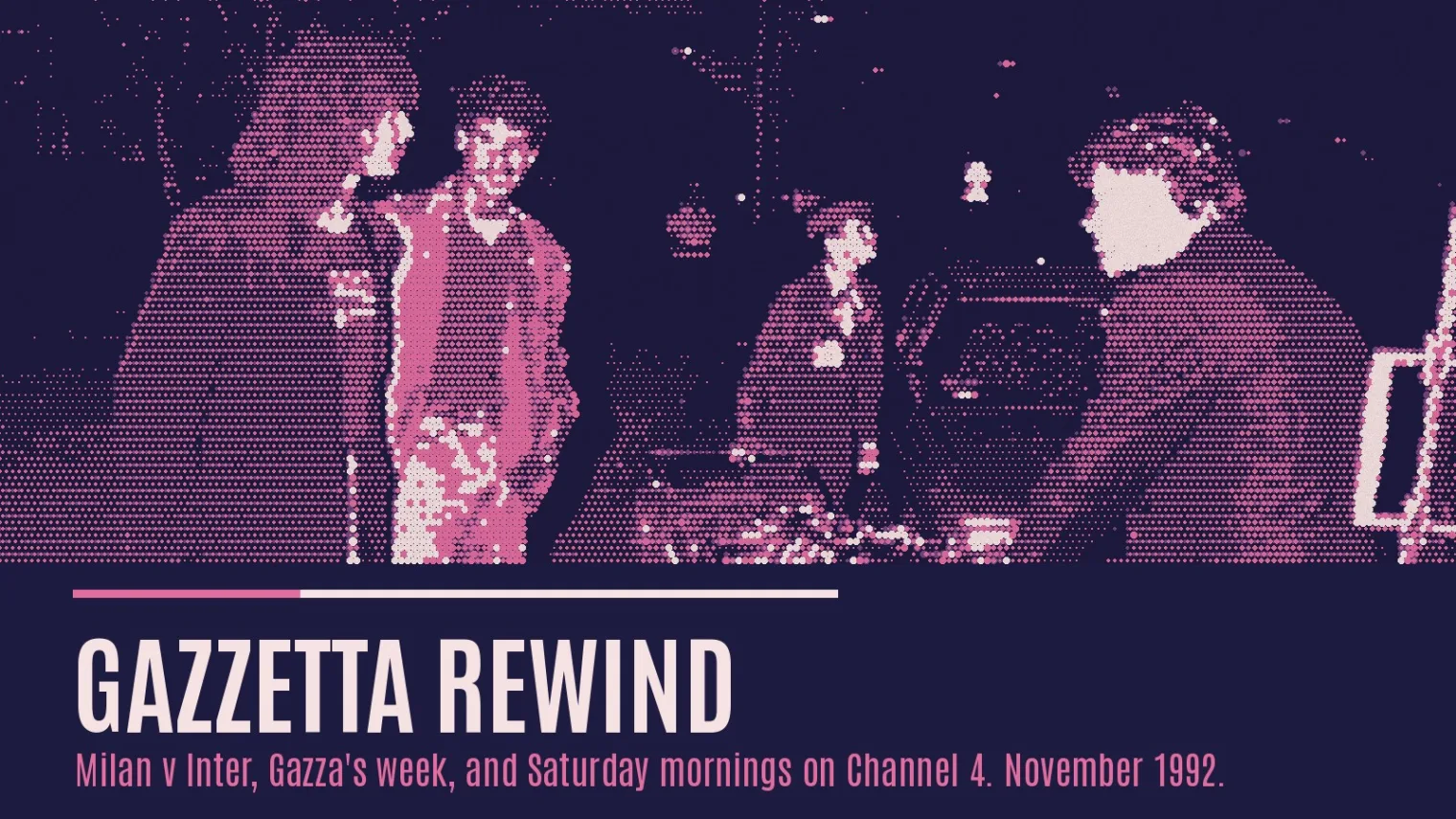
Thirty-four years ago this weekend, Channel 4’s Saturday-morning show had no Serie A goals to show, so it gave us Cremona, a Napoli scandal, a wedding speech and Marco van Basten. The next afternoon brought the 117th Milan derby, live, and one of the worst moments of a young goalkeeper’s career.
Some television you remember for what happened in it. Some you remember for when it happened. Gazzetta Football Italia falls into the second group for most of us. It went out on Saturday mornings, after the cartoons and before the shopping, and if you were of a certain age you watched it in a dressing gown with a bowl of something sugary going soggy on your knee. The Sunday commentary that weekend in November 1992 gave the slot in passing: “you can see all today’s goals in Gazzetta Football Italia with Paul Gascoigne, 10:30 on Saturday mornings.” The new Premier League’s live games were on BSkyB, as the Independent’s Giles Smith noted that October while flicking between channels. In plenty of houses, Serie A was now the football you could actually see.
Each Sunday, this new series goes back to the episode from the same week of the 1992–93 season and to the Serie A weekend around it. The calendar for 2026–27 lines up almost exactly with that one, so this weekend’s episode is the one Channel 4 showed on Saturday 21 November 1992. A full upload of it sits on YouTube, all fifty minutes of it, and so does the full Channel 4 broadcast of the following afternoon’s Milan derby. Everything I describe from either programme comes from those uploads and their transcripts. Where they’re unclear, I’ve left it out.
By then, Channel 4’s experiment was eleven weeks old. Its coverage had started on Sunday 6 September with Sampdoria against Lazio, a 3–3 played, in Henry Winter’s words in the next day’s Independent, “at an almost English pace and intensity”, with Des Walker in it and Lazio playing “senza Gazza”. By late November it had settled into a rhythm: the live game on a Sunday afternoon, then the goals, the gossip and Gazza on Saturday morning. You could set your week by it.
A week without Serie A
This particular Saturday had a problem. There were no Serie A goals to show. The voiceover over the table late in the programme says it plainly: “no games in Serie A last weekend.” The league had stopped for the internationals, and the show had to fill fifty minutes with something else.
What it found tells you a lot about what Gazzetta was. Its opening item was a special report on Cremonese, then top of Serie B, and their trip to Lecce for a game between two promotion contenders. Cremona, the voiceover explains, is “a small medieval town about 50 miles southeast of Milan”, farming country, where the club gets crowds of around 5,000 and survives “by continually selling their young talent”. The film reels off the graduates: Vialli and the goalkeeper Michelangelo Rampulla at Juventus, Attilio Lombardo at Sampdoria. It introduces the division’s leading scorer, a 23-year-old called Andrea Tentoni. It’s affectionate, slightly baffled and entirely serious, and that tone stuck. It treated a provincial club in the second division as worth twelve minutes of a British Saturday morning, and you can’t imagine many other programmes doing that.
The report ends with Cremonese, who had recently beaten West Ham in the Anglo-Italian Cup, due in England the following week to play Tranmere Rovers. They went to Tranmere and won 2–1. Four months later, under Gigi Simoni, they beat Derby County 3–1 at Wembley to win the whole competition, with Tentoni among the scorers, and they went up to Serie A at the end of the season as well. Gazzetta had picked them out in November. It turned out to be a good tip.
The other thing to fill the gap was the midweek internationals. On the Wednesday, Italy had drawn 0–0 with Scotland at Ibrox in front of 33,029. James Richardson, whose job in this episode is the newspaper round-up, “all the news from behind the week’s headlines”, reported that the Italian press were “generally contented with the draw” but furious about how they’d been treated. By his account, the federation president, Matarrese, called it man-hunting, Signori said Italy had expected a battle “but not this much”, and Roberto Baggio came home with a suspected broken rib. It was an early lesson for a British audience: Italy found our football frightening.
The king of England
The same Wednesday, a few hundred miles south, England had beaten Turkey 4–0 at Wembley in a qualifier, and Paul Gascoigne had scored twice. The England statistics database has his first in the 16th minute after he went past two defenders, then Shearer’s diving header, then a deflected Pearce free-kick, then Gascoigne’s second, a left-footer from six yards after Des Walker had done the work down the left. The Herald’s report called it Graham Taylor’s biggest win in two and a half years in charge.
So the 21 November episode is a Gazza episode, and it opens with him. He sounds like a man who has had the week of his life and slept in a chair at the end of it. “Sister got married, great result for England,” he says, “and not only that, I scored a couple of goals to please Graham Taylor.” Richardson’s paper review notes that the Italian press were saving their enthusiasm for Wembley. The show’s own trail for Gazza’s segment calls him “the king of England”. The papers were also wondering, Richardson said, whether he could now reawaken Lazio.
His own segment, about halfway through, is filmed back home, and it’s the most Gazza thing you’ll ever see. He’s “shattered” but delighted. He explains that the man-of-the-match prize at Wembley was four tickets to America, worth about £8,000 by his reckoning, and that he put them back in the hat for the rest of the squad because “the whole team was absolutely magnificent”. Then he turns to the camera and asks if we can see his eyes. He has two black eyes, and he hasn’t the faintest idea how. “It’s no makeup,” he assures us, “I’m gonna tell you that now.”
Then we get footage from his sister’s wedding, including one of the speeches. The speaker says he has known Paul for 18 months and lists the damage: hair dyed about 20 different colours, “banned from two swimming pools and four pubs”. Then comes a long story about getting the England midfielder past the press outside by putting him in the boot of a car, then driving him round London in it. You couldn’t put that on a football programme now. You probably shouldn’t have then. It’s wonderful.
Richardson’s round-up had one more Gascoigne item: talk that Lazio, with Riedle unhappy and willing to leave, were seriously considering a bid for Blackburn’s Alan Shearer, valued by his club at £6 million. On the same list was a story that Manchester United had offered £5 million for Inter’s Darko Pančev, and another that Ruud Gullit would leave Milan the following June, with the Gazzetta dello Sport naming Roma, Fiorentina and Sampdoria as favourites. That one, at least, was right. Gullit joined Sampdoria in July 1993.
Napoli, and the first casualty
The strangest story in Richardson’s round-up was Napoli’s. “This week’s newspapers include one of the strangest stories we’ve seen all season,” he began, and he wasn’t overselling it. According to the Gazzetta dello Sport, on the Tuesday a group of about 20 young men turned up at Napoli’s training ground with bars and chains. They shouted to the new coach to “break the players’ backs”, then tried to do some of it themselves, going for several players, Roberto Policano among them. They spared Gianfranco Zola. The next day, Richardson said, the police denied the players’ story. Their version rested on a gardener at the ground who said the youths had insulted the squad but that it was Zola who threw the first punch. The players denied that vigorously, and both they and the club president were now travelling with armed escorts. I can’t find the details in an English-language source, so treat them as what Gazzetta reported, passed on to British teenagers on a Saturday morning, over cereal. The attack itself did happen, though. Il Mattino’s 2019 interview with Bianchi describes complicated weeks that ended with an assault on the squad at the club’s Centro Paradiso training ground in Soccavo.
The “new coach” in that story was Ottavio Bianchi, and he was only there because of the season’s first big coaching casualty. Napoli had sacked Claudio Ranieri after Milan beat them 5–1 at the San Paolo on 8 November, with Van Basten scoring four. The club’s own Napolipedia records six points from nine matches before the change. A history of the period puts it at five defeats in nine, which left them third from bottom. The Herald reported the sacking from “club sources”, with Bianchi or Azeglio Vicini, Italy’s coach at their home World Cup, tipped to replace him. It was Bianchi, the coach who had won Napoli their first title. In the same interview he said he turned the job down twice before taking it as a personal favour, and that after a couple of training sessions he knew the problem: “La squadra ha paura.” The team was frightened. Given the crowbars, you can see why.
Forty-two games and a little chaos
The last third of the programme belonged to Milan, and to the man everyone in Italy was trying to stop.
The preview for Sunday’s game calls it the 215th Milan derby overall and the 117th in the league, and asks the obvious question: eight weeks in, nobody had beaten AC Milan. Richardson went to see Marco van Basten, and the interview is a lovely piece of television, mostly because Van Basten seems so unbothered by any of it. “We are already 42 games unbeaten,” he says, as if he were reading out a shopping list. He reckons Milan are playing better than the season before, and he counts it up: eight games, 15 points, “and we made a lot of goals”. The coach, Fabio Capello, the voiceover tells us, puts it down to two things, concentration and humility. Van Basten adds a third, organisation from the top of the club down, which he thinks matters more than the money, although he’s honest enough to add that without money it would be very difficult.
Then he says the thing that sticks with you. Win everything, he explains, and by the start of the next season it’s forgotten. “The first game you lose, there are a lot of troubles and a lot of chaos.” He has won just about everything, the voiceover reminds us, two Italian titles and two European Cups among it, and he’s talking like a man who knows exactly how quickly Italy turns on you.
His own numbers that autumn were absurd. He’d scored three against Pescara in the second week, and two weeks before the show he scored four at Napoli, the game that cost Ranieri his job. “I played eight games and I made 12 goals,” he tells Richardson. The piece also says he has a new rival for the scoring lead in Lazio’s Giuseppe Signori. Van Basten is polite about him in the way champions are polite about people they intend to beat: a very good player, very quick, intelligent. “So I hope he will make a very good season,” he says, then adds, smiling, “but not so good.”
Over at Inter’s training ground, the report found a squad trying to stay relaxed and “a bit taken aback at the level of the expectations upon them”. Osvaldo Bagnoli’s side had drawn the first derby of the previous season, the voiceover recalled, and lost the second only to a late Massaro goal. Torino, who had held Milan 0–0 earlier in November, had shown it could be done. Van Basten’s last observation was that much of Italy, beyond the city, wanted Milan to lose. “I think Inter will give more than 100 per cent for that,” he said. He was right about that too.
Sunday: the 117th
You can still watch the Channel 4 broadcast of Milan against Inter on 22 November 1992 in full, and it’s worth an hour and a half of anyone’s Sunday. The commentator, addressed throughout as Peter, is Peter Brackley, Channel 4’s regular voice that autumn; Giles Smith’s October piece had him working “from the comfort of a studio in London”. Beside him is Paul Elliott, then of Chelsea and formerly of Pisa. Brackley’s opening line sets the tone for the whole series of these things: “This is the most prestigious and notorious derby in world football.”
The setting fully justifies it. Transfermarkt lists the crowd at 83,914, a sell-out. The upload’s own notes give 83,917, and the account of the match on the Milan fan archive Magliarossonera says about 85,000. Brackley tells us most of them were Milan fans. Magliarossonera adds that Milan had more than 73,000 season-ticket holders and came into the game unbeaten in 43 league Sundays, so Van Basten’s count was, if anything, a modest one.
The early commentary is full of the sort of detail British viewers lapped up. Franco Baresi was back in the Italy side after retiring from international football, “persuaded by his wife as much as anybody”, Brackley says, because she was fed up with him being at home too often, “apparently”. The referee, Arcangelo Pezzella, had a reputation for leniency: “He’s only sent 16 off in 108 games.” Inter were without Salvatore Schillaci, injured. Bagnoli, Magliarossonera’s account says, had left out his German, Matthias Sammer, and started Davide Fontolan, and it nearly paid off straight away. Midway through the first half Fontolan headed Rubén Sosa’s free-kick onto the bar, with Francesco Antonioli, Milan’s young goalkeeper, struggling. Sosa went off before the break with a strain, replaced by Pančev.
Then Milan did what Milan did that season. Five minutes before half-time, against the run of play by most accounts, including Elliott’s, Van Basten held the ball up between two defenders and slipped it inside. Gianluigi Lentini hit it into the top corner from the edge of the area. Brackley reached for the price tag, as everyone did with Lentini that season: “showing why they’ve paid 13 million pounds for him”. Magliarossonera calls it “un gran tiro all’incrocio dei pali”. RSSSF and Transfermarkt both give the goal in the 40th minute. Magliarossonera says the 39th, and I’m not going to argue about a minute.
The money ran through the commentary all afternoon. In the second half, Elliott mentioned that he’d been reading that Lentini earned £2 million a year. “A staggering amount,” he said. “I would have loved to have been the agent in that deal.” Brackley’s reply is the best line of the afternoon: “So, you’re not on 2 million at Chelsea, are you?”
Ruud Gullit, back in the side after a start to the season spent largely out of it, went off just before the hour for Demetrio Albertini, and Brackley noted the whistles around the ground. Elliott thought Gullit would be “very, very disappointed” not to have imposed himself. And Milan, as Magliarossonera’s account puts it, couldn’t finish Inter off. They sat on the lead and didn’t counter.
Twenty minutes from time, it cost them. Luigi De Agostini hit a shot from about ten yards outside the area. It bounced in front of Antonioli, who got his hands to it, let it go, and watched it roll back over the line. “Oh, what a goal!” cried Brackley, then, half a breath later, “Oh, what a mistake by Antonioli!” Elliott was blunter: “A woeful error.” The archives can’t agree on the minute either. RSSSF has De Agostini scoring in the 74th, while Transfermarkt and the upload’s Inter sources have the 69th. They all agree it was De Agostini, his first goal for Inter as Brackley noted, and they all agree on what happened to the ball.
“And that’s it,” Brackley said at the final whistle. “It finishes 1-1 in the San Siro.” Milan still hadn’t lost, but Inter had got something from the afternoon. The following Saturday’s Gazzetta, also on YouTube, reported that Inter fans were calling it the miracle of San Antonio. Brackley had told us in the first half that Antonioli, a former under-21 international, now seemed to be Milan’s first choice ahead of Rossi. Goalkeepers have had worse afternoons, but not many have had them in front of 84,000 people, live on British television, against Inter.
Elsewhere, on the vidiprinter
Part of the fun of the Channel 4 broadcasts was the scores from the other games, read out over the live action like a slightly exotic Grandstand. Brackley kept us updated all afternoon, and the rest of the round, according to RSSSF and Transfermarkt, went like this.
Lazio lost 2–1 at Foggia, and it hurt. Foggia went ahead through an Oberdan Biagioni penalty, and Bryan Roy, on his debut after his move from Ajax, made it two before half-time. “Gazza won’t be happy,” said Brackley, relaying the score. Signori pulled one back against his old club early in the second half, his 11th of the season. Foggia had Luigi Di Biagio sent off with a quarter of an hour left and held on anyway. The commentary confirmed Gascoigne played, and the following week’s Gazzetta showed him going past people in it. That was the second defeat in a row for Dino Zoff’s side, and it left them tenth. “We got beat again,” Gazza told the camera the following Saturday, cheerfully enough, before looking ahead to his first Rome derby.
In Turin, Torino against Juventus was the other derby, and Juventus won it 2–1 with a late own goal by Giorgio Venturin after Gianluca Sordo had put Torino ahead and Vialli had equalised. David Platt didn’t play. The next Gazzetta said he and Roberto Baggio had both been injured in the midweek internationals, which puts Baggio’s rib in context. Platt’s season in Turin had started, as Henry Winter noted in September, with him not even in the squad, and FBH has written about his Italian years if you want the rest.
At home in Genoa, Sampdoria beat Napoli 3–1 in Bianchi’s first game in charge. Napoli’s Paolo Ziliani, also making his debut, deflected a Roberto Mancini shot into his own net before half-time. Vladimir Jugović made it two after a backheel from Mancini, which the Sampdoria fan site Manicomio Blucerchiato calls “tiro pazzesco”, a crazy shot. Mancini then scored a penalty that Lombardo won, and Napoli’s consolation came off Moreno Mannini near the end. The result took Sampdoria third, the high point of a season that, for their English centre-half, was about to go wrong in instalments, as our Des Walker piece tells it.
The rest was a typical Serie A Sunday. Tomas Brolin got Parma’s winner at Cagliari. Abel Balbo scored twice as Udinese beat Genoa 3–0. Gheorghe Hagi scored for Brescia in a draw with Fiorentina. Pescara, bottom, beat Atalanta 2–0, with Dunga among the scorers. Andrea Carnevale gave Roma a late winner over Ancona. Afterwards Milan were on 18 points, with Juventus second on 14. The gap was four points after ten games, in the days of two points for a win. Elliott, Brackley and the whole of Italy kept saying it was a long way to go, and they were all being polite.
What came next
The derby didn’t end Milan’s run, and neither did anyone else for months. The next Sunday they won 1–0 in Turin. Channel 4 showed that one live as well, and it will be the subject of the next instalment of this series. The run finally ended at San Siro on 21 March 1993, when a Faustino Asprilla free-kick gave Parma a 1–0 win. By then it was 58 league matches, going back to May 1991. The Independent’s report noted that the previous Serie A record had been Fiorentina’s 40 in the 1950s, and quoted Capello: “Defeat is never a liberation.” Milan still won the title.
Van Basten didn’t see the end of it. Milan’s own account of the season says that, having just been awarded his third Ballon d’Or, he chose to have an ankle operation after the 13th round, and Milan slowed down without him. Watch the interview now, with him calmly explaining how quickly the chaos comes, and it’s hard not to wince.
Gascoigne got his Rome derby on 29 November and scored the equaliser four minutes from time after Giuseppe Giannini had put Roma ahead, according to both RSSSF and Transfermarkt. Eleven days after Wembley, the king of England had his Roman afternoon too.
And Gazzetta? In November 1992 it was still working out what it was. That’s what makes this episode such a good place to start. It has a Serie B report that a better-planned show would have cut, Gazza with two black eyes and no idea how he got them, a Napoli crowbar story nobody could confirm, and the best centre-forward in the world explaining that winning is only ever borrowed. And there was no Serie A football to show, which forced it to be more interesting than it needed to be.
Next Sunday, here: Juventus against Milan, Gazza’s derby, and what Richardson made of Inter’s miracle. Bring your own cereal.