Paul Scholes is 52 today. He was the most gifted English footballer of his generation, and the least interested in being seen. His career is a run of exits, from the Nou Camp in a club suit to England at 29 to an Etihad comeback announced an hour before kick-off, and every one of them was on his own terms.
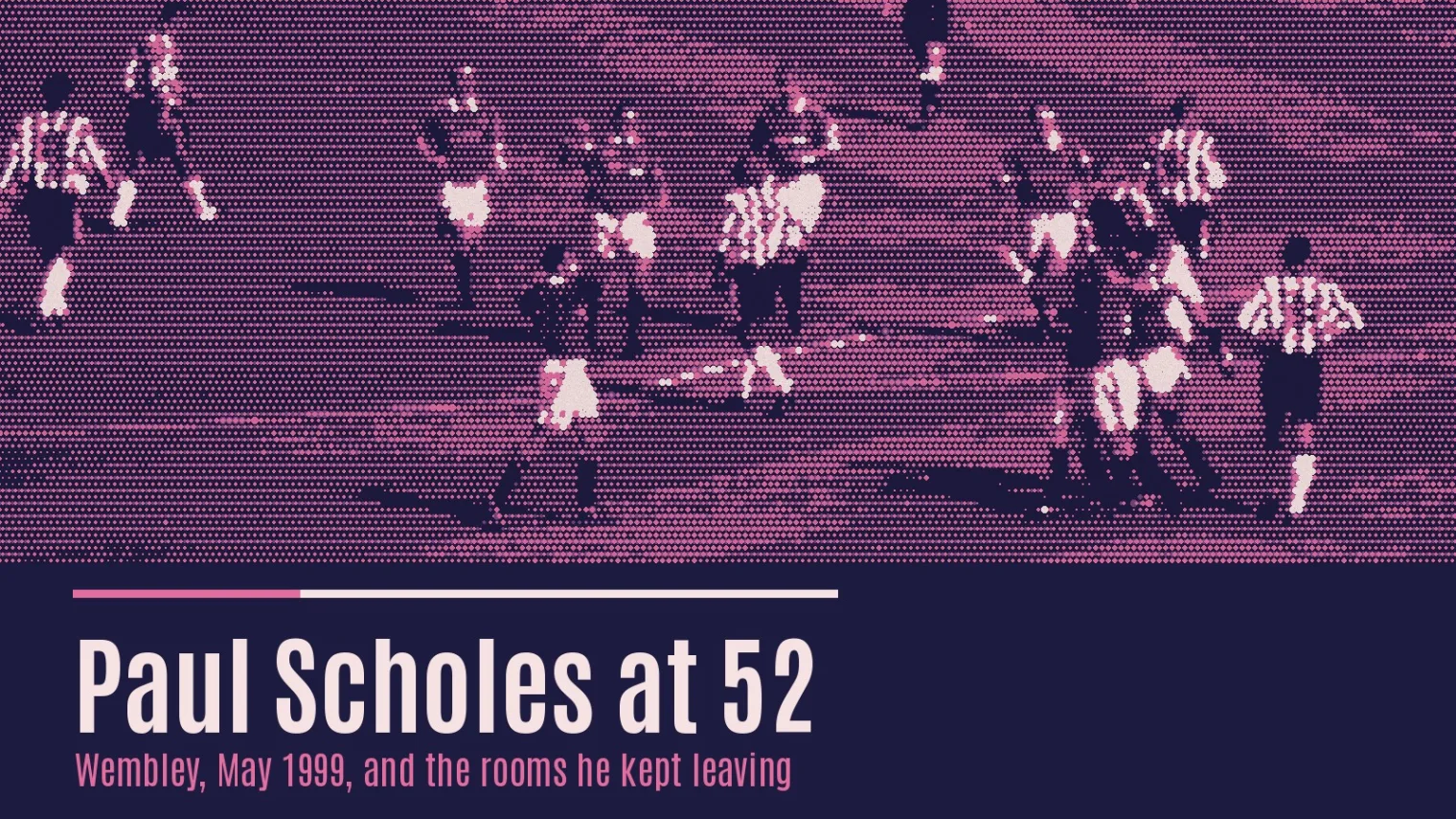
The photograph behind the print at the top of this page was taken at Wembley on 22 May 1999. It shows Manchester United’s players crowding round somebody in the middle distance, on the striped grass of the old stadium, while a handful of Newcastle players in black and white wander back towards the centre circle. The photographer, Michael Cairns, shared it under a Creative Commons licence (CC BY 2.0), and the man in the middle of the huddle has just scored United’s second goal in the FA Cup final. That man is Paul Scholes, though you can hardly see him. He has all but vanished under his team-mates, which seems about right.
Four days later he was in Barcelona, wearing a club suit and watching from the stands.
Paul Scholes is 52 today. The Observer’s long profile of him in 2008 gives the date and the place: Paul Aaron Scholes, born 16 November 1974 in Salford. The birthday post that set this piece going, from @FootballRemind, credits him with 25 trophies at United. The BBC once captioned a picture of him with “18 major trophies”. The difference presumably comes down to what you count, with Charity Shields and the like, and he would hate being asked to settle it. What nobody disputes is the eleven Premier League titles and the two Champions League winner’s medals, one of which, by his own account, he doesn’t really count.
That is where this piece starts, because it is where Scholes himself starts whenever he is asked about it. Most great footballers’ careers are written up as a list of the places they arrived at. Scholes’s is best told through the places he left, or never got to, or walked out of. He left the room more often than any great player I can think of. Every time, he left it his own way.
“He’s got no chance – he’s a midget”
Begin with the version of him that nearly didn’t arrive. FourFourTwo opened its big interview with him, done in his first retirement, with what it said was Alex Ferguson’s verdict on first seeing him in a youth team game in the late 1980s: “He’s got no chance – he’s a midget.”
Brian Kidd, who helped Eric Harrison with United’s youth sides, offered a gentler version when he brought him to the Cliff. Harrison told the Observer that Kidd had warned him: “He’s only tiny, he’s got ginger hair – you’ll probably have a bit of a giggle. But he can’t half play.” Harrison’s own assessment, given in the same piece, is as good a scouting report as you’ll read on anyone: “He has no real pace, no strength, but he is clever and has quick feet.”
He very nearly didn’t come at all. The Observer’s interviews with the people who found him describe a lad from the Langley estate in Middleton, a pupil at Cardinal Langley High School, whose father Stewart had been a decent local footballer. He stood on the terraces at Boundary Park as a boy. Mike Coffey, the United scout who taught him at school, said his hero was Oldham’s centre-forward Frankie Bunn. “He is an Oldham nut,” Coffey said. Scholes played for a Boundary Park Juniors side with the Neville brothers and Nicky Butt. When Coffey recommended him to United, he had to pull the boy into his office and talk him into it. “He was very reluctant and took a couple of days to be convinced.”
When FourFourTwo’s readers reminded him that he had been at Maine Road in 1990 cheering Oldham on against United in the FA Cup semi-final, he didn’t deny it. He explained that his dad was an Oldham fan, Boundary Park was ten minutes up the road and Old Trafford cost money. A young United fan was in there too, he said, but he was hard to find on a Saturday afternoon.
Then there’s the matter of the Class of 92, which he is always filed under. Strictly speaking, he wasn’t in it. The side that won the FA Youth Cup in 1992 had Beckham, Butt, Gary Neville and Giggs. According to Harrison’s account in the Observer, Scholes came into that team afterwards and scored against Leeds in the 1993 final, which United lost. He was also missing for spells because of Osgood-Schlatter disease, a growing pains knee condition, and Harrison remembered him “not a happy chappy at all with me” about sitting out training. “But,” Harrison added, chuckling, “when he returned he was absolutely lethal.”
Even in the most famous group photograph in English football, then, Scholes was standing just outside the frame. He’d have been quite happy with that.
The first room: the suit at the Nou Camp
His United debut came in a League Cup tie at Port Vale in September 1994, as RTÉ’s 2008 profile records. Within a few seasons he had become the player whose emergence, RTÉ argued, allowed Ferguson to sell Paul Ince to Inter. That’s a fairly big claim to make for a ginger kid from Middleton, and it was right.
By the spring of 1999 he was one of the first names on the teamsheet, except on the night it mattered most. In the semi-final second leg in Turin on 21 April, Ferguson left him out at the start. As the Guardian’s Michael Walker reported, Ryan Giggs was missing, so Jesper Blomqvist played on the left and Nicky Butt in the middle, with “Scholes’s artistry being sacrificed at the start”. Juventus went 2-0 up inside eleven minutes through Filippo Inzaghi. Roy Keane headed one back and was then booked for a late tackle on Zinedine Zidane, which meant that if United got through he would miss the final. Dwight Yorke equalised, and Scholes came on for Blomqvist after 68 minutes.
The Observer’s 2008 profile puts it in a sentence that I think sums up his whole career: “Scholes’s tackling failed him again and he was shown the dreaded yellow card.” It was his second booking of the competition. Andy Cole scored the winner five minutes from time, United were in their first European Cup final since 1968, and Scholes wasn’t going to play in it.
Twenty-one years later he was still annoyed, mainly with Didier Deschamps. “I tackled Deschamps and I’ve seen it a few times. I don’t think it was a foul, to be honest with you,” he said in 2020, as the Mirror reported. “It was right in front of the ref, he screamed like a big girl, like a big baby which didn’t help me.” He made his own case against himself in the same breath, which is very Scholes: “It got me booked and I missed the final but I may not have played in the final, you never know.”
So the week of the Treble went like this. On 16 May, United beat Spurs at Old Trafford and won the league. Six days later, at Wembley, Scholes scored the second goal against Newcastle in the FA Cup final, the moment in the photograph. On 26 May, at the Nou Camp, he sat and watched. RTÉ recorded that Keane, beside him, “almost felt as sorry for Scholesy” as he did for himself. According to the Observer, the two of them could do nothing on the eve of the game but stay up drinking with the fans.
You know what happened in the final. There’s a whole FBH piece on that season if you want it. Teddy Sheringham equalised in the 91st minute and Ole Gunnar Solskjaer scored two minutes later. Then the players who hadn’t played came down onto the pitch to join in. Scholes has never pretended that he enjoyed that part. “You don’t feel part of it one bit,” he said, as reported by the Daily Mail. “We went on the pitch at the end but you’re embarrassed. It’s embarrassing, honestly.” To FourFourTwo he went further: “I got a winner’s medal in 1999, but I don’t feel like I won it because I wasn’t involved in the final, so to me I only won it once, in 2008.”
Plenty of players have a medal they didn’t earn on the night and keep it on the mantelpiece anyway. Scholes’s view is that it doesn’t really count. I think it’s the most revealing thing he has ever said.
The second room: England, and the Swede on the left
His England career began in a hurry and ended the same way. The Guardian’s 2004 retirement report records his debut as a substitute against South Africa in 1997. His first start came in Le Tournoi in June that year, against Italy, when he set up Ian Wright and then scored himself in a 2-1 win. FBH wrote about that tournament for a different free-kick entirely. “I didn’t expect to be in the squad so soon but I wasn’t nervous,” he said at the time, according to the Guardian’s highlights panel. “It’s just something that doesn’t seem to bother me.”
Football bothered him much less than talking about football did. In March 1999 Kevin Keegan told him to “go out and drop hand grenades”, and he scored a hat-trick against Poland at Wembley. FourFourTwo asked him whether, running off to celebrate the third, he really had been thinking “Oh no, I’m going to have to talk to the press now”. He said yes, it would have gone through his head. Three months later at Wembley, against Sweden, he went in on Håkan Mild in the way the Guardian later described as taking Keegan’s advice “a little too literally”. The Observer records that he became “the first and last England player to be shown a red card at the old Wembley”. That is a record nobody can now take off him.
At Euro 2000 he scored after three minutes against Portugal in Eindhoven, and England lost 3-2. You may remember the evening. The Guardian’s highlights panel lists it under “Most forgettable goal”. When Sven-Göran Eriksson was appointed that winter, Scholes, who didn’t comment on much, was quoted saying: “It’s the England team and I’d like to see them with an English manager.” Eriksson then picked him in 36 of his 66 caps and went around saying “When Scholes plays well, England play well”, which tells you a fair bit about both men.
Then the goals dried up. The Guardian put the numbers together the day he quit: nine goals in his first 19 caps and five in the next 47. Between a goal against Greece in Athens in June 2001 and a header against Croatia at Euro 2004 he went 2,257 minutes of international football without scoring. By then Eriksson had stopped playing the diamond that had been built around him. Before the Switzerland game in Coimbra, the Guardian reported, David Beckham led a delegation to Steve McClaren asking for a flat four in midfield. Eriksson then met Beckham, Scholes, Steven Gerrard and Frank Lampard in his hotel room, and the straw poll went three to one. Scholes was the one. Lampard and Gerrard went into the middle, and Scholes went to the left.
On 3 August 2004 he left. “This is a decision I have not taken lightly,” he said. “Euro 2004 was fantastic but afterwards I felt the time was right for myself and my family to make it my last England appearance.” He was 29. Ferguson, who as the Guardian noted had been “at loggerheads with the FA” over him for years, revealed that Scholes had come to see him about it a year earlier and had been told to wait until England had qualified. “He values his family life and wants to spend more time with his kids,” Ferguson said. “I don’t think he feels he’s missing anything now.”
Almost everybody decided at the time that it was about the left wing. The Guardian’s own reporter thought the formation row had influenced him, and the Observer in 2008 wrote that he went “seemingly because Sven-Göran Eriksson had shunted Scholes out to the left of midfield”. Scholes has spent twenty years patiently saying it wasn’t. “A lot of people said that and blamed Sven for me quitting England, but the truth is I played on the wing for Man United too and scored a lot of goals,” he told FourFourTwo. “The truth is I got on great with Sven.” In a 2020 BBC interview he gave the plainer reason: “I had a young family at the time and going away for England for 10 days at a time, sometimes six weeks in the summer, it just wasn’t ideal and I wasn’t enjoying it.”
In that BBC interview he also admitted, for the first time as far as I can find, that he got it wrong: “I do regret leaving England so soon.” The reason he gave is interesting. Ferguson went on to rebuild him as a deep-lying midfielder who controlled games instead of arriving in the box. Scholes called playing there from 30 to 35 “probably the most enjoyable part of my career”, and said “I finished with England too early to progress in that position.” England kept the attacking midfielder who had stopped scoring, and United got the passer.
England asked him back once, officially, before the 2010 tournament in South Africa. It came, he told the BBC, as a phone call from Stuart Pearce, who was on Fabio Capello’s staff. “Capello didn’t ring me, maybe if he had it might have been different.” He said no, because he hadn’t been part of qualifying and other players had spent two years away from their families earning the place. That is a very Scholes reason for turning down a tournament.
No celebrity bullshit
The line in the @FootballRemind post is Roy Keane’s, and it is genuine. The Observer in 2008 quotes it as something Keane “wrote in his autobiography”. The fuller version, as RTÉ printed it, reads: “He was arguably the most gifted player in our squad. Paul was the perfect pro. Superb on the field, modest and sensible off it. No celebrity bullshit, no self-promotion or glory-hunting, an amazingly gifted player who remained an unaffected human being. A superb footballer, a beautiful passer of the ball, a free-scoring midfielder, a tough and resilient lad who never shirked a tackle.”
What’s striking, reading it now, is how specific Keane is about what Scholes didn’t do. A modern football biography would praise him for his brand. Keane praised him for not having one. FBH has written plenty about Keane himself, a man who didn’t throw compliments around. This is about as warm as he gets.
The evidence for the “no celebrity bullshit” part runs all through the 2008 Observer profile, and it’s funny. The paper reported that Scholes, by then earning £75,000 a week, had never given a one-to-one interview unless his club or country made him. His one endorsement, a boot deal with Nike, was notable for asking almost nothing of him. “If you go around the world, he is one of the only players not asked to do public appointments,” a Nike executive said. “He’s a shy guy, but that’s fine.”
Then there’s the charity dinner. In August 2003, Eric Harrison talked him into attending a fundraiser for the National Asthma Campaign at Old Trafford. Scholes is asthmatic, and so is Harrison’s wife. Harrison told the Observer what happened when they arrived. “Paul said, ‘What do I have to do?’ I told him he was on the top table for the dinner. That got him going. ‘I’m not!’ he said.” In the paper’s version Scholes’s first words were: “Shit! I don’t have to get up and say a few words, do I? And with a microphone? What do I do?” He did it, and did it well, and they raised £22,000. “And he never even had a go at me for getting him there,” Harrison said.
FourFourTwo’s readers asked him whether he had ever been tempted by an earring, a pattern shaved into his hair or a big tattoo. “There’s no way in the world I’d get any of that done – no way,” he said. “I don’t think I’ve ever acted big-time. I could never jump to the front of a queue or anything like that: I would be too embarrassed.” If anyone has ever summed up the anti-Beckham better, I haven’t read it. The Guardian’s writer reached for the same idea on the day he left England, calling Scholes “an anti-Beckham” and his “deep attachment to one piece of England”. The point wasn’t that he disliked Beckham, who was a friend. He just didn’t want any of what came with being Beckham.
It wasn’t all sainthood, and Keane would be the first to say so. In November 2001, with Juan Sebastián Verón in the side and Scholes pushed up as a second striker in what the Observer called “arguably his worst season”, he was dropped against Liverpool and then picked for a weakened League Cup side at Arsenal. He refused to get on the coach. He was fined, and the Observer called it “the start and finish of Scholes and controversy”. Asked about it by FourFourTwo, he called it “a stupid thing to do”, and said Ferguson “just fined me and we got on with it”. His worst hairdryer, he said, was for giving the ball away at Newcastle. As for the tackling, FourFourTwo reminded him that Keane had once said he never mistimed a tackle because they were all deliberate fouls. Scholes conceded that if somebody had got him, “I would try to bide my time to get them back… so I suppose Roy does have a point.”
The third room: Moscow, and the one that counts
The 2005 FA Cup final was the first ever settled on penalties, and the Observer notes that Scholes missed the kick that would have made it 5-5 against Arsenal. In 2006 he was out for the second half of the season with an eye problem that, RTÉ said, “could have cost him his career”. When he came back and United won the title for the first time in four years, Ferguson said it was like getting a new player.
Then came the spring of 2008, and the room he had been shut out of nine years earlier. In the Champions League semi-final against Barcelona at Old Trafford, after a 0-0 first leg, he hit the shot from distance that won the tie 1-0. FBH’s piece on the Moscow final covers that night and the one in Moscow. “It was a fantastic goal,” Ferguson said afterwards, according to the Observer. “It was a marvellous moment for him.”
Ferguson had already promised him a place in the final. The Observer noted that Ryan Giggs’s ten titles were not enough to get him off the bench and Scholes’s suspension nine years earlier was apparently enough to guarantee his start. Ferguson was quoted by RTÉ: “I would have to be sentimental when it came to choosing my team. I’d have to pick Paul to play because he deserves it.” United won on penalties in Moscow. “It was great to win it in Moscow against Chelsea,” he told FourFourTwo, in the same answer in which he said he’d only won the thing once.
His team-mates’ verdict on him had been settled long before that. In the Observer’s profile, Rio Ferdinand was asked who the best player at a club with Cristiano Ronaldo and Wayne Rooney was, and answered straight away. “For me, it’s Paul Scholes. He’ll do ridiculous things in training like say, ‘You see that tree over there?’ – it’ll be 40 yards away – ‘I’m going to hit it’. And he’ll do it.” FourFourTwo said the United players called him “Sat-Nav”. In the same interview he admitted aiming balls just past Ferguson’s head in training “to try to wake him up”, and once hitting Phil Neville on the head from distance: “It sent him flying – it was hilarious!”
The fourth room: retirement, briefly
In the 2011 Champions League final at Wembley, Barcelona beat United 3-1 and Andrés Iniesta, as FourFourTwo pointed out, couldn’t get Scholes’s shirt quickly enough. That summer Scholes retired. He told FourFourTwo that a groin injury in a Champions League game against Rangers, which should have cost him a week, had cost him about seven, and that after Christmas he never felt right. “After that, I could never get any freshness in my legs. They felt heavy all the time.”
He lasted seven months. On Sunday 8 January 2012, United went to the Etihad for an FA Cup third-round tie against a Manchester City side that had beaten them 6-1 at Old Trafford in October. BBC Sport reported that Scholes’s return was announced only an hour before kick-off. Ferguson later said United had registered him on the Friday and told nobody, not even the players, “simply because of the impact value”. “It was a bit of a shock about Scholes – we didn’t even know until we were in the dressing-room,” Rooney told ITV. Ashley Young had taken his number 18, so he wore 22. When he came out to warm up, the BBC said, United’s fans gave him “a rapturous reception”.
It was not a fairy tale, and I’d be doing him no favours to pretend it was. The BBC’s match report has him coming on for Nani just before the hour with United 3-1 up and City reduced to ten men. He “spread some trademark passes”, the report said, but “looked very short of match sharpness” and “gave the ball away for City’s second goal”. United won 3-2. On ITV, Keane said he was “very surprised” and that Scholes had “retired seven or eight months ago because he thought his legs were gone”. When some of the coverage that week called the comeback a “regressive step”, Ferguson snapped back: “How can it be regressive? You’re getting a player for nothing who’s been part of the club for 20-odd years.”
Ferguson was right. He played on to the end of the following season and won one more title. On 11 May 2013 he announced he was “finally hanging up my boots for good”, in the same week Ferguson said he was going. The BBC noted that he had become only the third player to make 700 appearances for United, after Bobby Charlton and Giggs, and that the trophy handed over at Old Trafford against Swansea that Sunday was his eleventh Premier League title. “Playing football is all I have ever wanted to do,” he said. That may be the longest public statement he ever volunteered.
Better than you remember
It’s tempting, on a birthday like this, to make Scholes into a saint of the old game, the anti-footballer of the Premier League era with his golf and his Saturdays at Boundary Park and his refusal to say a few words into a microphone. Some of that is true, and a lot of people have written it already. The Observer in 2008 quoted Bobby Charlton saying he had “something that warms the heart on an old player”. RTÉ that week called him “the antidote to the spoiled brats of the modern game”. It’s all a bit much, and he’d say so.
What strikes me, going back through it, is how consistently he made his own decisions. He wasn’t swept along the way the Class of 92 story suggests. He had to be talked into United in the first place. He told Ferguson a year early that he wanted out of England, waited until they had qualified, and then went anyway. He turned down Capello’s staff on a point of fairness to players he barely knew. He retired when his legs told him to, and came back when he missed it, without a word to anyone until an hour before kick-off. He even decided that one of his two European Cup medals didn’t count. Keane’s “unaffected human being” is right, but “unaffected” undersells it. Scholes knew exactly what fame and football were offering him, and he picked through it like a man choosing from a menu.
He has since become a pundit, and a blunt one, which would have amazed the Observer writer who called him “Trappist-like” in 2008. That’s a different career and a different piece. Today he’s 52, and the photograph at the top of this page is still the right one: Wembley, May 1999, the second goal in a Cup final, and a man you can barely make out under a pile of his own team-mates. Four days later he was in a suit in the stand at the Nou Camp, wishing he wasn’t there. He’d probably say he’d rather be under the pile, unseen, than be the one everyone was looking at.