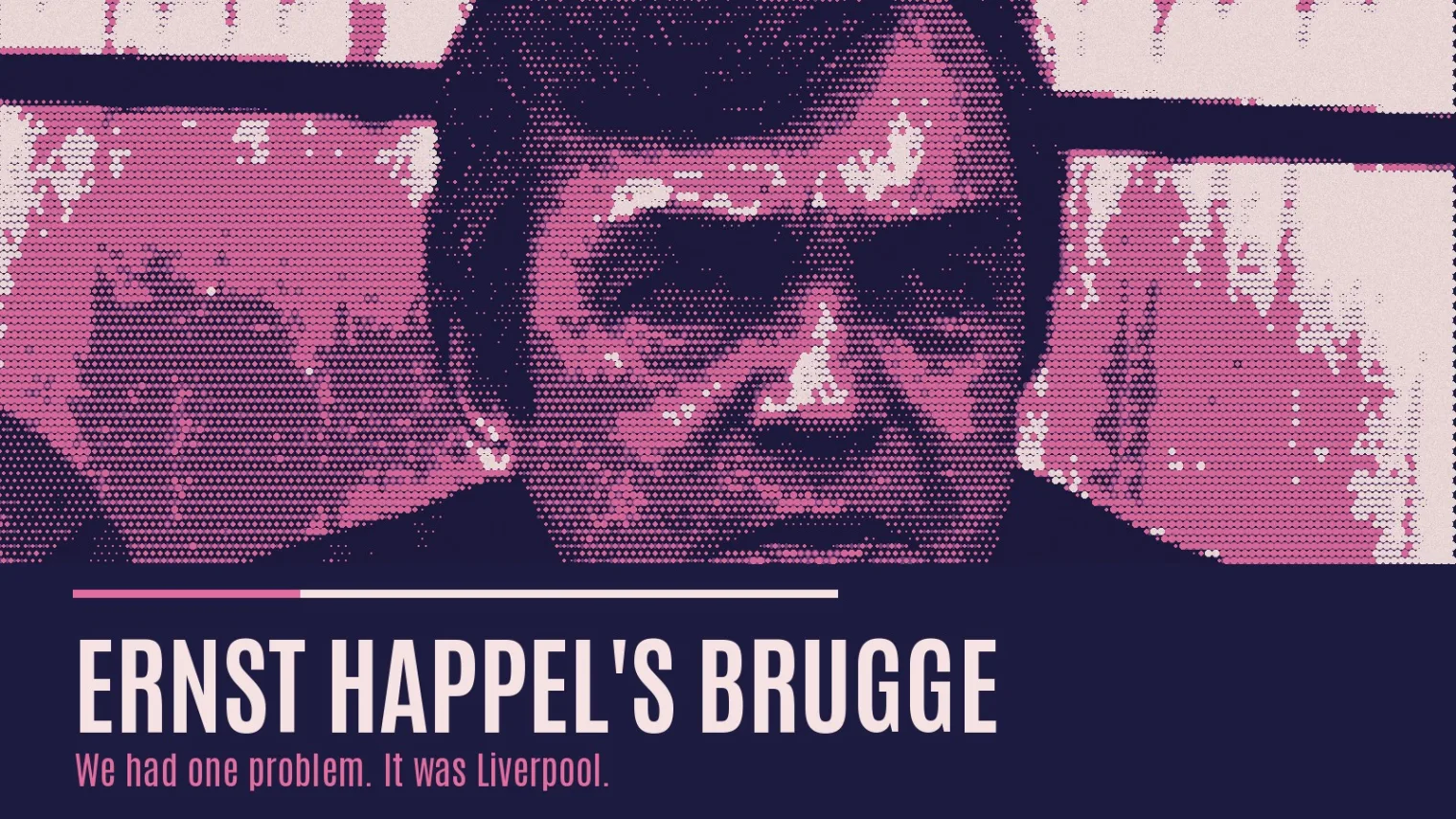
Three days after Wembley, Ernst Happel was back in the dugout. On 13 May 1978, at the Olympiastadion in Bruges, Club Brugge played a friendly against the Netherlands, the national team Happel was also managing, and would take to the World Cup in Argentina a fortnight later. Bert Verhoeff of Anefo photographed him that afternoon in a pinstripe suit and a loud tie, staring out at a game his club lost 1–3. It is not a picture of a man celebrating. It is a picture of a man who has just taken a Belgian provincial club to a European Cup final, lost it, and now has another final to think about.
This weekend Club Brugge is 135 years old. The club was founded on 13 November 1891, and to mark the anniversary the museum in the East Stand of the Jan Breydel Stadium — the ground that began life as the Olympiastadion — has opened a temporary exhibition on the thing those 135 years still turn on: the two European finals against Liverpool, in 1976 and 1978. “We have gathered many objects and digitised photographs and video material,” the club’s director of public affairs, Peter Gheysen, told Belga. “There will also be accounts from former players.” Eleven days after the museum weekend, on 25 November, Club Brugge will host Liverpool again, in the Champions League.
Georges Leekens, who played in both those finals and later managed the club twice, has already written the caption for the exhibition, whether he meant to or not. “We had one problem,” he told Simon Hart in Champions Journal. “It was Liverpool – and we got them in the final both times.”
“It’s 10 to 10 and training begins at 10 o’clock”
When Happel arrived in January 1974, Club Brugge were the defending Belgian champions, and that fact can mislead you. The title, won the previous spring under the Dutch coach Leo Canjels, had been the club’s first in 53 years, sealed with a 1–1 draw at Anderlecht on 8 April 1973 and a Raoul Lambert goal. They had only just taken a Flemish name, Club Brugge Koninklijke Voetbalvereniging, in place of Royal Football Club Brugeois. They were still working out what it meant to be professional. The midfielder Henk Houwaart, who had played for Happel at ADO Den Haag and recommended him to the board, later told the journalist Wim Degrave that a few years earlier the players had kept crates of beer in the dressing room for after training. That detail, and a good deal of what follows, comes from Degrave’s book De Happel jaren, as drawn on by Dan Billingham in The Blizzard.
Happel had already made Feyenoord the first Dutch winners of the European Cup, in Milan in 1970. A short, unhappy spell at Sevilla, then in the Spanish second division, had followed. He did not waste a greeting on the new job. Billingham records his first words to the Brugge players, in German: “Hello! I’m Ernst Happel. It’s 10 to 10 and training begins at 10 o’clock.” Then he left the dressing room.
Lambert, who had been at the club since 1962 and would never leave it, told a Belgian television documentary in 2009 that he almost threw up after that first session. “We only trained for an hour but it felt like we’d been training for a whole week.” At the end of the season Happel sold Johny Thio, Erwin Vandendaele and Pierre Carteus, Belgian internationals who had helped win the title. “They are all in their 30s,” he said, “and as a coach you just can’t change players in their 30s.” In came Roger Van Gool, 24, and René Vandereycken, 21. The left-back Jos Volders later told Degrave that Happel once had them sprinting with tree trunks on their backs. Julien Cools, the midfielder who would become the side’s metronome, remembered camps of more than one session a day and “loads of running”. Every session included matches in which the players were limited to two touches. “This really helped to speed up our play,” Cools told Billingham.
The shape could be 4-4-2 or 4-3-3. The idea did not change. Full-backs went forward. The side was expected to impress its fitness on domestic opponents who were, in many cases, still semi-professional. “There was very little in the way of tactical preparation in Belgian matches,” Cools said. “It was the other team that had to adapt to us – that was Happel’s philosophy.” Leekens, looking back, put it in a single sentence: “Happel built a hard-working team with a lot of modern football – very physical, attacking football. We had a little bit of the Ajax style and I think the only weakness was that we were sometimes too attacking.”
It did not come together at once. In Happel’s first full season, 1974/75, Club Brugge finished fourth, 12 points behind RWD Molenbeek, and squeezed into the UEFA Cup by a point. In the same spring they left their old ground, De Klokke, for the new Olympiastadion, which they would share with city rivals Cercle. The first official match in the new place was a 1–2 defeat to the champions, RWDM. The second thing that happened there was more useful. Europe came to visit.
Ipswich, cigars, and a photograph on the wall
Happel told journalists before the 1975/76 UEFA Cup that the aim was the third round. By early October that looked like a joke. Brugge had come through against Lyon, including a 3–0 home win that was the first European night in the new stadium, and had then gone to Portman Road and been beaten 3–0 by Bobby Robson’s Ipswich Town. “In Ipswich we didn’t touch the ball; they destroyed us,” Leekens remembered. “But at home it was already 3–0 at half-time. Ipswich came along with their cigars, [thinking] ‘Easy.'” Vandereycken scored the fourth in the 88th minute. A capacity crowd stayed on the terraces to celebrate.
What followed was a run that still looks, on paper, as if it belongs to a bigger club. Roma were beaten 1–0 home and away. Milan went the same way, more or less. Hamburg were edged 2–1 on aggregate in the semi-finals. Billingham notes that in their home legs on the way to the final, Happel’s side scored 11 and conceded none. The players had started going out, two or three at a time, to drink a beer with supporters’ groups across Flanders on a Monday night. “The day after, we’d have double training!” Leekens said. “That was the spirit of this team: we fought for each other on the pitch and, off the pitch, we were friends.”
At Anfield, on 28 April 1976, they played as if they had not been told the script. Liverpool had just beaten Barcelona in the other semi-final and had already won the First Division. Paisley started with a front line of Kevin Keegan, John Toshack, David Fairclough and Steve Heighway. In the fifth minute Raoul Lambert ran onto an under-hit header from Phil Neal and chipped Ray Clemence. Ten minutes later, after a move that ended with a headed lay-off from Lambert, Julien Cools half-volleyed the second. Cools later told Billingham he still thinks about that finish every day. A photograph of it hangs in his house in the countryside near Antwerp.
“At 2–0 we had a chance to make it three,” Leekens said. They did not. Paisley took off Toshack at half-time, sent on Jimmy Case, and switched the attack to the flanks. Toshack, Ian Herbert later recorded, was devastated, and years afterwards called the change “a tribute to the tactical knowledge of Paisley as much as anything else”. In six second-half minutes, as UEFA’s record of the tie has it, Ray Kennedy, Case and Keegan — the last from the penalty spot, after Heighway had been fouled — turned 0–2 into 3–2. Case, remembering the night for LFChistory, said the equaliser came off a Kennedy shot that came back to him: “It could have hit my thigh and run out of play, but I jumped instinctively and side-footed the ball into the net.” Leekens still calls Keegan’s penalty “very soft”. The attendance was 49,981.
The second leg, on 19 May at the Olympiastadion, was the same story told more quietly. Lambert scored from the spot after 11 minutes and, for a few minutes, the aggregate was level. Four minutes later Keegan finished from a free-kick, after Emlyn Hughes had taken it short, and Liverpool held on. Herbert wrote that as they paraded the cup around the new stadium, the base of the trophy actually fell off. Brugge had been the first Belgian side of the Happel years to reach a European final, and they had done it in the same month Anderlecht were winning the Cup Winners’ Cup. They went home as league champions too. They did not have the cup.
Happel, being Happel, had not spent the fortnight in awe. Before the final, Billingham records, he had said: “Liverpool don’t play football, all they do is run, run and run.” It was a good line, and a revealing one, from a coach whose own method was to run opponents into the ground. At Roma in the quarter-finals, with the tie poised at 1–0 on aggregate at half-time, he had asked his players, “Can’t you see that this Roma are shit?” Lambert scored again after the break.
Madrid, Gladbach, and a birthday in the net
The next season they won the league again, and the cup besides. The Belgian Cup final of 12 June 1977, a 4–3 win over Anderlecht on a scorching afternoon, went into club history as the “Davies Cup”, after the Englishman Roger Davies, who scored twice. Cools won the Golden Shoe. In the European Cup, played by Club Brugge for only the second time, they beat Steaua Bucharest and then Real Madrid, Paul Breitner and all, 2–0 at home after a 0–0 in Spain. In the quarter-finals they led Udo Lattek’s Borussia Mönchengladbach from the 23rd minute of the first leg until the 85th minute of the second, when a rare mistake by the Danish goalkeeper Birger Jensen — rushing off his line to a ball lofted towards the edge of the area — gave Gladbach a 1–0 win on the night and a 3–2 win on aggregate. Billingham notes that the 1–0 defeat was Club Brugge’s only loss in 14 home European ties between 1975 and 1978, a list that included Ipswich, Liverpool, Roma, Milan, both Madrid clubs, Hamburg and, in time, Juventus.
Jensen put it right the following season. The 1977/78 European Cup run is the one the museum has been waiting 135 years to show properly. KuPS of Finland were beaten 9–2 on aggregate, Panathinaikos 2–1. Then Atlético Madrid came to Bruges for the quarter-final first leg on 1 March, which happened to be Jensen’s birthday. Thierry Van Acker, then 12, was standing behind the goal. “Minutes before the game he’d received flowers from his fans and had hung them up in the net,” he told Champions Journal. Jensen later saved a penalty from Marcial to protect a 2–0 lead, a save Van Acker says “made us believe everything was possible”. In Madrid they went 2–0 down by half-time. Happel, instead of hanging on, sent on an extra striker, Bernard Verheecke. Cools and Lambert scored, the tie finished 3–2 on the night, and Brugge went through 4–3 on aggregate.
The semi-final was Giovanni Trapattoni’s Juventus, with Dino Zoff in goal. Club Brugge lost 1–0 in Turin, holding out until the 86th minute. For the return Happel picked four forwards. Van Acker remembers “30,000 spectators screaming their lungs out”. After three minutes the captain, Alfons Bastijns, met Vandereycken’s angled ball and poked it past Zoff. In the 116th minute of extra time, Jan Sørensen reached the byline and cut the ball back for Vandereycken to find the roof of the net. Club Brugge were in the European Cup final, the first Belgian club to get there, and still the only one. UEFA’s own account of the season added a dry aside: the win had “Belgians everywhere (except, perhaps, Brussels) dreaming of a first European Champion Clubs’ Cup win”. Anderlecht, in the capital, had their own ideas about who ran Belgian football. For once they were watching from the side.
It came at a cost. Leekens ruptured an ankle ligament in the semi-final and made the final with only days to spare. Lambert, the club’s great centre-forward, had played on against Juventus with a painkilling injection and could not recover. “His presence means a lot to us psychologically,” Happel said beforehand, and then had to do without him. Paul Courant, the No 10 who had scored a brilliant goal against Atlético, was out with a groin injury. Into the side, for a final at Wembley, Happel brought the Hungarian Lajos Kű, who had played one match for the club.
Wembley, 10 May 1978
About 25,000 Club Brugge supporters crossed the North Sea for the final, by ferry from Calais, Zeebrugge and Ostend, and by coach into central London, where they gathered in Trafalgar Square. L’Équipe, on the morning of the game, ran a headline that Simon Hart later recorded as “Liverpool and Wembley: tough for Brugge”. It was. Liverpool were the holders. Keegan had gone to Hamburg; Kenny Dalglish had arrived from Celtic to replace him. The crowd, LFChistory’s record of the night has it, was 92,500.
David Lacey, writing in the Guardian, watched Happel’s side try to live without Lambert and Courant. They “decided to concentrate on stifling Liverpool’s movements with dedicated man-to-man marking and an offside trap ever improving in efficiency”. Leekens was blunter. “It was like their attack against our defence, and for 90 minutes that is difficult against class players like Kenny Dalglish.” For an hour it almost worked. Jensen, whom the club history still calls world-class that night, blocked Fairclough, tipped over a header from Alan Hansen, and flung himself at Terry McDermott’s feet after a passing move with Graeme Souness and Dalglish that, Lacey wrote, left “the offside trap gaping in astonishment”.
The goal, when it came, was in the 64th minute, Dalglish’s 30th of the season. Steve Heighway, on for Case and freshly recovered from a damaged rib, had been on the pitch less than a minute. Phil Neal held the ball near the right-hand corner flag, released it to McDermott, and a chip along the byline found Dalglish. The ball came back to Souness, who held it until the Brugge line stepped up, then slid the pass through. Dalglish’s shot went wide of Jensen’s right hand. It was, Lacey thought, a goal that “summed up their thoughtful mood of the night”.
Brugge had two real chances. Early in the second half, Vandereycken’s crossfield ball put Sørensen in on the right; he was blocked, and Clemence nearly lost a race for the loose ball with Kű. With about ten minutes left, an under-hit Hansen back-pass sent Sørensen through. Clemence saved at his feet. Jan Simoen struck the rebound beyond him, and Phil Thompson, behind his goalkeeper, blocked on the line. “We had one big one but Jan Sørensen missed it,” Leekens said. Cools, speaking to Billingham, was still more sparing: “We just couldn’t compete.”
Bob Paisley, afterwards, blamed the Belgians for the lack of a spectacle. “It takes two teams to make a game into a spectacle and Bruges only seemed to be concerned with keeping the score down,” he told the Guardian. “We controlled the game from start to finish.” Happel was unimpressed in the other direction. “Liverpool seemed only a shadow of the side we played in the Uefa Cup final two seasons ago. I was disappointed with them, but they deserved their victory although we were handicapped by injuries to two players.”
Both men were describing the same match. Paisley had watched a final his team had to solve in open play, without the blunt instruments of the long ball, and had solved it. Happel had watched a final his team could not attack as he preferred, because the two players who usually made the attacking possible were in the stands, and had tried to turn it into a problem of patience. For an hour it was a problem. Then it was 1–0, and it was over, and the 25,000 who had come from Bruges had a long journey home.
A second final, and a walk-out
The photograph in the dugout was taken 72 hours later. Happel was still Club Brugge’s coach and still the Netherlands’ coach, a dual role he had held since the August before, and the friendly against his own international side is one of the odder footnotes in either job. Six weeks after that, in Buenos Aires, the Netherlands reached the World Cup final. Rob Rensenbrink hit the post in the 90th minute with the score at 1–1; Argentina won 3–1 in extra time. Two European finals and a World Cup final, all lost, in the space of a year and a half. It would have been a reasonable moment to stop. Happel did not stop.
The unravelling in Bruges came in the autumn. Pre-season was already sour: some players were accused of not working hard enough, a planned weekend off was cancelled so that Brugge could fill in at a Feyenoord tournament, and after heavy defeats to Everton and Benfica four regulars were sent to the reserves. In the first round of the 1978/79 European Cup they were knocked out by Wisła Kraków. After the second leg in Poland, Billingham writes, Jensen threw his boots at Happel.
The break, when it came, in November 1978, was not really about Kraków. The sporting director, Antoine Vanhove, was overheard in a café in Bruges scorning Happel as a drinker, a womaniser and a Nazi. The last of those, Billingham notes, cut deepest. Happel’s Austrian biographer Klaus Dermutz recorded that he had been pushed out of Rapid Vienna’s youth ranks in the 1930s for refusing to sing Nazi songs; membership of the Hitler Youth had been all but required of young footballers at the club after the Anschluss. Before that last European tie in Kraków, Happel had taken the entire Brugge squad to Auschwitz. He walked out of the club.
His next job, incongruously, was at KRC Harelbeke, bottom of the Belgian second division, taken on, it was said, as a favour to a friend who had money in the club. He kept them up, went to Standard Liège, and in 1981 arrived at Hamburg, where, in 1983, he became the first manager to win the European Cup with two different clubs. The team he beat in that final, at the Olympic Stadium in Athens, was Juventus. Trapattoni again.
Cools left Brugge in 1979 and captained Belgium to the final of the 1980 European Championship, which they lost 2–1 to West Germany, Vandereycken scoring from the spot. Lambert, a one-club man from 1962 to 1980, would later be honoured as the greatest player in the club’s history; Champions Journal credits him with 23 European goals for the Blauw-Zwart. Jensen, looking back in 2017, needed only one sentence. “Without Happel,” he said, “Club Brugge wouldn’t be anything like it is today.”
135 years, and the same opponent
No Belgian club has reached a European Cup or Champions League final since. Anderlecht lost a UEFA Cup final to Tottenham at White Hart Lane in 1984, and Royal Antwerp lost the Cup Winners’ Cup at the old Wembley to Parma in 1993. Those are near misses of a different order. Happel’s Brugge remain the standard, and the standard is a side that beat Milan, Madrid and Juventus, led 2–0 at Anfield after 15 minutes, and twice ran into Liverpool when a trophy was on the table.
The modern club motto, adopted in 2011, is “No Sweat, No Glory”. It is a marketing line, and it also happens to be a fair description of those midweek nights in the mid-1970s, when a coach who barely spoke to his players, and who sometimes made them run with tree trunks on their backs, turned a club that had waited 53 years for a second title into the only Belgian team ever to walk out for a European Cup final. Leekens, who was there, kept coming back to the same point. “The guys were afraid of him. He was a real leader. He got 200 per cent out of the group. He made every player better… He didn’t overload us with theory… He said, ‘Look for the solutions.'”
This Saturday, 14 November, the museum in the East Stand is open until one o’clock, and the temporary exhibition is about those two finals. It is also, as it happens, 34 years to the day since Happel died. He was 66, two weeks short of his 67th birthday. He died at the university clinic in Innsbruck, of lung cancer, at 17:17 on 14 November 1992, a fact the Austrian papers still mark when the date comes round, from Der Standard in 2002 to Kurier on what would have been his 100th birthday. He had gone home to coach Austria, and he did not live to see whether they would reach the 1994 World Cup.
In Bruges they do not need a death date to remember him. They have a stadium that his years helped to fill, three titles in a row that were not matched until 2022, and a European Cup final that nobody has equalled. They also have, this month, Liverpool on the fixture list again. The exhibition will still be in the memory when that match kicks off. The question it quietly asks is the same one Leekens has been answering for 40 years. The football was good enough. The problem was the opponent.