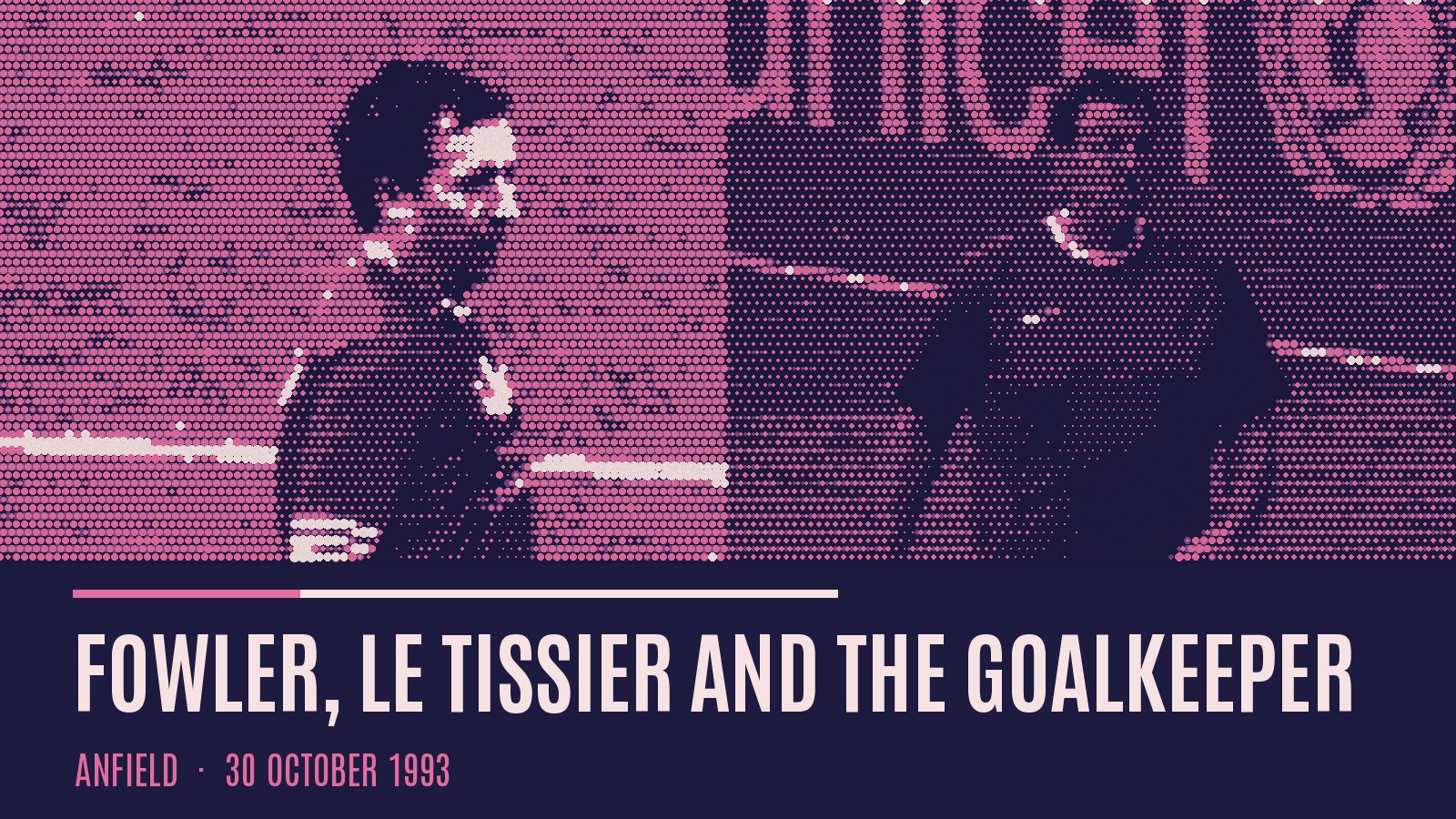
An 18-year-old local lad scored three. A Guernseyman nobody trusted scored two. And the man in goal for Southampton was already halfway to Blackburn.
Every so often English football produces an afternoon that looks, in hindsight, like a seminar. Nobody planned it, nobody announced the subject, and the people taking part were mostly worried about the league table. But go back to it thirty-odd years later and the whole of the argument is laid out in front of you, a little untidy, like notes on a desk.
Liverpool 4 Southampton 2 at Anfield on Saturday 30 October 1993 is one of those afternoons. On paper it was a bad side beating a worse one. Liverpool had gone five successive league games without scoring. Southampton were second from bottom. Both managers were under the kind of pressure that turns fanzines nasty. But on the pitch that day were two of the most naturally gifted English-league forwards of the decade, one at the very start of his career and one being told, again, that he was a problem. And in goal for the visitors was a man whose transfer was already agreed and who spent ninety minutes being abused by a crowd that thought he had turned them down.
Two clubs in a mess
It is easy to forget how bad things were at Anfield in the autumn of 1993. Graeme Souness had been in charge for two and a half years, and FBH has written before about his gift for making enemies. One of the Sunday reports collected in the club’s newspaper archive put it bluntly. “Twice his board have forborn to sack him. Now, after five successive goalless league games, the home gate, averaging 42,000, dropped by 10,000. And still he looks out for excuses, not inwards for reasons.”
Souness had his explanation ready. “I took over a team that was going backwards,” he said. Players used to come to Anfield, he went on, and spend a couple of years in the reserves learning the Liverpool way. “But the players I was buying had to be an immediate success in the team. Some have not done that.” The reporter’s reply was three questions long: “Wrong players? Wrong prices? Wrong manager?” And then the line that should have stung most: “The ironic truth, lost on Souness, is that with £21 million spent… the club have an 18-year-old local carrying their torch.”
Southampton were arguably in a worse state. Ian Branfoot’s side had lost eight of their first 11 league matches. The same report noted that Branfoot appeared in a fanzine beneath the headline “Hope You Die Soon”, which, it said, had at least swung decent supporters behind him. And Branfoot had done something many Saints fans would never forgive. He had dropped Matthew Le Tissier.
The luxury
Le Tissier had been left out for Paul Moody, a striker who, as the Telegraph later put it, “spent most of his career in the lower leagues”. The concern was his work rate, the eternal English worry about a player who does not run around enough to look as though he is trying. Results did not improve. So for the visit of Kevin Keegan’s Newcastle to The Dell on Sunday 24 October, live on Sky, Branfoot brought him back.
What happened next is part of Premier League folklore. On the hour, with the game goalless, Moody was warming up. “I remember seeing Paul warming up after 60 minutes and just thinking it would be for me,” Le Tissier told Sky Sports years later. Then Iain Dowie headed a long ball just behind him. Le Tissier flicked it up with his heel, lifted it past Barry Venison, took it over Kevin Scott and slid it past Mike Hooper. “When I scored the goal the camera panned to Branfoot and I lip-read him saying, ‘Sit down Moods’.” Andy Cole equalised, and then with less than three minutes left Le Tissier took a header from Neil Maddison on his thigh and volleyed the winner into the top corner from 25 yards. FBH readers will know the rest of the Le Tissier story, from his last goal at The Dell backwards, but it is worth remembering that the most famous goal of his career was scored by a man who had been out of the team the week before.
Six days later Southampton went to Anfield, and the argument about him went with them. On the Saturday night, Alan Hansen called Le Tissier, “somewhat grudgingly” according to one of the next day’s reports, a “luxury”. The same writer was having none of it. “Give us such luxuries. Now, more than ever, English football needs fantasy.”
The boy
If Le Tissier was the luxury English football could not decide whether to afford, Robbie Fowler was the bargain it had produced without trying.
He had made his debut only five weeks earlier, at Craven Cottage on 22 September in the first leg of a Coca-Cola Cup tie against Fulham, and scored in a 3-1 win. In the second leg at Anfield on 5 October, in front of a crowd of 12,541, he scored all five in a 5-0 win. According to the club, he became only the fifth man to score five in a game for Liverpool, after John Miller in 1892, Andy McGuigan in 1902, John Evans in 1954 and Ian Rush in 1983. It was his fourth senior appearance. He was 18.
So by the time Southampton came to Anfield, he was not a secret. But there is a difference between five against Fulham, then in the third tier, and a hat-trick in the Premiership.
The goalkeeper nobody wanted to lose
There was a third story that afternoon, and the crowd made sure it was heard. Tim Flowers had been Southampton’s goalkeeper since the late 1980s. He was 26, had won his first England cap that summer, and was about to become the most expensive goalkeeper in British football. Liverpool had bid for him. So had Blackburn. Branfoot confirmed after the game that Liverpool’s offer had been accepted by Southampton, and that a Blackburn offer had been turned down. “There had been no further developments, he stressed,” as LFChistory’s report puts it.
A Reuters wire that week reported he had turned down a move to Liverpool, and he was, in the report’s words, “taunted by the Liverpool faithful throughout”. The Sunday writer’s version is much better. “Tim Flowers began the match as the keeper of Southampton’s goal, as yet unbought and, as the contumely heaped upon his head by an unforgiving crowd told him, unloved. That it was his last game for them was hardly in doubt. At the end of it he threw his gloves into the visiting support and disported himself as though he had given a grateful gallery a flawless performance of Othello.”
There is a lovely twist. “Human conduct being so capricious, the Kop eventually sent Flowers on his way, presumably to Blackburn, with an ovation. He had indeed played nobly, though not nobly enough to deny Liverpool a handsome victory.”
Five days later, on Friday 5 November, Flowers joined Kenny Dalglish’s Blackburn for £2.4 million, breaking the British record for a goalkeeper. Henry Winter’s piece in the Independent noted that Southampton had signed him from Wolves for £70,000 seven years earlier, and that Dalglish had now spent just under £15m since promotion. Southampton had replaced him with Dave Beasant from Chelsea for £300,000. Eighteen months later Flowers would be a league champion, part of the Blackburn side of 1995. It is one of the stranger what-ifs of the decade. Liverpool wanted him and the fee was agreed. Imagine the 1990s with Flowers, not David James, behind that defence.
The match
It was, by every account, a very good game. One report called it “brisk, open, careless, brilliant”, which is about as good a four-word summary of mid-90s English football as you will find.
Fowler scored first, after 14 minutes, a downward header from a Rob Jones cross that came after a short corner involving Mark Wright. Thirteen minutes later he scored again, and this was the goal that tells you what kind of player he was going to be. Neil Ruddock hit a long ball forward. Fowler chested it down, took it round his marker and, as LFChistory’s report has it, arrowed “a low drive into the far corner”. That is not a goal you can coach. The touch takes him away from the defender and the finish is struck before the defender has worked out where the ball went.
Then Le Tissier. Five minutes before half-time, Dowie headed the ball down to him. He flicked it from his left foot to his right and back onto his left, “comprehensively beating Mark Wright”, and drilled it on the half-volley past Bruce Grobbelaar. The Sunday writer saw in it “intuition, balance and, that sine qua non, command of the ball”. Another report said Le Tissier turned defenders, “especially Wright, into lurching drunks”. Mark Wright was an England centre-half. This was a rough afternoon for him.
Liverpool attacked at the start of the second half. On 62 minutes Paul Stewart back-heeled a Dominic Matteo cross, Flowers could only parry, and Rush scored from close range. Twice Flowers denied Stewart, Matteo and Rush. Then on 78 minutes the substitute Glenn Cockerill put Le Tissier through, and he clipped the ball beyond Grobbelaar’s dive with the outside of his right boot, just inside the post. Southampton were back in it at 3-2. Fowler made a superb solo run, the ball broke to an unmarked Steve Nicol, and Flowers was saved by the woodwork.
The fourth goal, which gave Fowler his hat-trick, was a mess, and wonderfully so. Four minutes from time he curled in a free kick from the right. Rush ran in to distract Flowers. Most observers thought Rush failed to touch it. The ball drifted in at the far post. One report described Flowers as “grounded and utterly fooled”. Fowler was later confirmed as the scorer.
Master and protégé
Fowler was honest about it afterwards. “I saw Rushie make his run and I was trying to find him,” he said. That honesty is a big part of why people loved him. He then said the thing that probably mattered most to him: “Anyone would be pleased to score three in the Premiership, so I’d say it’s better than the five I got in the Coca-Cola Cup. Since I’ve been in the side the service to the front men has been really good. Anyone who doesn’t learn from Ian Rush needs shooting.”
That last line is pure Fowler, cheerful and slightly violent. It is also the key to the afternoon. Ten years earlier, almost to the week, Rush had scored five against Luton at Anfield. Now he was 32, the captain, and the reports agreed he was the best player on the pitch. “Rush, alert, selfless and committed, excelled,” wrote one. “Despite Le Tissier and Fowler, he was the best man on view.” Another described the two Liverpool strikers as being “like master and protege”, and said Fowler’s “finesse, awareness and changes of high pace in Rush’s image lit up the team”.
Rush’s selflessness, the willingness to make a run for a free kick he would not touch, is what made Fowler’s goal possible. It is a fitting thing for a hat-trick to hinge on: the older man taking the defender and the goalkeeper with him so the younger one could score.
Souness brought Fowler into the press room clutching the match ball. “I think you saw a young man out there today who could one day be anything he wants to be in football,” he said. “He’s played eight games and has now scored ten goals, and that speaks for itself. Apart from the goals, he has a great awareness and a great understanding of the game of football. He is playing against people who have been around the Premiership for many years now and he out-thinks and outwits a lot of them. That’s something that will only improve.”
It is a generous and accurate quote, and it is also, given everything else happening to Souness that autumn, the quote of a man who knew he needed good news. Souness resigned in January 1994. Fowler stayed for another seven years.
The other manager
Branfoot, meanwhile, was in the odd position of having lost the game and found his best player again. “We were 2-0 down before we started to play,” he said. “The younger players were a bit overawed but once we started playing, I fancied us and thought we would get something out of the game.” He said Flowers had done “extremely well today under a lot of pressure.”
On Le Tissier, he said the two goals at Anfield had come close to being as good as the two against Newcastle. “Matthew has worked extremely hard during the last five or six weeks. He looks fitter and sharper, and he’s getting back to the Matthew Le Tissier that we all love.”
The Sunday writer was more sceptical. “What Le Tissier is still doing at Southampton, he alone knows,” he wrote. “Restored to the first team by a manager whose trust he clearly lacks, he has scored four times in a week.” He went on: “When some other club finds the money, or summons the will, Le Tissier will surely be accommodated elsewhere.”
He was wrong about that, gloriously. Le Tissier never left. Branfoot left instead, in January 1994, and Alan Ball came in. According to the Telegraph, Ball gathered the squad at his first training session and pointed at Le Tissier. “Whether you like it or not he is the best player at this club by a million miles. His goals will keep us up.” Under Ball, Le Tissier scored 45 goals in 65 games playing behind the strikers, and in the last six games of that 1993-94 season he scored eight and made six to help Southampton stay up by a single point. Sky’s records give him 25 league goals that season. FBH has argued elsewhere about Southampton’s best season, and the survival Le Tissier dragged them to in 1994 belongs in that conversation.
Blanchflower’s question
The best paragraph written about this game, though, is not about either goal. It is the Sunday writer remembering Danny Blanchflower. “It all depends on how sympathetically you regard talent,” he wrote. “Danny Blanchflower once asked: one man is consistent, his best is seven out of 10; another can give you nine out of 10 but is more variable. To whom does the manager look?” He offered an example of the first type: David Batty, who had just joined Blackburn for £2.75 million. And Le Tissier, he noted, “is not even sure of a regular place in the team second from bottom.”
That question ran right through English football in the 1990s. Glenn Hoddle had faced it in the 1980s. Le Tissier faced it all his career and won only eight England caps. And for a few years, Fowler seemed to be the answer to it: a player with nine-out-of-ten talent who also, somehow, did it every week. He scored goals the way other people breathe.
What happened next
Fowler became the most natural finisher of his generation in England. He would go on to score 183 goals in two spells at Liverpool, though for this piece what matters is the boy holding the match ball in the press room and saying he had been trying to find Rushie.
Le Tissier stayed at The Dell for the rest of his career and became a sort of patron saint of loyalty in an era that was about to forget the word. Flowers won the title. Souness and Branfoot were both gone by the end of January. Rush, the best man on view, kept going, and kept making runs for other people.
Thirty-three years on, it is hard not to read the afternoon as a parable about the English game’s uncertain relationship with talent. One genius was 18 and adored by everyone. The other was 25, adored by his supporters and treated with suspicion by his manager and, on that evening’s television, by the most respected pundit in the country. The crowd at Anfield applauded both. They also booed the goalkeeper, then applauded him too. Football crowds are not consistent. They tend to be right about talent, though.
“Give us such luxuries,” the man from the Sunday paper wrote. On 30 October 1993 at Anfield, for one afternoon, we had two of them.