


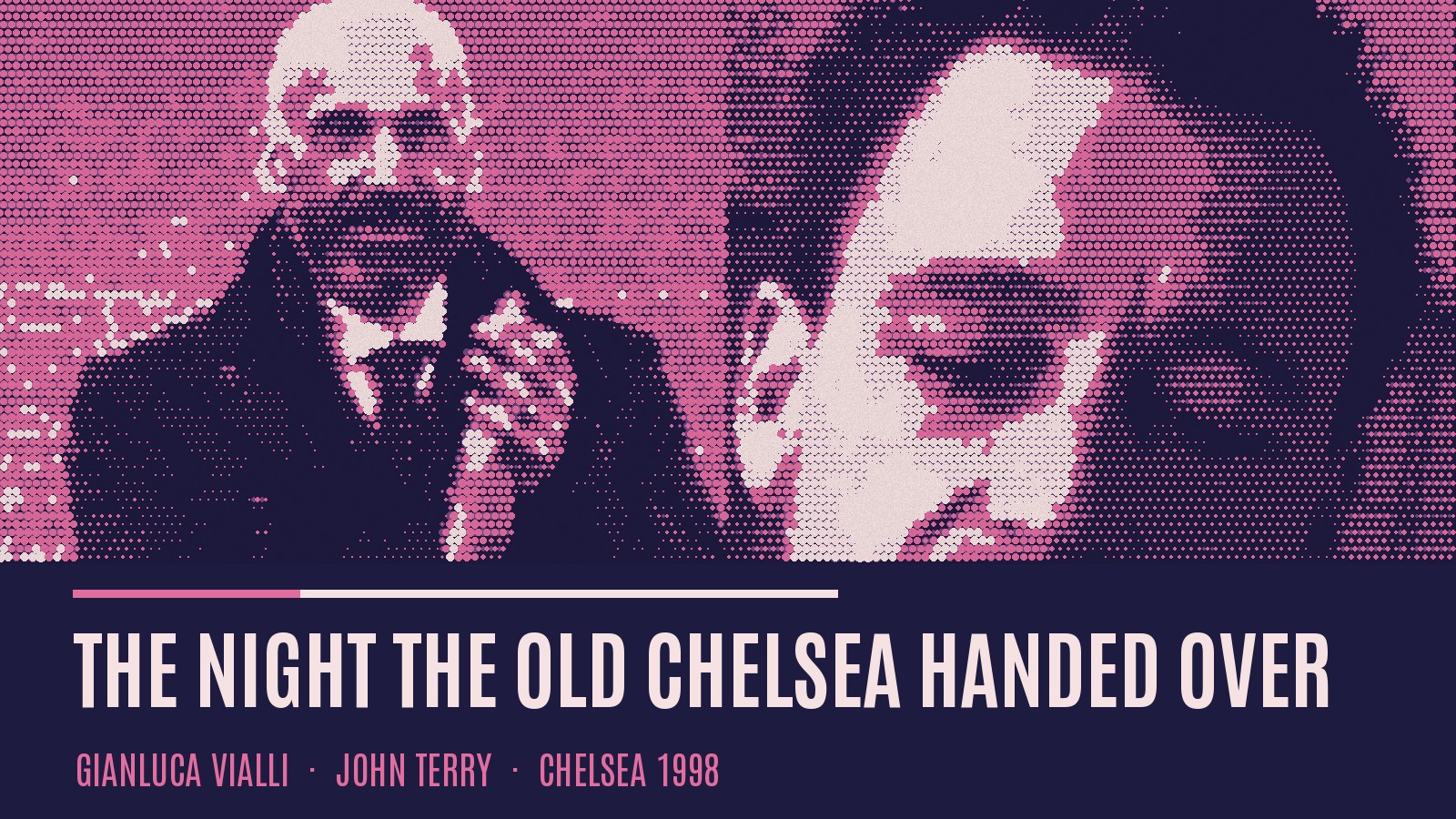
On 28 October 1998 a player-manager in Diadora boots scored three against the league leaders and then sent on the apprentice who ran his baths. Nobody at Stamford Bridge knew they were watching one era pass the ball to the next.
There is a kind of football match that only exists in the memory of the people who were there and the statisticians who have to be. Midweek, autumn, League Cup third round, both teams rotated to the point of anonymity, a crowd that turned up partly out of habit and partly because it was a Wednesday and there was nothing on telly. Most of these games dissolve on contact with the night bus home. A few do not, and almost never for the reason anyone thought at the time.
Chelsea 4 Aston Villa 1, Stamford Bridge, Wednesday 28 October 1998, is one of those. Read the report filed that night and it is a slightly grumpy piece about a cup that nobody was taking seriously. Martin Thorpe, writing for the paper’s sports desk, called it “a run-out for both clubs’ squad players” that “made a mockery of what is supposed to be a serious competition”, and said “the evening had an anti-climactic feel”. He wasn’t wrong. Chelsea were missing eight of the side that had drawn 0-0 at Leeds the previous Sunday. Villa, who were top of the Premiership, had made six changes from their draw with Leicester. It was the sort of fixture managers use to find out which of their reserves can be trusted on a wet Tuesday in February.
And yet. The player-manager picked himself and scored a hat-trick. Then, with four minutes left and the tie won, he looked along his bench and sent on a 17-year-old centre-half to play right-back. The boy’s name was John Terry. He would go on to play 717 times for Chelsea and win 15 major honours. It is not too much to say that in those last few minutes against Villa, the cosmopolitan, champagne-and-Bosman Chelsea of the late 1990s and the Chelsea that would rule English football in the 2000s were on the pitch together, for the first time, in the same blue shirts.
The man in the Diadoras
To understand what Gianluca Vialli was doing in a League Cup tie against Villa’s reserves, you have to remember how strange Chelsea were in 1998, and how much of that strangeness was his.
He had arrived in the summer of 1996 on a free transfer, a move made possible by the Bosman ruling a year earlier. Six weeks before he trained with his new teammates in west London, he had lifted the European Cup in Rome as captain of Juventus after a penalty shootout against Ajax. FBH has written about that night and Ravanelli’s goal, but it is worth sitting with the scale of it. This was a man who had been one of the Goal Twins at Sampdoria with Roberto Mancini, who had scored both goals in a Cup Winners’ Cup final, who had won Serie A in the 1990-91 season, the only title in Sampdoria’s history, and who had moved to Juventus for a world-record fee of £12.5m. He was the son of a self-made millionaire and had been raised in a 14th-century castle in the village of Belgioioso. As the Guardian’s obituary put it, he “had an unusually wealthy background for a footballer”.
This man, at 32, chose Chelsea. Chelsea in 1996 had not won the league since 1955 and had not won a major trophy between the Cup Winners’ Cup of 1971 and the FA Cup of 1997. They had Ruud Gullit as player-manager, a story FBH has told before, and they were in the middle of a reinvention that felt, from the outside, like someone had swapped the Shed for a Milanese wine bar. Gianfranco Zola came that autumn. Roberto Di Matteo had come the same summer as Vialli. Frank Leboeuf was there, and Dan Petrescu. It was gloriously, unapologetically entertaining.
Vialli did not always fit. He won the FA Cup in his first season but was given only five minutes off the bench in the final against Middlesbrough, and for much of his time under Gullit his place in the side was far from guaranteed. Then, in February 1998, Gullit was sacked, and Ken Bates gave the job to the Italian with the shaved head.
Champagne
His first match in charge was the second leg of a League Cup semi-final against Arsenal, with Chelsea 2-1 down from the first leg. Before kick-off, the new player-manager handed his players glasses of champagne in the dressing room. It is the single most Vialli thing that ever happened, and it is also the kind of thing you could not imagine at an English club now. As Nicky Bandini wrote after his death, “A top-level coach encouraging players to drink alcohol before a game sounds implausible in 2023 but then so does the idea of a club such as Chelsea hiring a player-manager in the first place.”
It worked, of course. Mark Hughes, who had been to see the Queen to collect his MBE that morning and then committed three fouls in the first three minutes, scored. So did Di Matteo and Petrescu. Chelsea won 3-1. Glenn Moore’s report in the Independent the next morning noted that as the fans filed out, “I’m a Believer” came over the public address. Vialli said the players were fantastic and that he was very proud of them. Then he said something that tells you he already understood what he had taken on. “I envy Ruud because he was so calm. I hope I can now get some sleep, I hope I can get used to it or I will have a heart attack. I don’t want to think about football 24 hours a day.”
He would think about it 24 hours a day for the next two and a half years, and he would win an awful lot. The League Cup final against Middlesbrough, 2-0 again. The Cup Winners’ Cup in Stockholm, where Zola came off the bench and scored the only goal against Stuttgart within seconds, and Vialli became, at the time, the youngest manager to win a European competition. The Super Cup that August. Third in the league in 1998-99, Chelsea’s best top-flight finish since 1970. The FA Cup in 2000. On trophy count alone, Bandini pointed out, he is the club’s most successful manager of the era before Roman Abramovich. FBH readers who remember Zola’s Chelsea will remember how much of that period felt like a holiday that nobody wanted to end.
A cup holders’ night
So that is the Chelsea that walked out against Villa in October 1998. Holders of the League Cup, holders of the Cup Winners’ Cup, a club that had discovered winning things was actually rather nice and wanted to do more of it, but which was also, in that strange late-90s way, slightly embarrassed to be seen to care about the League Cup now there was a title to chase.
Look at the team sheet and you can see both things at once. Dmitri Kharine in goal. Petrescu, Celestine Babayaro, Michael Duberry, Bernard Lambourde. Gus Poyet, Dennis Wise, Mark Nicholls, Jody Morris in midfield. Tore André Flo and Vialli up front. Zola, unused, on the bench next to Kevin Hitchcock. Three teenagers or near-teenagers among the substitutes who got on: Neil Clement, Jon Harley and John Terry.
Villa had Michael Oakes in goal, who was, according to Thorpe, “excellent”, and a lineup that included Ugo Ehiogu, Ian Taylor, Mark Draper, Julian Joachim, Simon Grayson, Riccardo Scimeca and Darius Vassell off the bench. John Gregory’s side were top of the table. They took the lead after ten minutes when Draper’s 25-yard free kick took a big deflection off the wall.
Chelsea took over from there. Just after the half-hour Villa lost the ball in their own half, Lambourde picked it up and ran at a back-pedalling defence, and “the ball flew to Vialli and the Italian stroked it home”. On 67 minutes Vialli, who Thorpe wrote “had been running around like a spring lamb on this rare outing”, took Poyet’s pass in the area, turned and beat Oakes. Four minutes later Taylor fouled Flo, Wise took the free kick and Flo headed the third. And with six minutes left, Vialli got his third.
It was not an important hat-trick. It was the kind a 34-year-old striker who is also the manager gets when the opposition have half a mind on Saturday. But watch the way he celebrated in any of his Chelsea goals and you understand that, for Vialli, there was no such thing as an unimportant goal. Here was a man who said he could have been a soldier if football had not worked out, and who had written, in the book he co-authored with Mancini about their Sampdoria title, “Don’t believe anyone who says football is a war. It’s a sport, a game. And you play games with your friends.”
Five minutes
What happened next is the bit everyone remembers now, and nobody noticed then.
In the 86th minute, with Chelsea 4-1 up, Vialli took off Petrescu and sent on the teenager to play right-back. According to Chelsea’s own account, the Romanian “did not take kindly to being withdrawn”. Within a minute of the boy coming on, the captain, Wise, was sent off for a bad tackle. Chelsea’s ten men saw the game out without bother, and that was that.
Terry’s own memory of the night, which he gave years later on a podcast, is a perfect piece of anti-mythology. “I was slightly nervous but not massively,” he said. “I knew I was on the bench so you get out in the warm-up and get a feel for the stadium and the atmosphere. As the game went on, I think we were 4-1 up at the time and there was about five minutes left on the clock so I knew I was kind of safe. There’s not much you can mess up in five minutes so I just went on, didn’t think anything of it. Wisey got sent off after about 20 seconds of me being on the pitch and that was my debut over really.”
There is something lovely about that. The future captain of Chelsea and England, a player whose whole public identity would be built around blood and bandages and the armband, remembers his debut chiefly as the night someone else got sent off. It is the most English of debuts, a footnote to a red card.
And it is worth remembering how close Terry came to never getting there. Two years earlier, Chelsea had told his parents they did not think he would get a youth training scheme contract. “I was really small and had this puppy fat for about two or three years that I just couldn’t shift,” he said in the same interview. “Physically, everyone else was developing but it felt like I was never going to get through it.” He went through a growth spurt at 15 or 16 and was thrown on as a sub in a reserve game at Luton, playing in midfield, when Chelsea were 5-0 down. He scored twice in about ten minutes, got his contract, and moved to centre-back in his first season as a scholar.
Running the bath
The relationship between the player-manager and the boy is the heart of this, and Terry has told it with real warmth. In 2023, ahead of a legends match at Stamford Bridge in Vialli’s memory, he remembered the most unglamorous detail imaginable. “I remember those Diadora boots Luca used to wear and, as an apprentice, I used to run his baths for him,” he said. “He used to like it really hot with a little bit of bubbles, so he could get in with his boots on and they would mould around his feet. He was so normal with me for someone so high profile, such a legend in the game. He was an unbelievable man and brilliant with the younger players.”
Think about that picture for a second. In the late 1990s, apprentices still cleaned boots and ran baths. A European Cup-winning captain sits in a hot bath in his football boots so the leather moulds to his feet, an old Italian trick, and the boy who ran the water is the future of the club. Somewhere in that steam is the whole story of how English football changed in those years: the Continental star with his strange professional rituals, and the English kid learning from him at close quarters.
The connection keeps recurring. When Terry made his first start, Vialli scored both goals in a 2-0 FA Cup win over Oldham. When Terry needed first-team football in 2000, it was Vialli who set up a loan to Nottingham Forest with his old Sampdoria teammate David Platt, then the manager at the City Ground. And when Terry came back, Vialli did something that Terry still talks about.
“There were obviously a lot of experienced players around the first team at that time and I’d come back from a loan, but Luca put me, Jody Morris and Jon Harley on the bench for the final,” he said. “He could have quite easily thought: ‘Oh, they’re young players, I’m going to go with experience’. But he pulled us in and said: ‘You’re the future of our football club and it’s important that you’re involved today’. But the key is that he said ‘the future of our football club’, because that’s how he saw Chelsea.”
The final was the 2000 FA Cup final, the last at the old Wembley. The opponents were Aston Villa. Di Matteo scored. Terry didn’t get on, but, as he put it, “we felt part of that day”. So there it is: his first game as a Chelsea player was against Villa, under Vialli, and his first winner’s medal came against Villa, under Vialli, eighteen months later. Football does not usually rhyme that neatly.
The handover nobody saw
Here is what makes 28 October 1998 more than a nice pub-quiz answer. Read the team sheet again and you have two Chelseas on it.
One is Vialli’s Chelsea: Petrescu, Poyet, Leboeuf in the wider squad, Zola on the bench, Flo, Lambourde, Babayaro, Kharine. A club of brilliant, slightly fragile imports who arrived on Bosman frees and big wages, won cups with style, finished third and never quite turned into champions. It was a team with a lot of joy in it, and not a huge amount of defending.
The other is the Chelsea that came next. Terry, of course, but also Jody Morris and Jon Harley, the academy boys Vialli trusted. Within a few years Terry would be the spine of the side Claudio Ranieri began and José Mourinho finished, the side that won the league in 2005, fifty years after the last one. That Chelsea defended for its life. It was built around an English centre-half who blocked shots with his face.
Vialli, though, was sacked only five games into the 2000-01 season, as the Guardian obituary put it, “in the modern Chelsea tradition”, while still in full flow. He went to Watford for a year, which didn’t work, and never managed again. He became a television analyst, set up a sports investment company, and in 2019 became head of delegation for Mancini’s Italy, and was there when Italy won Euro 2020 at Wembley. He died of pancreatic cancer in January 2023, aged 58. FBH paid tribute at the time.
He never saw the league title he was building towards as Chelsea manager. But he picked the boy who would lift it. That is a strange kind of legacy, and a very football one. Vialli’s Chelsea won trophies with a cosmopolitan swagger that the English game had never really seen; Terry’s Chelsea won titles with an English stubbornness that its foreign owners came to depend on. And for four minutes plus stoppage time on a Wednesday in October, against a team that was top of the league and playing its reserves, they were on the same pitch.
What the reports missed
Thorpe was right that night. It was an anti-climactic game, the League Cup was being treated with contempt by both sides, and Wise’s red card left a sour taste. Nobody in the press box wrote a word about the substitute who came on for Petrescu, and why would they? Debuts in the last four minutes of a dead League Cup tie are ten a penny, and most of the boys who make them are playing non-league football within five years.
That is the beauty of these nights in retrospect. You can’t see a handover while it’s happening. You only see it when you go back to the team sheet, years later, and find the name that means something now and meant nothing then.
So raise a glass, preferably of something sparkling, to the player-manager who scored three against the league leaders and then gave five minutes to the kid who ran his bath. “You’re the future of our football club,” he told Terry before that FA Cup final. He was right, as he usually was about football. He just wasn’t there to see it.
