


The 1920s was a decade of seismic shifts, a period where the world, emerging from the long shadow of the Great War, sought to rebuild itself through the collective rhythms of culture, industry, and sport. It was the age of Jazz, the dawn of the Talkies, and the era in which Association Football definitively transitioned from a Victorian pastime into the modern global obsession we recognise today. To look back at football in the 1920s is to witness the forging of the game’s soul—a time when tactics were intellectualised in Viennese coffee houses, when the first true global superstars emerged from South America to dazzle Europe, and when the grand cathedrals of the sport, like Wembley and the Estadio Centenario, rose from the earth.
Football in the 1920s: A World Rebuilding Through the Game
This was a decade of binaries: the gritty, mud-churned reality of the English First Division contrasted against the balletic finesse of the “Danubian School”; the amateur ideals of the Olympic movement clashing with the rising tide of professionalism; and the monochromatic formality of the spectators set against the vibrant, newly knitted colours of the “granny scarf.” It was the era of giants: Herbert Chapman, Dixie Dean, Ricardo Zamora, and José Leandro Andrade.
The White Horse Final and the Rise of Wembley
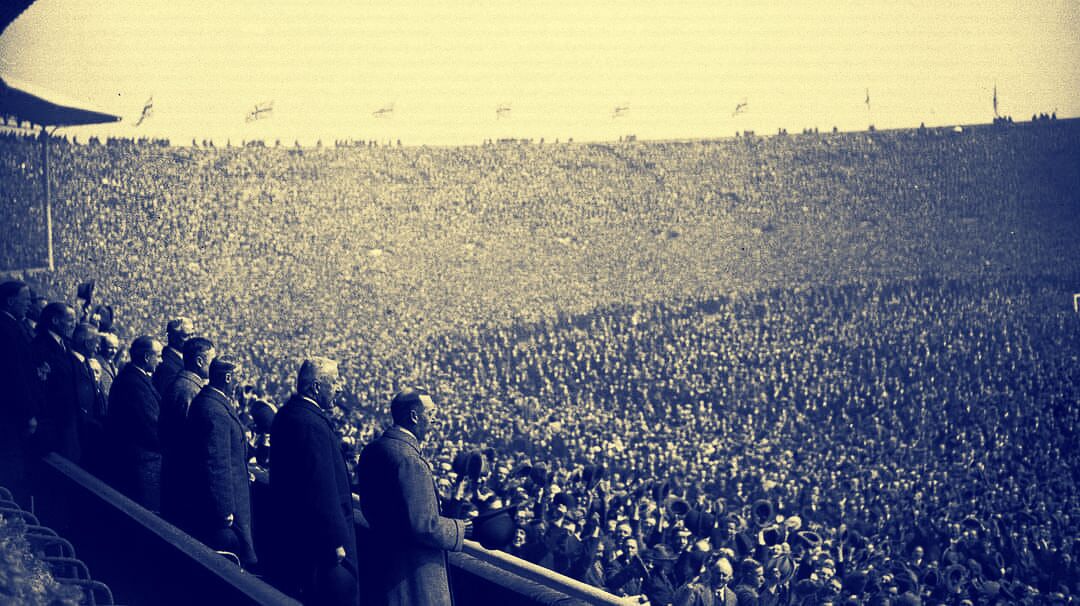
If one single event could symbolise the explosion of football as a mass spectacle in the 1920s, it was the opening of the Empire Stadium at Wembley in 1923. Built in just 300 days at a cost of £750,000, the stadium was intended to be the centrepiece of the British Empire Exhibition, a “grey fortress” standing atop a hill, marked by its iconic twin towers.
On April 28, 1923, the stadium hosted its first major event: the FA Cup Final between Bolton Wanderers and West Ham United. The official capacity was set at a staggering 126,047, yet the sheer magnetism of the new venue and the post-war appetite for entertainment drew a crowd estimated between 150,000 and 300,000. By early afternoon, the turnstiles were overwhelmed. Observers described a “solid slope of pink faces” arranged in a wide ellipse around the “oval of exquisite green turf”.
As kick-off approached, the containment failed. The crowd began to bulge and spill over the barriers. A “solid phalanx of men in caps” rushed the gates and climbed the iron girders, eventually submerging the pitch in a sea of humanity. The “sacred grass” disappeared beneath the mob, and it seemed impossible that a match could be played.
From this chaos emerged the defining image of British football in the 1920s: PC George Scorey, mounted on his grey horse named Billie (who appeared white in the high-contrast monochrome photography of the day). Scorey and Billie became the heroes of the hour, gently insinuating themselves into the throng to clear the pitch inch by inch. The match, famously delayed by 45 minutes, was played with spectators standing on the very touchlines, creating a human wall that trapped players like West Ham’s Jack Tresadern during throw-ins.
Bolton Wanderers won 2-0, with David Jack scoring the first-ever goal at Wembley just two minutes into the game. But the football was secondary to the event itself. The “White Horse Final” was a weird, mad scene, yet it was enjoyed as a sensation—a moment where the sheer scale of football’s popularity became undeniable, cementing the sport as a national ritual.
Herbert Chapman and the Architecture of Modern Football
While Wembley provided the stage, a man named Herbert Chapman was rewriting the script for how the game was played. In the early 1920s, English football was often a rugged affair, but Chapman, first at Huddersfield Town and later at Arsenal, introduced a level of tactical sophistication and professionalism that would define the era.
Chapman was a visionary who believed in “organising victory” rather than waiting for it. Taking charge of Huddersfield Town in 1921, he implemented a counter-attacking philosophy based on a strong defence and fast, short passing. He encouraged his reserve teams to play the same system as the first team, ensuring that any player could step in seamlessly—a precursor to the modern squad system. Under his guidance, Huddersfield Town became the first club to win three successive League titles (1924, 1925, 1926), a dynasty built on the brilliance of players like Clem Stephenson and George “Bomber” Brown.
Chapman’s genius was necessitated by a fundamental change in the laws of the game. In June 1925, the offside rule was relaxed, reducing the number of defenders required between the attacker and the goal from three to two. This change was intended to cure a “goal drought,” and it worked almost too well, leading to high-scoring matches. While other managers panicked, Chapman innovated. He withdrew the centre-half from the midfield to the centre of the defence, creating the “stopper” role, and pulled the inside forwards deeper to link play. This created the “WM” formation (3-2-2-3), a tactical shape that would dominate English football for decades.
In 1925, Chapman moved to Arsenal, doubling his salary and promising to make them the “Newcastle of the South”. He rebuilt the team with a ruthless eye for talent, signing stars like Charlie Buchan and Alex James. He was also a pioneer off the pitch, advocating for floodlights, numbered shirts, and even the renaming of the local tube station to “Arsenal”. By the time of his premature death in 1934, Chapman had laid the foundations for Arsenal’s dominance, proving that a manager could be the most important figure at a football club.
Dixie Dean and the Limits of the Human Body
While Chapman engineered systems, a young man from Birkenhead was busy destroying them. William Ralph “Dixie” Dean represented the physical zenith of the 1920s footballer. In the 1927-28 season, Dean achieved immortality by scoring 60 league goals for Everton—a record that stands to this day and is unlikely to ever be broken.
Dean’s prowess was almost supernatural, especially considering he had recovered from a severe motorcycle accident in 1926 that left him with a fractured skull and jaw; doctors were unsure if he would ever play again. He returned to the pitch with a metal plate rumoured to be in his head, a myth fueled by his extraordinary heading ability, which pundits described as the finest the game had ever seen.
The climax of his record-breaking season was a piece of sporting theatre. Going into the final match against Arsenal, Dean needed three goals to break the record of 59 goals set by George Camsell. He scored two in the first half. As the clock ticked down at Goodison Park, the tension was unbearable. Then, with minutes remaining, Dean rose above the Arsenal defence to head home a corner, sealing his 60th goal and sending the crowd into delirium. Dean was the ultimate hero of the working-class terraces, a man who, despite his fame, remained a “humble hero”.
The Danubian School and Central Europe’s Football Revolution
While the English game was defined by the mud of the penalty box and the physicality of the rush, Central Europe was engaging in an intellectual revolution. In the cities of Vienna, Budapest, and Prague, football was being dissected and reimagined in the smoke-filled air of the coffee houses.
This was the era of the “Danubian School,” a style of football characterised by short, rapid passing and fluid movement—the “Danubian Whirl” The epicentre of this movement was Vienna, where the game transcended class boundaries. Intellectuals, writers, and players mingled in establishments like the Café Ring, described as a “revolutionary parliament of the friends and fanatics of football”. Here, amidst the clinking of silver spoons, transfers were discussed, and tactics were analysed with the same rigour applied to literature or chess.
The architect of this cerebral style was Hugo Meisl, the head of the Austrian Football Association. A multi-lingual Jewish intellectual born in Bohemia, Meisl was a visionary who believed sport could bridge nations. Alongside the English exile Jimmy Hogan—whose emphasis on technique was rejected in Britain but revered on the continent—Meisl built the foundations of the Austrian “Wunderteam”.
The defining figure of this movement was Matthias Sindelar, known as Der Papierene (“The Paper Man”) for his slight build. Sindelar was the antithesis of the English centre-forward. He was a deep-lying technician with “brains in his legs,” a player whose movements were likened to the solving of a chess puzzle or the punchline of a joke. In the coffee houses, his goals were discussed not just as athletic feats but as aesthetic compositions.
In 1927, this region gave birth to the Mitropa Cup (La Coupe de l’Europe Centrale), the first major international competition for clubs. It pitted the best professional teams from Austria, Hungary, Czechoslovakia, and Yugoslavia (and later Italy) against one another. It was a tournament of fierce rivalries and high technical standards, where teams like Sparta Prague and Rapid Vienna battled for supremacy, laying the groundwork for the future Champions League. The Mitropa Cup was a “diplomatic endeavour on the football pitch,” creating the first generation of travelling fans who crossed borders to support their clubs.
Uruguay, José Leandro Andrade, and the First Global Superstars
While Europe looked inward, a storm was brewing across the Atlantic. The 1920s belonged to Uruguay, a small nation that would fundamentally shift the axis of football power. Prior to 1924, South American football was largely a mystery to Europe. When Uruguay entered the 1924 Paris Olympics, they were an unknown quantity, travelling in third-class steerage on a steamship to reach France. To fund their trip, they played a tour of Spain, sleeping on wooden benches and training on the ship’s deck to stay fit.
When they took the field in Paris, they played a style of football—fútbol criollo—that the Europeans could not comprehend. It was fluid, artistic, and devastatingly effective. They dismantled Yugoslavia 7-0 in their opening game, mesmerising the crowd with their short passing and individual brilliance. They marched to the gold medal, defeating Switzerland 3-0 in the final.
The star of this team was José Leandro Andrade, the “Black Marvel” (La Merveille Noire). Born in poverty to a 98-year-old father who was a former slave and allegedly a practitioner of African magic, Andrade worked as a carnival musician and shoe-shiner before finding football. In Paris, he became the first global football superstar. He was an elegant half-back who dominated games without seemingly touching an opponent, using feints and body swerves to glide past challenges.
Off the pitch, Andrade was a sensation in Roaring Twenties Paris. He frequented the most exclusive apartments, was courted by women, and embraced the nightlife of the Jazz Age, even dancing the tango with Josephine Baker. He challenged the racial prejudices of the time simply by being excellent, elegant, and undeniable.
Uruguay defended their title at the 1928 Amsterdam Olympics, defeating their bitter rivals Argentina in a replay. This dominance in the 1920s was the catalyst for FIFA to organise the inaugural World Cup in 1930, which Uruguay would host and win, cementing their status as the first true global powerhouse of the sport.
Ricardo Zamora and the Birth of Spanish Football Celebrity
In Spain, the 1920s marked the transition from regional squabbles to a unified national obsession. The decade culminated in the foundation of La Liga in 1929. Though Barcelona won that inaugural title, the era was defined by the figure of Ricardo Zamora, the goalkeeper known as El Divino (The Divine One).
Zamora was the prototype of the celebrity footballer. On the pitch, he was instantly recognisable in his cloth cap and white polo-neck jumper, attire he claimed protected him from the sun and opponents. He was brave to the point of recklessness, famous for diving at the feet of onrushing forwards. Off the pitch, he was a dandy who smoked three packs of cigarettes a day and enjoyed fine cognac.
His legend was forged in 1920 at the Antwerp Olympics, where Spain won silver. Zamora was sent off against Italy for punching an opponent and was later arrested upon his return for trying to smuggle Havana cigars into Spain. In 1929, he famously played against England with a broken sternum, helping Spain become the first continental team to defeat the English, 4-3. His transfer from Espanyol to Real Madrid in 1930 for 150,000 pesetas shattered world records and signalled the beginning of the Galáctico era decades before the term existed.
Newsreels, Radio, and the First Media Age of Football
The 1920s was not just about the games played, but how they were seen. This was the golden age of the newsreel. For the first time, millions of people who could not attend the matches could witness the “spectacle of actuality” in their local cinemas.
Companies like Pathé Gazette, Gaumont Graphic, and later British Movietone brought the action to the masses. The newsreels were short, punchy, and often light-hearted, sandwiched between cartoons and feature films. They created a shared visual language for the sport. The sight of the King shaking hands with players at Wembley, or the flickering images of foreign teams, brought the world closer together.
In Ireland, the newsreels took on a more complex role. Amidst the violence of the War of Independence and the Civil War, the cinema became a space of “fearful joy”. Audiences in Dublin watched footage of the “Battle of the Four Courts” or the signing of the Anglo-Irish Treaty, events that ruptured the flow of history. Yet, even in these turbulent times, sport remained a constant. The 1920 Bloody Sunday massacre at Croke Park, where British forces opened fire during a Gaelic football match, remains a scar on the decade, a reminder that sport could not always escape the political realities of the time. However, even as the Civil War raged, Dublin cinemas screened footage of the fighting, and the “pulsing nowness” of the newsreel allowed audiences to witness their own history unfolding.
Technologically, the experience of the fan was changing. 1927 saw the first live radio broadcast of a football match in the UK—Arsenal vs. Sheffield United—on the BBC. Listeners used a numbered grid published in the Radio Times to follow the location of the ball, giving birth to the phrase “back to square one”. This innovation allowed the drama of the match to enter the domestic sphere, connecting the stadium to the living room in a way that would eventually revolutionise the consumption of sport.
Leather, Wool, and the Material Reality of the 1920s Game
To look back at the 1920s is also to remember the material reality of the sport. It was a time of heavy, water-logged leather balls that became “bricks” in the rain, dangerous to head and difficult to control. The ball’s weight, technically standardised, varied wildly depending on the weather conditions, making the feats of headers like Dixie Dean even more impressive.
Players wore heavy wool jerseys that grew heavier with sweat and rain. There were no shin pads for many, and boots were heavy leather constructs with nailed-in studs that offered poor traction on the muddy pitches of the era.
Fans, too, had their uniform. The terraces were a sea of flat caps and dark overcoats, a monochromatic mass of working-class men. The football scarf, now a global symbol of fandom, began as a “cottage industry,” knitted by mothers and grandmothers (“Granny scarves”) to keep fans warm on the bitter, open terraces. They were simple bar scarves, striped in team colours, long enough to wrap around the neck multiple times—a woollen armour against the elements. These scarves were often the only splash of colour in the greyscale world of the 1920s stadium.
Why the 1920s Still Matter
The 1920s closed with the promise of a new era. The success of the Olympic tournaments had proven the viability of a global football competition. In 1928, FIFA voted to organise a World Cup in 1930, open to all member nations. The stage was set for Uruguay to host the world, building the colossal Estadio Centenario to mark the occasion.
It was a decade that transformed football from a scattered collection of amateur pursuits into a professional, international, and media-driven industry. It gave us our cathedrals in Wembley and the Centenario. It gave us our idols in Dean, Zamora, and Andrade. It gave us the tactical blueprints of Chapman and the Danubian School.
Looking back through the mist of a century, the 1920s appears not as a distant, primitive era, but as the moment the modern soul of football was forged—a time of grit, elegance, and the roaring noise of a world falling in love with the beautiful game.
