


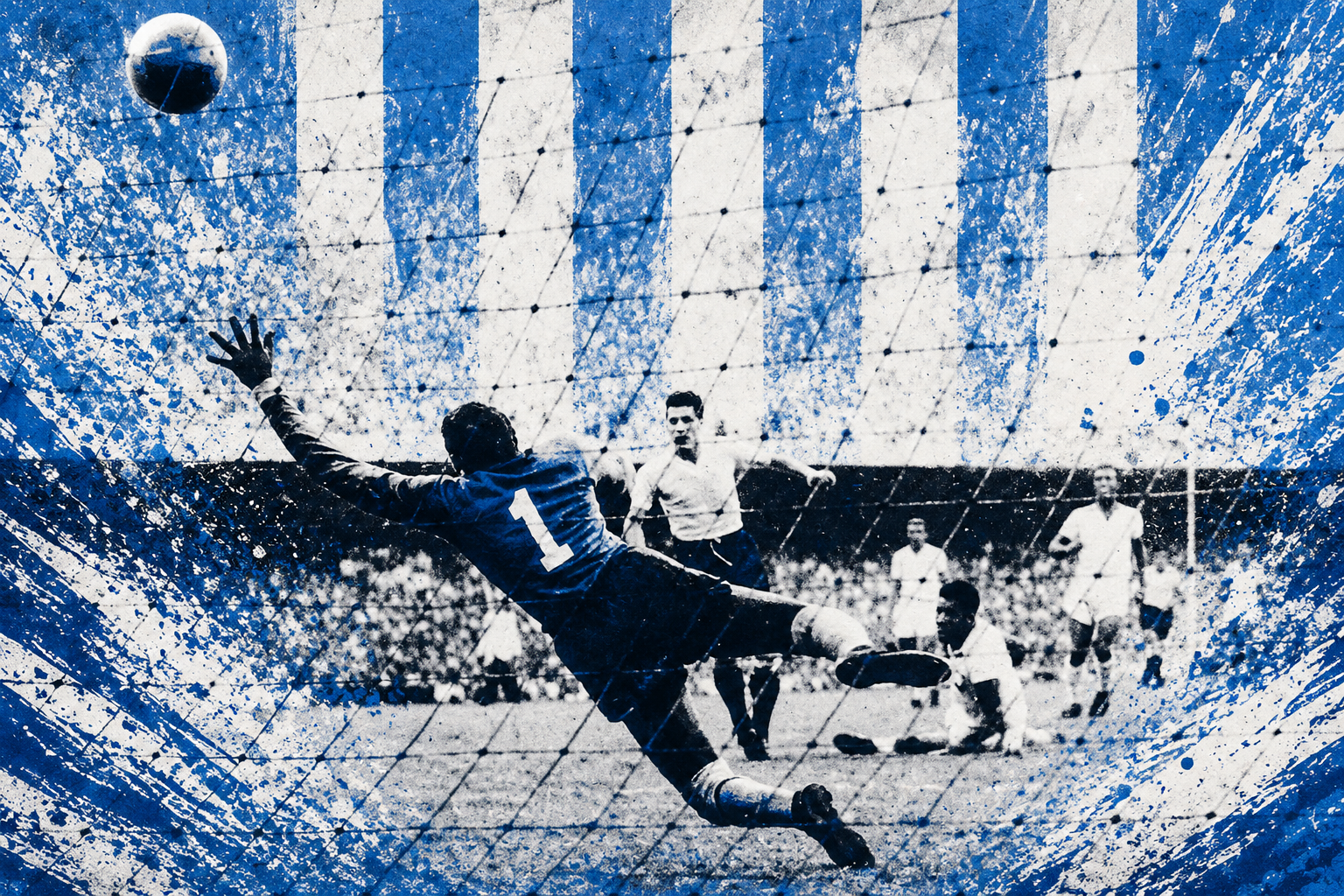
Juan Alberto Schiaffino was not simply the man who scored in the Maracanazo. He was one of football’s earliest great tactical minds, a player who turned intelligence into a weapon before the modern game had the language to explain him.
The Shot That Made Brazil Hear Its Own Fear
The silence did not arrive all at once. It seemed to move through the Maracanã in layers.
First came the brief disbelief behind the goal. Then the hesitation in the high concrete stands. Then the strange, stunned quiet of a crowd that had already begun to live inside its victory.
Brazil had entered 16 July 1950 as a nation preparing for coronation. The newspapers had written as if the World Cup had already been won. The stadium, vast and swollen with expectation, carried more than supporters. It carried certainty. Brazil did not even need to beat Uruguay. A draw would be enough.
Then Alcides Ghiggia ran at Bigode on the right.
Uruguay were 1-0 down. The match had tilted towards Brazil after Friaça’s goal early in the second half. Around them, almost everything suggested surrender. The noise. The heat. The emotion. The scale of the occasion. But Uruguay had Obdulio Varela’s defiance and Juan Alberto Schiaffino’s calm.
Ghiggia drove low into the box and cut the ball back. Schiaffino arrived with the cold timing of a man who had seen the move before it existed. No theatrical swing. No desperate snatch. He struck first time, low and hard, beyond Moacir Barbosa.
Brazil still had time. Brazil still had the draw. Brazil still had the advantage.
Yet something irreversible had happened.
The goal did not merely level the match. It introduced doubt into a stadium built on certainty. It told Brazil that the day could break. Fourteen minutes later, Ghiggia scored the winner and the Maracanazo became one of football’s defining traumas.
Ghiggia would later own the most famous line about the afternoon, saying that only three people had silenced the Maracanã: Frank Sinatra, Pope John Paul II and himself. But before Ghiggia finished the job, Schiaffino changed the psychology of the match.
He was rarely the loudest man in football history. Rarely the most mythologised. Rarely the easiest to reduce to a poster or a clip.
But when chaos arrived, Juan Alberto Schiaffino understood it before anyone else.
More Than the Man Who Broke the Maracanã
The easy version of Schiaffino’s story begins and ends in Rio de Janeiro. That is understandable, but it is also misleading.
He scored Uruguay’s equaliser in the decisive match of the 1950 World Cup. He helped break Brazil’s heart. He became part of a national wound that still echoes through football history.
But to define him only through the Maracanã is to mistake the incident for the argument.
Schiaffino was not simply a World Cup hero. He was one of the first great footballers whose genius was almost entirely intellectual. He did not overpower matches. He decoded them. He did not need to dominate the ball constantly. He needed only to appear where the match had quietly become vulnerable.
Cesare Maldini, who played with him at AC Milan, gave perhaps the most accurate description of him. Schiaffino, he said, had “a radar where his brain should be”.
That line matters because it explains why Schiaffino still feels modern. Before football had a common language for scanning, spatial control, tempo management or positional rotation, he was already living inside those ideas.
He played as an inside-forward, but that term does not quite contain him. At times he was a No.10. At times a second striker. At times a deep organiser. At times a forward who drifted away from the centre-backs not to hide, but to pull the game into a more favourable shape.
The best players of his generation often looked like masters of instinct. Schiaffino looked like a master of consequence. Every touch seemed to ask what would happen next.
Montevideo, Italian Blood and a Football Education in Survival
Juan Alberto Schiaffino Villalba was born in Montevideo on 28 July 1925. His father was of Italian origin, his mother Paraguayan. That background matters less as biography than as football inheritance.
Uruguay gave him the edge. Italy would later give him the stage. Between the two, he formed a football identity built on craft, restraint and calculation.
He grew up in a city where football was not decorative. Montevideo football had technique, certainly, but it also carried a hardness that came from neighbourhoods, rivalry and national pride. Uruguay had already won Olympic gold in 1924 and 1928 and the first World Cup in 1930. For a small nation, football was not escape. It was proof.
Schiaffino was not built like a destroyer. He was slender, almost fragile to the eye. That shaped him. Players who cannot win by force learn earlier than others how to survive by timing.
He worked as a baker before becoming one of the game’s great interpreters. That detail has survived because it suits the mythology, but it also says something true. There was nothing ornamental about his rise. No academy polish. No protected path. His game was formed in the rougher grammar of Uruguayan football, where elegance had to withstand contact.
At Peñarol, he found the perfect place to sharpen it.
The Moment Peñarol Realised He Was Different
By the late 1940s, Schiaffino had become more than a gifted forward. He had become the organiser of Peñarol’s attack.
Peñarol were not a finishing school. They were one half of Uruguay’s great domestic rivalry, a club built for pressure. In that environment, Schiaffino’s authority came not through volume, but through trust. Teammates gave him the ball because he gave them better decisions back.
He was already a major figure before the 1950 World Cup. The Guardian later described him as an “outstanding positional player” who could dribble past opponents with ease. That phrase, positional player, is the key. Plenty of players could beat a man. Schiaffino knew when beating a man mattered and when it was merely theatre.
In Uruguay’s 8-0 win over Bolivia at the 1950 World Cup, he scored four goals. That match has sometimes been dismissed because Bolivia were weak opposition, but it revealed something important. Schiaffino was not just a passer or an organiser. He could arrive in scoring positions with ruthless timing.
That made him difficult to mark. Follow him too tightly and he would drag you into areas you did not want to defend. Leave him alone and he would punish you. Press him aggressively and he would release the ball before the pressure truly arrived.
His rise was not dramatic in the modern sense. It was not a sudden explosion. It was a gathering recognition that he understood the game on a different level.
The Player With a Map Inside His Head
Schiaffino’s greatness began with how little he wasted.
His touch was clean, but not showy. His passing was imaginative, but rarely indulgent. His movement was subtle enough to be missed by a casual observer and devastating enough to ruin a defensive plan.
He played in the old inside-left channel, but his work anticipated the modern playmaker. He dropped into midfield when the match needed order. He moved between lines when defenders expected him to stay high. He accelerated play when a defence was unbalanced and slowed it when his own team needed breath.
That is what made him so hard to copy.
Some players possess obvious gifts that young footballers can imitate badly. A stepover. A shooting style. A posture over the ball. Schiaffino’s gifts were less visible. His first movement before receiving. The small angle he created with his body. The half-second delay before a pass. The decision not to run.
Football did not yet talk about “scanning”, but Schiaffino scanned. Football did not yet talk about “finding pockets”, but he found them. Football did not yet talk about “controlling tempo”, but he did that better than almost anyone of his era.
He was not a luxury player. That is crucial. The lazy reading of elegant footballers is that they decorate games. Schiaffino controlled them. His intelligence had competitive force.
Freedom Against the System
The central tension of Schiaffino’s career was not scandal, ego or rebellion. It was more interesting than that.
It was freedom against structure.
In Uruguay, he had been formed by a culture that valued improvisation inside collective toughness. In Italy, he entered a game increasingly obsessed with shape, discipline and defensive control. Many South American attackers struggled with that shift. Their flair was admired, then constrained.
Schiaffino was different because he did not need freedom in the childish sense. He did not want to wander for the sake of wandering. He wanted freedom to interpret.
That made him precious and awkward at the same time.
A coach could place him in a system, but the system had to understand that his greatest value came when he could bend it. Too much rigidity would reduce him. Too much looseness would waste him. His genius lived in the space between instruction and instinct.
That is why he translated so well to Milan. Serie A did not soften him. It gave his intelligence a harder test.
Milan, Money and the Proof That Intelligence Could Travel
In 1954, AC Milan signed Schiaffino from Peñarol. It was not just a transfer. It was a statement.
Milan were buying more than a South American star. They were buying a way of seeing football. The club’s own records describe him as having established himself as the great leader of Peñarol before moving to Milan, where he would play 171 matches, score 60 goals and win three Serie A titles.
The adaptation could have been difficult. Italy was tactically severe. Defenders were unforgiving. Space disappeared quickly. Reputation meant little once the marking began.
Schiaffino adjusted because his football did not depend on one physical advantage. He was not faster than everyone. He was earlier than everyone.
At Milan, he played with men of serious football intelligence, including Nils Liedholm and Cesare Maldini. Around them, Schiaffino became the player who gave Milan a second brain. He did not simply add South American style to an Italian side. He helped Milan think more fluently.
The Scudetti of 1955, 1957 and 1959 confirmed his domestic importance. But the deeper significance was tactical. Schiaffino showed Italian football that creativity did not have to live outside structure. It could operate inside it, improve it and still retain imagination.
That idea would become central to the best European football of later decades.
Brussels 1958: Schiaffino Against Di Stéfano
If the Maracanã made Schiaffino immortal, the 1958 European Cup final proved he belonged in the highest tactical conversation of the age.
Milan faced Real Madrid at the Heysel Stadium in Brussels on 28 May 1958. Madrid were chasing a third consecutive European Cup. Alfredo Di Stéfano was the competition’s defining player, a footballer of immense range, authority and competitive arrogance.
UEFA’s own retrospective on the match records Di Stéfano’s respect for Milan. “They were our big rivals,” he said, naming Maldini, Liedholm and Schiaffino among the phenomenal players in their team.
Schiaffino scored first, finishing a quick counter-attack from the edge of the area. Later, he assisted Ernesto Grillo as Milan led 2-1. Madrid equalised through Héctor Rial and eventually won 3-2 in extra time through Paco Gento.
The result went Madrid’s way. The meaning was less one-sided.
Di Stéfano later called it the toughest final of Madrid’s five-in-a-row European reign. That tells you what Schiaffino had done. Milan did not merely compete with Madrid’s dynasty. They made it suffer.
In that final, Schiaffino was not nostalgia. He was not a fading World Cup hero playing on memory. He was a 32-year-old mind still capable of bending the biggest game in Europe.
The International Split That Complicated the Myth
Schiaffino’s international career carries a strange duality.
For Uruguay, he became eternal. For Italy, he became part of something more complicated.
Because of his Italian heritage, he later represented the Azzurri as an oriundo. On paper, it made sense. Italy wanted elite talent. Schiaffino had settled into Serie A and understood the country’s football culture better than most foreign-born players could.
But international football is not only about eligibility. It is about belonging, timing and emotional fit.
With Uruguay, Schiaffino was part of a story that exceeded sport. With Italy, he was a brilliant player inside a less coherent chapter. His Italian caps did not reshape his legacy. They complicated it.
That tension is useful because it prevents the story becoming too neat. Schiaffino was not simply a national monument. He was also a footballer caught in the mid-century movement of talent, identity and money across borders.
He belonged to Uruguay emotionally. He belonged to Italy professionally. His football, in truth, belonged to both.
Roma and the Late Reinvention
Schiaffino’s move to Roma in 1960 could have been treated as an epilogue. It became something more revealing.
Age took away speed, but it did not take away understanding. If anything, his reading of the game became even clearer. At Roma, he played deeper, at times almost as a free man behind the line, using his passing and anticipation to organise play from areas far removed from his old inside-forward starting point.
That late-career adjustment matters because it confirms the central truth of his career. Schiaffino was never dependent on position. He was dependent on interpretation.
Players who survive only through athletic gifts often decline when the body changes. Schiaffino adapted because his primary gift was mental. The legs had to follow the brain, not the other way round.
With Roma, he helped win the Inter-Cities Fairs Cup in 1961. It was not the defining chapter of his career, but it was a final proof of his versatility. He had been a scorer, creator, organiser and, eventually, almost a defensive conductor.
Few great forwards have travelled so far across the pitch without losing their identity.
The Maracanã Looks Different Once You Understand Him
Return, then, to Rio.
The equaliser in 1950 is often remembered as a goal in a national tragedy. That is understandable from the Brazilian side. But from Schiaffino’s side, it was something more precise.
It was not an isolated strike. It was a tactical and psychological act.
Brazil had played the occasion. Uruguay played the match. That distinction explains everything.
When Varela slowed the game after Brazil’s opener, he was refusing emotional collapse. When Ghiggia attacked the right flank, he was targeting a weakness. When Schiaffino arrived to finish, he was completing a move built on nerve, timing and recognition.
The goal did not happen because Uruguay were lucky. It happened because Uruguay were clear-headed when Brazil became emotional.
That was Schiaffino’s football in one moment. Calm where others rushed. Precision where others forced. Thought where others felt pressure.
Fourteen minutes later, Ghiggia made the silence permanent. But Schiaffino had made it possible.
Why Football Still Misunderstands Schiaffino
Schiaffino’s legacy is secure among historians, but still underpowered in the wider public imagination.
There are reasons.
Limited footage hurts him. So does the fact that he played before the global television age. So does his temperament. He was reserved rather than theatrical. Even UEFA’s profile of the 1958 final notes his contrast with Di Stéfano, recording Schiaffino’s own line: “I wasn’t lucky to become a footballer, it was my destiny.”
That sentence is revealing. It has no performance in it. No self-mythologising. Just acceptance.
Football often remembers players who demand memory. Schiaffino did not demand it. He earned it quietly, through decisions that made teams better and opponents less certain.
He influenced the idea of the intelligent attacker, the player who could connect midfield and forward line, who could control rhythm without needing permanent possession, who could make structure and creativity serve the same purpose.
You can see traces of that idea in later playmakers. Not because they copied him directly, but because he helped prove the type could exist. The cerebral forward. The deep creator. The attacking organiser. The player who looked less like a finisher than a strategist, until the moment he finished.
What is misunderstood about Schiaffino is not his quality. Most serious football historians know he was great. What is misunderstood is the nature of that greatness.
He was not great because he scored in the Maracanã.
He scored in the Maracanã because he was great.
The Calmest Mind in the Loudest Game
Juan Alberto Schiaffino changed football quietly.
He did not leave behind a mythology of rebellion. He did not become the face of excess, glamour or tragedy. He did not need football to turn him into theatre.
His gift was colder and rarer.
He made the game think.
At Peñarol, he became the intelligence of a great Uruguayan side. At the Maracanã, he placed doubt inside Brazil’s certainty. At Milan, he proved that South American imagination could thrive inside European structure. At Roma, he reinvented himself when the body changed but the mind remained sharp.
Some footballers dominate because they are impossible to stop. Schiaffino dominated because he was impossible to read.
That is why his story still matters. Not because it belongs to a vanished golden age, but because it explains something permanent about football. The game has always rewarded power, courage and technique. But at its highest level, it still bends towards intelligence.
In the Maracanã, the world heard the silence.
Schiaffino had heard it coming.
