

UEFA is now seen as one of football’s great power brokers, but its origins lie in something far more fragile: a wounded continent trying to find a way to meet again.
Cinematic Opening: A Night in the Parisian Mud
The rain began long before kick-off and showed no intention of stopping.
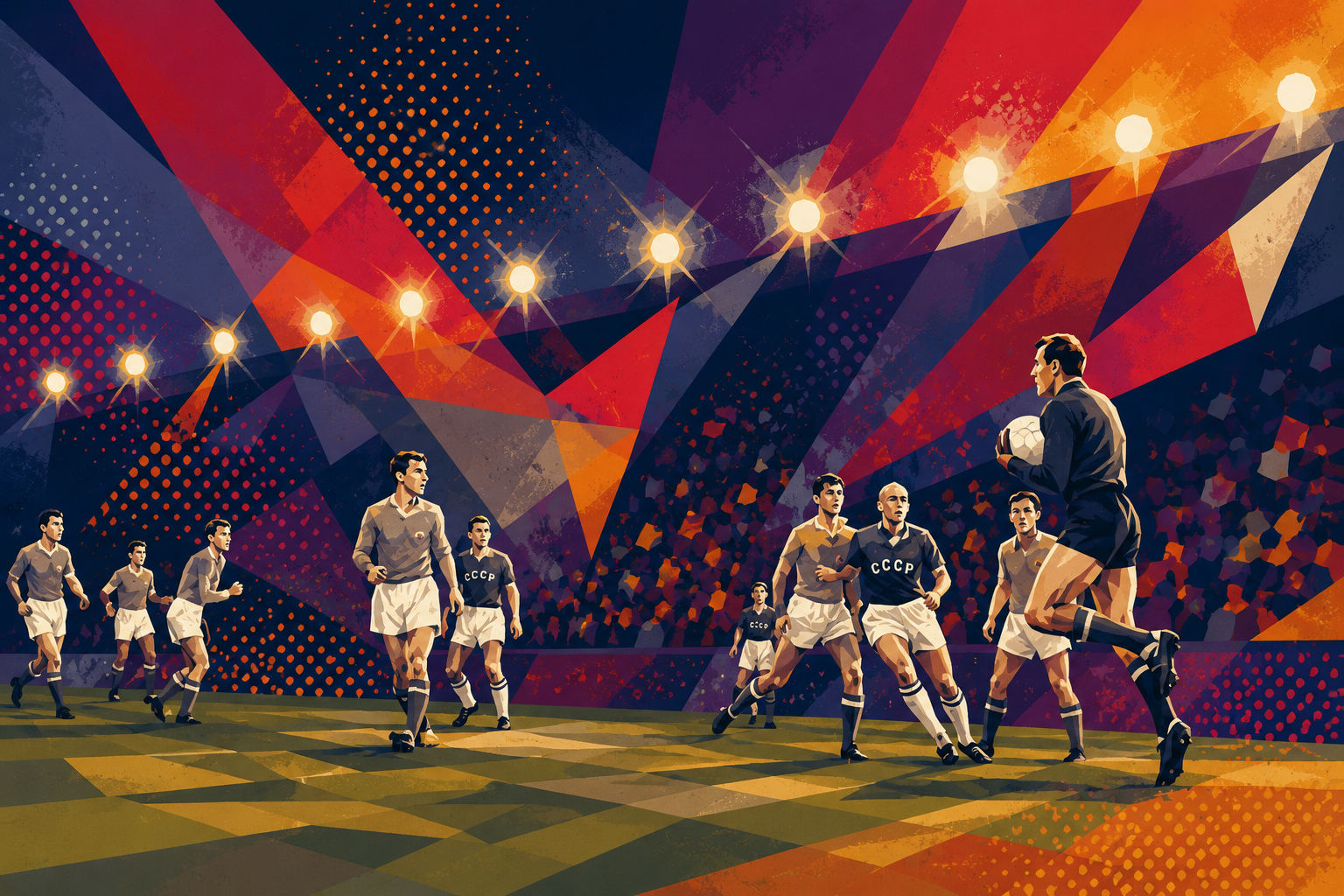
By the time the players emerged from the tunnel at the Parc des Princes on 10 July 1960, Paris had been swallowed by a heavy summer downpour that turned the surface into sludge. Mud clung to socks and boots. Passes stopped dead in standing water. Beneath the floodlights, the pitch looked less like the stage for a continental final than the aftermath of a battlefield.
Fewer than 18,000 spectators had drifted into the stadium, many sheltering beneath newspapers and raincoats, unaware they were watching one of the most politically charged matches European football had yet staged. This was the final of the inaugural European Nations’ Cup, the tournament that would later become the UEFA European Championship. It was so new, so uncertain in its purpose, that several of the continent’s major powers had treated it with indifference. Yet the two teams who reached Paris carried far more than footballing expectation.
The Soviet Union and Yugoslavia had spent the previous decade staring at one another across a fractured communist world. Since Josip Broz Tito’s split from Joseph Stalin in 1948, relations between the two states had hardened into distrust. Political alliances shifted. Borders stiffened. Ideological suspicion seeped into public life.
Now they met in a rainstorm in western Europe with a trophy between them.
The match itself became attritional almost immediately. Players slid through the mud. Tackles arrived late. Attacks dissolved into chaos. Lev Yashin, the Soviet goalkeeper dressed entirely in black, barked instructions through the rain as though trying to hold the evening together by force of will. At half-time, with the pitch deteriorating further, Soviet defender Boris Kuznetsov reportedly hammered makeshift metal studs into the soles of his team-mates’ boots in a desperate attempt to improve their grip.
Still the game dragged on.
Yugoslavia, elegant and technically gifted, had controlled long stretches. The Soviets relied increasingly on resilience. By the closing stages of extra time, exhaustion consumed both sides. Shirts hung heavily from shoulders. Legs cramped. Every movement looked borrowed.
Then, with seven minutes remaining, Valentin Ivanov lifted a hopeful cross into the Yugoslav penalty area.
For a moment, the ball seemed to hang there in the rain.
Viktor Ponedelnik attacked it first.
The 23-year-old forward, who had spent the days before the final fishing with Yashin to calm his nerves, rose above the Yugoslav defenders and steered a header back across goalkeeper Blagoje Vidinić and into the far corner.
The Soviet players collapsed into the mud.
In Moscow, where it was approaching one o’clock in the morning, newspaper editors rushed to print the line that would become immortal: “Ponedelnik scores on Monday.”
By the time English referee Arthur Ellis blew the final whistle on a 2-1 Soviet victory, supporters had already spilled onto the pitch. In the chaos, somebody tore Yashin’s famous flat cap from his head and disappeared into the Paris night with it.
The following morning, much of the French press devoted more attention to a catastrophic crash at the Tour de France than to the final itself. Yet among the administrators and officials who had watched from the stands, there was a sense that something larger had just occurred.
For ninety minutes, in the middle of the Cold War, Europe’s political fractures had been suspended beneath floodlights and rain.
The continent had found a way to meet.
Reframing UEFA: The Bureaucrats Who Built a Bridge
To many modern supporters, UEFA represents the cold machinery of contemporary football.
It is the organisation of luxury hospitality boxes and carefully choreographed draws in Switzerland. The guardian of regulations that often appear selectively enforced. The institution that expanded the Champions League while speaking the language of competitive balance. For younger generations especially, UEFA exists largely as a corporate regulator, associated less with idealism than with broadcast packages, sponsorship inventories, and legal battles against breakaway super leagues.
That perception is understandable. In many ways, UEFA helped create the modern football economy that now dominates the sport. The organisation presides over a system that concentrates extraordinary wealth among a relatively small group of elite clubs while asking the rest of the continent to survive on solidarity payments and aspiration.
Yet to view UEFA solely through that modern lens is to miss the extraordinary historical accident at the centre of its existence.
UEFA was not originally conceived as a commercial empire. It emerged from a continent still psychologically damaged by war, occupation, dictatorship, and political division. Its earliest architects were not marketing executives or television strategists, but administrators who believed football could become one of the few remaining spaces where Europeans might still recognise one another as neighbours rather than enemies.
That sounds romantic now. At times, it was. But it was also practical.
In the decade after the Second World War, Europe was splitting into hostile ideological blocs. NATO and the Warsaw Pact formalised military division. Borders hardened. Travel became politically charged. Across large parts of Eastern Europe, state surveillance and propaganda infiltrated ordinary life. Even sporting contact between nations carried diplomatic consequences.
And yet football kept moving.
Long before the European Union evolved into a functioning political project, football clubs and national teams were already crossing borders that governments viewed with suspicion. Supporters travelled. Journalists exchanged ideas. Tactical systems collided and evolved. European football created a cultural conversation that politics often could not.
UEFA became the structure that allowed that conversation to survive.
The organisation’s founders understood something many politicians did not: people who would never read the same newspapers or trust the same governments would still gather around the same match. Football provided emotional common ground in a continent that lacked almost everything else.
That is why the organisation’s early figures matter.
Henri Delaunay, the French administrator who spent decades pushing for a European championship for national teams, believed continental competition could help normalise cooperation after years of destruction. Ottorino Barassi, the Italian official who famously protected the Jules Rimet trophy during the Second World War, treated football almost as a cultural inheritance that needed guarding. Gabriel Hanot viewed European club competition not merely as entertainment, but as a way of forcing isolated football cultures to confront one another.
These men were not naïve. They understood nationalism remained embedded within football. In many ways, that was precisely the point. UEFA’s early competitions did not attempt to erase national identity. They gave rival nations somewhere to channel it without violence.
The irony, of course, is that the same institution born from post-war cooperation would eventually become one of the most powerful commercial gatekeepers in global sport.
The story of UEFA is not the story of corruption replacing purity. That would be too simple, and historically false. Money, influence, and political pressure existed from the beginning. Santiago Bernabéu was already trying to lure Soviet players towards Real Madrid within hours of the 1960 final ending.
No, the real story is more complicated than that.
UEFA spent decades building a shared European football culture powerful enough to unite the continent. In doing so, it also created a product valuable enough to distort the very ideals upon which it had been founded.
Origins: A Meeting in Basel
The idea arrived long before Europe was ready for it.
In the late 1920s, Henri Delaunay had already begun advocating for a continental championship for national teams, convinced that European football required its own identity rather than existing merely as an extension of FIFA’s global structure. At the time, the proposal sounded impossibly ambitious. International travel remained complicated, political tensions simmered beneath the surface of the interwar period, and many football associations still viewed cross-border competition with suspicion.
Delaunay persisted anyway.
Colleagues often described him as meticulous to the point of obsession. He believed football administration needed structure and permanence, not simply enthusiasm. While others focused narrowly on domestic calendars and bilateral friendlies, Delaunay thought in continental terms. He imagined regular European competition before Europe itself had found a stable post-war identity.
Then history intervened.
The rise of fascism, the collapse of diplomatic relations across the continent, and eventually the Second World War pushed football into survival mode. Stadiums were damaged or requisitioned. Players disappeared into military service. Administrators operated within fractured political systems. In some regions, football became propaganda. In others, it became a brief emotional escape from destruction.
Few figures embodied that fragile relationship between football and survival more vividly than Barassi.
During the war, the Italian administrator secretly removed the Jules Rimet trophy from a Rome bank vault and hid it to prevent Nazi occupying forces from seizing it. The story has since acquired almost mythological status within football history, but its symbolism matters. European football in the 1940s felt vulnerable, impermanent, and worth protecting.
By the early 1950s, however, the continent had begun to rebuild itself. Domestic football recovered quickly. Attendances rose. Floodlit matches drew huge crowds. International fixtures regained prestige. The 1954 World Cup in Switzerland, with Hungary’s tactical brilliance and West Germany’s improbable triumph in Bern, reinforced the sense that European football was entering a new era of sophistication and influence.
Administratively, the decisive breakthrough arrived in 1953.
At an Extraordinary FIFA Congress in Paris, member associations approved amendments allowing continental confederations to be formally established beneath FIFA’s global authority. It was, in effect, permission for Europe to govern its own football affairs collectively.
A year later, on 15 June 1954, representatives from national associations gathered at the Hotel Euler in Basel.
The meeting itself lacked grandeur. Europe’s football leaders arrived carrying the same political and logistical anxieties that defined the wider continent. Romania’s delegates failed to attend after being denied visas by the Swiss authorities. The Greek representatives arrived late following severe travel delays. Britain remained hesitant about continental integration. The English Football Association still viewed itself as culturally separate from much of European football and represented Welsh interests during parts of the discussion.
Even the language inside the room reflected the fragmented nature of post-war Europe. Administrators worked through translation, compromise, and mutual suspicion.
Yet the atmosphere also carried a sense of necessity.
European football needed coordination. FIFA’s expanding global reach increasingly diluted specifically European concerns around calendars, competitions, refereeing, and governance. More importantly, administrators recognised that football itself was already becoming continental whether institutions adapted or not.
A formal motion was passed: “The European national associations decide definitively on the constitution of a group of the said associations, under a form to be determined.”
The wording sounded cautious, almost timid. The implications were enormous.
Ebbe Schwartz of Denmark became UEFA’s first president shortly afterwards. Delaunay became its first general secretary. Membership fees were intentionally modest at 250 Swiss francs annually, ensuring smaller and economically damaged football nations could participate.
The organisation itself barely existed structurally. UEFA initially operated with limited resources and little certainty regarding its future influence. There were no billion-euro broadcasting deals waiting on the horizon. No anthem. No global branding strategy. No sense that European club football would eventually become the sport’s financial centre of gravity.
There was only an idea.
That Europe, despite everything it had recently endured, might still be capable of gathering around football under a single institutional roof.
Rise: The Wolves, the Press, and the Reluctant Rulers
UEFA’s founders initially imagined that international football would sit at the centre of the organisation’s identity.
Delaunay’s great ambition remained a European championship for national teams. Club football, while popular domestically, was still viewed by many administrators as secondary, commercially unstable, and potentially disruptive to carefully protected league calendars. Even within UEFA itself, there was uncertainty about how much power clubs should be allowed to accumulate across borders.
Then Wolverhampton Wanderers switched on the floodlights.
In December 1954, Wolves hosted a series of high-profile friendlies at Molineux against some of Europe’s most celebrated sides. Under Stan Cullis, the English champions represented everything British football believed about itself in the post-war period: physically dominant, tactically disciplined, mentally resilient, and fundamentally superior to continental opposition.
The most famous of those matches came against Budapest Honvéd.
Honvéd were no ordinary club side. They formed the backbone of Hungary’s revolutionary national team, the Aranycsapat, whose tactical fluidity had humiliated England 6-3 at Wembley barely a year earlier before dismantling them 7-1 in Budapest. The Hungarians represented the future of football. Their movement, technical intelligence, and positional interchanging exposed the rigidity of the British game.
Yet on a cold night at Molineux, Wolves fought back from 2-0 down to win 3-2 beneath the floodlights.
The reaction in England bordered on triumphalism. The Daily Mail proclaimed Wolves “Champions of the World”, a headline that captured both the pride and insularity of English football at the time. Many within Britain genuinely believed the debate had been settled.
Across the Channel, Gabriel Hanot was furious.
Hanot, a former French international and influential journalist at L’Équipe, regarded the English response as intellectually absurd. Writing in the aftermath of the match, he dismissed the idea that superiority could be declared through isolated friendlies played under selective conditions.
“The idea of a world, or at least European championship for clubs is worth putting out and we are going to venture it,” Hanot wrote.
If football wished to identify the strongest club side in Europe, it required a proper continental competition. Not exhibition matches. Not newspaper hyperbole. A structured tournament forcing the continent’s best teams to confront one another directly.
What followed was one of the most important acts of journalistic intervention in football history.
Rather than waiting for UEFA to act, L’Équipe began designing the competition itself. Hanot, alongside Jacques Ferran and Jacques de Ryswick, drafted regulations for a 16-team European tournament played under floodlights during midweek evenings. Invitations were sent to many of the continent’s most prominent clubs. Meetings were arranged in Paris. Momentum built rapidly.
UEFA, however, remained hesitant.
At the organisation’s inaugural Congress in Vienna in March 1955, conservative administrators worried about fixture congestion, political complications, and the possibility that powerful clubs might begin operating independently of national associations. UEFA was still young, under-resourced, and unsure of how aggressively it should impose itself on the club game.
In truth, the organisation feared losing control before it had fully established itself.
Then FIFA intervened.
The global governing body made it clear that any international club competition required formal UEFA oversight and the consent of national associations. Suddenly, UEFA faced a choice: either embrace the tournament or risk watching European club football organise itself elsewhere.
On 21 June 1955, UEFA officially took control of the European Champion Clubs’ Cup.
The irony was extraordinary. The competition that would eventually define UEFA’s global identity had not emerged from the governing body itself, but from ambitious journalists impatient with administrative caution.
The early resistance also exposed deep fault lines within European football culture, none more significant than England’s relationship with the continent.
Chelsea, newly crowned English champions under Ted Drake, initially intended to participate and had even contributed to discussions surrounding the tournament’s structure. Yet the Football League hierarchy, led by the deeply conservative Alan Hardaker, regarded European competition with suspicion bordering on contempt.
Hardaker considered midweek continental travel disruptive and unnecessary. More broadly, he distrusted the growing influence of foreign football cultures upon the English game. In his memoirs, he later admitted the decision to withdraw Chelsea from the competition was reached with startling indifference: “There was not a glimmer of curiosity. The decision was taken and the subject forgotten.”
It was one of the great strategic miscalculations in English football history.
While England stayed home protecting its traditions, the rest of Europe accelerated into modernity.
On 4 September 1955, the European Cup officially began in Lisbon as Sporting Clube de Portugal and FK Partizan played out a chaotic 3-3 draw. Floodlights illuminated the stadium. Radio audiences spread across borders. Newspapers treated the competition with fascination.
Something fundamental had shifted.
For the first time, Europe’s football cultures were no longer developing separately.
They had entered the same conversation.
Peak: The Tactical Crucible of the Continent
What ultimately made UEFA transformative was not administration, nor even diplomacy.
It was collision.
Before the arrival of regular continental competition, European football existed largely as a series of isolated tactical cultures developing in parallel rather than in conversation. Ideas travelled slowly. Many coaches encountered foreign systems only through occasional internationals, newspaper reports, or hearsay. Domestic dominance often reinforced intellectual complacency.
The British game remained attached to physical directness. In Central Europe, the old Danubian school prioritised technical combinations and positional intelligence. In Latin football cultures, improvisation and individual artistry carried greater value. In Italy, defensive structure evolved almost as an ideological principle.
Then UEFA forced these worlds into direct confrontation beneath floodlights.
The European Cup became football’s great tactical laboratory because it removed the comfort of familiarity. Teams could no longer dominate within closed national ecosystems while ignoring developments elsewhere. Every spring, the continent’s strongest clubs were compelled to solve entirely different football problems against entirely different football philosophies.
That constant exposure accelerated the sport’s evolution.
The defining early example arrived at Hampden Park on 18 May 1960.
Before more than 127,000 spectators, Real Madrid dismantled Eintracht Frankfurt 7-3 in the European Cup final in what remains one of the most influential matches in football history. The scoreline alone barely captured the scale of the tactical shock.
Frankfurt had entered the final after defeating Rangers 12-4 on aggregate in the semi-finals and were considered physically powerful enough to compete with anyone in Europe. Yet against Madrid, they appeared structurally obsolete.
The Spanish side moved with extraordinary fluidity. Alfredo Di Stéfano drifted across the pitch, organising attacks from seemingly impossible positions. Ferenc Puskás alternated between centre-forward, creator, and finisher. Francisco Gento stretched the game relentlessly from wide areas. Defenders stepped into midfield. Midfielders attacked space beyond the forwards.
Traditional man-marking systems simply collapsed beneath the movement.
Di Stéfano later summarised Madrid’s collective principle with characteristic economy: “No player is as good as all of us together.”
The reality was radical. Madrid demonstrated that elite football could no longer be organised through static positional roles alone. Intelligence, rotation, and spatial control were becoming decisive.
Across Europe, coaches watched carefully.
Matt Busby studied continental tactical structures obsessively after Manchester United’s encounters with Madrid. Helenio Herrera refined Catenaccio partly as a response to the attacking fluidity spreading through Europe. Defensive organisation itself evolved because UEFA competitions demanded it.
Then came Ajax.
By the early 1970s, Rinus Michels and Johan Cruyff had transformed European football again through the emergence of Total Football, a tactical ideology impossible to separate from UEFA competition. Ajax won three consecutive European Cups between 1971 and 1973 not merely because they possessed brilliant players, but because they reimagined football’s relationship with space.
Positions became temporary. Pressing became collective. Defenders initiated attacks. Forwards defended aggressively from the front. Every player understood multiple roles simultaneously.
Cruyff articulated the principle years later with deceptive simplicity: “Playing football is very simple, but playing simple football is the hardest thing there is.”
That simplicity was an illusion. Ajax’s system required extraordinary intelligence, conditioning, and tactical trust. It could not simply be copied through diagrams. It demanded cultural transformation inside clubs.
Again, UEFA provided the proving ground.
Domestic dominance alone could never fully validate revolutionary tactical ideas because domestic opponents often shared similar football assumptions. European competition exposed systems to hostile stylistic environments. Ajax were not merely outperforming Dutch rivals. They were dismantling champions from Italy, Spain, England, and Germany.
And Europe adapted in response.
The continent’s tactical history increasingly became a chain reaction generated through UEFA competition. Bayern Munich’s disciplined physicality emerged partly in opposition to Ajax’s fluidity. Arrigo Sacchi’s Milan later fused pressing, compactness, and zonal organisation into a new collective ideal after studying earlier European evolutions. Pep Guardiola would eventually draw directly from Cruyff, who himself had been shaped by European competition under Michels.
This was UEFA’s real footballing significance.
The organisation did not simply organise prestigious fixtures. It forced football cultures to confront ideas they previously could have ignored.
That process often felt uncomfortable. Entire national football identities were exposed as outdated in front of continental audiences. England’s tactical isolation became increasingly obvious through repeated European disappointments during the 1960s and early 1970s. Italian defensive systems were alternately admired and criticised depending on results. Dutch football changed how pressing was understood globally. Spanish clubs reshaped technical standards.
UEFA became the arena where football modernised itself through conflict.
The sport advanced because Europe’s best sides could no longer remain strangers to one another.
Conflict: The Beautiful Game in a Broken World
The great contradiction at the heart of UEFA was impossible to escape.
The organisation existed to connect Europe through football at precisely the moment Europe itself remained deeply divided by ideology, dictatorship, military tension, and historical trauma. Every major UEFA competition carried political undertones whether administrators acknowledged them publicly or not.
Football could suspend hostility temporarily. It could never fully remove it.
That tension surfaced repeatedly throughout UEFA’s early decades, but nowhere more dramatically than during the inaugural European Nations’ Cup.
Spain should have been there.
On paper, the quarter-final between Spain and the Soviet Union promised one of the defining international contests of the era. Spain possessed a magnificent generation of talent: Di Stéfano, Luis Suárez, László Kubala, Gento, José Santamaría. Technically, tactically, and individually, they were strong enough to win the tournament.
Politically, however, the fixture was toxic.
General Francisco Franco had spent decades constructing his dictatorship around anti-communist identity after the Spanish Civil War. The Soviet Union had supported the Republican side against Franco’s Nationalists. Even twenty years later, the hostility remained raw. Allowing the Soviet anthem to play in Madrid was politically unthinkable to the regime. The possibility of Spain losing to the USSR was worse.
The players sensed trouble immediately.
Preparations stalled. Uncertainty spread. Eventually the message arrived from above.
Spain would not play.
UEFA refused to bend.
The organisation awarded the Soviet Union a walkover and fined the Spanish federation, establishing an important precedent. Continental competition could not function if authoritarian governments retained veto power over fixtures whenever ideology became inconvenient.
Yet the episode also revealed UEFA’s fragility.
Football administrators wanted to present the sport as politically neutral, but neutrality itself was becoming impossible. Every anthem, every border crossing, every away trip into a rival ideological sphere carried symbolic weight.
Even travel became emotionally charged.
Players from Eastern Bloc nations often described European away matches as surreal encounters with another reality. Soviet and Yugoslav footballers arrived in western cities filled with commercial advertising, nightlife, and consumer abundance they rarely experienced at home. Western players travelling east encountered intense state oversight, suspicious security environments, and heavily politicised media narratives.
And still the matches continued.
That persistence mattered.
At the height of the Cold War, UEFA competitions became one of the few genuinely pan-European cultural spaces still functioning consistently across ideological borders. Supporters who distrusted one another’s governments still watched the same players. Coaches still exchanged tactical ideas. Journalists still travelled across frontiers. The continent kept talking through football.
But UEFA’s political tensions were not limited to East versus West.
Within western Europe itself, football increasingly exposed conflicts between nationalism and integration, tradition and modernity, control and freedom.
English football provided perhaps the clearest example.
For decades, many within the English establishment viewed continental football with suspicion. Administrators such as Hardaker feared European competition would dilute domestic authority and expose English football to foreign tactical influences. The irony, of course, was that England’s refusal to engage fully with Europe ultimately accelerated its tactical vulnerability.
By the 1970s and early 1980s, however, English clubs had become dominant within UEFA competition. Liverpool, Nottingham Forest, and Aston Villa conquered Europe through organisation, intensity, and psychological resilience.
Then came Heysel.
On 29 May 1985, before the European Cup final between Liverpool and Juventus in Brussels, years of inadequate stadium infrastructure, poor crowd segregation, institutional complacency, and escalating hooligan violence culminated in catastrophe. As panic spread inside the decaying Heysel Stadium, supporters were crushed against a collapsing retaining wall.
Thirty-nine people died.
The images shattered European football’s self-image. UEFA could no longer present continental competition simply as glamorous sporting theatre linking nations through shared passion. The organisation was now confronting questions of safety, governance, policing, responsibility, and moral authority.
For many supporters across Europe, the old European Cup died that night.
English clubs were banned from continental competition for five years, with Liverpool serving a longer exclusion. Stadium regulations tightened dramatically. UEFA became more interventionist, more bureaucratic, and more conscious of reputational control. The transformation was necessary, but it altered the emotional texture of European football permanently.
The innocence disappeared.
And perhaps that was inevitable.
Because UEFA’s entire history is really the story of football attempting to rise above Europe’s fractures while constantly being pulled back towards them. Politics, nationalism, violence, money, and power never vanished from the game. They simply evolved alongside it.
The remarkable thing is not that UEFA failed to escape those pressures.
It is that the project survived them at all.
Key Chapters: Television, Power, and the Champions League Revolution
If UEFA’s early decades were driven by idealism and tactical exchange, its modern identity was shaped by two forces far more powerful than either: television and money.
The transformation began cautiously.
In the mid-1950s, many football administrators regarded live broadcasting as a threat rather than an opportunity. Club directors feared supporters would stop attending matches if games could be watched at home. National associations worried television would weaken domestic competitions by exposing audiences to foreign clubs and players.
UEFA itself approached the issue carefully.
At the 1955 Congress in Vienna, delegates debated cross-border broadcasting rights with visible anxiety. The organisation established regulations around how European fixtures could be transmitted internationally. It wanted control before expansion.
Yet beneath the caution, something revolutionary was already happening.
Television was shrinking Europe.
For the first time, supporters in Glasgow could watch football from Madrid. Fans in Belgrade could observe tactical developments in Milan. Across both sides of the Iron Curtain, UEFA competitions increasingly created shared sporting reference points that transcended national media ecosystems.
This mattered enormously during the Cold War.
UEFA became one of the few institutions operating consistently between western broadcasting networks and eastern systems. European football crossed ideological borders through television signals even when diplomacy struggled to do so politically.
When Real Madrid faced Eintracht Frankfurt in the 1960 European Cup final, the match reached audiences across the continent. Millions watched Di Stéfano and Puskás dismantle Frankfurt in real time. A shared European football consciousness began forming through television long before digital globalisation existed.
UEFA gradually understood the scale of what it controlled.
By the 1970s and 1980s, European nights had become cultural events. Floodlit midweek football carried its own atmosphere, mythology, and emotional weight distinct from domestic competition. Broadcasters recognised the value immediately. So did sponsors.
Then the economic landscape changed entirely.
The late twentieth century brought satellite television, aggressive commercial sponsorship, and accelerating player salaries. Europe’s richest clubs increasingly realised their true financial value no longer depended primarily on domestic football. Continental competition generated larger audiences, larger sponsorship opportunities, and eventually larger political leverage.
UEFA suddenly faced a dangerous problem.
The organisation’s greatest success had created institutions powerful enough to threaten its authority.
By the early 1990s, leading clubs were openly discussing the possibility of a breakaway European super league. Traditional knockout football no longer satisfied their commercial ambitions. Elite clubs wanted guaranteed high-profile fixtures, predictable broadcasting inventory, and protection from early elimination.
UEFA adapted or risked irrelevance.
At an Extraordinary Congress in Montreux in 1991, UEFA approved major changes to the European Champion Clubs’ Cup. Two knockout rounds were followed by group stages, creating more matches between major sides and a more stable commercial product. UEFA then selected Swiss-based TEAM Marketing to handle centralised marketing. From the 1992-93 season, the competition was presented with its own distinctive logo, musical theme, and identity as the UEFA Champions League.
The changes were radical. Branding became centralised. Commercial rights were packaged systematically. Television presentation became more theatrical, more polished, more globally marketable.
The famous anthem, adapted from Handel’s Zadok the Priest, reinforced the sense of ceremony and prestige. UEFA no longer sold merely football matches. It sold continental grandeur.
Financially, the transformation was astonishing.
Revenues expanded. Broadcasting deals reached global markets. Sponsorship income surged. Elite clubs became multinational entertainment brands rather than primarily local sporting institutions.
And then came Bosman.
The 1995 ruling by the European Court of Justice altered European football permanently by abolishing transfer fees for out-of-contract players moving within the European Union and removing restrictions on EU nationals. The consequences were immediate and profound.
Wealthy clubs could now construct squads from across the continent with unprecedented freedom. Tactical standards improved dramatically as football became more cosmopolitan. Managers absorbed ideas internationally. Dressing rooms became multilingual. The Champions League evolved into the highest concentration of club talent the sport had ever seen.
But UEFA’s old ideal of continental balance began collapsing under the weight of its own success.
The richest clubs accumulated disproportionate revenue through repeated Champions League participation. Domestic leagues across Europe became increasingly unequal. Historic clubs from smaller football economies struggled to compete financially with the emerging super-club class.
The contradiction became impossible to ignore.
The same competition that once exposed isolated football cultures to new tactical ideas now risked concentrating influence within a relatively closed aristocracy. UEFA had created a pan-European meritocracy that gradually hardened into hierarchy.
And yet the organisation remained trapped.
Without the elite clubs, UEFA’s competitions lost global relevance and commercial value. Without redistribution mechanisms, much of European football risked financial decay. Every reform became a balancing act between competition and preservation, spectacle and sustainability.
That balancing act still defines modern UEFA.
The organisation is often criticised for protecting established power structures, and frequently with justification. But the deeper truth is more uncomfortable: UEFA spent decades building a continental football ecosystem so successful, so culturally dominant, and so financially valuable that controlling it became almost impossible.
The institution built to unite European football eventually became responsible for managing the consequences of its own triumph.
The Defining Moment Revisited: The Morning After in Paris
The celebrations carried on until dawn.
Hours after the Soviet Union defeated Yugoslavia in the rain at the Parc des Princes, the players drifted through the Paris night exhausted, soaked, and euphoric. Their financial reward for becoming the first champions of Europe was modest even by the standards of the era. Yuri Voinov later recalled that the squad received small bonuses, but it hardly mattered.
“We didn’t need much,” Voinov remembered years later. “We were drunk on victory.”
For a generation raised amid war, reconstruction, and ideological discipline, simply existing in Paris together after winning a continental title felt extraordinary enough. The players wandered through cafés near the Eiffel Tower. Some barely slept.
Then came the meeting that revealed football’s future.
The following afternoon, the Soviet delegation attended a reception in central Paris. At some point during the gathering, Santiago Bernabéu entered the room.
Bernabéu, the formidable president of Real Madrid, already understood European football more clearly than almost anyone alive. While many administrators still viewed UEFA competitions primarily through diplomatic or sporting lenses, Bernabéu recognised the economic possibilities immediately. He saw audiences, prestige, political influence, and eventually enormous financial power.
And he wanted the Soviet players.
According to Ponedelnik, Bernabéu approached several members of the USSR squad, including Yashin, Igor Netto, Ivanov, Slava Metreveli, and Ponedelnik himself. Contracts, salaries, and possibilities were discussed with startling confidence.
“He was ready to buy half of our team,” Ponedelnik later said.
The Soviet players politely resisted. Officially, they remained amateurs representing state institutions rather than privately contracted professionals. Transfers of that scale across the Iron Curtain were politically impossible anyway.
But the moment mattered symbolically.
Less than twenty-four hours earlier, football had appeared to fulfil UEFA’s highest idealistic promise. Rival nations from opposite sides of Europe’s ideological divide had competed peacefully for a continental title beneath the same floodlights. Politics had briefly yielded to sport.
Now the forces that would define modern European football were already emerging around the table.
Money. Power. Prestige. Control.
The scene feels almost prophetic in retrospect.
Bernabéu represented the future as much as Delaunay had represented the past. UEFA’s founders imagined football as a mechanism for continental cooperation. Elite club presidents increasingly understood it as a mechanism for continental dominance.
Both visions would shape the decades ahead.
That is why the 1960 final remains such an important symbolic moment in UEFA history. Not because the tournament itself immediately transformed European football. In truth, the inaugural European Nations’ Cup attracted relatively limited attention outside specialist circles. Several major nations had declined to participate seriously. Attendances were inconsistent. Media coverage remained modest compared to the World Cup.
But the competition proved something larger.
It proved Europe could stage itself collectively through football.
Not perfectly. Not peacefully at all times. Not free from politics, inequality, or exploitation. But consistently enough that the idea survived.
That survival should never be taken for granted.
Throughout the Cold War, military alliances shifted, governments collapsed, dictatorships emerged and fell, borders hardened and reopened. Yet UEFA competitions continued almost uninterrupted across the continent. Clubs travelled where politicians sometimes struggled to cooperate. Players learned one another’s languages. Tactical ideas crossed borders faster than diplomacy often could.
The football was real enough to keep Europe talking to itself.
And that, more than the trophies themselves, became UEFA’s lasting achievement.
Legacy: The Guardians of a Fractured Ideal
UEFA’s legacy is difficult to judge cleanly because the organisation ultimately became both the solution and the problem.
It helped create the modern idea of European football as a shared cultural space. It also helped create the financial ecosystem that now threatens competitive balance across that same landscape. To portray UEFA either as heroic unifier or cynical profiteer is to flatten a far more uncomfortable truth.
The organisation has spent most of its existence trying to manage contradictions it helped unleash.
Its greatest historical achievement remains undeniable.
Long before European political integration reached anything resembling stability, UEFA competitions were already functioning across borders that had recently been consumed by war, dictatorship, occupation, and ideological hostility. In the 1950s and 1960s, it was entirely possible for a Hungarian footballer, a Spanish supporter, a Soviet goalkeeper, and an Italian administrator to share the same continental football conversation while their governments distrusted one another profoundly.
That mattered culturally.
Football became one of the few arenas in which Europeans regularly encountered one another outside explicitly political frameworks. Supporters learned foreign clubs, foreign players, foreign tactical systems, and eventually foreign football identities. Continental competition normalised interaction.
In many ways, UEFA built a functioning emotional version of Europe before politicians built an administrative one.
Its influence spread globally.
The structure and prestige of UEFA competition became the model for continental football elsewhere. The Copa Libertadores evolved through similar ideas of continental rivalry and prestige. Confederations across Africa and Asia borrowed heavily from UEFA’s organisational frameworks. Even the modern global appetite for club competitions owes intellectual debt to the European Cup’s success in transforming cross-border club football into elite sporting theatre.
Tactically, UEFA’s impact upon football history is almost impossible to overstate.
Without regular European competition, many of the sport’s great ideological evolutions would likely have developed more slowly or in isolation. Total Football, pressing systems, zonal marking structures, positional rotations, and modern possession football all accelerated through repeated continental exposure. European football modernised itself through confrontation.
And yet the modern criticisms of UEFA are not unfair.
The Champions League era transformed European football economically, but it also entrenched inequality at historic levels. Repeated participation generates enormous financial advantages for already powerful clubs, allowing them to monopolise talent, infrastructure, and global visibility. Historic clubs from smaller nations increasingly function as developmental ecosystems feeding elite leagues elsewhere.
The gap widens almost every season.
UEFA often presents itself as the defender of football meritocracy, yet many critics argue the organisation primarily protects established power structures while distributing enough solidarity funding to preserve the illusion of competitive openness. The repeated expansion of the Champions League, coefficient systems favouring major leagues, and complicated qualification structures have all intensified accusations that European football increasingly resembles a closed aristocracy.
Then came the Super League crisis in 2021.
When several of Europe’s wealthiest clubs attempted to create a breakaway competition guaranteeing permanent elite participation regardless of sporting merit, UEFA suddenly found itself defending principles many supporters felt it had already weakened itself.
The irony was unavoidable.
For decades, UEFA had commercialised European football aggressively to satisfy elite clubs and global broadcasters. But in doing so, it had helped create institutions powerful enough to challenge UEFA’s authority altogether.
And yet supporters largely sided with UEFA.
Not because they trusted the organisation completely, but because the Super League proposal represented something even more dangerous: the removal of uncertainty itself. European football’s emotional power still depends on the possibility that history can be interrupted by merit, atmosphere, or collective belief.
UEFA, despite everything, still protects some version of that possibility.
Perhaps that explains why the organisation remains so difficult to define emotionally. It is neither purely guardian nor villain. It remains trapped between competing responsibilities impossible to reconcile perfectly: protecting elite commercial value, preserving continental competitive ecosystems, satisfying broadcasters, defending sporting legitimacy, expanding globally, and retaining historical authenticity.
Every major UEFA decision now exists inside those tensions.
The organisation founded by idealists in Basel became the steward of football’s most valuable sporting property. In the process, it inherited all the compromises that accompany power.
But even now, beneath the sponsorship branding and television choreography, traces of the original idea remain visible.
On European nights, clubs from countries separated by language, politics, economics, and history still walk onto the same pitch beneath the same anthem.
The continent still gathers.
Closing Reflection: The Border and the Ball
UEFA was never as pure as nostalgia sometimes pretends, and it was never as cynical as modern criticism often suggests.
From the beginning, the organisation contained both idealism and ambition. The men who gathered in Basel in 1954 genuinely believed football could help reconnect a wounded continent, but they were also administrators, politicians, and competitors aware of power, influence, and prestige. The tensions shaping UEFA today did not suddenly appear with television money or the Champions League. They simply grew larger as European football itself became impossible to contain.
And yet the central achievement endures.
For more than seventy years, through dictatorships, Cold War paranoia, political boycotts, hooligan violence, commercial excess, and repeated threats of fragmentation, UEFA competitions continued to force Europe into the same conversation. Rival nations kept travelling. Opposing supporters kept gathering. Football cultures kept colliding and evolving.
That continuity matters.
Because modern Europe was not built solely in parliaments, treaties, or diplomatic summits. Part of it was built under floodlights in midweek stadiums scattered across the continent. Part of it was built in railway stations filled with travelling supporters, in newspaper reports translated across borders, and in crowded living rooms where audiences watched foreign clubs for the first time.
Football did not erase Europe’s divisions. It gave them somewhere else to go.
Perhaps that is why the image that lingers is still the one from Paris in 1960.
The rain. The mud. The exhausted players collapsing into the pitch. Yashin searching for his missing cap in the chaos after the final whistle.
For a few hours, in the middle of a divided continent, people who distrusted one another’s governments still stood together watching the same match.
The institutions, formats, sponsors, and politics changed afterwards. The arguments never stopped. They still have not stopped now.
But the game continued to cross the border anyway.
