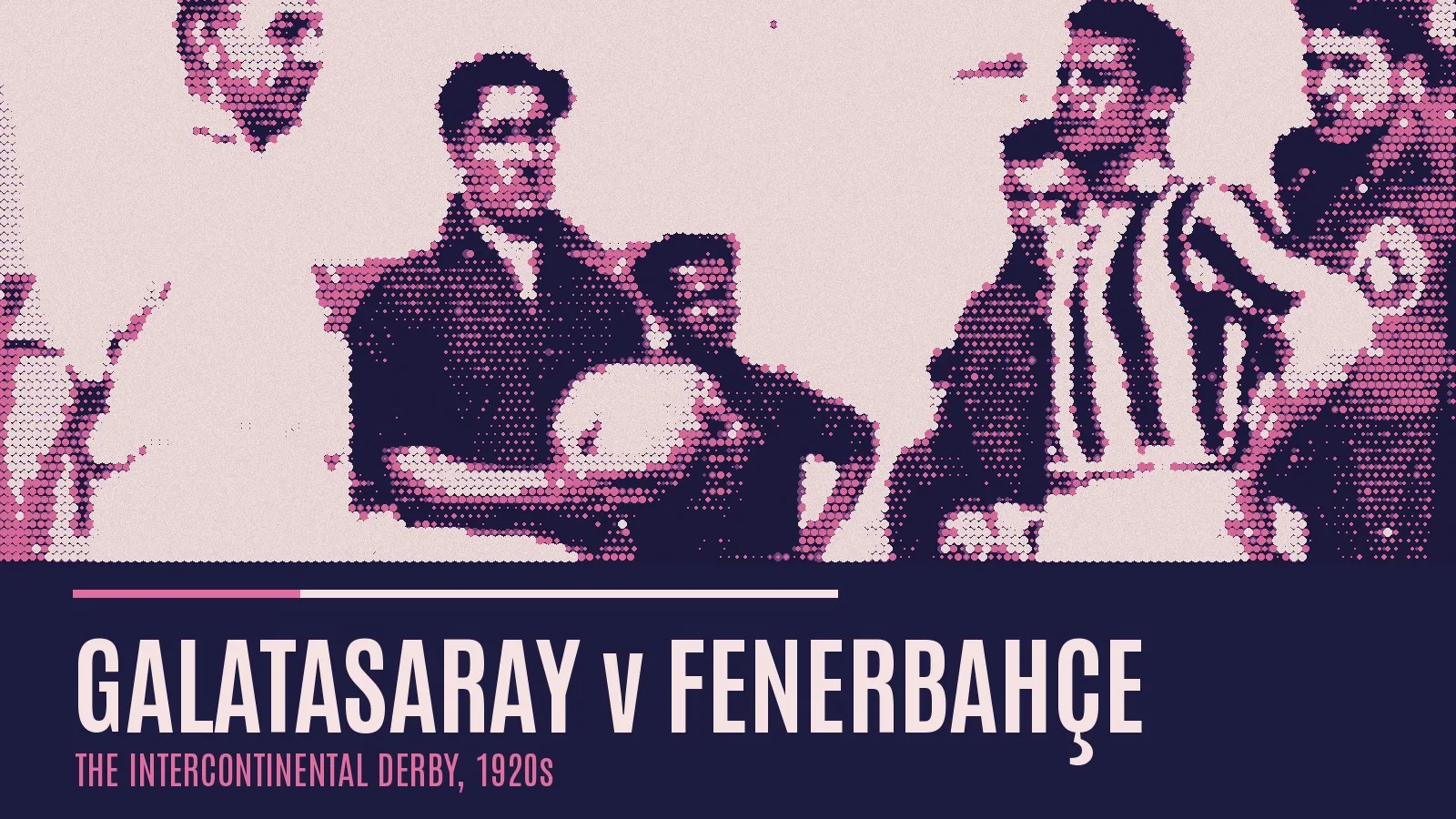
Galatasaray v Fenerbahçe, the Intercontinental Derby: two clubs founded by schoolboys who weren’t supposed to have them, a century of matches across a strait, and a fixture that now seems to happen as much in press conferences as on the pitch.
Most derbies are about a street, a river or, if the planners have been feeling cruel, a ring road. Istanbul’s big one is about a continent. Galatasaray play on the European side of the city and Fenerbahçe on the Asian side, which is why Turkish broadcasters and the Anadolu Agency call it the intercontinental derby without a trace of irony. Every other city rivalry on earth is local. This one claims a whole landmass on each side, which is either the grandest thing in football or a slightly ridiculous one, and I’ve never managed to decide which.
The old version of this post had no trouble deciding. It told you which club was the people’s and which was the establishment’s, as though a club of millions could be summed up in a sentence and filed away. I’ve taken that out. I couldn’t find a source that would stand behind it, and in any case the clubs’ own founding stories are more interesting than the stereotypes. Both start with teenagers, both start with something close to secrecy, and both start with a ball.
The ball, the lard and the shoe
Galatasaray’s story begins in a school. Galatasaray High School, the club’s official history explains, was founded by Bayezid II in 1481 to educate future statesmen, and took its name from the district it stood in, Galata Sarayı, the Galata Palace. By the late 19th century it was where organised sport in Turkey began: a gymnast called Monsieur Curel brought physical education into the syllabus, and in 1870 held a training festival at Kağıthane where the winners got medals and everybody got rice pilaf with mutton afterwards. The club notes, with some pride, that the pilaf became a tradition of its own. I mention it because it’s the most sensible approach to sports prizegiving I’ve ever come across.
Football arrived at the school as a mess. The club’s history admits frankly that the first games were “nothing but a disorganized, fully chaotic hustle of many students in one field”, which describes most school football in most countries to this day. Around it, Istanbul’s organised game belonged to other people. Two Englishmen, James Lafontaine and Horace Armitage, had founded Kadıköy Football Club in 1901. A row among its English players produced a breakaway, Moda, in 1903, and in 1904 those clubs joined Imogen, Elpis and Strugglers in an Istanbul Football Union. Every team was foreign or run by the city’s minorities, and the Galatasaray boys, says the club’s own account of its foundation, watched them with interest and some resentment.
So in 1905 they started their own. The founder, Ali Sami Yen, later described it in his book Ellinci Yıl (“The Fiftieth Year”), and the passage the club quotes is the best founding document in football. The decision was taken during a literature lesson with their teacher, Mehmet Ata Bey. Asım Tevfik became accountant, “because he was good at collecting a penny for the club every week from the members”. Cevdet became vice chairman “because he was washing our jerseys”. And Ali Sami was chairman because, as he puts it, “I knew how to oil and inflate the ball.”
He goes on: “I was caring for the ball as it was my own blood. After all, all we had was a ball. I bought lard every morning on my road to the school. I would oil and inflate the ball with it. I made a patch to the ball by cutting a piece from my new shoe.” I’ve read a lot of club histories, and most of them begin with a meeting in a pub and a resolution. Here the first chairman is a teenager who sacrificed his new shoes for the ball. You can tell a lot about a club whose founding myth is about looking after things, and a lot about a city where the most important qualification for high office was knowing where to buy lard.
The ambition was stated plainly too: “Our goal is to play in a collective way like English, to signify a certain color and a name and to beat non-Turkish teams.” Bulgarian and Serbian schoolmates joined them, which the club records without fuss. The names Gloria and Audace were considered and rejected. According to the researcher Cem Atabeyoğlu, cited by the club, the name Galatasaray came from spectators at the team’s first game, a 2-0 win over a Greek side, who called the players “the gentlemen of Galata Palace”. Most clubs are named by committees. This one was named by the crowd, which is just about the most Istanbul thing in this piece.
There’s a coda in the same history that I can’t leave out. Ali Sami Yen recalls visiting his old friend Emin Bülent Serdaroğlu on his deathbed. Emin had fallen out with the club years before and, Ali Sami thought, had come to hate sport altogether. With his last strength he beckoned the founder over and said: “Ali Sami… You were unfair to me all this time, I am the No. 2 member of Galatasaray.” Asım Tevfik, who held the No. 2 card, was ready to give it up for him. A man dying and still worrying about his membership number tells you more about what these clubs mean in Istanbul than any amount of talk about passion.
Daffodils on the Asian shore
Two years later and across the water, in Kadıköy, a second group of young men did much the same thing, but more quietly. Fenerbahçe’s official history says the club was founded in 1907 by Nurizade Ziya Songülen, Ayetullah Bey and Necip Okaner, and founded “secretly in order to keep a low profile”, because Sultan Abdülhamit II had forbidden Turkish youths from setting up clubs to play the game the English families played, “something they could only watch in envy”. Ziya Songülen became president, Ayetullah general secretary and Necip Okaner general captain.
The club’s first badge was the lighthouse on the Fenerbahçe headland, the fener in the name. Its first colours were white and yellow, “the colours of the daffodils scattered around the Fenerbahçe peninsula”. The colours became yellow and navy in 1910, when Topuz Hikmet redesigned the badge. Until a change in the law in 1908, the history says, everything was done “under strict secrecy”. Galatasaray’s history has its own version of the legal problem: there was no law of associations in 1905, so the club only gained a legal identity after the law was passed in 1912 and was formally registered on 14 August 1913.
So both great Istanbul clubs began, in effect, as illicit schoolboy societies run by teenagers who had seen the English play and decided they wanted a go. I find that moving, and slightly funny. It’s hard to imagine a modern Turkish derby, with its riot police and boardroom statements, coming from boys hiding a football from the Sultan, but that’s the family tree. The daffodils and the lard ball are the two most innocent objects in the history of a rivalry that soon stopped being innocent.
Fenerbahçe joined the Istanbul League in 1909, the club history says, won nothing in its first three seasons, and then won the 1912-13 championship without losing a game. Their first-ever team, which the club lists, included Asaf, Ziya, Hasan, Sami, Ayetullah, Mazhar, Necip, Fethi, Galip, Hüseyin, Hasan and Nevzat. Two Hasans in the first eleven seems careless, but they got it sorted by the second title.
A field called the priest’s meadow
The two clubs first met on 17 January 1909, in a friendly, at Papazın Çayırı. The Anadolu Agency translates the name as “the field of the priest” and notes that it is where Fenerbahçe’s stadium, Ülker or the Şükrü Saracoğlu, stands today. Galatasaray won 2-0. (The Galatasaray history mentions that the English clubs’ Union ground, where they played, is also where the Şükrü Saracoğlu now is. Istanbul’s football history keeps returning to the same few acres, like a cat to a warm windowsill.)
It’s worth stopping on that detail. The first derby was played on what is now Fenerbahçe’s home ground, and Galatasaray won it. Over the next century, a lot of what happened in this fixture can be read as one side trying to put the other in its place on its own turf. That reading becomes less of a metaphor and more of a literal description in April 1996.
Before we get there, the overall record. The Anadolu Agency counted 394 meetings in November 2021: Fenerbahçe had won 147, Galatasaray 124, and 123 were drawn. Fenerbahçe also led on goals, 513 to 464. In the 128 top-flight league meetings, Fenerbahçe had 50 wins to Galatasaray’s 35, with 43 draws. Those numbers will have moved on since, and I haven’t been able to find a later count I trust. They’re worth having anyway, because they show the derby itself is fairly even and slightly in Fenerbahçe’s favour. Galatasaray’s case rests elsewhere, as we’ll see.
Souness and the flag
Graeme Souness arrived as Galatasaray manager in June 1995, after 18 months out of the game following his exit from Liverpool, and lasted one season. He is remembered in Istanbul far more fondly, and far more furiously, than a single season would lead you to expect, and that comes down to one night.
He told the story to FourFourTwo, and it starts with an insult. Soon after he arrived, he says, a Fenerbahçe vice-president told a newspaper: “What are Galatasaray doing signing a cripple as a coach?” Souness had had open-heart surgery while he was at Liverpool, and took the remark as meaning he was on his last legs. “I’d been around the block enough times to know what goes around comes around,” he says.
It came round in the two-legged Turkish Cup final of 1996. Galatasaray finished fourth in the league that season, 16 points behind Fenerbahçe, and had lost 3-1 at the Şükrü Saracoğlu. So the cup was the season’s only chance of revenge. They won the first leg 1-0 at the Ali Sami Yen, the stadium named after the boy with the lard. In the second leg, in Kadıköy, they were losing 1-0 when Dean Saunders, Souness’s old Liverpool striker, scored deep into extra time to win it.
What happened next, according to Souness, was not premeditated. A giant Galatasaray flag was passed over the fence, the players paraded it, and it ended up in his hands just as they ran off for the presentation. “Nothing was premeditated. It just happened,” he says. Then he caught sight of the vice-president. “I said to myself, ‘I’ll show you who’s a cripple’, and made my way over to the centre circle with the flag on a mission to plant it in the pitch.”
The best part of his account is the bit that undercuts it. “At first, I must have looked like a right berk. I tried and failed to stick it next to the kick-off spot. I had two attempts, because the ground was so hard, before I finally got third time lucky.” Every famous act of defiance should have a moment where the hero has to try three times, and Souness, to his credit, is the one who tells you about it. Then he looked up at the people who had stayed in the stands and realised “it wasn’t my cleverest move”. Fans tried to climb the perimeter fence. Someone ripped the flagpole out. He ran for the tunnel under police shields while missiles rained down. “I wasn’t frightened,” he says, “but I still thought it wise to make a run for it.”
In the FourFourTwo telling the flag is a reply to a personal insult as much as a club statement. In Istanbul it became a club statement anyway. That’s the thing about this derby: whatever you meant, the city decides what it meant.
Copenhagen, and what it changed
If the flag was Galatasaray’s most notorious act of the 1990s, their most important came four years later and had nothing to do with Fenerbahçe, except that it changed the balance between them for a generation. In May 2000 Galatasaray beat Arsenal in the UEFA Cup final at the Parken Stadium in Copenhagen: 0-0 after extra time, 4-1 on penalties, with Patrick Vieira and Davor Šuker missing for Arsenal. It was, as UEFA’s report put it, Turkey’s first European honour.
UEFA quotes Fatih Terim on what it meant: “In the past, Turkish players watched finals on television. Now they have the chance to play the starring role.” They had come in by the back door, as a third-placed side from the Champions League group stage, and only after beating AC Milan in their final group game. Then they knocked out Bologna, Borussia Dortmund, Mallorca and Leeds. Gheorghe Hagi was sent off in extra time of the final for striking Tony Adams, which is the most Hagi thing that could have happened, and the most Tony Adams thing that could have happened to a centre-half.
For the derby, the point is this. Fenerbahçe could, and did, lead the head-to-head. But from 2000 Galatasaray had something no other Turkish club had, and their supporters have never let anyone forget it. Rivalries are not settled by results between the two teams alone. They’re settled by what each side can say in an argument at a wedding, and since Copenhagen Galatasaray have had the last word in that argument.
Under-19s in Şanlıurfa
Skip forward to the 2020s and the derby has a new habit: some of its most significant episodes aren’t really football matches at all.
The 2023-24 Turkish Super Cup was meant to be played in Riyadh in December 2023. It was postponed, the BBC reported, when the Saudi organisers refused to let the players wear warm-up shirts bearing the image of Mustafa Kemal Atatürk. It was rescheduled for 7 April 2024 in Şanlıurfa, about 1,000 kilometres from Istanbul and in the region hit by the 2023 earthquake, with the proceeds going to victims.
Fenerbahçe had a Europa League quarter-final against Olympiakos four days later and asked for the match to be moved. The request was refused. They had also asked for a foreign referee and been turned down. Two of their players had just been banned after Trabzonspor fans invaded the pitch during a league game in March, and the club’s members had even voted on whether to leave the league. The members voted to stay. So Fenerbahçe sent their under-19 side. Mauro Icardi scored for Galatasaray after one minute, and the Fenerbahçe youngsters walked off. Galatasaray celebrated with the trophy. Fenerbahçe said they had taken the field “not to win but to defend the truth”.
Four days later the federation fined Fenerbahçe 115,000 euros and awarded Galatasaray a 3-0 win, the BBC reported. That means the official score of a final in which Galatasaray scored once is three. There’s a pure Turkish football logic to that.
I’ve tried to feel strongly one way or the other about the walk-off, and I can’t quite. A club that thinks the system is rigged against it is entitled to protest. A protest that makes a group of teenagers walk off the pitch at a match staged to raise money for earthquake victims is a strange way to make it. Mostly it struck me as the furthest anyone had yet pushed the old idea that this fixture is about more than football: in Şanlıurfa it was about everything except football.
The Mourinho year
Then Fenerbahçe hired José Mourinho, which for a club trying to calm things down was like hiring a fireworks display as a nightwatchman.
He was appointed in June 2024. According to the BBC’s Burak Abatay, he promised supporters that the yellow-and-navy shirt would become his “skin”. The derby at the end of February 2025 finished 0-0, refereed by a Slovenian, Slavko Vinčić, after both clubs asked for a foreign official. Afterwards, asked about his 19-year-old defender Yusuf Akçiçek, Mourinho said: “I have to thank the referee. After the big dive in the first minute and their bench jumping like monkeys on the top of the kid… with a Turkish referee you would have a yellow card after one minute and after five minutes I would have to change him.”
Galatasaray announced that they would “initiate criminal proceedings” over what they called “racist statements”, and complain to UEFA and FIFA, the BBC reported. Fenerbahçe said the words had been “completely taken out of context” and “can in no way be associated with racism”. The Turkish federation then banned Mourinho for four matches and fined him the equivalent of £35,194, citing his statements about Turkish referees and saying his remarks about the opposition “contained expressions that could encourage violence and disorder in sports”, according to the BBC. The ban was later cut to two matches, and Mourinho, who denied being racist, sued Galatasaray for 1,907,000 Turkish lira.
The figure is worth a second look: one million, nine hundred and seven thousand. 1907 is the year Fenerbahçe was founded. Whoever settled on that number knew exactly what they were doing, and it’s the funniest legal claim I’ve seen in football. You don’t sue your rivals for damages. You sue them for a founding date.
It didn’t help. He was sacked on 29 August 2025, two days after a Champions League play-off defeat by Benfica, the BBC reported, having finished second in his only season. Abatay summed it up: “no trophies, no derby victories”. Fenerbahçe were, he wrote, “still chasing its first league title since 2014”, and the hope had been that Mourinho would “stop arch-rivals Galatasaray’s dominance”. Instead he became another man who arrived on the Asian shore promising the world and left without beating the side from Europe.
Twenty-six
Which brings us to where the rivalry stands as I write in October 2026. On 9 May 2026 Galatasaray beat Antalyaspor 4-2 at home to win the 2025-26 Süper Lig with a match to spare, the Anadolu Agency reported. It was a record 26th league title, and they finished four points clear of Fenerbahçe. Read alongside the BBC’s line about Galatasaray’s “dominance”, that is the picture of the last few years: Fenerbahçe have been close, and Galatasaray have been champions.
Close is a horrible place to be in a two-club city. Finishing second to a team from Leeds or Lyon can be put down to bad luck. Finishing second to the people across the water, while they parade the trophy, is personal, and every derby turns into a referendum on the gap between the two.
What the founders would make of it
I keep coming back to the two founding stories, because they explain the derby better than any list of results. Both clubs were started by teenagers who wanted to play the English game and beat the people who already played it. Both had to work around the authorities: the Galatasaray boys had no law to register under, and the Fenerbahçe boys met in secret because the Sultan had banned that sort of thing. Both clubs were, at the start, small acts of defiance carried out by people with very little except a ball and some nerve.
What has changed is the scale and, perhaps, the target. Ali Sami Yen wanted to beat the foreign clubs. A century later the two clubs he and Ziya Songülen helped bring into being spend a good deal of their energy fighting each other’s boards, the federation and its referees, sometimes by letter, sometimes by walking off and, in Mourinho’s case, with a lawsuit priced at a founding year. The defiance is still there. It has turned inward, onto the city’s own institutions and onto each other.
The old version of this post ended with a list of reasons the rivalry “transcends” sport. I’d rather end with a meadow. The field of the priest, where they first played in January 1909, is now under one of their stadiums, and the ground where the English clubs once played their union fixtures is under it too. In 1996 a Scotsman needed three goes to drive a flagpole into that ground, because it was so hard. I suspect it has been hard for over a hundred years: hard to win on, hard to plant anything in, and hard to leave without someone throwing something. Ali Sami Yen, who looked after a single ball as if it were his own blood, would probably have understood that better than anyone in the directors’ box today.
For more on what derbies do to cities, see the Athenian derby, Olympiacos against Panathinaikos, and for what happens when the Bosphorus hosts someone else’s final, the night of Liverpool against AC Milan in 2005. A ground that carries a city’s identity in the same way is the subject of our piece on the Camp Nou.