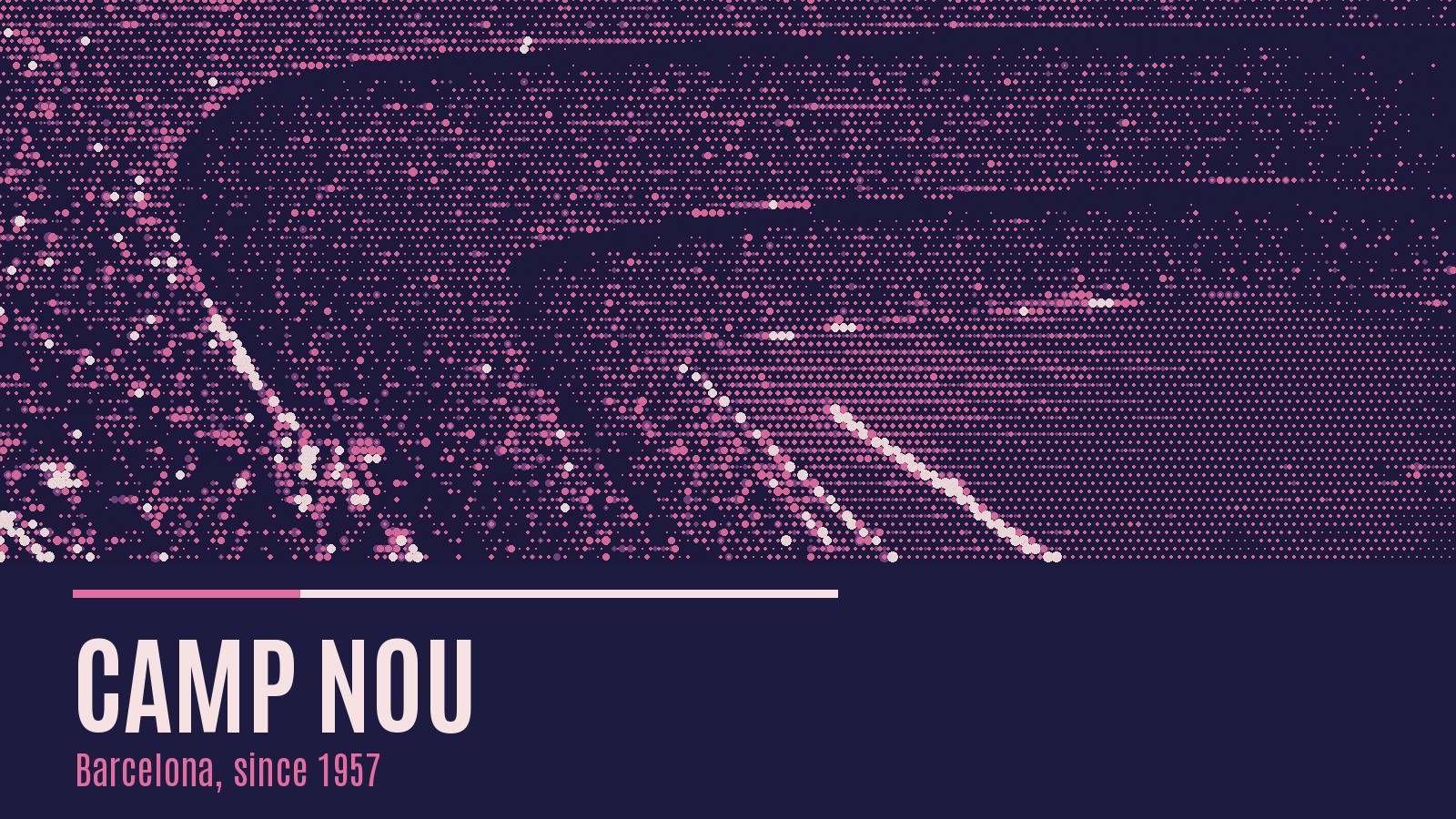
Great Stadiums: Camp Nou. Barcelona’s home was born in debt, opened unfinished, survived a dictatorship that disliked what it stood for, and has spent the last few years as a building site with a football club attached. It is, by some distance, the most famous football ground in the world. It is also, for the moment, not quite finished. That is very Camp Nou.
The ground that Les Corts could not contain
Every great stadium begins with a smaller one that has stopped being big enough, and in Barcelona’s case the smaller one was Les Corts. The club’s own history of the Camp Nou divides the club’s life into three ages: the wandering years, when Barça moved from ground to ground like a lodger who kept falling out with the landlady; the settled years at Les Corts, opened in 1922; and the third age, the Camp Nou, which “reflects the expansion and grandeur of the club on a global scale”. It is a very Barcelona way of putting it. Most clubs would say they needed a bigger ground. Barcelona says it needed a bigger ground in order to reflect its grandeur on a global scale.
To be fair, Les Corts had tried. After the Civil War the membership grew every year, and the old ground was extended and extended again: the grandstand in 1944, the south goal in 1946, the north goal in 1950. It still was not enough. From 1948, the club history says, people were increasingly keen on the idea of a completely new ground, and the question became not whether but where, and how anyone would pay for it.
The story usually told is that one man forced the issue. Ladislao Kubala, the Hungarian forward who arrived in 1950, was so thrilling that the crowds who came to see him could no longer be fitted into Les Corts, and so the Camp Nou was built for Kubala. It is a lovely story, and the club’s own historians, rather admirably, decline to let it stand unchallenged. Kubala certainly raised the temperature, they say, but the decision to build was inspired just as much by the league titles of 1947-48 and 1948-49, won before he had signed. And the first concrete step came in September 1950, fifteen days before Kubala played his first friendly for the club, when the president, Agustí Montal i Galobart, signed an option to buy land in the area of the city known as La Maternitat. Kubala was the occasion. The members were the cause.
Three years of arguing, three years of building
What followed was, in the club’s own word, turbulent. In February 1951 a stadium commission decided to move the project to the top of the Diagonal, the great avenue that slices across the city, and there followed what the history calls “a series of sterile negotiations with the Authorities that did not seem to be getting anywhere”. The project seemed to have been shelved for good. Then, in November 1953, Francesc Miró-Sans won the presidential election on a promise to get the thing built, took office in February 1954, moved the site back to the land bought in 1950, and on 28 March 1954, in front of 60,000 supporters, the first stone was laid, with the civil governor presiding and the Archbishop of Barcelona, Gregorio Modrego, giving his blessing.
It is worth pausing on that guest list. This was Franco’s Spain, fifteen years after the end of a civil war in which Barcelona had been on the losing side. The new stadium could only be built with the cooperation of the regime’s men, and the regime’s men duly turned up, in their good suits, to bless it. The contradiction never really went away. The Camp Nou would become the place where Catalans could do in public what they could not easily do elsewhere, and it was opened by the people they were doing it in front of.
The architects were Francesc Mitjans Miró, who happened to be the president’s cousin, and Josep Soteras Mauri, with Lorenzo García Barbón. The construction firm, INGAR, estimated the job at 66,620,000 pesetas and eighteen months. It took longer, and it cost, by the club’s own account, around 288 million pesetas, more than four times the estimate, paid for with mortgage bonds and short-term debt that, the history says with commendable frankness, “would leave the club in heavy debt for many years after”. There is a pattern here, and we will come back to it.
24 September 1957
The opening was set for 24 September 1957, and Barcelona went about it as only Barcelona could. There were sports events across the city all weekend. The poet Josep Maria de Sagarra wrote a sonnet for the occasion; a new anthem was composed. On the day there was a solemn mass, the stadium was blessed by the archbishop, a choir sang Handel’s Hallelujah chorus and an image of the Virgin of Montserrat was raised. The president’s box held the club president, the mayor, the civil governor and José Solís Ruiz, the general secretary of the regime’s Movimiento. The stadium was not finished. More than 90,000 people came anyway.
The football, when it finally began at half past four in the afternoon, was a friendly against a Polish side from Warsaw, the club history records, and Barça won 4-2. The first goal ever scored at the Camp Nou came after eleven minutes, from Eulogio Martínez; Tejada, Sampedro and Evaristo added the others. At half-time, 1,500 dancers performed a sardana, the Catalan circle dance, and 10,000 doves were released. You can read that as civic pageantry or as something slightly more pointed. The sardana was the dance of Catalan identity, danced in a stadium opened by the dictatorship’s ministers, and nobody in the president’s box seems to have objected. Perhaps they thought it was just dancing.
When it opened, the Camp Nou held 93,053 people. The original plan had been for 150,000, which was abandoned, presumably when somebody looked at the bank statements. The pitch was 107 metres by 72. The principal materials were iron and concrete. Floodlights followed in 1959, an electronic scoreboard in 1976, and the building settled into its long middle age as one of the biggest football grounds in Europe.
More than a club
It was at a lectern rather than on the pitch that the Camp Nou acquired its motto. On 17 January 1968, Narcís de Carreras took office as president and, in his acceptance speech, said the words the club has been repeating ever since. As the club’s own account of the phrase renders them: “Barcelona is more than a football club. Barcelona is more than a place of leisure where we go to watch the team play every Sunday. More than those things, it is the spirit that is so ingrained within us.”
What is charming about the club’s telling of this story is how little it oversells it. In all honesty, it says, the original intention “was probably no more than a description of how supporters are so fervently loyal to their club. He could have been speaking about any football team.” But under Franco there was another reading, and it did not go unnoticed. The phrase did not catch on straight away; it took an advertising campaign in 1973 before it entered the language, and only much later did it become the semi-official slogan that is now, in the club’s words, “emblazoned on the Camp Nou terraces”. The seats in one stand spell it out: MÉS QUE UN CLUB.
De Carreras was a complicated figure for a Catalan hero. AS, marking the speech’s fiftieth anniversary, records that he had been a deputy mayor of Barcelona and would go on to run La Caixa, the savings bank. It also tells the best story about him. At the 1968 Copa del Rey final in the Bernabéu, which Barcelona won 1-0 amid a hail of bottles, the wife of the regime’s interior minister turned to him in the directors’ box and offered her congratulations, because, after all, Barcelona was Spain too, wasn’t it? De Carreras’s reply, in Catalan, translates roughly as: “Madam, let’s not get carried away”, though the original verb is a good deal earthier than that. More than a club, in other words, sometimes meant more than a polite answer.
Cruyff, Sotil and a fourteen-year wait
The arrival that gave the Camp Nou its first great modern team took the best part of four years to complete. Barcelona had wanted Johan Cruyff since the late 1960s, when, as the club’s history of the transfer explains, their English coach Vic Buckingham, who had given Cruyff his Ajax debut as a teenager, recommended him. The obstacle was that Spanish football had banned foreign players. That ban was only lifted, in May 1973, after the club’s president, Agustí Montal, commissioned a lawyer’s study into the dozens of South American “natives” who had been signed by other Spanish clubs on dubious paperwork, and threatened to publish it. Even then Ajax did not want to sell. Barcelona had already signed a Peruvian, Hugo Sotil, and, the club admits, were so sure they would not get Cruyff that they tried for Gerd Müller instead.
Cruyff got his way, as Cruyff generally did. The deal was finally done in room 1043 of the Alpha Hotel in Amsterdam on 13 August 1973, with Barcelona’s coach, the former Ajax manager Rinus Michels, at the negotiating table. A registration dispute kept him out of competitive football until 28 October, when he made his debut at the Camp Nou against Granada, in front of 100,000 people. Barcelona were second from bottom. Cruyff scored twice in a 4-0 win, and the club’s records show it was the first of 26 unbeaten matches that brought the 1973-74 league title, with five games to spare. Sotil, an old hero of the Estadio Nacional in Lima, scored the third that day. The Camp Nou has had more glamorous afternoons since, but few that changed so much.
The 1982 extension and the World Cup
By the early 1980s Spain had a World Cup to stage and the Camp Nou had a third tier to build. The 1982 extension added 22,150 places, according to the club, and took capacity to some 115,000. A VIP area and new press box went in at the same time. And on 13 June 1982 the stadium staged the opening match of the tournament, Argentina, the holders, against Belgium.
It did not go to script. Diego Maradona was playing on what was about to become his home ground: Barcelona had signed him on 4 June, nine days before the tournament, for a record 1,200 million pesetas. He was 21. The crowd was 95,000, according to the match record, and Belgium won 1-0 with a 62nd-minute goal from Erwin Vandenbergh. It is one of football’s better jokes that the most talked-about player in the world began his first World Cup by losing to Belgium in front of a crowd that, within months, would be cheering him every other week. His two seasons at the club, the club itself admits, were “full of bad luck”: hepatitis, a serious ankle injury, then a move to Napoli.
The 1980s brought other changes. The club museum was added in 1984. Ten years later, the club says, the pitch was lowered by 2.5 metres to allow the lower tier to be extended, the standing areas behind the goals were converted and the moat around the pitch was removed. By the end of the century, with the last terraces turned into seats, the capacity had settled at around 99,000. It was still enormous. It simply no longer had room to pretend it was bigger than that.
Kiko, an Olympic final and a lion’s roar
Two of the Camp Nou’s greatest nights did not involve Barcelona at all. On 8 August 1992, at the Barcelona Olympics, Spain’s footballers played Poland for the gold medal at the Camp Nou. Poland led 1-0 at half-time; Abelardo equalised, Kiko made it 2-1, Poland drew level, and then, in the 90th minute, Kiko scored again. RSSSF’s records list the score as 3-2. That Spain team included a number of players who would go on to be very good indeed. It was gold, won at home, in a stadium that had spent thirty-five years being, among other things, a statement that Catalonia was not quite the same as Spain. The crowd did not seem to mind.
Seven years later came the night that, for an English audience at least, defines the place. On 26 May 1999 Manchester United played Bayern Munich in the Champions League final. Bayern led through Mario Basler’s early free-kick and were still leading as the clock ticked past 90. “The red and white ribbons already being attached to the trophy were not destined for them,” as UEFA’s match report puts it. Teddy Sheringham turned in Ryan Giggs’s scuffed shot; two minutes later he headed David Beckham’s corner on for Ole Gunnar Solskjær, and it was over. The crowd was 90,245, which remains, according to UEFA’s own records, the record attendance for a Champions League final. “This is the greatest moment of my life,” said Alex Ferguson. “I’ve just hugged and kissed them. I’ve slobbered all over them.” The losing coach, as UEFA’s line-ups record, was Ottmar Hitzfeld, whose career we have written about before.
Pigs, bottles and the empty stadium
The Camp Nou’s relationship with Real Madrid has always been the thing that gives it its edge, and never was the edge sharper than on 23 November 2002. Luís Figo had left Barcelona for Madrid two years earlier for a world-record fee, and his second return was, by any measure, unwelcome. When he went to take a corner in the 74th minute, the Guardian reported, he was “showered with plastic bottles, fruit, lighters and sandwiches, in addition to a whisky bottle”. The referee took the players off; the Guardian’s news report put the delay at 13 minutes, Sid Lowe’s column at sixteen. The detail everyone remembers was supplied by Sid Lowe in the Guardian: “staring up from the Camp Nou turf, was a real life, bona fide pig’s head”, from a suckling pig, which one Barcelona director tried to dismiss on the grounds that “we don’t even eat cochinillo in Barcelona”. The game finished 0-0. Barcelona’s president, Joan Gaspart, said Figo had spent too long taking his corners. It was not his finest hour, and it was not the stadium’s either.
Fifteen years later the Camp Nou made a political statement of the opposite kind: it said nothing at all. On 1 October 2017, the day of the disputed Catalan independence referendum, with police violence against voters across the region, Barcelona asked for their match against Las Palmas to be postponed. La Liga said no. Twenty minutes before kick-off, the club decided to play behind closed doors, the Guardian reported, “leaving thousands of supporters stranded outside”. Barça won 3-0, with two from Lionel Messi and one from Sergio Busquets, in a ground built for 99,000 and occupied by 22 players and some stewards. Gerard Piqué, who had tweeted a photograph of himself voting that morning, called it “the hardest game to play”. It may be the strangest match ever played at the Camp Nou, and the one that best explains what the phrase on the seats is supposed to mean.
Montjuïc, and the long way home
And then, in the summer of 2023, Barcelona moved out. The redevelopment of the Camp Nou, the centrepiece of a project the club calls Espai Barça, was to take capacity from 98,000 to 105,000 and put a roof over the whole thing, The Stadium Business reported as work began, with the Turkish firm Limak building it for €960m. The club decamped to the Estadi Olímpic Lluís Companys on Montjuïc, the hill above the city. Their last game at the old Camp Nou was against Mallorca on 28 May 2023.
The president, Joan Laporta, hoped to be back for the club’s 125th anniversary at the end of 2024. They were away for 909 days, by the club’s own count. The return came on 22 November 2025, against Athletic Club, after what the Guardian’s Sid Lowe politely called “a series of missed targets”. The stadium was not finished. The club had a licence for 45,401 spectators, covering the main stand, the south goal and one side; the north end was still a building site. The ground would carry the name Spotify, under a €280m naming-rights deal agreed in 2022. The crowd was 45,157, and Barcelona won 4-0, with two from Ferran Torres and one each from Robert Lewandowski and Fermín López.
It is hard to think of a more fitting way for the Camp Nou to begin its second life. It opened in 1957 unfinished, over budget and in debt; it reopened in 2025 unfinished, late, and with €1.45bn of financing to repay. It was blessed in 1957 by the archbishop and the regime, and in 2025 by a streaming service. Some things about the place, it turns out, are not under construction at all.
The cathedral and the congregation
There is a temptation, writing about the Camp Nou, to reach for the word cathedral, and the old version of this article did so in its headline. It is not quite right. A cathedral is built to make the people inside it feel small. The Camp Nou, for all its size, has always been about making a particular group of people feel large: the members, the socis, who own the club and elect its president, who paid for the place with their subscriptions and their patience, and who have been asked to be patient again.
Its history is full of things that are not about football. A first stone laid by a dictatorship’s governor. A sardana at half-time. A president’s speech that meant more than it said. A pig’s head. An empty stadium on a referendum day. You could tell the story of modern Catalonia through those moments, and people have.
But it is also full of football, more of it and better than almost anywhere else: Kubala’s crowds, Cruyff’s debut, Maradona’s first defeat, Kiko’s late winner, Sheringham and Solskjær, and everything that came after. Our piece on Mestalla, down the coast in Valencia, describes a very different kind of Spanish ground, older, steeper and more intimate, and the comparison is instructive. Mestalla feels like a neighbourhood. The Camp Nou feels like a nation that has not quite decided whether it is one.
The new stadium, when it is finished, is supposed to hold 105,000. Barcelona being Barcelona, nobody would bet the house on when. But when the third tier is full and the north end is open and the letters on the seats are back where they belong, the Camp Nou will once again be the biggest club ground in Europe, the most famous in the world, and still, after all these years, slightly in debt. Barcelona would not have it any other way.