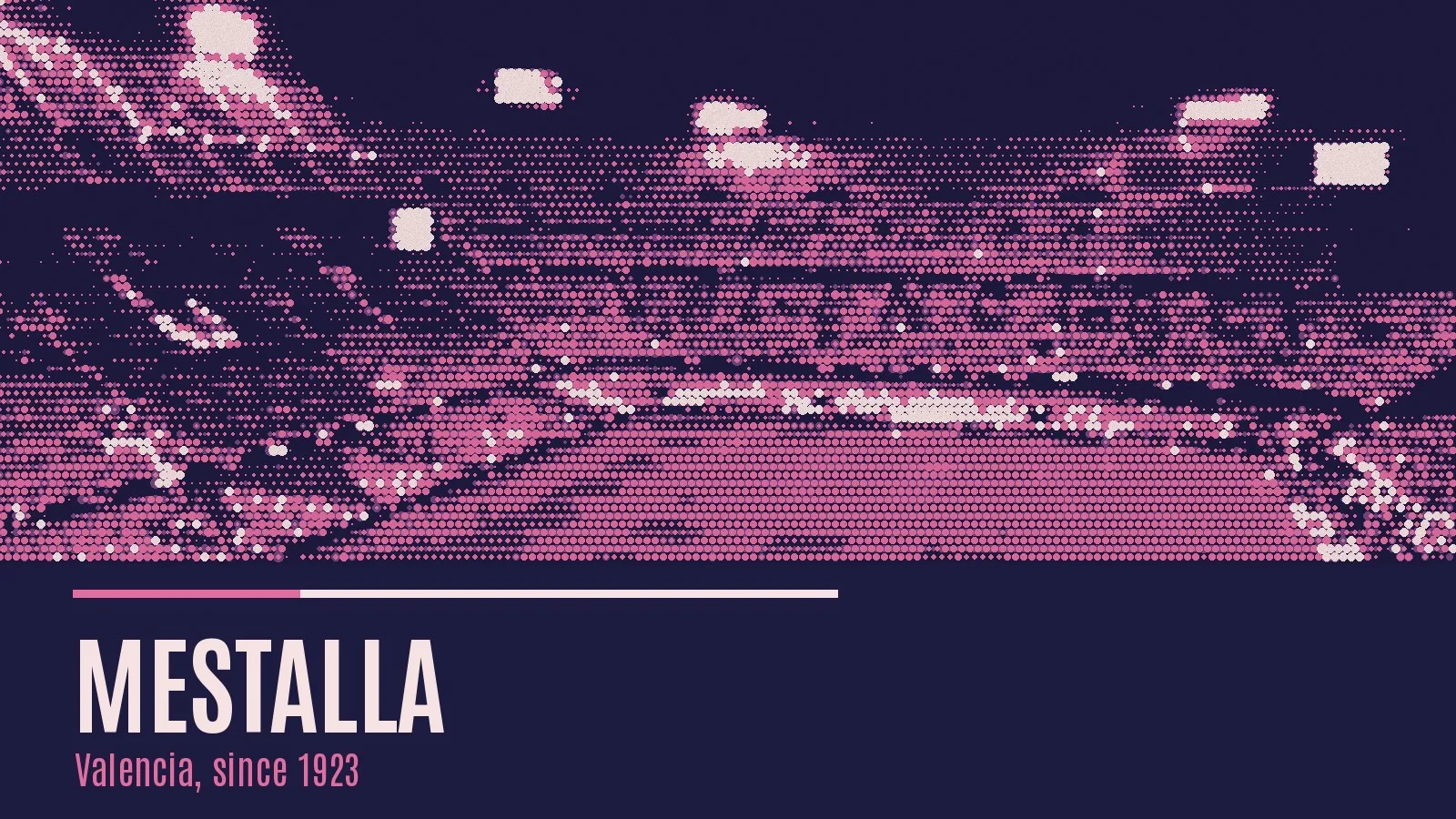
Mestalla takes its name from an irrigation canal, has been a concentration camp, a junkyard, a flood refuge and a food bank, and has spent most of the past two decades waiting to be replaced. It is still, for the moment, the most vertical football ground in Spain’s imagination.
A canal, a field, a name
Most football grounds are named after a person, a sponsor, a street or a district. Mestalla is named after a ditch. The club’s own official history says so with no embarrassment at all: the ground was “given the name of one of the canals that irrigate the city”. That seems right for Valencia, a city whose wealth was built on water, rice and orange groves, and whose relationship with that water has not always been friendly. A canal is useful and ancient and, under the wrong conditions, dangerous. Mestalla has been all three.
It opened on 20 May 1923 with a friendly between Valencia FC and Levante FC. The club’s history notes that this meant “bidding farewell to the old ground, Algirós, which will always have a place in history as the first home of the club”. Even in those early years, when Valencia were not yet in the Primera División, the new ground could hold 17,000. The first renovation came in 1927. By the time of the Civil War, capacity had grown to 25,000.
Then the war came. Here the official history, usually written in the cheerful register of club websites everywhere, turns suddenly bleak. Mestalla became “one of the grounds most damaged in the Civil War. Mestalla was used as a concentration camp and junkyard. It only kept its structure, with just a single stand, during the conflict.” There is no elaboration, and perhaps none is needed. It is worth sitting with that sentence for a moment before going on to the trophies, because it tells you something about what a football ground can be asked to do, and what it can survive.
The Electric Forward Line
After the war, the ground was rebuilt, and Valencia started winning. The first trophy, according to the club, was the Cup in 1941. The rebuilt Mestalla became the place to watch what the history calls “the legendary ‘Delantera Eléctrica’ of Epi, Amadeo, Mundo, Asensi and Gorostiza”, the Electric Forward Line, who helped Valencia to three league titles and two cups. “These years of sporting success,” the history adds, “also served to help restore Mestalla to its former glory.”
That’s a common pattern in football, and a slightly mysterious one. A ground is a physical thing, made of concrete, steel and wooden benches. But its glory, its reputation, the thing people mean when they talk about it, is made almost entirely by what happens on the grass. A beautiful stadium with a bad team is a sad place. An ugly stadium with a great one becomes a cathedral. Mestalla in the 1940s was presumably not much to look at, patched up after a war, but the Electric Forward Line made it matter.
The biggest single change came in the 1950s, when, the club says, a building project produced a stadium holding 45,500. This is where the Mestalla most people picture was born: the steep, close stands rising almost sheer from the touchline, the sense of a crowd stacked on top of the pitch rather than arranged around it. It is the kind of ground where visiting players look up and feel the stands lean in on them.
The flood
Then, in October 1957, the canal city remembered its river. The Turia burst its banks, in what the club calls “the heaviest flood in Valencia’s history”, and Mestalla was badly damaged.
The more vivid account comes from the club’s own oral history, recorded for the ground’s centenary. In a 2022 piece, Valencia’s media team spoke to two men who had lived in the neighbourhood when the water came on 14 October 1957. The flood covered the pitch, but the ground also became a refuge. José Pérez, then 93, remembered the police shouting a warning, “riada, riada, riada”, flood, flood, flood. “We got out however we could,” he said. “The firemen were taking people across the rooftops to the ramps of Mestalla.” Manolo Llopis, 67, said that many people from the barrio climbed up onto those ramps. “That was what saved us from the flood, so that nobody drowned.”
There’s something quietly moving about that. The steep ramps and high stands that made Mestalla an intimidating place for visiting teams were, for one terrible day, simply high ground. The architecture of football became the architecture of survival. Nobody designs a stadium to be a lifeboat. But a big concrete bowl in a low-lying city is a good place to be when the water comes.
Mestalla recovered. The club history says that it “not only returned to normal, but experienced some improvements”, including floodlights switched on during the Fallas festival of 1959. That’s a very Valencian detail: the city’s great festival of fire, used to christen the ground’s first electric light.
European nights and a change of name
The 1960s brought Europe. The club’s history records that Nottingham Forest were the first foreign team to play an official match at Mestalla, on 15 September 1961, and that a golden era of continental success followed, with the Fairs Cups of 1962 and 1963. Forest would turn up again, with neat symmetry, in 1980, when Valencia beat them in the European Super Cup. The club notes that this was the last European final played at Mestalla.
For a quarter of a century, though, the ground was not officially called Mestalla at all. In 1969 it was renamed after Luis Casanova Giner, the man the club history calls its “most emblematic president for a quarter of a century”. The history says the familiar phrase “Anem a Mestalla”, let’s go to Mestalla, started to fall out of use. And then comes one of the nicer stories in any club archive. Casanova “admitted that this honour had left him completely overwhelmed”, and in 1994 he himself asked for his name to be taken off and the old name restored. There are not many football presidents, in Spain or anywhere else, who have asked for less recognition.
In the 1970s, with Alfredo Di Stéfano as manager, Valencia finished second in the league, lost two cup finals narrowly, and played in the European Cup for the first time. The club history says this helped matches at Mestalla take on “a party atmosphere”. In the summer of 1973 the ‘Sillas Gol’ stand was introduced, which meant the end of fourteen rows of terracing to make way for seats. The directors also began to think about moving the ground out of the city altogether. That idea was dropped, for the time being. It would come back.
Kempes and the World Cup
In the late 1970s and early 1980s, Valencia had Mario Kempes, whom the club history describes, with pardonable pride, as “the best player in the world” at the time. With “El Matador” in the side, Valencia won the Copa del Rey, the Cup Winners’ Cup and the European Super Cup in consecutive years.
Meanwhile, Spain was getting ready to host the 1982 World Cup, and Mestalla, still officially the Luis Casanova, was chosen as the national team’s base for the group stage. A club article explains what that took. The investment was approved in April 1978 and building started the following month: the old stands were replaced and plastic seats put in, the drainage was improved, the dressing rooms updated and the entrances widened.
Spain’s first match, on 16 June 1982, did not go to plan. The host nation, with Arconada in goal, Camacho, Gordillo, Juanito and López Ufarte in the team, drew 1-1 with Honduras. Zelaya put Honduras ahead after seven minutes, and López Ufarte equalised from a penalty in the 65th after Enrique Saura, a Valencia player, was brought down. The club’s own account calls it, with some understatement, a surprise. Saura made up for it four days later, scoring the winner against Yugoslavia, also at Mestalla. That’s the way of home grounds. They give you your worst nights and your best ones, often in the same week.
Ten years later, the club notes, Spain’s Olympic team was based at Mestalla on its way to gold at the Barcelona Games of 1992. The ground had hosted the national team’s first game in Valencia as far back as 1925.
The ground of other people’s stories
One of the nicest lines in the official history is a list. Mestalla, it says, “has hosted several Cup finals, has been home to Levante, home to the Spanish team and an exile for Castellón and Real Madrid in the European Cup; it has been a place to watch greats such as Kempes, Maradona and Pelé.”
That list is worth reading slowly. Levante are Valencia’s city rivals, and the opponents on the ground’s first day. Castellón are a neighbouring club from up the coast. And Real Madrid, the most self-regarding club in Europe, once had to borrow Valencia’s ground for a European Cup tie. A football ground isn’t only the property of its own club. It’s a civic resource, a place where the region’s football goes when it has nowhere else to be. Grounds like Mestalla accumulate other people’s stories alongside their own, the way an old house keeps the marks of everyone who has lived in it.
FBH has written before about grounds with a similar civic role, such as the Ibrox of Glasgow, and the Vélodrome in Marseille, a stadium built for municipal pride as much as for football. Mestalla belongs in that company. It is Valencia’s ground in both senses: the club’s and the city’s.
Two finals in a row
For many fans outside Spain, the Mestalla of memory is the ground of the early 2000s, when Valencia reached two consecutive Champions League finals. The semi-final second leg against Leeds United on 8 May 2001 is a good example of what the place could do to a visiting side.
The first leg in Leeds had finished goalless. Leeds came to Valencia without Lee Bowyer, banned for three matches for allegedly stamping on Juan Sánchez in that first game, RTÉ reported. Valencia were missing Amedeo Carboni and Rubén Baraja, both suspended. A quarter of an hour in, Sánchez, of all people, scored from Gaizka Mendieta’s low cross. Leeds were furious. The BBC’s report said bluntly that Sánchez had opened the scoring “by clearly using an arm” to turn the ball in, though it allowed that “the question of intent as he dived headlong to reach the ball may have persuaded the referee to ignore the contact”. RTÉ was more cautious, saying the ball “seemed to strike his shoulder”. The Swiss referee, Urs Meier, waved play on.
Leeds still needed only one goal to go through on away goals, and for the rest of the first half they pushed hard. Then, just after the restart, Valencia killed the tie. The BBC timed Sánchez’s second at “precisely 100 seconds after the restart”, a left-foot drive into the bottom corner after he had “galloped into acres of space”. Six minutes later Mendieta, the captain, hit what the BBC called “a carbon copy strike” from the same spot. Sánchez hit the post later on. Alan Smith was sent off near the end for a reckless challenge on Vicente. Valencia won 3-0 and were in their second successive final.
That night says a lot about Mestalla at its best. It wasn’t the noise alone, although there was plenty of that. It was the way the ground seemed to compress the game, so that ten minutes of pressure just after half-time felt like a siege. Grounds with steep, close stands can do that. They make a stadium feel smaller and louder than it is, and they make a visiting side feel more alone.
The new stadium that wasn’t
For most of this century, though, the story of Mestalla has been about leaving it.
The idea of moving out of the city had first been floated in the 1970s. In the 2000s it came back in a new and much more dangerous form. Sid Lowe, writing in the Guardian in March 2009, described the plan with a bleak comic exactness. The plan of Juan Bautista Soler, then Valencia’s majority shareholder, was simple: Valencia “would sell up, move somewhere better, and make a fortune”. “We’re going to be the envy of Spain,” Soler said.
“There was just one tiny flaw in the plan,” Lowe wrote. “It was rubbish.” Spain’s property bubble burst. On 25 February 2009 Valencia admitted that work on the new stadium, a “gigantic white elephant seating 75,000”, had stopped. The club owed €14m to FCC and Bertolín, the companies building it, and €14m to its players. Lowe described a club with “two training grounds and two stadiums, one they couldn’t sell and one they couldn’t afford to build”. His opening paragraph is a small masterpiece of football writing: a foreman whistling, the cranes stopping, men in hard hats laying down their tools over a half-built bowl.
For years afterwards the unfinished stadium sat on the Avenida de las Cortes Valencianas as a reminder of what the boom years had promised and failed to deliver. Meanwhile Mestalla, the ground that was supposed to be sold, carried on doing its job. The official history ends with a line that is slightly poignant, given everything that had happened. The old ground has been updated again, “and now has a majestic appearance, with a capacity to accommodate 49,430 fans. Above all, it continues to be the home for all Valencianistas whilst they await the construction of the new stadium on Avenida de las Cortes Valencianas.”
Food bank
In the autumn of 2024, Valencia again had to deal with deadly floodwater, this time in the DANA storm that devastated much of the region. Once more the old ground was turned into something other than a football stadium.
From Wednesday 30 October to Sunday 3 November 2024, the club opened Mestalla to the public as a drop-off point for food and basic necessities, working with the Banco de Alimentos food bank. The response, the club said, was “massive”. In five days, Mestalla took in 1,056,750 kilograms of food and essential goods, collected by hundreds of citizens and by volunteers from the club, the food bank and CaixaBank, and distributed to the worst-affected towns. Players from the men’s first team, the women’s team and the academy joined in.
In 1957, people had climbed Mestalla’s ramps to escape the water. Sixty-seven years later, people came to the same ground carrying food for those the water had ruined. It’s hard to think of a better summary of what a city’s football ground can be, on the days when football doesn’t matter at all.
Waiting for the Nou
On 10 January 2025, Valencia finally resumed work on the new stadium, almost sixteen years after the cranes stopped. The club’s announcement promised a ground with 70,044 seats, aimed at hosting top FIFA and UEFA matches, and due to open in the summer of 2027. The architects are Fenwick Iribarren, who designed three stadiums for the 2022 World Cup, and the builder is FCC Construcción, one of the companies that was owed money in 2009. The roof, translucent and designed to cover every seat, is by Schlaich Bergermann & Partner, whose previous roofs, the club notes, include the Maracanã’s.
The club calls the Nou Mestalla “the most significant non-sporting project in Valencia CF’s over century-long history”. The plans include restaurants, a megastore, a museum, an auditorium and more than 6,500 hospitality seats. The stands, the club says, will be orange and will carry the bat symbol, “similar to the current Mestalla”.
That last phrase is telling. Every new stadium promises modernity, comfort and hospitality. Very few manage to bring the old ground’s soul with them, and fans know it. The club’s own description of the new building leans, at the crucial moment, on the old one.
It’s too early to say whether the Nou Mestalla will work, and this isn’t the place for predictions. What can be said is that the old ground, which was supposed to have been sold and demolished years ago, has had a remarkable afterlife. It has been a concentration camp, a junkyard, a refuge, a World Cup base, a stage for two European finals in a row and a food bank. It has survived two floods and a property crash. It even survived having its name taken away, and got it back because the man it was named after asked for it.
Leaving the canal
When Valencia do finally move, the old ground will be the last physical link to the canal that gave it its name, and to the long, odd, century-long story of a club and a city growing up together around a field.
It will be strange to see it go. Football is full of clubs that have left their old grounds, and FBH has written about several, from the Camp Nou‘s long renovation to the grounds that were simply lost. Moving rarely goes as smoothly as the renderings promise, and the old ground is always better in memory than it was in the rain.
But Mestalla may be a special case. It isn’t only that it was steep, loud and close, though it was all of those things. It’s that the people of Valencia went there when they had nowhere else to go, in 1957 and again in 2024. You can build a new stadium for 70,000 people with a translucent roof and an auditorium. It’s much harder to build one that people will climb up to when the water comes.