


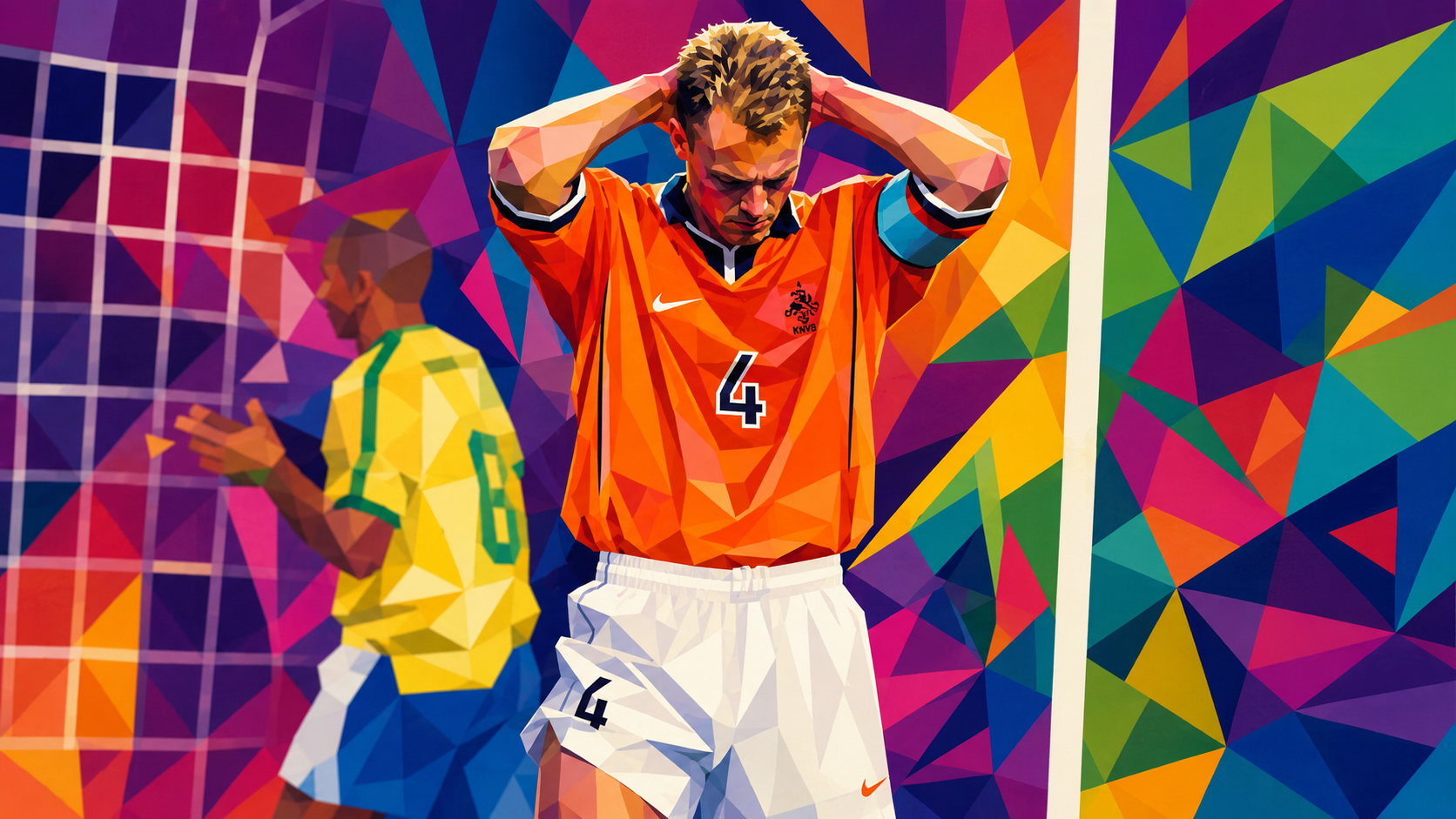
Saint-Denis, Marseille and the old Dutch dread
On the night of 7 July 1998, the Netherlands stood on the edge of finally becoming what the football world had spent a decade insisting they already were.
The Stade Vélodrome in Marseille pulsed beneath the floodlights. Orange shirts clung to exhausted bodies. Legs tightened. Passes shortened. Voices sharpened. Across the pitch stood Brazil, the defending world champions, football’s ultimate authority dressed in yellow. Across from them stood a Dutch side that many believed played the game better than anyone else alive.
Yet as extra time drifted toward penalties, there was a familiar unease surrounding the Netherlands. Not panic exactly. Something older than panic. Something inherited.
Edgar Davids bent forward with his hands on his knees, his protective goggles catching the light. Dennis Bergkamp stared blankly into the distance near the halfway line, expressionless, almost detached from the chaos around him. Jaap Stam paced in widening circles. Guus Hiddink folded his arms tighter against his chest.
They had been here before. Not this exact match. Not this exact stadium. But this feeling.
The Netherlands had spent the 1990s assembling one of the most technically gifted collections of footballers the international game had ever seen. Bergkamp. Patrick Kluivert. Davids. Clarence Seedorf. Marc Overmars. The De Boer brothers. Stam. Edwin van der Sar. Players raised inside a football culture that treated intelligence as obligation and beauty as responsibility.
And still, every tournament seemed to end the same way. A missed penalty. A fractured dressing room. A moment where the emotional weight of expectation became too heavy to carry.
The shootout began beneath a noise that sounded less like excitement and more like dread.
Ronaldo scored first for Brazil. Frank de Boer answered for the Netherlands. Rivaldo scored. Bergkamp converted calmly enough, but the balance already felt fragile. Emerson scored Brazil’s third. Then Phillip Cocu missed.
The Dutch were not merely taking penalties against Brazil. They were taking penalties against history.
Then came Ronald de Boer.
The walk from the halfway line felt endless. Cláudio Taffarel waited on the goal line, arms loose, eyes fixed. Ronald de Boer struck low. Taffarel saved.
The Brazilian bench exploded. Dutch players froze where they stood.
By the time Dunga converted Brazil’s fourth penalty, the truth had already settled over Marseille. The Netherlands were out. Again.
Not destroyed. Not humiliated. Something far crueller than that.
They had been magnificent at times in France. Bergkamp’s goal against Argentina four days earlier had felt like football elevated into art, a passage of control and imagination so perfect it seemed impossible that any human being could improvise it under World Cup pressure. Against Yugoslavia, against South Korea, against stretches of Brazil itself, the Dutch had played football that felt liberated from gravity.
And still they were walking away empty-handed.
As the Brazil players celebrated beneath the Marseille sky, the Dutch drifted slowly toward the tunnel, isolated inside their own thoughts. Bergkamp did not look angry. Davids did not look furious. They looked haunted, as though they had lived through a scene they already knew by heart.
For a decade, the Netherlands had produced some of the finest footballers in the world. They had changed tactical thinking, influenced modern coaching and played the game with a level of technical fluency few national teams have ever matched.
Yet whenever football narrowed into its most unforgiving moments, whenever tournaments demanded emotional certainty over expression, something inside them seemed to fracture.
They did not fail because they lacked winners
For years, Dutch football in the 1990s has been explained through the language of weakness.
Too emotional. Too divided. Too soft when it mattered.
It is one of the laziest conclusions in modern football history.
The Netherlands did not repeatedly fail because they lacked elite players or competitive mentality. They failed because they were trying to solve football in a different way to almost everyone else around them. While other nations increasingly embraced structure, pragmatism and emotional discipline, the Dutch remained committed to the idea that football should still contain freedom, intelligence and aesthetic courage.
That commitment made them extraordinary.
It also made them unstable.
Tournament football, at its core, is rarely romantic. It rewards control of emotion more than purity of expression. The longer competitions progress, the smaller matches become. Space disappears. Fear grows. The game slows into calculation. Eventually, great tournaments are often decided not by brilliance but by who best survives tension.
The Netherlands entered almost every major tournament of the 1990s with enough talent to win it. In pure footballing terms, they were frequently equal or superior to the teams that eliminated them. The problem was that Dutch football carried additional weight into every match it played. The Netherlands were not simply expected to win. They were expected to win correctly.
That burden had existed long before Bergkamp, Davids or Kluivert arrived.
Ever since the revolution of the 1970s under Johan Cruyff and Rinus Michels, Dutch football had become tied to an idea larger than results themselves. Total Football was not merely a tactical system. It became a national identity, a statement about intelligence, movement and cultural superiority through the ball. Dutch football came to view itself not just as successful when victorious, but righteous when aesthetically convincing.
Cruyff once put the paradox more simply than anyone: “Playing football is very simple, but playing simple football is the hardest thing there is.” That line has followed Dutch football for decades because it contains both the beauty and the burden of the national idea.
Even triumph carried conditions.
The 1988 European Championship should have liberated the Netherlands from that pressure. Marco van Basten’s volley against the Soviet Union remains one of the defining images in football history, a goal so technically absurd it still looks impossible decades later. Yet Euro 88 did not release Dutch football from its own mythology. If anything, it reinforced it. The Netherlands had finally won something major while playing football that still looked distinctly Dutch. Beauty and victory had briefly aligned.
The problem was what came next.
By the 1990s, Dutch football had created a generation raised not simply to compete, but to interpret the game intellectually. Ajax academies produced footballers who understood positional rotation, spatial manipulation and tactical responsibility at an unusually young age. Young Dutch players were encouraged to think constantly, question constantly and express themselves constantly. It produced astonishing footballers. It also produced strong personalities, ideological stubbornness and dressing rooms filled with competing interpretations of how football should be played.
Other national teams often gathered around hierarchy.
The Netherlands gathered around debate.
That tension ran through the entire decade.
Managers rarely survived without conflict. Players challenged tactical decisions openly. Cliques formed. Media scrutiny intensified every disagreement. Even victory often felt temporary, as though harmony could dissolve at any moment. At Euro 1996, the squad fractured publicly over divisions and mistrust. Davids criticised Hiddink and was sent home. Ruud Gullit withdrew from the 1994 World Cup squad after clashing with Dick Advocaat. Louis van Gaal later tried to impose stricter tactical order on the national side and failed to qualify for the 2002 World Cup.
The Netherlands were often too emotionally complicated to become machine-like winners.
But that complexity was inseparable from what made them brilliant in the first place.
No team of the era played quite like them. France became champions through balance and collective control. Germany through authority and resilience. Brazil through rhythm and individual genius. Italy through defensive mastery. The Dutch, meanwhile, often seemed to exist somewhere between philosophy and improvisation. They could suffocate opponents technically for an hour, then suddenly unravel emotionally within minutes.
That is why the decade continues to fascinate.
Not because the Netherlands failed despite being talented, but because they represented an alternative vision of elite football. One where beauty was treated seriously. One where tactical intelligence and technical fluency mattered as much as efficiency. One where football still felt expressive rather than industrial.
And for long stretches of the 1990s, nobody on earth played the game more beautifully.
They just could not quite survive it.
The impossible inheritance
Long before Bergkamp controlled Frank de Boer’s pass against Argentina, before Davids covered half a football pitch in protective goggles and fury, before Seedorf became one of the most intelligent midfielders of his generation, Dutch football had already created a problem for itself.
It had fallen in love with an ideal.
The Netherlands entered the 1990s carrying the weight of a footballing identity unlike any other major nation in Europe. Germany expected efficiency. Italy trusted defensive structure. England still romanticised courage and momentum. Brazil viewed football as rhythm and improvisation. But the Dutch carried something more complicated into every tournament: the expectation that football should be played intelligently, beautifully and progressively all at once.
That expectation came from the 1970s.
The great Dutch sides of 1974 and 1978 never won the World Cup, yet they altered football permanently. Under Michels and inspired by Cruyff, the Netherlands transformed positional play into something fluid and almost ideological. Defenders stepped into midfield. Midfielders drifted into attack. Space became something to manipulate rather than merely occupy. Total Football was not chaos disguised as freedom. It was an intensely demanding system built on technical excellence, collective intelligence and perpetual movement.
But history remembered those teams differently.
The 1974 side became mythologised not simply because they were brilliant, but because they lost. The defeat to West Germany in Munich created one of football’s enduring narratives: the beautiful losers, morally victorious despite the scoreboard. Dutch football internalised that story in dangerous ways. Beauty became inseparable from identity. Style became part of national self-worth.
By the time the 1990s generation emerged, they inherited more than tactical ideas. They inherited unfinished emotional business.
The Ajax academy became the purest expression of that inheritance. Young Dutch footballers were not developed simply to survive elite football physically. They were educated in football intellectually. First touch, spatial awareness and tactical flexibility were treated as essential from childhood. Players learned multiple positions. They were taught to think several passes ahead. Coaches demanded understanding, not merely obedience.
It produced footballers who often appeared technically ahead of their era.
Frank de Boer could split defensive lines from forty yards with either foot. Seedorf played midfield with the calm authority of someone ten years older than he actually was. Kluivert moved with the instincts of a street footballer inside the structure of an elite centre-forward. Bergkamp seemed capable of slowing football down entirely, receiving the ball as though time itself bent around him.
And then there was Davids.
Davids represented another side of Dutch football entirely. If Bergkamp embodied elegance and control, Davids embodied confrontation. He pressed like somebody personally insulted by the existence of the opposition. His aggression transformed Dutch midfields from decorative into competitive. Before Davids returned to the side during the 1998 World Cup after suspension, the Netherlands lacked balance. Once he came back into midfield, they suddenly looked complete.
Yet even that carried tension.
Dutch football often struggled to reconcile artistry with discipline. The national side continuously swung between freedom and structure, between expression and control. Too much tactical rigidity and players rebelled. Too much freedom and the team became emotionally volatile. Coaches spent the decade trying to solve the same impossible equation.
Cruyff himself hovered over all of it like an unavoidable ghost.
Even when he was not directly involved, his influence shaped every discussion around the national team. Dutch football discourse became obsessed with whether sides were “playing correctly”. Victories were analysed aesthetically. Defeats became philosophical crises. Managers were not merely judged on results but on whether they upheld the nation’s footballing identity.
That pressure consumed people.
Beenhakker clashed with senior players before Italia 90. Advocaat’s relationship with Gullit collapsed before USA 94. Hiddink spent much of Euro 96 navigating dressing-room fractures instead of tactical preparation. Van Gaal later attempted to impose greater structural discipline on the national side and encountered resistance almost immediately.
Every Dutch manager eventually found himself confronting the same reality: coaching the Netherlands was not simply about selecting a team. It meant managing a national argument about football itself.
And still, despite all the instability, the football could be breathtaking.
That was the contradiction at the heart of the decade.
The Netherlands produced teams capable of passages of play that no other international side could quite replicate. Their movement often looked instinctive without becoming chaotic. Their defenders could build attacks elegantly. Their forwards understood space like midfielders. Even neutral supporters were drawn toward them because Dutch football retained something increasingly rare at elite level: imagination.
But imagination is difficult to stabilise over seven-match tournaments.
Especially when the players carrying it have spent their entire lives being told that football is not merely about winning, but about expressing something deeper through the game itself.
The team that had everything except peace
The great Dutch sides of the 1990s often looked magnificent from a distance.
Then you moved closer.
Inside the dressing rooms, the meetings, the training camps and the press conferences, there was frequently tension humming beneath the surface. Not always explosive. Sometimes subtle. Sometimes intellectual. Sometimes personal. But almost always present.
The Netherlands did not merely carry the pressure of expectation into tournaments. They carried competing visions of football, identity and authority.
That friction existed across the entire decade.
At Italia 90, the defending European champions arrived in chaos. Beenhakker had replaced Thijs Libregts shortly before the tournament after senior players reportedly lost confidence in the manager. Gullit later admitted the squad never truly settled in Italy. Van Basten looked isolated. The football became cautious and disconnected. By the time Frank Rijkaard spat at Rudi Völler during the defeat to West Germany, the image felt symbolic of a side emotionally fraying under pressure.
The Netherlands had not simply lost composure in Milan.
They had lost coherence.
Yet the deeper tensions became clearer as the decade progressed and a new generation emerged from Ajax.
Van Gaal’s Ajax side of the mid-1990s should have become the foundation for sustained international dominance. The 1995 Champions League winners were young, tactically advanced and heavily Dutch. Van der Sar, Frank de Boer, Ronald de Boer, Seedorf, Davids, Kluivert and Michael Reiziger all came through the same ecosystem. They understood positional rotation instinctively because they had grown up inside it.
But that shared football education did not automatically create harmony.
Dutch football has always been unusually conversational. Players spoke openly about tactics, selection and systems in ways that would have been unthinkable in many other national setups. Debate was normalised. Authority was constantly challenged. Seniority alone rarely guaranteed obedience.
Sometimes that openness sharpened the team intellectually.
Sometimes it exhausted it emotionally.
The fractures inside Dutch football were never simply tactical. They were generational, cultural and, at times, racial.
By the mid-1990s, the Netherlands national team increasingly reflected the changing face of Dutch society itself. The emergence of players with Surinamese heritage such as Davids, Seedorf, Kluivert, Reiziger and Winston Bogarde transformed the national side technically and athletically. They brought aggression, improvisation and confidence to a football culture that had historically prized structure and positional intelligence above almost everything else.
But integration inside Dutch football was not always smooth.
Several black Dutch players spoke or were reported as feeling scrutinised differently by sections of the media and public. Mistakes could become interpreted as attitude problems. Confidence could become arrogance. During Euro 96, tensions inside the squad deepened visibly after criticism surrounding younger players. What appeared externally as “disharmony” often carried more complicated undertones beneath the surface.
Davids, unsurprisingly, became the lightning rod for much of it.
He was too confrontational to hide discomfort politely. During Euro 96, after criticising Hiddink’s management publicly, he was sent home from the tournament. Contemporary reports quoted him as complaining that Hiddink listened too much to other players. Later accounts carried the more infamous line that Hiddink should stop putting his head in certain players’ backsides.
In many national setups, such a moment would have been treated simply as indiscipline.
Within Dutch football, it became another ideological argument.
Was Davids destructive? Or was he exposing truths others preferred to leave unspoken?
Even years later, Dutch football never entirely settled on the answer.
And this was the contradiction running through the entire decade. The Netherlands produced highly intelligent footballers raised inside a culture that encouraged expression, tactical questioning and individuality. But tournament football often demands emotional hierarchy and simplification. The Dutch dressing room rarely stayed simple for long.
That complexity exhausted managers repeatedly.
Hiddink’s challenge was as psychological as tactical. Van Gaal approached the problem differently, attempting to impose stricter collective discipline and clearer structural control. Yet even Van Gaal eventually discovered the limits of authority inside Dutch football culture. Too much rigidity suffocated creativity. Too much freedom risked emotional fragmentation.
The balance never fully held.
And yet, paradoxically, those same tensions often made the Dutch extraordinary to watch.
Because the openness that destabilised them emotionally also sharpened them intellectually. These players saw football differently. Conversations that might have remained private in other camps became open debate within the Netherlands setup. Tactical disagreements were not unusual. They were cultural.
That mindset could produce breathtaking football.
It could also become exhausting when pressure tightened around a tournament.
Dennis Bergkamp and the search for control
If the Netherlands of the 1990s often felt emotionally combustible, Dennis Bergkamp seemed built in opposition to chaos itself.
He did not celebrate goals wildly. He rarely raised his voice. He moved through matches with the detached calm of somebody trying to solve a puzzle invisible to everybody else on the pitch. While other elite forwards of the era imposed themselves physically or emotionally, Bergkamp imposed himself through precision.
Every touch appeared deliberate. Every movement economical. Every decision measured.
In a decade where Dutch football frequently spiralled into noise, Bergkamp became its quiet centre.
His greatness lived in tiny details.
The angle of a first touch. The pause before a through ball. The half-second movement that shifted a defender’s weight the wrong way.
Against Argentina in Marseille, Roberto Ayala actually defended the situation reasonably well initially. He tracked Bergkamp’s movement tightly as Frank de Boer’s diagonal pass travelled across the pitch. But Bergkamp’s first touch altered the geometry of the duel instantly. Instead of cushioning the ball conventionally into space ahead of him, he killed it almost vertically, freezing Ayala’s momentum for a fraction of a second. That tiny hesitation created the opening for the second touch that eliminated the defender completely.
Elite football often turns on microscopic moments like that.
Bergkamp understood them instinctively.
He was never the quickest physically. He did not overpower defenders consistently. Instead, he manipulated defensive structures through anticipation. Matches often seemed to slow down around him.
The famous goal against Argentina remains the clearest example. Frank de Boer’s pass was extraordinary enough on its own, struck with impossible precision from deep inside the Dutch half. But Bergkamp’s control elevated the sequence into something almost unreal. One touch killed the ball instantly. The second eliminated Ayala. The third finished the move before Carlos Roa could react.
Three touches.
That was all.
Even now, the goal feels strangely modern. Not because of its athleticism, but because of its intelligence. Bergkamp did not overpower defenders. He manipulated geometry.
Perhaps no player represented the ideals of Dutch football more completely during the 1990s.
He had emerged through the Ajax system, where technical perfection and spatial awareness were treated as obligations rather than luxuries. But Bergkamp also carried something distinctly un-Dutch in temperament. He disliked emotional excess. He preferred order. At times, he even seemed uncomfortable with celebrity itself.
At Internazionale, he struggled badly inside Italian football’s rigid tactical culture. The chaos of Serie A defending, the physical aggression and the emotional hostility of the environment suffocated him. Italian newspapers questioned whether he was tough enough. Bergkamp later admitted he felt isolated and misunderstood in Milan.
Then came Arsenal.
Under Arsène Wenger, Bergkamp found the structure he craved. Training became calmer. Football became positional rather than frantic. Around him, intelligent runners like Overmars, Nicolas Anelka, Freddie Ljungberg and Thierry Henry gave his game rhythm and balance. English football in the late 1990s still largely revolved around speed and force. Bergkamp introduced pause. He made Premier League defenders defend space rather than merely chase movement.
His influence transformed Arsenal culturally as much as tactically.
But internationally, the search for control was harder.
The Dutch national side constantly threatened to become emotionally unstable around him. Bergkamp often looked like a player attempting to create order within a system permanently vulnerable to disorder. He needed intelligent movement around him. He needed technical trust. He needed calm.
Sometimes he found it.
The Bergkamp-Kluivert partnership during the 1998 World Cup briefly looked close to perfect. Kluivert occupied centre-backs physically and pinned defensive lines deeper, creating the pockets Bergkamp wanted between midfield and defence. Bergkamp orchestrated attacks through movement and timing while Kluivert destabilised defensive structures through presence alone.
Yet there remained something fragile about it all.
Perhaps because Bergkamp himself understood football’s cruelty more deeply than most. He had lived through the missed penalty against Brazil in 1994. He had experienced Euro 1992 ending with Van Basten’s penalty miss against Denmark. He had seen the fractures of Euro 1996 from inside the dressing room. Every Dutch tournament seemed to end with emotional collapse arriving suddenly after periods of technical brilliance.
And so Bergkamp became something unusual in football history: a player whose elegance carried visible melancholy.
Even at his peak, there was often a sense that he understood how temporary beautiful football could be.
That is partly why the Argentina goal still resonates so deeply decades later. It was not merely technically brilliant. It felt like a brief victory against chaos itself. For three touches, Dutch football escaped all its contradictions. The noise disappeared. The pressure disappeared. Everything aligned perfectly.
Then Brazil happened four days later.
Tournament football versus Dutch football
The deeper the Netherlands moved into tournaments during the 1990s, the more they encountered the same uncomfortable truth.
Knockout football did not always reward the things they valued most.
Across the decade, the Dutch repeatedly produced football of extraordinary technical sophistication. Their players were more positionally fluid than almost any opponents they faced. Midfielders rotated naturally. Full-backs stepped into central spaces. Centre-backs initiated attacks rather than merely defending them. Their best sides controlled possession without becoming static and attacked without losing structure entirely.
But tournament football rarely stays open forever.
Eventually every major competition narrows into tension.
Games become slower. Space disappears. Risks feel heavier. One mistake becomes terminal. In those moments, football often ceases to reward imagination and begins rewarding emotional simplification instead. The best knockout sides are not always the most expressive. They are usually the most stable.
The Netherlands rarely felt entirely stable.
This was partly tactical and partly psychological. Dutch football in the 1990s depended heavily on rhythm. When matches flowed naturally, the Oranje could overwhelm opponents through movement and technical superiority. Their players understood space instinctively because most had been raised inside the same footballing philosophy. They could suffocate teams through circulation of the ball alone.
But when rhythm broke down, uncertainty entered quickly.
West Germany exposed this in 1990. The Netherlands arrived in Italy as European champions but looked strangely disconnected throughout the tournament. Their football slowed into hesitation. The famous round-of-16 defeat against the Germans is remembered largely for Rijkaard’s altercation with Völler, but beneath the chaos sat a more revealing issue. The Dutch no longer looked emotionally aligned. Their football became reactive rather than expressive. Germany, meanwhile, looked brutally certain of itself.
That difference mattered.
The same pattern appeared again against Denmark at Euro 1992. Technically, the Dutch were superior. They created more pressure, controlled longer stretches of possession and carried more individual quality across the pitch. But Denmark played with emotional simplicity. There was no ideological burden attached to their football. No philosophical inheritance. They defended compactly, attacked directly and embraced the chaos of the occasion.
The Netherlands, meanwhile, tightened visibly as the match drifted toward penalties.
Then came the miss from Van Basten.
Even now, the image feels almost unnatural. Van Basten was not simply an elite striker. He was perhaps the purest technical finisher in world football at the time. Yet his penalty lacked conviction entirely. Peter Schmeichel saved comfortably.
The Dutch had once again reached the emotional edge of a tournament and fallen away from it.
By the mid-1990s, another problem had emerged. International football itself was changing.
Sacchi’s Milan, Capello’s tactical control and the increasing athletic intensity of elite football were reshaping the sport. Space was becoming harder to find. Defensive structures were more compact. Transition moments mattered more than sustained artistic dominance. Tournament football increasingly rewarded compression, discipline and emotional patience.
The Dutch still wanted to stretch the game intellectually.
That difference became painfully visible against England at Euro 1996. Terry Venables simplified the match brilliantly. England played directly, aggressively and emotionally in front of a home crowd already intoxicated by momentum. The Netherlands never settled. Their defensive structure collapsed under pressure and the game spiralled away from them emotionally long before the final whistle.
The 4-1 defeat was not merely tactical.
It felt psychological.
The 1994 World Cup quarter-final against Brazil had shown a different version of the same problem. The Dutch fell behind 2-0 against a side containing Romário and Bebeto, yet instead of collapsing, they transformed the match into chaos. Bergkamp scored. Aron Winter equalised. Suddenly Brazil looked vulnerable, dragged into a game of movement and unpredictability they had not wanted to play.
Then Branco scored from distance and it ended.
Again, the Dutch had lost a match where they had briefly made football feel limitless.
That became the recurring tension of the decade. The Netherlands repeatedly produced moments where football appeared almost liberated from structure entirely. But tournaments are ultimately designed to compress freedom. The deeper competitions progress, the more emotionally disciplined teams tend to survive.
The Dutch were too intelligent not to feel that pressure.
And perhaps that was the problem.
Football at the highest level eventually asks players to stop thinking and simply act. Penalty shootouts especially reduce the sport to instinct, nerve and emotional clarity. Dutch football, by contrast, spent the 1990s analysing itself constantly. Every defeat became philosophical. Every tactical adjustment became ideological. Every tournament carried the emotional weight of national identity.
The Netherlands did not simply play football.
They carried an argument about football onto the pitch every summer.
1998: the closest they came
For a few weeks in France during the summer of 1998, the Netherlands finally looked complete.
Not just talented. Not just entertaining. Not just dangerous.
Complete.
Previous Dutch sides of the decade had usually carried some visible imbalance. Italia 90 collapsed beneath confusion and ego. Euro 92 ended in emotional paralysis. USA 94 lacked cohesion. Euro 96 fractured internally before it could properly begin.
France 98 felt different.
Hiddink, calmer and more emotionally intelligent than many of his predecessors, understood that managing the Netherlands required more than tactical diagrams. He recognised that Dutch footballers needed space psychologically as much as structurally. Hiddink loosened the atmosphere around the squad without sacrificing discipline entirely. For perhaps the only sustained period of the decade, the Netherlands looked emotionally aligned with themselves.
And the football was magnificent.
Van der Sar brought calm from the back, already anticipating the modern goalkeeper’s role in buildup play. Frank de Boer stepped into midfield with the confidence of a playmaker stationed at centre-back. Stam gave the side physical authority it had often lacked in earlier tournaments. Phillip Cocu balanced spaces intelligently while Overmars stretched defences vertically with frightening speed.
Then there was Davids.
No player altered the emotional energy of the team more dramatically.
Davids had missed the opening matches through suspension and the Netherlands initially looked slightly passive without him. Once he returned, the midfield transformed completely. He pressed aggressively, recovered possession in difficult areas and injected urgency into the side whenever rhythm slowed. He was not simply destructive. He understood exactly when Dutch football risked becoming too comfortable.
Davids gave the team edge.
Ahead of him, Bergkamp and Kluivert formed one of the most intelligent forward partnerships of the era.
Kluivert was still only twenty-two during the tournament, but already carried the aura of somebody destined for greatness. Physically imposing yet technically refined, he offered Dutch attacks structure without sacrificing fluidity. Bergkamp drifted between lines, orchestrating attacks almost invisibly, while Kluivert occupied defenders centrally and linked play with understated quality.
For long stretches in France, the Netherlands played football that felt years ahead of its time.
The 5-0 destruction of South Korea during the group stage was almost impossibly fluid. Overmars attacked space relentlessly. Cocu arrived late into midfield pockets. Bergkamp manipulated defenders through movement alone. Watching the Dutch at their best often felt like watching a team playing with slightly more time than everyone else.
Then came Yugoslavia in the round of sixteen.
The match itself was chaotic, tense and increasingly emotional, exactly the kind of occasion that had often destabilised previous Dutch teams. Bergkamp gave the Netherlands the lead, Yugoslavia responded, and the game drifted toward extra time beneath rising pressure.
In the final minute, Davids collected possession outside the area and drove a low shot through traffic into the bottom corner.
The celebration mattered.
Davids did not look relieved. He looked furious, as though the Netherlands had personally offended him by making life difficult again. Around him, teammates exploded emotionally. The goal felt important not simply because it won the match, but because it suggested this Dutch side might finally possess the emotional force previous generations lacked.
Then came Argentina.
Even before kick-off in Marseille, the atmosphere carried unusual tension. Argentina represented more than an opponent. They represented footballing authority, emotional hardness and tournament ruthlessness. Diego Simeone prowled midfield. Roberto Ayala defended with permanent aggression. Ariel Ortega carried the volatility of South American football in its purest form.
The match itself unfolded like high-level theatre.
Kluivert scored first after beautiful Dutch combination play. Claudio López equalised quickly. Ortega was sent off late after headbutting Van der Sar. Suddenly the game opened into nervous possibility.
And then football briefly became art.
Frank de Boer’s pass travelled almost sixty yards diagonally through the Marseille air. Bergkamp watched it descend over his shoulder with Ayala closing fast beside him. Most forwards would have needed another touch simply to settle the ball. Bergkamp’s first touch killed its momentum instantly. His second shifted the angle away from Ayala entirely. His third finished the move before Roa could react.
Commentators screamed. Dutch supporters lost themselves completely. Even neutral observers understood they had witnessed something rare.
The goal became immortal because it seemed to contain the entire Dutch football identity within a few seconds. Technique. Imagination. Precision. Courage under pressure.
For one moment, the Netherlands looked destined for the final.
And that is what makes the Brazil defeat so painful in retrospect.
Because unlike previous tournaments, there was no obvious flaw this time. No major dressing-room implosion. No tactical imbalance impossible to ignore. No shortage of talent or experience. Against Brazil in Marseille, the Dutch stood level with the best side in the world and often looked superior technically.
The semi-final became one of the defining tactical contests of the decade.
Hiddink’s decision to push Davids aggressively toward Brazil’s midfield line disrupted the rhythm that normally flowed through Dunga and César Sampaio. Whenever Brazil attempted to settle possession centrally, Davids exploded forward to compress space immediately. It prevented Ronaldo from receiving clean service consistently during long stretches of the match.
At the back, Stam produced perhaps the finest performance of his international career.
Ronaldo arrived in Marseille as the most frightening forward in world football, a player capable of destroying defensive structures through acceleration alone. Stam refused to defend him passively. Rather than retreat continuously, he stepped into challenges early and used his physicality to disrupt Ronaldo before he could fully turn. Few defenders of the era could match Ronaldo athletically in open space. Stam’s aggression reduced the amount of open space available in the first place.
Meanwhile, Frank de Boer’s distribution became increasingly important as the game stretched emotionally. Brazil defended compactly through the centre, forcing Dutch buildup wider than Hiddink ideally wanted. De Boer responded by bypassing pressure lines entirely with diagonal switches toward Overmars and Ronald de Boer.
And yet, despite all the tactical sophistication, the match still drifted eventually toward emotion.
That was always the danger for the Dutch.
Because once games stopped flowing naturally, they became vulnerable to self-awareness. Every missed chance slightly altered body language. Every interruption increased tension. Brazil, by contrast, looked psychologically familiar with the environment itself.
The Netherlands still looked like a side trying to intellectually control pressure.
Brazil simply lived inside it more comfortably.
When the penalties arrived, decades of tension seemed to arrive with them.
The penalty team
Eventually, the Netherlands became something no elite football nation ever wants to become.
Predictable in heartbreak.
Not tactically predictable. Emotionally predictable.
Every major tournament of the 1990s seemed to lead the Dutch toward the same narrow corridor, where technical brilliance slowly gave way to hesitation, tension and the unbearable stillness of penalties.
The pattern became so familiar it almost acquired mythological force.
Van Basten against Denmark in 1992. Seedorf against France in 1996. Cocu and Ronald de Boer against Brazil in 1998. Frank de Boer, Stam and Bosvelt against Italy in 2000.
Different players. Different tournaments. Same feeling.
What made it stranger was that the Netherlands were never short of technically gifted penalty takers. Van Basten remains one of the finest finishers football has ever produced. Seedorf struck the ball as cleanly as almost any midfielder of his generation. Cocu had composure and experience. Frank de Boer possessed extraordinary control in possession. Kluivert carried supreme confidence throughout most of his career.
Yet during the defining moments of tournaments, Dutch certainty repeatedly dissolved.
Perhaps because penalties exposed the exact tension Dutch football spent the decade trying to escape.
For ninety minutes, the Netherlands could intellectualise football beautifully. They could manipulate shape, space and tempo with sophistication beyond most opponents. Their football allowed complexity. Rotations. Improvisation. Interpretation.
Penalties remove all of that.
No movement. No combinations. No philosophy.
Just one player alone with his own thoughts.
That reduction seemed to torment the Dutch.
Schmeichel saved from Van Basten in the Euro 92 semi-final and Denmark went on to win the tournament. Four years later against France, the pattern repeated itself with quieter cruelty. Euro 96 had already been emotionally exhausting for the Dutch. Dressing-room tensions, media scrutiny and the humiliation against England had destabilised the squad long before the quarter-final in Liverpool. Against France, however, they rediscovered composure. The match became cagey and tense, exactly the kind of emotionally compressed football Dutch sides historically struggled to navigate.
Then penalties arrived.
Seedorf missed. France progressed.
Again, the Dutch had not been overwhelmed technically. They had simply reached the psychological edge of the tournament before their opponents.
By 1998, the pressure had become historical as much as immediate.
When Ronald de Boer walked toward the spot against Brazil in Marseille, he was carrying more than a semi-final penalty. He was carrying Van Basten’s miss. Germany in 1990. Denmark in 1992. England in 1996. Every conversation about Dutch fragility. Every suggestion that the Netherlands lacked something emotionally essential.
Footballers hear those narratives, whether they admit it publicly or not.
The body changes under pressure. Movements shorten. Thought speeds up uncontrollably. Decision-making becomes crowded by consequence.
The Dutch increasingly looked like a side aware of their own history while still living inside it.
Nothing captured that more brutally than Euro 2000.
The Netherlands entered the tournament on home soil playing some of the finest football in Europe. They dismantled Yugoslavia 6-1 in the quarter-final with astonishing fluidity. Kluivert looked unstoppable. Davids controlled midfield games almost single-handedly. Frank de Boer distributed possession with complete authority from the back. Dutch supporters genuinely believed this was finally the moment the cycle would end.
Then came Italy.
The semi-final in Amsterdam unfolded like psychological torture disguised as football. Gianluca Zambrotta was sent off early. The Dutch dominated possession completely. They won two penalties in normal time.
Frank de Boer missed the first. Kluivert hit the post with the second.
Still the Netherlands attacked relentlessly. Still Italy survived. Francesco Toldo saved and saved again.
By the time the shootout arrived, the atmosphere inside the Amsterdam ArenA felt almost fatalistic. Dutch players walked toward the spot not with confidence, but with visible emotional weight. Frank de Boer missed again. Stam launched his effort over the bar. Kluivert scored, briefly restoring hope, before Bosvelt saw his penalty saved.
Italy barely needed to be brilliant by that stage. The Netherlands were collapsing internally in real time.
Afterward, Dutch journalists and former players searched desperately for explanations. Mental weakness. Tactical confusion. Pressure. Arrogance. Fear.
The truth was probably more uncomfortable.
The Netherlands had spent the entire decade trying to play football with emotional and intellectual openness. That openness produced some of the era’s most beautiful football. But penalty shootouts reward emotional simplification above all else. They reward players capable of narrowing the moment into pure instinct.
The Dutch rarely simplified anything.
Not football. Not pressure. Not themselves.
And so, by the end of the decade, the Netherlands became defined not only by the brilliance they produced, but by the strange sense that every tournament eventually narrowed toward the same unavoidable ending.
Euro 2000: the night the decade ended
By the summer of 2000, the Netherlands were no longer simply chasing a trophy.
They were trying to escape themselves.
Everything about the tournament appeared perfectly arranged for redemption. The European Championship was being co-hosted by the Netherlands and Belgium. Dutch football arrived with perhaps its deepest squad since the 1970s. The scars of France 98 remained painful, but they had also created emotional maturity inside the group. Bergkamp was still magnificent. Davids had become one of the world’s most complete midfielders. Van der Sar brought authority in goal. Stam intimidated centre-forwards before matches even began.
And for long stretches of Euro 2000, the Dutch looked unstoppable.
They defeated France in the group stage despite both sides rotating heavily. They overwhelmed Denmark. Then came the quarter-final against Yugoslavia in Rotterdam, one of the most exhilarating performances of the entire decade.
The Netherlands won 6-1.
But the scoreline barely captured the scale of the domination. Kluivert scored a hat-trick. Overmars attacked space mercilessly and scored twice. Seedorf dictated tempo calmly from midfield. Davids covered ground with frightening intensity. Every Dutch movement appeared connected to another. Yugoslavia could not cope with the speed of the rotations or the intelligence of the positioning.
For one evening, Dutch football looked almost fully realised.
The Amsterdam ArenA waited for the semi-final against Italy with growing certainty.
Not hope. Certainty.
Italy arrived carrying familiar stereotypes. Defensive. Reactive. Cynical. Yet beneath those clichés sat one of the mentally toughest football nations the sport has ever produced. Dino Zoff’s side understood tournament football instinctively. They understood suffering, compression and emotional patience.
The Netherlands still believed football should eventually reward superiority.
Within thirty-four minutes, Zambrotta had been sent off. Italy retreated deeper and deeper. Orange waves crashed forward continuously. The stadium roared with every attack, every cross, every loose ball bouncing dangerously inside the penalty area.
Then the penalties started.
Not the shootout. The first penalties.
The Netherlands were awarded one midway through the first half after Alessandro Nesta brought down Kluivert. Frank de Boer stepped forward. Toldo saved.
Still the Dutch kept coming.
Davids drove through midfield repeatedly, snarling at teammates to increase the tempo. Bergkamp drifted between defensive lines searching for angles that no longer existed. Kluivert occupied defenders physically while Seedorf sprayed possession across the pitch. Italy barely crossed the halfway line for stretches of the match.
And yet they survived.
Then came another penalty.
Kluivert stepped forward this time. He struck the post.
Inside the stadium, anxiety began spreading visibly through the crowd. The noise changed. Dutch attacks became increasingly frantic, less precise, more emotional. Italy sensed it immediately. Maldini slowed the game constantly. Cannavaro cleared everything. Toldo seemed to grow larger with every save.
By extra time, the match no longer resembled football so much as psychological erosion.
The Netherlands had spent the evening trying to force destiny into submission. Italy simply refused to break.
Then came the shootout.
From the moment the players gathered near the halfway line, there was an unbearable familiarity to it all. Dutch supporters had seen this film too many times before. The players looked like they had too.
Frank de Boer walked forward first again.
Toldo saved again.
Stam launched his penalty violently over the bar. The ball disappeared into the Amsterdam night as though released from years of accumulated pressure. Kluivert scored. Paolo Maldini missed, briefly extending Dutch hope. Then Bosvelt saw his effort saved. Italy went through 3-1 on penalties.
When Francesco Totti had chipped his penalty down the middle earlier in the shootout with reckless calm, the psychological difference between the two sides became impossible to ignore. Italy viewed pressure as something to absorb. The Dutch experienced it as something multiplying internally.
Afterward, the silence around the Amsterdam ArenA felt heavier than anger.
Dutch players sat motionless in the dressing room. Davids stared at the floor. Bergkamp looked emotionally drained. Rijkaard resigned shortly after the tournament. Once again, the Netherlands had produced some of the best football in Europe without reaching the final.
But Euro 2000 felt different from previous failures.
This time there were no obvious excuses left.
No tactical inferiority. No lack of talent. No hostile away atmosphere. No stronger opponent controlling the match.
The Netherlands had dominated an exhausted ten-man Italy side for almost two hours and still could not cross the final emotional threshold.
It felt less like a defeat and more like the closing chapter of an entire footballing era.
Because by the end of Euro 2000, the central contradiction of Dutch football in the 1990s had become impossible to escape. The Netherlands had produced teams of extraordinary intelligence, imagination and technical sophistication. They had shaped how modern football would eventually evolve.
But in the sport’s smallest and most emotionally brutal moments, they remained vulnerable to themselves.
Brazil, again
And so it returns to Marseille.
Not to Bergkamp’s masterpiece against Argentina, but to the match that followed. The one that revealed everything the Netherlands had spent the decade trying to outrun.
Brazil did not dismantle the Dutch technically in the 1998 World Cup semi-final. They did not expose some obvious tactical flaw or overwhelm them physically. For long stretches, the Netherlands matched them completely. At times, they even looked superior. Davids controlled midfield transitions ferociously. Bergkamp drifted intelligently into dangerous spaces. Frank de Boer distributed possession with composure while Stam defended Ronaldo with startling authority.
This was not a lesser side falling bravely.
This was a great side standing level with another great side.
Which is precisely why the defeat lingered so painfully.
When Ronaldo gave Brazil the lead early in the second half, the Dutch response was impressive rather than emotional. They did not collapse. They kept playing. Hiddink’s side continued circulating possession patiently, searching for rhythm instead of panic. Then, with three minutes remaining, Ronald de Boer crossed from the right and Kluivert rose between Brazilian defenders to power a header beyond Taffarel.
The equaliser should have felt liberating.
Instead, there was tension almost immediately.
You could see it in the players’ faces as extra time began. Brazil looked tired physically. The Netherlands looked burdened mentally. Every misplaced pass seemed to carry additional consequence. Every loose touch generated visible frustration. Dutch football, so fluid for most of the tournament, slowly tightened into caution.
And perhaps that was always the hidden tragedy of the decade.
The Netherlands often reached the emotional edge of greatness and became too aware of what it would mean to cross it.
Other nations appeared able to simplify those moments. Germany treated pressure as routine. Italy embraced suffering almost culturally. Brazil carried the arrogance of repeated success. The Dutch, by contrast, frequently looked trapped between confidence and self-awareness. They understood the stakes too clearly. They felt history arriving before it had fully happened.
That is why the penalties against Brazil felt heavy long before the first kick.
When Cocu missed, Dutch players immediately looked inward rather than outward. Heads dropped slightly. Movements slowed. Even Bergkamp’s successful penalty could not entirely reset the emotional atmosphere around the team.
Then came Ronald de Boer.
And in many ways, that moment became the perfect metaphor for the Netherlands in the 1990s.
Not because Ronald de Boer lacked quality. Far from it. He was technically excellent, tactically intelligent and deeply experienced at elite level. But when he walked toward the ball in Marseille, he carried an invisible weight accumulated across an entire decade. Van Basten against Denmark. The unresolved frustrations of Italia 90. The collapse against England at Euro 96. The endless conversation around Dutch fragility. The burden of beauty without reward.
Taffarel saved.
Dunga scored.
Brazil reached the final.
Asked afterward whether he was a penalty specialist, Taffarel answered: “No, this was God helping me.” The line was revealing. Brazil could translate the moment into faith. The Dutch seemed to translate it into another argument with themselves.
That image matters because it stripped away the comforting myth that the Netherlands simply lacked luck. Luck alone cannot explain why the same emotional pattern repeated itself across multiple generations, multiple managers and multiple tactical systems.
Something deeper was happening.
Dutch football in the 1990s produced players trained to think deeply about the game, to interpret space creatively and to express themselves within complex tactical structures. It created extraordinary footballers. But tournament football often demands emotional surrender rather than intellectual control. Eventually, every elite side reaches moments where instinct matters more than philosophy.
The Netherlands rarely looked fully comfortable there.
And yet reducing the decade to failure still feels profoundly unfair.
Very few international sides are remembered decades later with this level of affection, fascination and emotional clarity without having won anything major. Nobody speaks nostalgically about efficient quarter-finalists. Football history remembers teams that leave emotional marks on the sport itself.
The Dutch did that repeatedly.
Children copied Bergkamp’s touch against Argentina in playgrounds across Europe. Coaches studied Ajax positional structures endlessly. Midfielders learned from Davids’ intensity and Seedorf’s intelligence. Modern positional football, in many ways, carries Dutch fingerprints everywhere.
But the deeper reason the Netherlands of the 1990s still matter is simpler than tactics.
They made football feel vulnerable.
Their victories felt exhilarating because collapse always seemed possible. Their defeats hurt because they played well enough to deserve more. Every tournament carried the sense that the Netherlands were simultaneously capable of brilliance and self-destruction, sometimes within the same passage of play.
That tension made them unforgettable.
And perhaps that is why the image of Marseille still lingers so powerfully. Not because the Dutch lost another penalty shootout, but because the match revealed the entire contradiction at the heart of the decade.
The Netherlands could imagine football more beautifully than almost anybody else.
They just could not always survive the emotional cost of imagining it that way.
The team that changed football without winning it
The Netherlands did not define the 1990s through silverware.
They defined it through influence.
That distinction matters because football history often remembers winners immediately but understands innovators slowly. The Dutch sides of the 1990s rarely completed the final step at major tournaments, yet many of the ideas that dominate modern football emerged more clearly through them than through the teams that actually lifted trophies.
Look across elite football today and traces of that Dutch generation appear everywhere.
Ball-playing centre-backs. Goalkeepers involved in buildup. Midfield rotations. Fluid front lines. Positional interchanges. Technical midfielders capable of pressing aggressively. Wide players stretching defensive structures vertically. The obsession with spatial control rather than rigid positions.
The Netherlands did not invent all these concepts during the 1990s, but they carried them into modern football with unusual clarity.
Frank de Boer, for example, often looked less like a traditional defender and more like a deep-lying playmaker temporarily stationed at centre-back. Long before the modern game normalised central defenders stepping aggressively into buildup phases, De Boer was breaking lines with diagonal passes hit from impossible angles.
Van der Sar anticipated the evolution of the modern goalkeeper before the position fully transformed. Comfortable receiving under pressure and technically composed in possession, he became one of the key transitional figures between traditional shot-stoppers and the sweeping distributors that would later define elite football.
Seedorf helped redefine what an elite midfielder could be physically and intellectually at once. Powerful enough to survive transitional football, yet technically refined enough to dictate rhythm against compact defences, he became one of the prototypes for the multifunctional midfielders modern systems demand.
Then there was Davids.
Without Davids, Dutch football in the late 1990s often drifted toward decorative control rather than competitive dominance. His aggression altered the emotional temperature of matches. Midfield pressing in modern football increasingly demands players capable of combining tactical intelligence with relentless physical intensity. Davids embodied that balance years before it became fashionable.
And Bergkamp’s influence stretched far beyond the Netherlands themselves.
At Arsenal, he became one of the most important transitional figures in English football history. Before Wenger and Bergkamp, the Premier League still largely valued intensity over technical refinement. Bergkamp introduced a different rhythm to English football. Suddenly forwards dropped into deeper spaces intentionally. Combination play accelerated around the penalty area. Younger players began valuing first touch and spatial awareness differently.
The Netherlands of the 1990s ultimately left behind something more enduring than medals. They altered how elite football thought about intelligence.
Even Pep Guardiola’s football lineage carries Dutch fingerprints through Cruyff’s influence at Barcelona. The positional structures dominating modern football owe enormous debts to Dutch tactical thinking, especially the Ajax and Cruyff ecosystems that shaped so many players from this era. The idea that every player should understand space universally rather than positionally became central to elite coaching across Europe.
In many ways, modern football became more Dutch after the Netherlands stopped dominating tournaments.
And yet the emotional legacy of the decade remains more complicated than tactical influence alone.
Most unsuccessful international sides disappear historically. Their defeats fade because they leave little emotional residue behind them. The Netherlands were different. Their football was too vivid to vanish quietly. Bergkamp against Argentina. Kluivert against Brazil. Davids charging through midfield in Marseille. The destruction of Yugoslavia at Euro 2000. Even the defeats remain visually alive decades later.
That is partly because the Dutch never played sterile football.
Even their collapses carried drama and personality. The emotional volatility of the team, frustrating as it often became, also prevented them from becoming forgettable. Supporters did not merely watch the Netherlands in the 1990s. They experienced them.
There is also a temptation to frame the decade purely as waste, as though the absence of a major trophy invalidates everything else. But football history rarely works that cleanly. The Netherlands did not fail because they lacked greatness. They failed because greatness itself is unstable.
Especially the kind of greatness built on expression, intelligence and freedom.
Tournament football often rewards emotional conformity. The Dutch remained stubbornly themselves almost to the end. They questioned authority. They complicated systems. They searched for beauty even under pressure. At times, that idealism sabotaged them.
At other times, it elevated football entirely.
Beauty leaves different scars
After Italy eliminated the Netherlands at Euro 2000, Dutch supporters remained inside the Amsterdam ArenA long after the final penalty.
Some stood silently. Some applauded. Some simply stared at the pitch.
There was anger, certainly. But there was also recognition. By then, the pattern had become painfully familiar. Another Dutch side had arrived carrying enough talent to win the tournament. Another Dutch side had played football nobody else could quite replicate. Another Dutch side had disappeared beneath the weight of its own tension.
And still people loved them anyway.
Perhaps because the Netherlands of the 1990s made football feel human in a way many successful teams do not. They were vulnerable publicly. Emotional publicly. Their football never felt machine-made. Even at their best, there was always a sense that everything could either become transcendent or collapse entirely within moments.
That uncertainty gave the football life.
Years later, children still recreated Bergkamp’s goal against Argentina in parks and playgrounds across Europe. Coaches still study Ajax positional structures from the era. Midfielders still watch Davids searching for clues about aggression and control. The tactical fingerprints of that Dutch generation remain everywhere in the modern game.
But the deeper memory is emotional rather than tactical.
People remember how the Netherlands made them feel.
The tension before penalties. The elegance of Bergkamp’s touch. The chaos beneath the beauty. The strange sense that football could still be art and tragedy at the same time.
They never became world champions.
Yet few international sides without a major trophy are remembered with this much affection decades later.
The Netherlands of the 1990s did not simply play football.
They made the game feel fragile, intelligent and alive.
