A dressing-room vote, a president who preferred Madrid’s money, and the one man in the story who only ever wanted Barcelona.
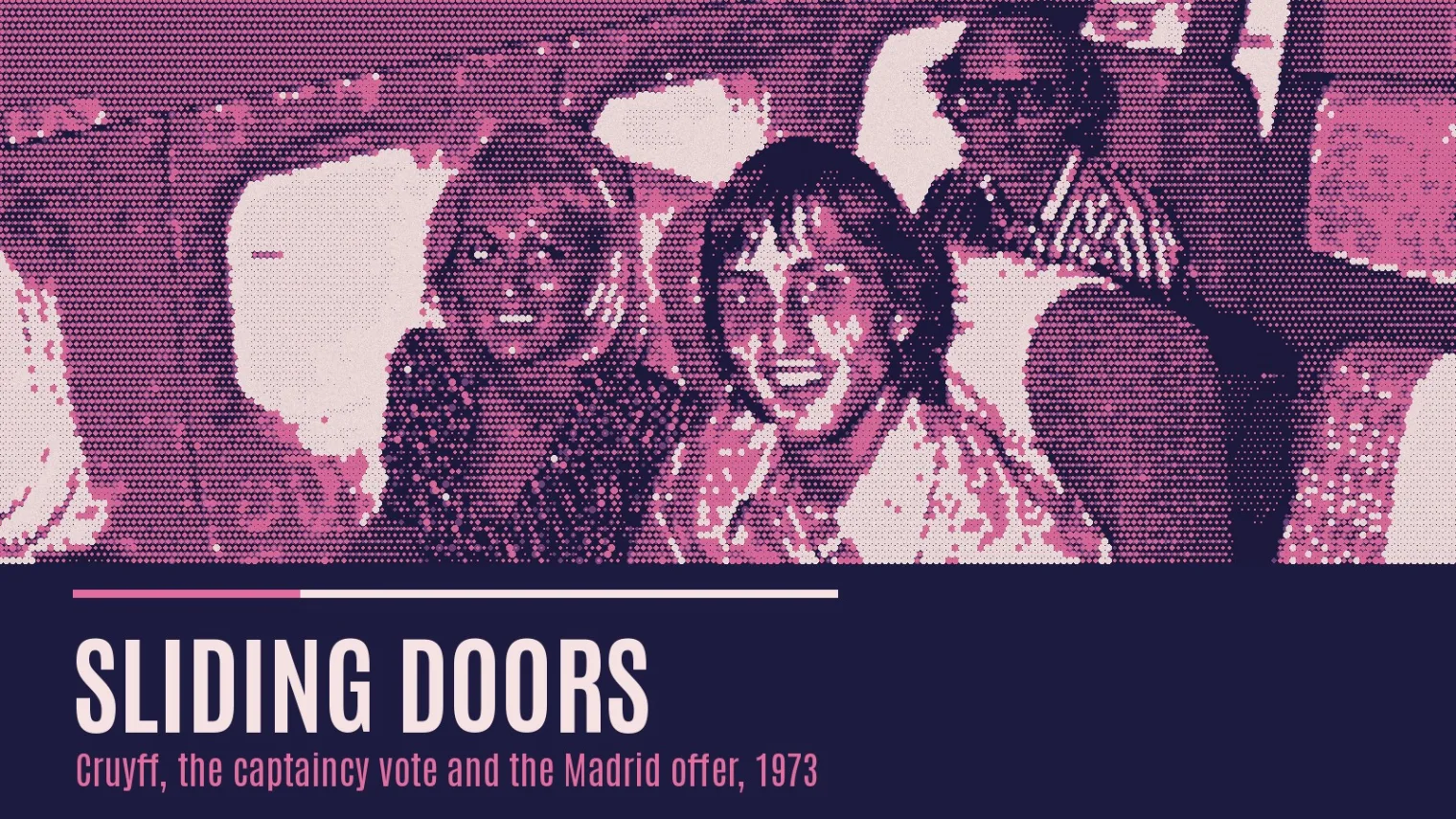
There is a photograph, taken on Thursday 23 August 1973 by Hans Peters for the Dutch agency Anefo and now held by the Nationaal Archief, of Johan Cruyff in an aeroplane seat at Schiphol. He is in a pale shirt with the collar wide open, his wife Danny is beside him in a polka-dot dress, and both of them are grinning at the camera like people who have got away with something. A man in big glasses sits in the row behind, looking far less pleased about the whole thing. The archive caption is admirably flat: Johan Cruyff and wife in aeroplane on departure from Schiphol to Barcelona. The Back Pages dates his arrival in the city to the same day.
Ten days earlier he had been sold for a world-record fee. Less than three months before that he had captained Ajax to a third straight European Cup. Somewhere in between, his own team-mates had voted to take the captaincy off him. Ajax’s president had tried to send him to Real Madrid instead, and Madrid had believed, almost to the end, that he was theirs. So the grin is fair enough. He had got away with something, and most of what came after for Barcelona follows from it. The other ways that summer could have ended are worth a proper look.
What happened once he got to Spain, the 0-5 at the Bernabéu in February 1974 and the season around it, FBH has already told in full, and this piece won’t tell it again. This one is about the doors that nearly opened instead.
The vote
The first door was a ballot.
Ajax in the summer of 1973 were, on paper, the best team in the world. They had beaten Juventus 1–0 in Belgrade on 30 May, Johnny Rep heading in inside five minutes, and kept the European Cup for good. On the way they had put four past Bayern Munich in Amsterdam and beaten Real Madrid home and away in the semi-final, Gerrie Mühren scoring the only goal at the Bernabéu. They had won the Eredivisie as well. For a club that, six years earlier, had been knocked out by Dukla Prague on a hill in the Czech capital, it was quite a climb.
Inside the club, though, things had been coming loose since Rinus Michels left for Barcelona in 1971. Cruyff’s own account, in the autobiography published after his death and summarised by El Confidencial in 2016, is that Michels’s successor, the Romanian Ştefan Kovács, set aside the discipline and gave the players more freedom than was good for them. As the best player and the captain in 1972-73, Cruyff felt obliged to step in when he thought standards were slipping, and he says plenty of his team-mates took it as a bid for attention. El Confidencial also quotes David Winner’s Brilliant Orange, which calls that Ajax the closest anyone has come to running a great football team as a cooperative. The players picked the team, chose the tactics and decided which friendlies they fancied playing. Democracy, as Ajax were about to find out, is a wonderful thing right up until it votes against the best player in the world.
Kovács left after Belgrade to take over France, and George Knobel came in. On the first day of the pre-season camp at De Lutte, near the German border, Knobel told the squad they would elect a captain, which he said was the club’s custom. Mühren, quoted by Winner and cited by El Confidencial, remembered it differently: in nine years at Ajax it was the only such vote he could recall. Cruyff had been captain for the season just finished, and according to Gary Thacker’s account of the book, he suggested that he simply carry on without a ballot, which was rejected. Piet Keizer, who had worn the armband in 1971-72, wanted it back. The players voted in secret and chose Keizer.
Why they did it depends on who you ask. Pim van Dord, a young defender on the Ajax bench that season, told NRC Handelsblad in 2013 that in the players’ eyes Cruyff claimed too much of the glory and was paid too generously. The Dutch writer Leander Schaerlaeckens puts it more bluntly: his team-mates were tired of the power games, the diva behaviour and the injuries that seemed to coincide with standoffs, and at Ajax there was “mostly relief at his departure”. The striker Jan Mulder saw the result land. “He was furious,” Mulder said, in the line quoted by both The Back Pages and Ajax Daily. “To have his authority undermined like that was a deep insult. I saw it in his eyes.”
Cruyff’s version is shorter. “It was a terrible shock,” he wrote, in the passage Thacker quotes from the English edition. “I immediately went to my room and phoned Cor Coster and said he needed to find me a new club straight away. That was it. I had suffered the kind of injury that you can’t see with the naked eye.” Coster was his father-in-law and agent. In the Spanish edition, as El Confidencial reports it, he adds what made it worse: he and Keizer weren’t just team-mates but close friends.
The date is less tidy than the legend. The Back Pages and Ajax Daily put the ballot in August. The Dutch accounts, including the Ajax fan history Ajax Showtime, place it at the De Lutte camp, and El Confidencial puts it on the first day there. FC Barcelona’s own history, as we’ll see, has Cruyff signing a private agreement with Barcelona on 28 July. If that is right, the phone call to Coster came in July, and the “August vote” is really the August fallout. Either way, the order of events is the part that matters. The vote came first, and the move followed.
The long way round to Barcelona
Barcelona had wanted him for years before any of this. The club’s own fiftieth-anniversary account, written by Albert Fibla in 2023, starts in the late 1960s with Vic Buckingham, the Englishman who had given Cruyff his Ajax debut at 17 and was by then coaching at the Camp Nou, recommending him. The problem was that Spanish football had shut its doors to foreign players. AS traces that ban to the national team’s poor World Cup in Chile in 1962. In early 1970 Barcelona signed a private agreement with Ajax and Cruyff that would expire on 30 June, betting that the clubs’ assembly would vote to reopen the borders. On 9 March, to general surprise, they voted to keep them shut.
What followed was a very Spanish piece of lawyering. Clubs had been signing South American players who claimed Spanish parentage, the so-called ‘natives’, and Barcelona’s president Agustí Montal commissioned a study by the lawyer Miquel Roca i Junyent. It found that of the sixty or so who had arrived, 46 were dubious, with falsified birth certificates or worse. Montal threatened to publish. In May 1973, the club’s history says, the Spanish federation finally authorised foreign signings from the 1973-74 season. By then the price had gone up. Cruyff had won three European Cups since the 1970 agreement lapsed, and Bayern Munich, Real Madrid and Juventus had all been asking about him.
The Madrid door
This is where Real Madrid come in, and where the accounts stop agreeing.
The Spanish version told most often is that Madrid were ahead. AS, on the fiftieth anniversary, says Santiago Bernabéu reached an understanding with Ajax’s president Jaap van Praag to sign Cruyff behind the player’s back, which enraged him, and that Van Praag preferred to sell to Madrid. A 2016 AS feature says flatly that Van Praag had agreed to sell to Madrid for more money. Andy Bollen, in an extract from his Feyenoord book published by the Guardian, has Ajax “holding out and determined to sell him to Real Madrid” while Cruyff threatened to quit if they didn’t sell him to the Catalans. Ajax Daily agrees that the board favoured Madrid.
Madrid tell it the other way round. La Vanguardia’s Carlos Novo, writing from Madrid in 2023, reports two versions told at the club. In the first, after Ajax had knocked them out of the European Cup, Madrid planned to move for Cruyff as soon as the market opened. On 1 August 1973 Agustín Domínguez and Raimundo Saporta, Bernabéu’s right-hand man, went to A Coruña, where Ajax were playing in the Teresa Herrera tournament, and offered 30 million pesetas, far less than Barcelona, which was turned down. In the second, Bernabéu himself, talking to Martín Semprún of the newspaper Pueblo, is acid about it: “I had never been told so much, or so well, about a player as about the Dutchman, but neither he nor his club president were men of their word. We had it all agreed, but Van Praag asked us for a million dollars and threatened to go to Barcelona. I released Van Praag from his commitment.”
Put side by side, these are not small differences. In one story Madrid were outbid, and in the other they were the higher bidder. In one they walked away on principle, and in the other they never wanted to pay. What the versions share is that Madrid were in the room. In their own telling, two of their senior men were in Galicia that week, and every account from outside Madrid has Ajax’s president perfectly happy to see Cruyff in white. Even FC Barcelona’s account lists Madrid among the clubs asking. It just has Cruyff refusing to go.
The 2016 AS piece has the last act. Saporta kept phoning Van Praag until the end, and Cruyff held firm: “I am a man of my word and I gave it to Barça. I won’t play for another club. I have been waiting for this moment for three years.” He also gave a reason that had nothing to do with money. “People said I was going to a fascist country – I was born shortly after the war though and was taught not to just accept anything,” he said, in the quote carried by both The Back Pages and Ajax Daily. “Barcelona wasn’t at the same level as Madrid football-wise but it was a challenge to play for a Catalan club. Barcelona was more than a club.”
Ten days in August
FC Barcelona’s account of the endgame reads like a heist film written by an accountant. Montal and the club’s general manager, Armand Carabén, who was married to a Dutch woman, Marjorie van de Meer, had gone to Amsterdam and been told by Van Praag that Cruyff was not for sale. Barcelona, who had already signed the Peruvian Hugo Sotil, were so sure they had lost him that they turned to Bayern’s Gerd Müller, only for the German federation to refuse to let its players leave before the 1974 World Cup. AS says they got as far as a pre-contract with Müller, in case Cruyff went to Madrid.
Van Praag did eventually agree to meet Carabén in A Coruña. The meeting at the Hotel Atlántico lasted little more than a quarter of an hour. Ajax wanted three million dollars, Carabén said no, and that was that. A few days before, on 28 July, Cruyff and Barcelona had signed a private agreement in his lawyer’s office, valid only if a transfer was agreed with Ajax by 10 August. With the clock running, Cruyff went public. “Either I go to Barça or I hang up my boots,” he said in a statement. “If Ajax won’t sell me, I’ll go to court.” Carabén cut short his holiday on the Catalan coast. Van Praag came down to two million dollars, still too much. Cruyff then let it be known that he might not play against Groningen on the opening day of the Dutch season. He played, scored twice and made another, which is probably the most Cruyff way of not playing ever recorded.
On Monday 13 August the two clubs met at the Alpha Hotel in Amsterdam at 12.30. At 11 that morning, in the Esso Hotel round the corner, Van Praag made one last pitch to Cruyff himself: a much better contract, and the captain’s armband. Cruyff said no. Four Dutch businessmen then offered to match his Barcelona money, and he said no to them too. At 12.40 the meeting started in room 1043: Carabén and Michels on one side of the table, Van Praag and two economists on the other. Cruyff, his lawyer, Coster and Carabén’s wife waited in the bar. It went on for more than three hours, and Carabén twice left the room to ring Montal. At 3.55pm he came out, visibly exhausted, and said: “It’s done!”
The price depends on the currency. The Back Pages and Ajax Daily give 6 million guilders, about $2 million, a world record. El Confidencial has Barcelona paying 60 million pesetas, and AS’s 2023 piece says 62 million. Carabén himself, in a television documentary quoted by AS in 2016, broke it down as a million dollars for the player over three years and a little over a million for Ajax. Then there was the matter of getting the money out of Franco’s Spain, where foreign exchange went through a state institute whose rules had no category for footballers. Manuel Ortínez, who ran it, found one. “He was the one who gave us the formula to do the import as if it were a lorry,” Carabén said. “So Cruyff came into Spain as if he were a car.” AS’s 2023 telling has the paperwork classing him as livestock instead, and Bernabéu muttering that he would never sign a player who passed himself off as a cow. Whether the best footballer on earth was imported as a lorry or as cattle, it is the only world-record transfer I know of that a customs officer could, in theory, have asked to see the tyres on.
Ajax didn’t go quietly. Thacker notes that Cruyff played his last match for them on 19 August, a 6–1 win over FC Amsterdam at De Meer, and Anefo’s photographer was there for that too. Then the Dutch federation, with Van Praag behind it, refused to clear the transfer, arguing that the Dutch window had closed on 31 July. Cruyff played friendlies against Cercle Brugge, Kickers Offenbach, Arsenal and Ourense. He played no league football until he threatened to stop turning out for the national team, with a decisive World Cup qualifier against Belgium coming. His official debut was on 28 October against Granada: two goals, 4–0, with Barcelona 14th in the table and with more defeats than wins when he started. The rest of that season is in the other piece.
Door one: the vote goes the other way
Start with the smallest change. Say Knobel doesn’t call a ballot, or a few votes go the other way and Cruyff keeps the armband at De Lutte.
The best witness for this door is Cruyff himself, and he is unusually clear. Going to Barcelona was, of course, a wonderful step for his career, he says in the passage El Confidencial quotes, but it would never have occurred to him without that incident on the training ground. Mühren, quoted by Winner, thought that without the vote he would have stayed another couple of years. Knobel, many years later, insisted the vote had nothing to do with it. El Confidencial is sceptical of Knobel and of Cruyff alike. With Barcelona keen, half of Europe asking and the dressing room fraying since Michels left, the thought of leaving must at least have crossed his mind.
So the honest version of door one is not “Cruyff at Ajax for ever”. It is Cruyff at Ajax for 1973-74, perhaps 1974-75, and the interesting question is what that buys. What it doesn’t buy is the absence of tension. That Ajax had a problem with Cruyff, and the captaincy was just where the problem showed. But compare what actually happened. In the autumn of 1973, NRC recalled forty years later, the holders went out in the second round to CSKA Sofia, the same side Cruyff’s Ajax had played off the park home and away a year earlier. Ajax won 1–0 in Amsterdam, then lost 2–0 after extra time in a furious Sofia, with Mulder limping off on his bad knee a quarter of an hour from the end. In the league they finished third, five points behind Feyenoord.
Van Dord’s verdict on that season is the strongest argument for door one: “Cruyff was indispensable and irreplaceable.” Players like Arie Haan, Horst Blankenburg, Johan Neeskens, Wim Suurbier and Ruud Krol, he told NRC, thought they could manage without him, and thought they too could follow him abroad for the big money. When Ajax went to Sofia, they were already leaving in their heads. Keizer, the man who won the vote, stopped playing abruptly in 1974. Neeskens followed Cruyff to Barcelona after the World Cup. Ajax took four years to win the league again and fourteen to win another European trophy, the 1987 Cup Winners’ Cup, by which point Cruyff was back in charge of them. The European Cup took 22 years.
You can make the case, then, that keeping Cruyff for two more years would have held the side together for at least one more serious go at Europe. Their last three European Cups had been won by largely the same group, and a team that beats Bayern 4–0 doesn’t usually lose to CSKA Sofia. But Van Dord’s own words cut the other way too. The others wanted the money Cruyff had shown was out there. A Cruyff who stayed would have been a Cruyff on a new, bigger Ajax contract, which was exactly what Van Praag offered him at the Esso Hotel on 13 August, and the resentment that produced the vote would not have gone away. The likeliest version of door one is the same break-up a year or two later, with a better European run in between. The great Ajax was ending either way. The vote only decided who would be blamed.
And the other side of door one is Barcelona without him. They had Sotil and wanted Müller, whom they couldn’t have until after the World Cup. Their first league title since 1960 might not have come in 1974, and possibly not soon after. There would have been no son registered as Jordi, after Catalonia’s patron saint, in Franco’s Spain, a fight Cruyff won by registering the birth in Amsterdam, and none of the “El Salvador” mythology that made his return as coach in 1988 feel like a homecoming. That return gave Barcelona, in the Guardian’s obituary, four league titles and the 1992 European Cup, with Pep Guardiola promoted from the academy to run the midfield. It is not obvious that a Cruyff who had never played there would ever have been asked.
Door two: Cruyff in white
The bigger door is Madrid. Suppose Van Praag gets his way. Cruyff, faced with no Barcelona and no Ajax, decides that retirement at 26 is a bluff too far, and goes to the Bernabéu.
The first thing to say is that Madrid did not fall apart without him. They began 1973-74 with two foreigners of real quality, Günter Netzer and the Argentine Óscar “Pinino” Más. It was a bad season, the one with the 0-5, but they beat Barcelona 4–0 in the cup final at the Calderón, a final played without foreigners. Barcelona were without Cruyff, and Michels had flown back from the World Cup to take charge between Holland’s group games. Carlos Santillana told La Vanguardia that it was a thorn the 0-5 had left in them, and the 4–0 didn’t quite pull it out, though “it got a bit thinner”. The next season, under Miljan Miljanić, Madrid won the league with 50 points, twelve clear of Zaragoza, unbeaten at the Bernabéu and with five games to spare. Barcelona, with Cruyff, came third. José Antonio Camacho, then 18, was handed the job of marking Cruyff in his first game against him. “That’s what gave me my name in football,” he told La Vanguardia. Madrid won 1–0, and they went on to be champions.
So Cruyff in white is not the story of a struggling club rescued. It is the story of a strong club made stronger, with Netzer and Cruyff in the same side, Michels’s best pupil in a team built by Bernabéu. Purely as football, you would back that side to have won more than the one league title Cruyff actually won as a Barcelona player in five seasons. Barcelona were unbeaten in the league for months once he started. Madrid, already a club that won leagues as a matter of routine, might have looked a lot like Ajax in 1972 for a while.
But this is where the door starts to stick. Everything we know about Cruyff in that summer says he would have been miserable there, and that he would have made sure everyone knew it. He had told the press he would retire rather than go anywhere but Barcelona. He had told Van Praag he was a man of his word, and he had said, out loud, that playing for a Catalan club under Franco was part of the point. The Cruyff who threatened the Dutch federation with his own World Cup to get a registration cleared is not a Cruyff who sits quietly in a Bernabéu dressing room he never chose. Bollen’s Guardian extract makes the same point about Cruyff’s later move from Ajax to Feyenoord: what drove him was pride and a sense of having been wronged. Madrid would have got the player, and they would also have got him furious, from the first day.
And there is the thing Madrid would have lost, which is harder to measure. The most famous version of the Cruyff-Barcelona story isn’t really about 1974. It is the coach who came back in 1988 and remade a club in his own image, and that only happens because he’d already been the man who chose them. A Madrid Cruyff could still have become a great coach. It is very hard to see him becoming Barcelona’s.
The most telling witness on this door is a Madrid man. Vicente del Bosque, who joined Madrid in 1973 and spent thirty years there as player, youth coach and first-team manager, told La Vanguardia that Cruyff “was absolutely singular. He didn’t go by everyone else’s rules.” Then he went further: “Every team, more and more every day, is heading in the direction Cruyff gave football.” Imagine Del Bosque saying that about a former Madrid player, and you have measured how far door two leads from where we are.
The armband
The strangest detail in the whole story is the one FC Barcelona’s own account slips in almost in passing. At 11 o’clock on the morning of 13 August, ninety minutes before the clubs sat down in room 1043, Van Praag offered Cruyff a substantially improved contract and the captain’s armband. That was the thing his team-mates had voted to take away from him, and the president was offering to hand it back. Cruyff turned it down, walked round the corner to the Alpha’s bar, and waited for Carabén to come out and tell him it was done.
So the first door didn’t stay shut. It reopened for one morning, on the day he signed for Barcelona. By then he had a private agreement in a lawyer’s drawer, a statement out about retiring, and Madrid’s calls to turn down. Ten days later he was in an aeroplane seat at Schiphol, grinning, with Danny beside him and the man in the glasses behind them looking as if somebody had just told him the fee.