


Juninho Paulista’s Middlesbrough story was not merely a romance between a Brazilian playmaker and an English town. It was a collision of artistry, loyalty, tactical change and unfinished business.
Key takeaways
- Juninho’s tears at Elland Road in 1997 became one of the defining images of Middlesbrough’s Premier League heartbreak.
- His success challenged English football’s suspicion of small, technical South American playmakers.
- The 1996/97 season remains one of the strangest in Premier League history: two cup finals, 51 league goals and relegation.
- The 2004 League Cup triumph gave Juninho and Middlesbrough the closure that 1997 had denied them.
The tears that told the story
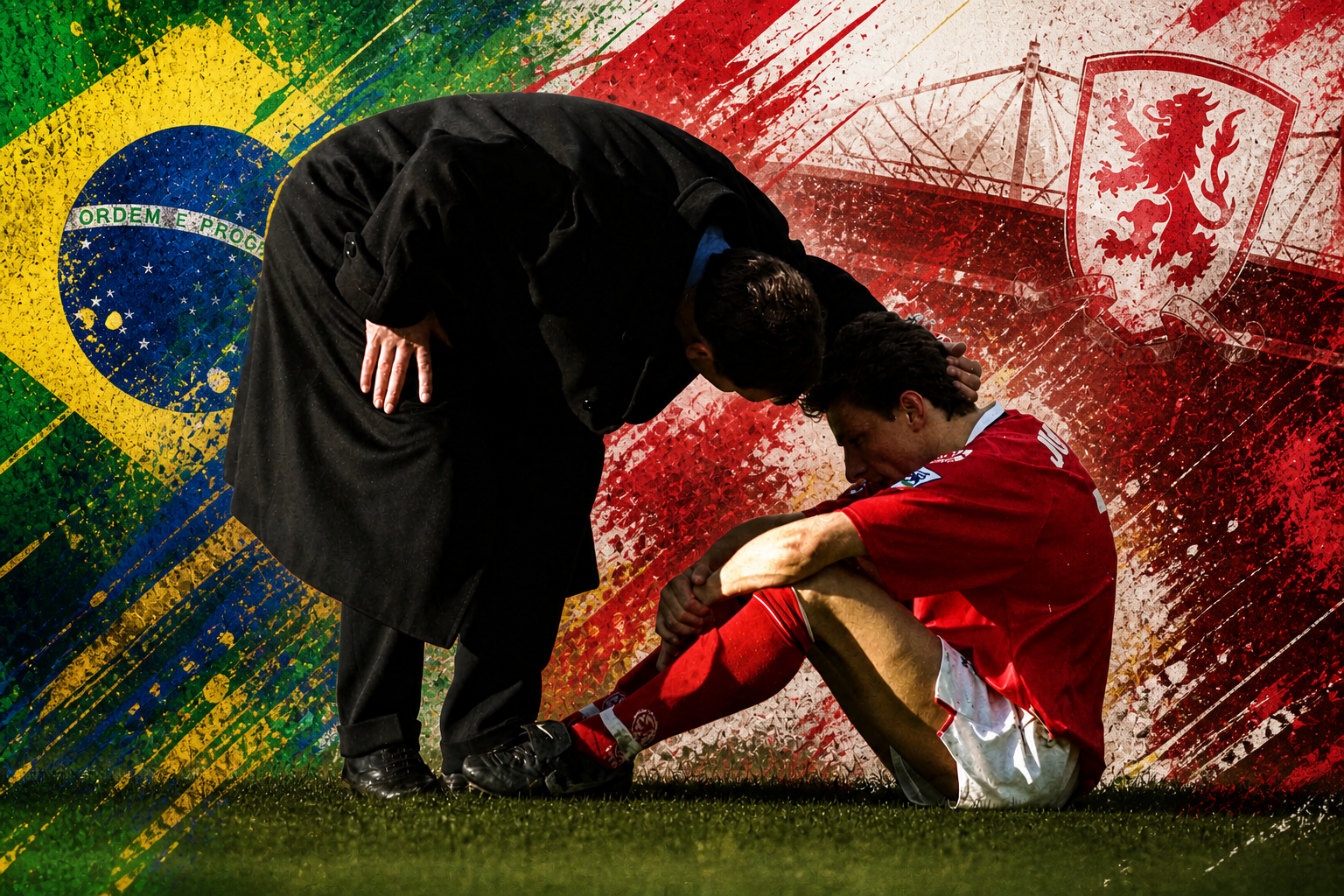
The mud of West Yorkshire clung to him like a physical manifestation of grief. It was May 11, 1997, and the air inside Elland Road was thick with the toxic, hollow resonance of a dream collapsing in on itself. The referee’s whistle had just blown to confirm a 1-1 draw between Leeds United and Middlesbrough, a result that condemned the Teesside club to relegation from the Premier League. As the reality of the situation washed over the stadium, Osvaldo Giroldo Júnior—universally known as Juninho Paulista—sank to the heavily scarred turf. He did not simply sit; he collapsed, burying his face in his hands, weeping with a profound, unconcealed agony that defied the typical stoicism expected of professional athletes.
At just 5ft 5in, wearing an oversized red-and-white shirt that seemed to swallow his slight frame, he looked devastatingly vulnerable. This was the reigning Brazilian Footballer of the Year, a global superstar courted by European royalty, shedding tears for an industrial town in the North East of England. The television cameras zoomed in, capturing a defining image of the decade. The tears were not an act of self-pity for a damaged personal brand or the sudden loss of a lucrative stage; they were a pure, unfiltered expression of empathy for a community he had adopted as his own.
“I cried because I was very emotional about the club,” Juninho would reflect years later. “I saw all of the people working to make Middlesbrough a better club and I felt all of that in that moment. Even now I remember this moment. It was very sad for us”.
In that fleeting, tragic snapshot on the Elland Road pitch, the deeply ingrained English cynicism regarding foreign ‘mercenaries’ was permanently dismantled. Juninho had not merely visited Middlesbrough; he had absorbed its soul, fighting a desperate, brilliant, and ultimately futile war to save it.
The failed experiment that was not really a failure
To the casual observer, the 1996-97 Middlesbrough season—which culminated in those tears in Yorkshire—is often lazily dismissed as a cautionary tale of hubris. It is widely remembered as a failed, chaotic experiment where a provincial club attempted to buy exotic flair without building a solid, sensible foundation. The conventional wisdom dictates that Bryan Robson’s flamboyant “United Nations of Football” was simply too fragile, too defensively naive, for the brutal rigours of the English top flight.
But this perception is fundamentally flawed, and it drastically undersells Juninho’s achievements. The true story of Juninho at Middlesbrough is not one of a samba star struggling in a gritty Northern town; it is the story of a diminutive playmaker who almost single-handedly accelerated the tactical evolution of the English game. In the mid-1990s, the Premier League was overwhelmingly physical, dominated by rigid 4-4-2 structures, relentless aerial bombardments, and combative, bruising midfielders. It was an environment hostile to nuance.
Into this brutalist landscape stepped Juninho, and rather than being broken by it, he bent it to his will. Middlesbrough scored 51 league goals that season, the highest of any team outside the top seven, playing a brand of breathtaking, end-to-end fantasy football that captivated the nation. Juninho was the creative architect of a side that reached two major domestic cup finals. He proved that an elite South American playmaker could not only survive the relentless physicality of English football but thrive within it. His legacy is not defined by the failure of a club’s defensive structure, but by the permanent alteration of English football’s DNA, validating the influx of global, technically superior imports that would soon follow. He was the anomaly that eventually became the blueprint.
Rejected for size, shaped by resistance
The immense resilience Juninho displayed on Teesside was forged in the fires of early, systemic rejection in his native São Paulo. Born on February 22, 1973, his initial foray into professional football was defined almost entirely by prejudice against his physical stature. Standing at just 1.65m, he was repeatedly dismissed by scouts at prominent clubs, including Corinthians and Clube Atlético Juventus, who unilaterally concluded that his thin, small build would preclude any success in the increasingly athletic modern game.
Undeterred by the institutional scepticism of the capital’s giants, Juninho and his family relocated to Itu, where he joined the youth system of Ituano FC. It was in this lower-pressure environment that his extraordinary technical proficiency was allowed to flourish, eventually overshadowing his physical dimensions. By the age of 18, he was a regular in the Ituano first team, leading them to a 7th-place finish in the São Paulo championship while scoring 10 goals.
The pivotal moment of his early career occurred during a 1993 match against the reigning champions, São Paulo FC. Juninho’s performance was so utterly dominant—scoring and assisting off the bench in a 3-3 draw—that São Paulo’s legendary manager, Telê Santana, insisted the club sign him immediately. Joining a historic squad that had just defeated Johan Cruyff’s Barcelona and AC Milan in the Intercontinental Cup, Juninho rapidly assimilated, overcoming his physical disadvantages with an extraordinary low centre of gravity, perfect balance, and peerless vision. By 1995, the diminutive outcast had evolved into the Brazilian Footballer of the Year.
“I looked flimsy, but I had strong muscles,” he later noted, dismantling the myth of his fragility. “I was small, but I wasn’t weak”.
The Wembley audition that changed everything
Juninho’s elevation to the global stage—and the genesis of his highly improbable move to Middlesbrough—crystallised during the 1995 Umbro Cup in England. Wearing the iconic number 10 shirt for the Seleção, the 22-year-old delivered a virtuoso performance against the hosts at Wembley Stadium on June 11, scoring a magnificent free-kick and laying on a sublime assist for Ronaldo. Sitting intently in the dugout was England assistant and Middlesbrough player-manager Bryan Robson. Robson, an archetypal English midfield warrior, recognised immediately that this Brazilian prodigy was the exact creative fulcrum his newly promoted side required as they transitioned into the modern Riverside Stadium.
The pursuit was nothing short of audacious. Juninho was being heavily courted by established European royalty, including Arsenal and Inter Milan, but Robson and Boro chief executive Keith Lamb flew directly to Brazil to pitch a vision. The pair spent days isolated in a small room at São Paulo’s training complex, drinking endless cups of black coffee and negotiating a £4.75 million fee. Crucially, they sold Juninho not just a lucrative contract, but an ambitious project.
“Middlesbrough were the ones who made a special effort to talk to me about the project,” Juninho recalled. “Bryan Robson and Keith Lamb came to Brazil, not to convince me to come to Middlesbrough but to show me what they wanted the club to become. Once I saw that, I trusted in them”.
His arrival on Teesside in October 1995 triggered mass, unbridled hysteria. The club sold out its season ticket allocation in a matter of days, and a crowd of 5,000 fans gathered at the Riverside to welcome a young man who emerged looking slightly overwhelmed in a suit that was visibly two sizes too big. The culture shock was immense and immediate. The weather was a brutal awakening; Juninho famously resorted to stuffing his boots with newspaper to combat the freezing Yorkshire cold, donning a “ninja cap” in training just to survive the elements. The language barrier was equally chaotic; the club-appointed interpreter, Palladino, was discovered to be translating entirely from his own imagination, famously ordering pheasant instead of beans for the bewildered star. Yet, rather than retreating into an affluent, isolated bubble, Juninho fully immersed himself. He chose to live in Levendale with his parents, frequently joining in street football matches with local children, bridging the massive cultural divide with pure, unpretentious humanity.
The No.10 English football did not know how to mark
What made Juninho so devastatingly effective during his peak years in England was his absolute mastery of the spaces that traditional British tactics had simply ignored. In the mid-1990s, the Premier League was stubbornly, almost dogmatically wedded to rigid, straight-line 4-4-2 formations. Juninho operated primarily in the ‘hole’—the vacant, fertile territory between the opposition’s midfield and defensive lines. English holding midfielders, accustomed to direct, physical, face-to-face combat, were entirely unequipped to track a player who drifted laterally, received the ball effortlessly on the half-turn, and accelerated instantly.
His debut, a 1-1 draw against Leeds United on November 4, 1995, provided an immediate, breathtaking thesis statement. Within eleven minutes, he had registered an assist, threading a perfectly weighted through ball past the Leeds defence for Jan Åge Fjørtoft to finish. More tellingly, he executed a nonchalant, humiliating nutmeg on the towering Carlton Palmer, a singular moment that symbolically dismantled the perceived hierarchy of English midfield physicality.
But to define Juninho merely by his samba flair and trickery is to fundamentally misunderstand his effectiveness. He possessed an intrinsic grit and a ferocious competitive edge that resonated deeply with the working-class ethos of Middlesbrough. He did not shirk physical confrontation; he welcomed it. When the imposing, muscular Belgian defender Philippe Albert attempted to intimidate him, the 5ft 5in Brazilian squared up to him without a moment of hesitation.
“I was tough on the pitch because they couldn’t beat me up in front of the referee,” Juninho asserted. “I wasn’t scared of anyone”.
His low centre of gravity allowed him to ride brutal tackles that would have snapped taller, more rigid players, and his phenomenal work rate—routinely staying after training for exhausting extra pitch runs to adapt to the relentless English tempo—ensured he was never a passive luxury player. He was the complete modern attacking midfielder: an artisan possessing the stamina and bravery of a blue-collar worker.
Brilliance, imbalance and the season that would not behave
The 1996/97 season remains the defining epoch of Juninho’s career, an era vibrating with immense, ultimately destructive tension. The core conflict lay in the drastic structural imbalance of Bryan Robson’s Middlesbrough. The ambitious chairman, Steve Gibson, had financed a dazzling attacking trident consisting of Juninho, the £7 million Italian striker Fabrizio Ravanelli, and the powerful, dreadlocked Brazilian midfielder Emerson. They were an exhilarating, terrifying force going forward, but critically, fatally flawed at the back. The sheer brilliance of their attacking machinery was constantly, agonisingly undermined by a porous, injury-ravaged defence. The team represented a constant, exhausting battle between offensive genius and systemic frailty.
This underlying tension erupted into a full-scale administrative disaster in December 1996. Faced with an acute injury and flu crisis that left Robson with only 17 fit players—including three goalkeepers and several untried youth prospects—the club took the drastic step of postponing a fixture against Blackburn Rovers with a mere 24 hours’ notice. The Premier League, displaying a ruthless adherence to bureaucratic protocol, punished the club with a devastating three-point deduction and a £50,000 fine. This draconian penalty created an insurmountable psychological and mathematical burden for the squad, turning a season of immense promise into a grim battle for survival.
A secondary, deeply personal tension involved Juninho’s intense loyalty to Middlesbrough clashing directly with his international ambitions. As the team fought a gruelling, losing battle against the drop, Juninho was acutely aware that playing second-tier football would severely jeopardise his place in Mario Zagallo’s Brazil squad for the upcoming 1998 World Cup in France. He was giving his absolute physical and mental peak years to a club spiralling inexorably towards the First Division. He was the Premier League Player of the Season, a dazzling, unstoppable creative force, anchored to a rapidly sinking ship. His individual excellence was entirely at odds with his club’s collective failure, creating a tragic dissonance that made his performances all the more heroic, and his eventual, tearful departure all the more inevitable.
Two finals, a broken dream and the long road back
The frantic pursuit of silverware during that doomed 1996/97 campaign encapsulated the chaotic brilliance of the era. Defying their league struggles, Juninho dragged Middlesbrough to both the League Cup and FA Cup finals, marking the club’s first major showpiece events at the old Wembley Stadium. In the League Cup final against Leicester City, opposition manager Martin O’Neill deployed the Swedish defender Pontus Kåmark with the sole, destructive instruction of man-marking the Brazilian entirely out of the game. The match ended in a tense 1-1 draw, with Boro ultimately losing the replay 1-0. Weeks later, in the FA Cup final, a staggering 43-second goal by Chelsea’s Roberto Di Matteo shattered Middlesbrough’s game plan before it could even formulate, resulting in a demoralising 2-0 defeat.
Following relegation, the tension between loyalty and global ambition finally broke. Juninho was sold to Atlético Madrid for an impressive £13 million in the summer of 1997. His time in Spain started brightly, forming a potent partnership with the Italian powerhouse Christian Vieri. However, absolute catastrophe struck on February 1, 1998. A brutal, reckless challenge by Celta Vigo defender Míchel Salgado broke Juninho’s fibula. The severe injury sidelined him for six agonising months, cruelly robbing him of his place in the 1998 World Cup squad—the very tournament he had left Teesside to guarantee. The physical trauma permanently altered his game; while his elite vision remained intact, the quicksilver acceleration that defined his early years was noticeably diminished.
He returned to Middlesbrough on loan for the 1999/2000 season, scoring four goals in 24 games and lifting the gloom around the Riverside, but it was his third, permanent spell beginning in 2002 that offered genuine, lasting redemption. Fresh from winning the 2002 World Cup with Brazil—where he intelligently adapted his game to play a disciplined, deeper midfield role under Luiz Felipe Scolari—he returned to a Boro side now managed by Steve McClaren.
The tactical relevance of this final chapter cannot be overstated. McClaren was an inherently pragmatic coach, meticulously building a structured, disciplined side. In 2004, this structured approach paid dividends as they reached the Carling Cup final against Bolton Wanderers at the Millennium Stadium in Cardiff. With early, clinical goals from Joseph-Désiré Job and Boudewijn Zenden, Middlesbrough secured a 2-1 victory, lifting the very first major trophy in their 128-year history. Juninho, having suffered the acute agony of 1997, had finally delivered the holy grail.
“Winning the League Cup meant a lot to me because we were reaching the goal we had dreamed about when the project started nine years before,” he reflected. “We had finally got Middlesbrough into Europe”.
Yet, the historic triumph birthed the bitterest conflict of his entire career. That very summer, McClaren unceremoniously, ruthlessly discarded him. Opting for a tactical shift to accommodate proven goalscorers Mark Viduka and Jimmy Floyd Hasselbaink, the manager froze Juninho out, citing systemic incompatibility and banishing him to train with the reserves.
“He wanted to push me out,” Juninho lamented, the betrayal still evident years later. “I don’t like managers who say one thing when they speak to you face-to-face but then don’t do what they say… Footballers are human beings, not products you can use but then throw away”.
Reluctantly, the club’s greatest icon was allowed to leave for Celtic on a free transfer, tragically missing out on the UEFA Cup adventure he had spent a decade striving to achieve. The brutal, cold pragmatism of modern management had entirely crushed the romanticism of the player.
Elland Road, Cardiff and the meaning of return
When we revisit that haunting, iconic image of Juninho weeping on the Elland Road turf in May 1997, the historical context is entirely transformed. At the time, it appeared to be the tragic, definitive conclusion of a brief, exotic fever dream—the sudden death of the Samba experiment in the industrial North. But with the full scope of history, those tears were not an ending; they were the baptism of an eternal, unbreakable bond.
The deep sorrow experienced that day laid the emotional bedrock for his subsequent returns to the club. The acute pain of 1997 made the unbridled ecstasy of Cardiff in 2004 possible. Without the devastating failure at Leeds, the triumph against Bolton would have been merely a statistical achievement; instead, it was a profound act of historical closure. It was the completion of a vow made by a 22-year-old boy from São Paulo to a fiercely proud town that had embraced him as a son. The tears at Elland Road were the price paid for the immortality secured in Cardiff.
The legacy beyond the romance
Juninho Paulista’s legacy is not built strictly on pristine statistics, even though his 29 Premier League goals stood for over a decade as the record for a Brazilian in England until Liverpool’s Philippe Coutinho finally surpassed it. His true, lasting legacy lies in how he fundamentally, irreversibly altered the cultural and tactical parameters of English football. Before Juninho, the Premier League was deeply suspicious of South American playmakers; after him, they became the ultimate tactical aspiration. He comprehensively demolished the xenophobic myth that flair players lacked the necessary grit and fortitude for a cold, unforgiving winter in the North East.
For Middlesbrough, his influence is immortal and without peer. In 2007, he was overwhelmingly voted the club’s greatest ever player in a fan poll, surpassing foundational legends like Wilf Mannion, George Hardwick, and Brian Clough. He changed the entire trajectory of the club, elevating them from a provincial yo-yo side to a team capable of attracting world-class international talent and competing on the European stage.
Even after his playing days, his footballing philosophy endured. Returning as president of his boyhood club Ituano, he adamantly insisted his academy coaches prioritise “technique and ability” over pure physical stature—a direct subversion of traditional Brazilian scouting that subsequently helped nurture the raw talents of players like Arsenal’s Gabriel Martinelli. What is most frequently misunderstood about Juninho is the lazy assumption that he was a fragile luxury player who succeeded in spite of his harsh environment; in truth, he succeeded because he possessed a relentless, industrial work ethic that perfectly complemented his South American artistry.
The Little Fella and the size of a town’s dream
Today, Juninho oversees the development of the next generation of talent in the warmth of São Paulo, thousands of miles removed from the biting winds and grey skies of the Tees Valley. Yet, the psychological geography remains permanently tethered. He arrived in England as an absolute novelty, a diminutive, shivering stranger stepping off a plane into the unknown, but he departed as the definitive architect of a footballing revolution.
He proved, unequivocally, that genius does not require a towering frame, and that the most profound, enduring footballing romances are often found in the most unlikely of cultural collisions. The Little Fella did not just light up a stadium; he redefined the absolute limits of what a small, post-industrial town in Europe dared to dream.
