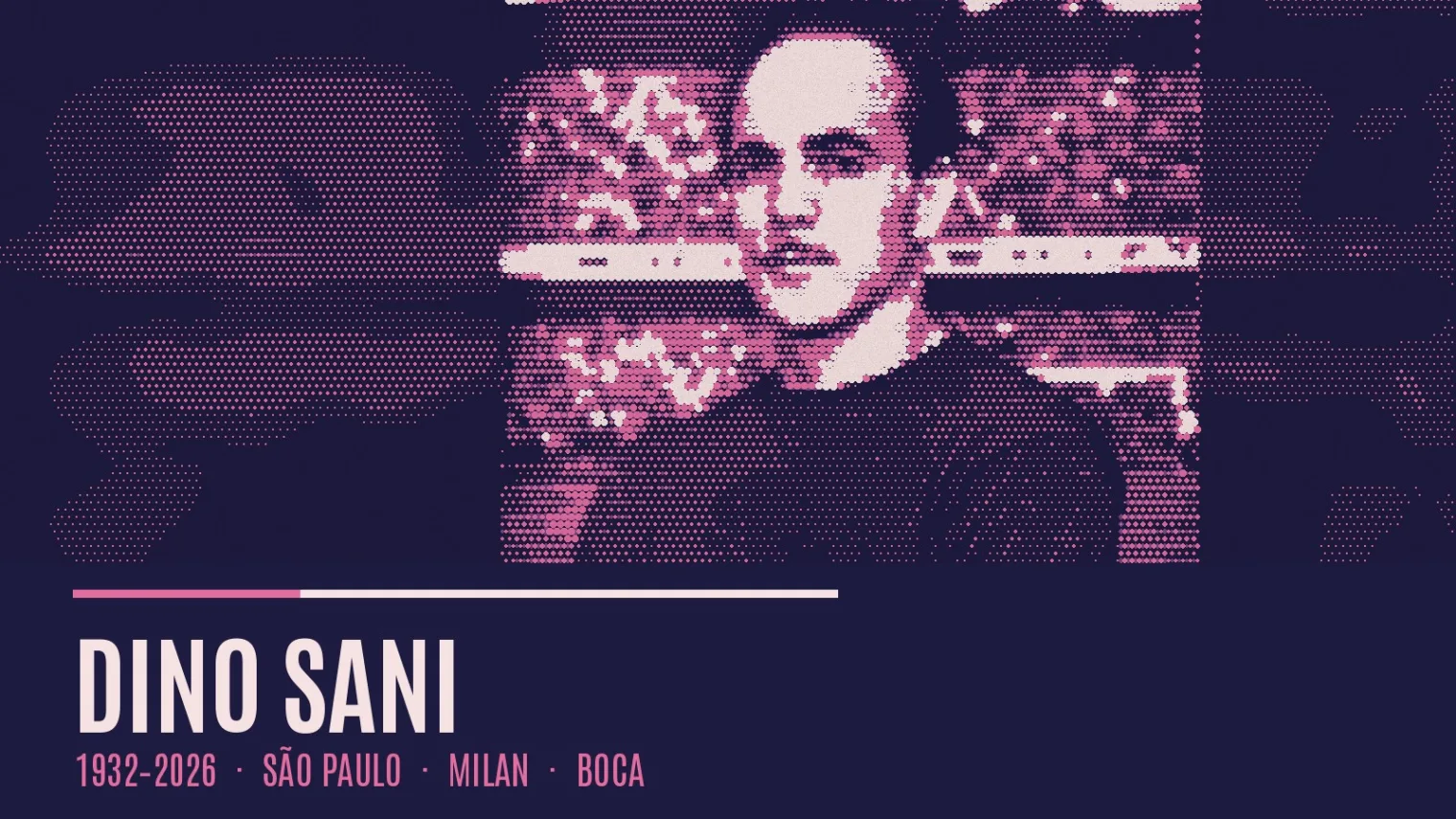
In 1984, the year he turned 52, Dino Sani gave an interview that was later shared under a headline that fits him better than any other: Este hombre vio todo. This man saw everything. When the clip resurfaced on X in 2025, the account that posted it summed him up in a line (translated from Spanish): “Interview with Dino Sani: he was a world champion with Brazil, saw River’s La Máquina, played for Boca and in Europe.” The original post did not need to say much more.
On Sunday night, 15 November 2026, Dino Sani died in São Paulo at the age of 94. The Brazilian football confederation, the CBF, confirmed the news, and so did the Federação Paulista, according to G1. No cause of death was given. The following evening, Futebol Portenho, the Brazilian site that covers Argentine football, reposted that old interview with a tribute of its own (translated from Portuguese): “Indeed, Dino Sani got to watch both La Máquina, River’s great team of the 1940s… and Lionel Messi, by then a veteran, winning a World Cup.”
That is the span of the life: from River’s La Máquina to Messi in Qatar, with a great deal of football history in between that Sani did not just watch but helped to make. He was the São Paulo playmaker that Béla Guttmann turned into a deep-lying passer. He was the slightly built, balding Brazilian whom Milan signed to fill the gap left by Jimmy Greaves, and who helped them to the Scudetto and then their first European Cup. He played for Boca Juniors and later coached them. He finished his playing career beside a teenage Rivelino at Corinthians, gave Paulo Roberto Falcão his first professional minutes at Internacional, and won two Uruguayan titles at Peñarol. O Globo‘s obituary called him a “referência de elegância no meio-campo”, a benchmark for elegance in midfield. It is hard to improve on.
Fifty metres from the Palestra
Dino Sani was born in São Paulo on 23 May 1932. In 2011 he gave a long oral-history interview to the FGV’s CPDOC and the Museu do Futebol, recorded in the Armando Nogueira auditorium at the museum on 11 June that year and published in edited form by Ludopédio. It is the closest thing we have to his own account of his life, and it begins with geography. The family home was on Rua Diana in Perdizes, fifty metres from Palmeiras’ ground, the Palestra Itália. “All I had to do was leave the house, run a little, climb the wall and drop down inside Palmeiras,” he said (translated from Portuguese).
His four grandparents, two from Tuscany and two from Ferrara, had come to Brazil with the Matarazzo industrial empire, and the whole family worked for it; his Brazilian-born father ran the transport side. He started at Palmeiras at 12 and went up through the infantil, juvenil and aspirantes sides into the professional squad. “The most important thing is that I did it all on my own, with nobody taking me to the club,” he said (translated from Portuguese). “I went because I loved the ball.”
G1 records that his professional career began at Palmeiras in 1950, the year he was part of the squad that won the Campeonato Paulista. But the club did not keep him. He was loaned to XV de Jaú, who won the second division and went back up in 1951, and when he returned he wanted out. Palmeiras, he said (translated from Portuguese), “didn’t make use of the kids. It only wanted the big names.” Folha de S.Paulo‘s obituary, by Humberto Peron, says he played only 15 professional games for them. Comercial, a São Paulo club that no longer exists, paid forty thousand cruzeiros for him and his youth-team friend Gino. For two years he also worked at Auto Três Leões, a car-parts firm on Avenida São João, chasing the lowest prices on materials, and gave the job up as soon as he turned professional.
Guttmann’s volante
Sani joined São Paulo in 1954, and it was there, as this week’s obituaries agree, that he became a great player. The man who made the difference was the Hungarian coach Béla Guttmann. Folha’s account is that Guttmann saw that Sani lacked the pace to play as a meia, an inside forward, and was too often receiving the ball with his back to his markers. So he moved him back to the position Brazilians call the volante, in front of the defence, where he could see the whole pitch.
Sani told the story in a sentence. He had started at inside right in the No 8 shirt, then moved to inside left in the No 10, and at São Paulo Guttmann put him at the head of the area. “I said I had never played in the position, but he replied: ‘Play, and leave the rest to me,'” he recalled (translated from Portuguese). “We scored four against Portuguesa and I never left it again.”
What Guttmann asked for sounds, from Sani’s description, remarkably modern. “He proposed a simple football, three touches to the opponents’ goal,” Sani said (translated from Portuguese). “He wanted switches of play, long passes, quick exchanges and less dribbling. We thought it was impossible.” In that system Sani was the man responsible for distributing the ball, and he found that the deeper role gave him more room and a wider view of the team. Guttmann was not a puritan about it, either. “He allowed the showboating if we scored three goals in 15 minutes.”
Folha describes the player that emerged: one who started all of São Paulo’s attacks with perfect passes, arrived late to shoot from distance, and, without the speed to chase opponents, had the timing to read the pass and take the ball before it reached its target. Peron’s verdict was that Sani was “a melhor tradução do volante técnico que todos nós procuramos”, the best embodiment of the technical volante everyone in Brazil is still looking for. He won the Paulista in 1957, partnering the great Zizinho in midfield. O Globo quotes the club’s historical archive as crediting him with 325 games and 113 goals between 1954 and 1961, an extraordinary return for a midfielder.
A short summer in Sweden
The São Paulo form took him into the national team. He was first called up in 1957 by Osvaldo Brandão, as a reserve in the squad that finished runners-up in the South American Championship in Peru, and Vicente Feola took him to Sweden the following year. He started the first two games, the 3–0 win over Austria and the goalless draw with England, then tore a muscle in a light training session on the eve of the Soviet Union match. Zito took his place and kept it. Sani watched the rest from the stands and later spent sixty days out. He never begrudged the man who replaced him. “What a player!” he said of Zito (translated from Portuguese). “He shouted at everybody, even Pelé.”
According to the CBF, he played 24 times for Brazil, winning 16, drawing four and losing four, and scored four goals.
Boca, the first time
After 1958, he said, the offers poured in, and the trick was to keep a clear head. When he left São Paulo, it was for the simplest of reasons (translated from Portuguese): “Because I wanted to earn more money.” São Paulo had played Boca Juniors at La Bombonera in a summer tournament and won by five. Sani marked Ernesto Grillo, the former Milan and Argentina inside forward, “without touching him, just by reading it first. I know their president went mad for me and came to buy me.”
It did not go smoothly. Infobae‘s obituary, citing El Gráfico, gives him 14 games and four goals for Boca, without a trophy. Sani’s own explanation was a clash of personalities with the club’s best player, Antonio Rattín, who played in his position “and wouldn’t stop needling me”. The coach at the time was Feola, Brazil’s World Cup winner, who eventually moved Rattín into the back line and asked Sani to play further forward when Grillo was injured.
Then Milan came looking for somebody else. A director who had already signed his 1958 team-mate Mazzola, and who had wanted Sani after the World Cup, came to Argentina to watch Boca’s Norberto Menéndez. They thought Menéndez was a midfielder, Sani said, when he was really a centre-forward. After a trial game in which both played, Milan took Sani instead.
Milan: the Greaves gap and the first European Cup
AC Milan’s legends page explains why he was needed: “Dino Sani was brought in during the season to take up the foreigner’s slot left vacant by English forward Jimmy Greaves.” His replacement was a midfielder, not a goalscorer, and Folha notes that some Milan supporters dared to call the short, already balding newcomer old.
They changed their minds quickly. La Repubblica‘s English-language obituary records his debut on 12 November 1961 against Juventus: Milan won 5–1 and Sani “was among the best on the pitch, lighting up the match with his through balls to his teammates.” He became a key player in Nereo Rocco’s side, and the club’s own verdict is that he “was decisive in claiming the 1961-62 Serie A title.” In the 2011 interview he remembered arriving with Milan five points behind Internazionale, who already thought themselves champions, and finishing three points clear. “It was a spectacle of a team,” he said of a dressing room that included Gianni Rivera, Cesare Maldini, Giovanni Trapattoni and Mazzola (translated from Portuguese).
The following season brought the European Cup. Sky Sport Italia notes that Milan beat Benfica 2–1 in the final at Wembley, the club’s first European triumph, and that Sani started. O Globo adds that it made Milan the first Italian side to win the competition. Folha goes further, writing that in the final “the Maestro”, one of the nicknames Milan’s supporters gave him, behaved like a coach on the pitch, changing his team-mates’ positions while Milan were losing before they turned the game round. The club’s legends page puts it more simply: “Gifted with a sharp mind and great tactical intelligence… he led the Rossoneri to the European Champion Club’s Cup title in 1963.”
He did not change his game for Italian football, either. “I admit I always did the same things in Brazil, in Argentina and in Italy,” he said (translated from Portuguese). “If you change, you abandon your style and you don’t produce.” He fed his team and scored from distance, usually from rebounds when the defence was open, and claimed he always finished as the team’s second-highest scorer. Milan record 78 matches and 20 goals in all competitions, 14 of them in 64 Serie A games.
There was one offer he refused. With Italian grandparents and a Scudetto to his name, he was asked whether he would play for Italy at the 1962 World Cup. Mazzola said yes, and played for Italy in Chile. Sani said no. “I had been in the country a little over six months and there was a fear of meeting Brazil along the way,” he explained (translated from Portuguese). “It would have been a disaster; I couldn’t risk it.”
He also played against Pelé’s Santos in the 1963 Intercontinental Cup, in a 4–2 win in Italy, but was injured for the return games at the Maracanã, where Santos won one game 1–0 with a penalty he still called, nearly fifty years later, “a disgrace” (translated from Portuguese). The Gazzetta dello Sport‘s English-language report quotes Milan’s tribute this week: “Dino Sani helped change an entire era for Milan, leaving a mark that time will not erase… Goodbye Dino, and thank you for making Milan great.”
Corinthians, and a boy called Rivelino
He came home to São Paulo’s third great club. G1 dates his Corinthians years from 1965 to 1968, and he won the 1966 Torneio Rio-São Paulo there, which meant he had played for Palmeiras, São Paulo and Corinthians, all three of the city’s big clubs. Folha says the veteran was a success in a team that was going through a long drought in the Paulista, and that Rivelino, the young star the fans called the Reizinho do Parque, has always been grateful for the advice Sani gave him early in his career. O Globo puts it more simply: at Parque São Jorge, he shared the midfield with the young Rivelino. He retired as a player in 1968, aged 36.
Inter, Falcão and the Gaúcho titles
The coaching career started almost at once, at Corinthians. Folha reports that, with very little experience on the bench, he was invited to coach Brazil for the 1970 World Cup and turned it down, out of solidarity with his friend João Saldanha, who had just been sacked; the job went to Zagallo. It is an extraordinary sliding-doors moment, and it rests on Folha’s account alone.
His great work as a coach was done in Porto Alegre. G1 and the CBF have him in charge of Internacional from 1971 to 1974, winning three consecutive Campeonatos Gaúchos in 1971, 1972 and 1973. Inter’s own tribute says he was part of the club’s run to eight straight state titles and launched some of the greatest players in the country into professional football, naming Paulo Roberto Falcão and Paulo César Carpegiani. He came back in 1983 and won a fourth Gauchão.
Falcão’s debut is a story in itself. GZH’s 2020 “Raízes do Gauchão” piece dates it to 15 April 1973, when the 19-year-old came on in the second half in place of the experienced Carbone against Esportivo of Bento Gonçalves. Inter lost 2–1, the first time a club from the interior had beaten them at the Beira-Rio. One of the former Inter players GZH spoke to remembered the coach this way (translated from Portuguese): “He was the one who taught Falcão to head the ball and to strike it first time. He was very intelligent and very calm.” Folha’s view is that Sani built the base of the side that won the Brazilian title in 1975 and 1976, and that in Falcão he revealed a volante as stylish as he had been himself.
Peñarol: the unbeaten title
In Uruguay he is remembered as something close to a hero. Montevideo Portal records that he spent three and a half years in charge of Peñarol, from early 1977 to mid-1980, and won two Uruguayan championships (1978 and 1979) and two Liguillas. His record was 166 official matches, 102 wins, 42 draws and 22 defeats, with five wins, ten draws and three defeats in the clásicos against Nacional. He was the coach on 16 July 1978, the day Fernando Morena scored his record seven goals against Huracán Buceo.
El Observador adds the detail that makes 1978 special: Peñarol won the title unbeaten, 17 wins and five draws, the last team to be champions without losing in a two-round championship, while Morena scored 36 league goals. The only blot was the Copa Libertadores, which Peñarol never won under him. Montevideo’s El País has observed that, apart from Sani, Peñarol’s foreign coaches had all left by the back door.
The goalkeeper Fernando Álvez, quoted by El Observador, posted his own farewell this week to “el querido ‘maestro'”, as they all called him (translated from Spanish): “I never in my life saw anyone strike the ball like him, two-footed, a crack; he gave me my debut in a clásico at 18.”
Boca, the second time
His return to La Bombonera in 1984 is the strangest chapter of all. Infobae records that he took over in May 1984 from Miguel Ángel “Zurdo” López, at a time of deep sporting and institutional crisis, and stayed until October. Those months included a fundraising tour on which Boca lost 9–1 to Barcelona, and a game against Atlas in which the goalkeeper Hugo Gatti came on as a forward because there was nobody else left. Sani’s record was 21 games, seven wins, six draws and eight defeats.
Clarín and Infobae both tell the story Argentines remember best. A week before his first game, Sani was the guest on the television programme Todos los goles, the forerunner of Fútbol de Primera, and was asked to pick the goal of the weekend. He chose an own goal: Marcelo Firpo of Atlanta, trying to clear a corner, had put the ball into his own net to give Vélez a 1–0 win. Clarín adds that it was an unforgettable day for Firpo anyway, because he had become a father for the second time.
That was the year of the interview that gave this piece its title. It is hard to think of a better summary of a man who had seen La Máquina, stood in a World Cup squad in Sweden, won the European Cup at Wembley, and now found himself picking an own goal as the best of the week on Argentine television.
The rest of the road
Infobae and the CBF list the later jobs: Coritiba in 1985, the Qatar national team in 1989–90, and finally Grêmio in 1991–92, where his coaching career ended. Along the way he also coached Palmeiras, Flamengo, Fluminense, Goiás and Ponte Preta. In the 2011 interview he said that of the clubs he had played for, he had coached all but São Paulo and Milan. He had a sharp memory of the 1991 Copa do Brasil final, which his Grêmio lost to Luiz Felipe Scolari’s Criciúma after a 1–1 draw in Porto Alegre, and of a near-post header from a corner he had warned his players about.
Asked why he stopped in the early 1990s, he did not dress it up (translated from Portuguese): “Fed up. It was 42 years of football, and I could have worked another ten, but I didn’t want the aggravation.” Directors, supporters, players and phone calls all day: “A real hell!”
He did not think much of what came after him, either. “Lots of running and not much brain,” he said of modern football in 2011 (translated from Portuguese). “I still have the head of the old football.”
Farewell
The CBF’s president, Samir Xaud, said: “We have lost one of our first world champions. Dino Sani wrote his name into the history of the Brazilian national team in 1958. His name will remain forever among the greats of the Seleção,” in the translation published by the Gazzetta. CNN Brasil and several other outlets noted that since Zagallo’s death in January 2024 he had been the oldest living Brazilian world champion.
The Brazilian-American Chamber of Commerce, where his son Dino Sani Jr is vice-president, published a family tribute. It says he shared about 52 years of marriage with his wife, Elza, who died in 2004, and that he is survived by his son and three granddaughters. The wake is on Thursday, 19 November, at the Cemitério da Paz in Morumbi, followed by the burial that afternoon.
What he saw
It is tempting to make Dino Sani a witness, the man in the corner of the photograph. The 1984 headline invites it, and the line about La Máquina and Messi is irresistible. But the more you read, the less he looks like a spectator. Guttmann gave him a new position and he made it his own. Milan signed him to fill a space in the squad and he ended up organising the side that won their first European Cup. Inter gave him a team and he gave them Falcão. At Peñarol he won a title without losing a game.
He saw everything, and for a remarkable stretch of it he was the one with the best view on the pitch, head up, deciding where the ball should go next.