


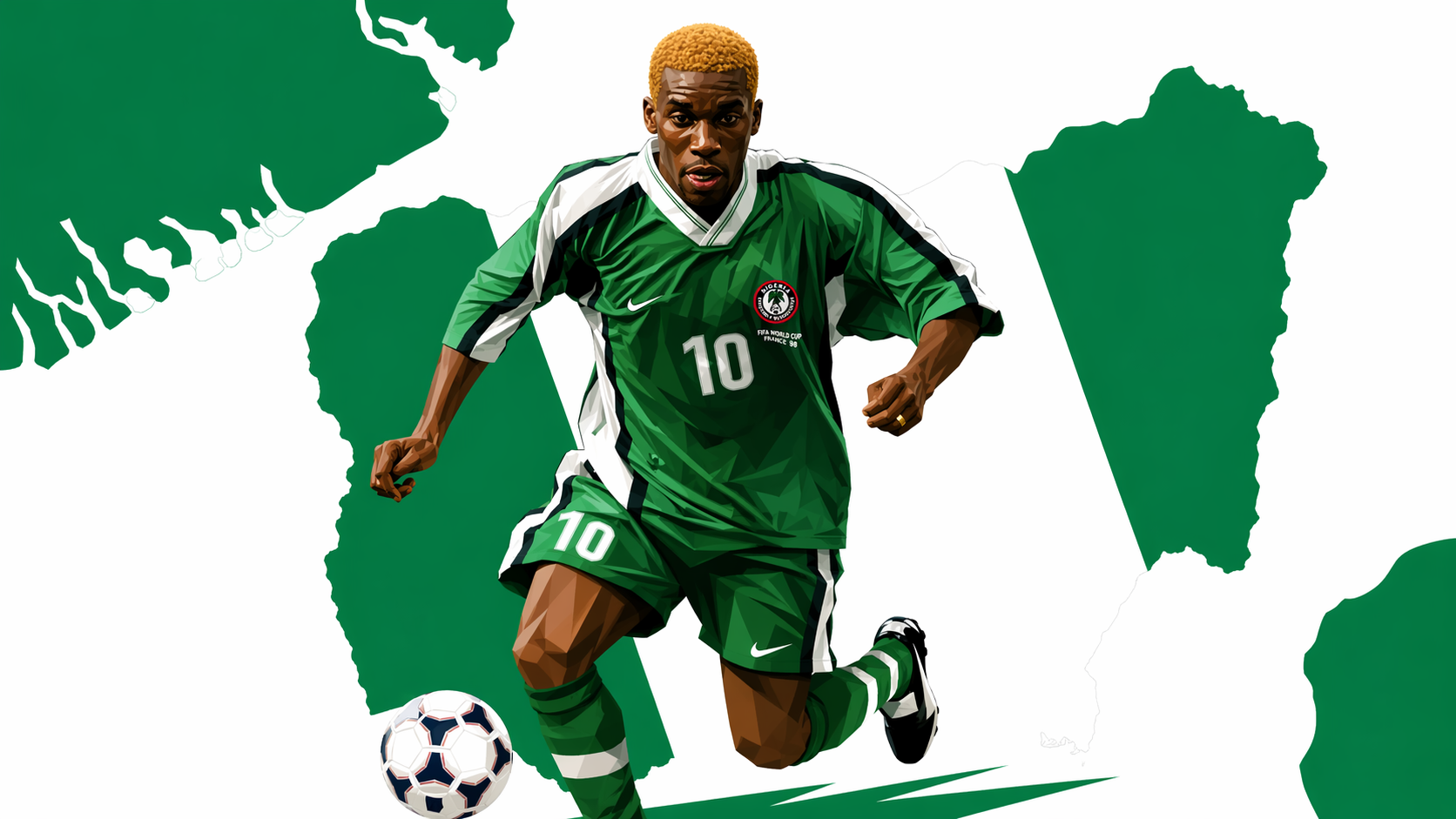
There are footballers who are measured by medals, footballers who are measured by numbers, and footballers who are measured by memory.
Jay-Jay Okocha belongs in the third group, which is often the hardest to define and the easiest to recognise. You know it when you see it. Years pass. Boots change. Tactics grow more rigid. The sport becomes richer, faster, cleaner, more choreographed. Yet the mention of one name still brings a smile, usually before a statistic, sometimes before a thought. That is Okocha.
He was not simply admired. He was enjoyed.
That matters. It matters because football, for all the analysis now wrapped around it, still lives on feeling as much as fact. Supporters remember the players who won things, of course, but they also remember the players who made a wet Saturday feel lighter, who turned a tired game into a good story, who did something you had not quite seen before. Okocha was one of those players. He could win matches, yes, but he could also change the atmosphere of a ground with one turn of the hips and a drop of the shoulder.
For many, especially in Nigeria and across the wider African football world, he was more than an entertainer. He was proof. Proof that a player could come from the streets of Enugu, walk into major European leagues, and still play on his own terms. Proof that flair did not have to be coached out of a footballer for him to survive at the highest level. Proof that imagination could travel.
That is why Okocha has lasted.
Where it started
He was born Augustine Azuka Okocha on 14 August 1973. The nickname arrived early and stayed forever. His older brother James was called Jay-Jay, and the younger Okocha inherited the name in the way nicknames often move through families and neighbourhoods, lightly at first and then with permanent force. Before long, Jay-Jay was not a nickname at all. It was an identity.
Like so many gifted players, he learned the game informally before he learned it properly. Street football gave him the first education that mattered. Tight spaces. Bad surfaces. Little time. Too many bodies. Older boys who would not step aside just because someone had talent. The street is ruthless in that way. It does not care about promise. It only cares whether you can keep the ball and do something with it.
Okocha could.
What stood out was not just close control, though he had plenty of that. It was confidence. He seemed to trust his feet completely. He trusted that the ball would obey him, trusted that the defender would blink first, trusted that football should be played with freedom. That sort of self-belief can look like arrogance to some eyes, but in gifted players it often reads differently. It looks like certainty. Okocha played as though the game made sense to him in a way it did not to most others.
Germany and the making of a top-level footballer
His route into the professional game took him through Enugu Rangers and then to Germany, where things started modestly enough with Borussia Neunkirchen. There is something fitting about that. Players of his type often begin far from the spotlight. They arrive in Europe with little noise around them, then force people to pay attention.
Eintracht Frankfurt certainly paid attention. German football in the early 1990s was not built for passengers or show ponies. It demanded work, discipline, physical commitment, and tactical seriousness. Okocha could do all of that, but he brought something else too. He brought invention.
The goal against Karlsruher SC remains the clip most often attached to his name from those Frankfurt years, and for good reason. It was the kind of goal that stays alive long after the table, the season, and much of the rest of the match have faded. Okocha jinked through defenders, wrong-footed Oliver Kahn, and finished with the sort of calm that makes outrageous skill look almost casual. It was not just a brilliant goal. It was a declaration. There was no need to explain what sort of player he was after that.
But to reduce his German years to a single goal would be to miss the point. Frankfurt gave him shape. It put his gifts into serious competition. It showed that he was not only a street artist who could survive in elite football, but a proper top-level midfielder who could carry responsibility. He could receive under pressure, roll away from a challenge, travel through midfield, and make something happen where nothing had seemed available.
He was not yet the finished figure football supporters now remember, but the outline was all there.
Turkey, and a perfect fit
Then came Turkey.
His move to Fenerbahce in 1996 mattered because it turned admiration into devotion. Some footballers fit certain clubs so naturally that the partnership seems obvious only after it has happened. Okocha and Fenerbahce were like that. The city, the noise, the heat of the derbies, the emotional scale of Turkish football, all of it suited him. So did the expectations. He was the kind of player who wanted the ball in charged moments. He wanted to try something difficult when everyone else was searching for safety.
Supporters responded immediately.
He scored goals there, plenty of them for a midfielder, and some from free-kicks struck with a violence and precision that still surprise people who remember only the tricks. That was the thing with Okocha. He could charm a game, but he could also hit it hard. Too much writing about him stops at the showmanship. That does him a disservice. He had substance. He could affect results.
His years in Istanbul deepened his reputation across Europe. By then he was no curiosity. He was a major talent. There was weight to his game, not just sparkle. He drew fouls, relieved pressure, broke rhythm for defenders, and carried a threat from distance. He was becoming the version of Okocha that many fans remember best: the dribbler with end product, the schemer with edge, the entertainer who could still leave a mark on the scoreboard.
Paris and the international stage
Paris Saint-Germain took him next, and the move made sense on paper. A glamorous club in a major city, a stage large enough for his personality, a side willing to invest heavily in talent. In Paris, Okocha became one of those players supporters never quite forgot, even if the team around him never fully matched the possibility of the era.
He arrived for a significant fee, and with that came expectation. Yet he did not shrink. French football saw the full range of him. The twists, the feints, the balance, the long-range strikes, the sudden changes of direction that left defenders set one way and watching him go the other. PSG did not always give him the silverware his talent deserved, but they gave him a setting in which his style travelled well. In Paris, Okocha looked like what he was: an international star.
This was also the period in which his reputation as a footballer’s footballer hardened. Other players knew. Opponents knew. Coaches might sometimes worry about risk, about one touch too many, about control versus expression, but footballers themselves tend to spot real gifts quickly. Okocha had that kind of respect. Not the polite respect reserved for good professionals. Something higher. The respect given to someone who can do things you cannot coach.
Bolton, where the legend settled
Still, for all the quality of his time in Germany, Turkey and France, it is in England that his legend settled most warmly.
That is partly because the Premier League was becoming a global obsession, partly because Bolton Wanderers were such an unlikely stage for a player of his reputation, and partly because the fit turned out to be perfect.
When he arrived at Bolton in 2002, the move felt surprising. Okocha had options. Sam Allardyce had a plan. Bolton, meanwhile, were not exactly a luxury destination. They were trying to stay alive in the top flight. Yet that is often where football gives us the best stories. The famous player does not always need the biggest club. Sometimes he needs the right one.
At Bolton, Okocha found a place where he could be both star and leader. The team had steel, experience and organisation, but he gave them colour. He also gave them confidence. That should not be dismissed as some vague dressing-room quality. It was visible. Teammates played with a little more ambition because he was there. The crowd expected something because he was there. Opposition players had to think differently because he was there.
Bolton supporters did not love him because he was famous. They loved him because he delivered.
There were the free-kicks, of course, especially the one against West Ham, hit with such conviction that it seemed to arrive before the goalkeeper had properly moved. There were the swivels and feints, the moments when defenders appeared to lose both balance and dignity. There were the touches in crowded areas that opened matches up. There was also the fact that he cared. He did not play as though Bolton were beneath him. He played as though the challenge interested him.
That made all the difference.
He became captain. He drove standards. He helped turn Bolton from a side fighting to survive into one that could look upward. Those Bolton teams were smartly built and well managed, but Okocha gave them something no manager can manufacture. He gave them personality. European qualification followed. For a club like Bolton, in that period, that was not a small thing. It felt enormous.
This is where nostalgia tends to simplify him, and where it should resist the temptation. Okocha at Bolton was not merely the smiling trickster in a less cynical age. He was older by then, and smarter. He knew when to slow a game. He knew when to pull a foul. He knew when to move the team thirty yards up the pitch by carrying the ball himself. He could still entertain, but he also understood control.
That version of Okocha deserves more respect than he sometimes gets.
The last years
His later years took him to Qatar SC and then briefly back to England with Hull City. By then, the peak had passed, as it always does. The body gives less, the recovery takes longer, and the game begins to belong to younger men. But there was dignity in those final chapters. Great players do not stop being themselves just because time arrives. Even in decline, there are traces. A pass weighted just right. A body swerve that still works. A touch that reminds everyone.
Retirement came in 2008, though players like Okocha are never really retired in the minds of supporters. They remain available through memory, through grainy clips, through stories told in pubs and barber shops and online arguments about the best players never fully captured by numbers.
Nigeria and something bigger
And then there was Nigeria.
Any account of Okocha that treats the club game as the whole story misses half of him.
With the Super Eagles, he became something larger than a footballer. He was one of the central figures in a great Nigerian side and one of the faces of a generation that changed how African football was seen. Nigeria won the Africa Cup of Nations in 1994 and burst onto the World Cup stage the same year with such confidence that the established powers had little choice but to take them seriously.
Okocha was still young then, but he already had presence. He did not carry himself like someone merely grateful to be there. That mattered. Nigeria played with ambition and personality, and Okocha suited both.
The 1996 Olympic gold in Atlanta remains one of the towering moments in African football history. Nigeria’s run to the title, beating Brazil and then Argentina, had drama, quality and symbolism. It said something important about what African teams could achieve when talent, belief and nerve met on the same stage. Okocha was central to that side. Not always in the most loudly statistical way, but in rhythm, in calm, in personality, in the feeling that Nigeria could go toe to toe with anyone.
He went on to play in three World Cups and later captained the national side. International football gave him a different burden from club football. At club level, he could be the gifted star. For Nigeria, he also had to be a senior figure, an example, a stabilising presence in an environment where pressure is rarely in short supply. He handled that with more seriousness than the stereotype of him sometimes allows.
More than flair
That stereotype is worth pausing on.
Too often, players like Okocha are filed lazily under flair. It is meant as praise, but it can also reduce them. Flair can become a way of avoiding the harder work of describing what a footballer actually was. Okocha was not just tricks and theatre. He had a strong frame, excellent balance, a fierce shot, and the courage to keep asking for the ball when matches became difficult. He could play centrally or wider, create or carry, dictate or disrupt. He was loose in style but not loose in talent.
He also carried a wider significance. African footballers in Europe had long dealt with narrow assumptions. Too strong, not disciplined enough. Athletic, but not refined. Direct, but not subtle. Okocha shredded that nonsense simply by playing. His technique was obvious. His imagination was obvious. His class was obvious. He did not issue rebuttals. He gave demonstrations.
That is part of why so many later players speak of him with reverence. Not because he came first in every category, but because he enlarged the category itself. He made room for a different understanding of what an African footballer could look like at the highest level.
Why he lasts
His influence can be traced across generations, though not always neatly. Some borrowed the swagger. Some borrowed the imagination. Some saw in him a licence to enjoy the game rather than merely endure it. He belongs in the broader story of African football’s rise, but he also stands slightly apart from it, because his appeal was never only regional or national. He was one of those rare players who could be loved anywhere.
And that brings us back to the beginning.
How should Okocha be remembered?
Not as the most decorated player of his age. He was not that. Not as the most efficient either. Football has always had room for colder, harsher forms of greatness. But if the question is which players made the game feel alive, which players turned football into something personal and playful without losing competitive edge, then Okocha belongs in any serious conversation.
He represented a kind of freedom that elite football has often struggled to preserve. He played with courage, but not the grim kind. His courage was expressive. He dared to try things in public. He dared to trust instinct. He dared to look joyful in a sport that can make people look burdened.
That is why he endures.
Mention Jay-Jay Okocha to those who saw him properly and the response is rarely neutral. They do not just nod. They remember. A turn in midfield. A free-kick bent with malice. A defender leaning the wrong way. A stadium lifting because something unusual might be about to happen.
Some players leave behind records. Okocha left behind pictures in the mind.
In the end, that is its own kind of greatness.
