


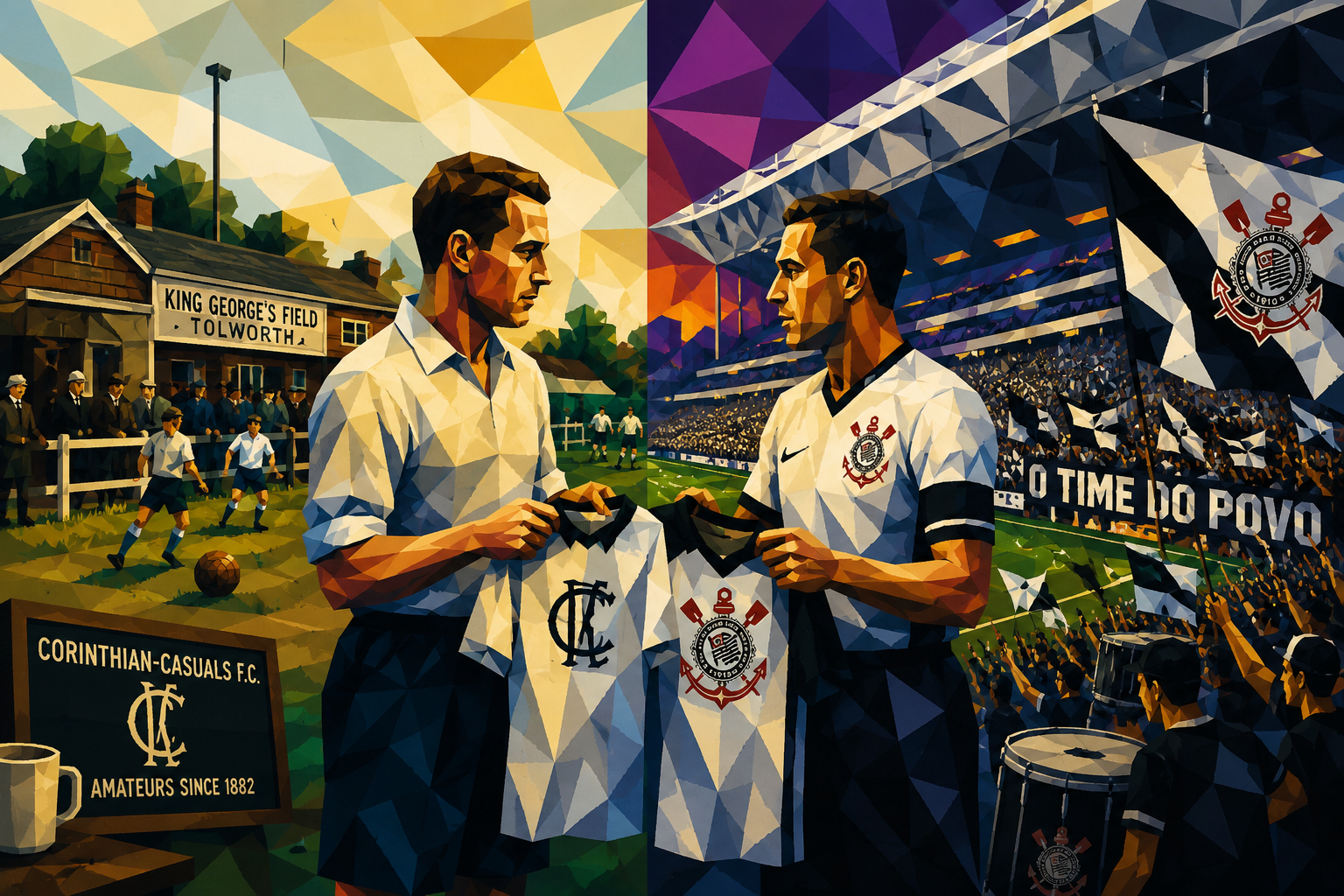
From Victorian amateur idealism to one of South America’s great football institutions, the bond between Corinthian-Casuals and Corinthians Paulista is not just a charming historical footnote. It is a story about memory, class, gratitude and the parts of football that survive long after success disappears.
The night the forgotten ancestors came home
The applause began long before the players emerged from the tunnel.
At first it sounded polite, almost ceremonial. Then the noise rolled properly around the bowl of the stadium, swelling from one stand to the next until 26,000 people were on their feet inside the Arena Corinthians in São Paulo. Black-and-white flags whipped through the humid January air. Drums hammered somewhere behind the goal. Supporters leaned over barriers just to catch a glimpse of footballers most of them had never actually seen play.
Not Barcelona. Not Real Madrid. Not Chelsea.
An amateur side from the lower reaches of English football, walking into one of the loudest stadiums in South America as though they were returning war heroes.
Some of the Casuals players looked stunned. Others grinned nervously. A few simply stared upward, trying to process the scale of it all. Most weekends, they played in front of crowds small enough to hear individual conversations from the touchline. Their home, King George’s Field in Tolworth, holds barely 2,000 people. On winter afternoons in the Isthmian League, the soundtrack is usually a passing train, the thud of tackles, the scrape of studs on concrete and the rattle of tea cups from the clubhouse.
Now there were television cameras tracking their every movement.
Brazilian reporters shouting questions.
Fans crying in the stands.
For the people inside the stadium, this was not novelty. It was not irony either. They were not applauding because the visitors were quaint or obscure. They were applauding because, in a very real sense, they believed they were looking at family.
A few years earlier, supporters of Sport Club Corinthians Paulista had been asked who should help mark their vast new stadium with a prestige friendly. The options included European royalty. Barcelona. Real Madrid. Chelsea.
The winner received 61 per cent of the vote.
Corinthian-Casuals.
That decision makes little sense in modern football logic. One club possesses tens of millions of supporters, multiple Brazilian league titles, a Copa Libertadores and two Club World Cup titles, including the 2012 final victory over Chelsea in Yokohama. The other fights yearly battles against relegation, finances and semi-obscurity in English non-league football.
And yet, on 24 January 2015, only one fixture truly mattered to the people of São Paulo.
Before kick-off, older supporters held scarves above their heads with tears gathering in their eyes. Some had travelled across Brazil simply to witness the meeting. Others spoke about the visitors with a kind of reverence normally reserved for founding myths. To understand why requires travelling backwards through football history, beyond the Premier League, beyond Pelé, beyond Wembley, back to a period when the sport itself still felt unfinished.
Back to England in the late nineteenth century.
Back to a club that believed football should be played without payment, without cynicism and without compromise.
Back to the Corinthians.
Late in the game, with the Brazilians leading, Casuals forward Jamie Byatt moved through the noise beneath a stadium that felt impossible for this level of football. Every touch from the visitors was cheered. Every tackle was applauded. The result barely registered. When the final whistle eventually arrived on a 3-0 victory for the home side, players embraced like relatives reconnecting after generations apart.
Then came the image that survived.
Byatt swapped shirts with veteran Corinthians Paulista midfielder Danilo. One black-and-white shirt for another. English amateur football handed back to Brazilian football like an heirloom returned to its descendants.
Around them, supporters wept openly.
The moment was almost too strange to process properly. A forgotten amateur club from suburban London receiving a reception usually reserved for continental champions. But the deeper truth is stranger still.
In England, Corinthian-Casuals are largely invisible.
In Brazil, they helped create one of the biggest clubs on Earth.
More than a charming football story
The easy version of this story has always been tempting.
Tiny English non-league club inspires giant Brazilian institution. Football heritage survives across continents. A charming historical quirk preserved through friendship and nostalgia.
But that interpretation undersells almost everything.
This is not really a story about an underdog club accidentally leaving behind a famous name. Nor is it simply about historical connection. The relationship between Corinthian-Casuals and Corinthians Paulista matters because it exposes a contradiction at the heart of football itself.
One club represents what the modern game became.
The other represents what it left behind.
That tension has existed since football’s earliest years. Even now, more than a century later, it still shapes the sport. Professionalism versus amateurism. Commerce versus idealism. Scale versus intimacy. Winning versus conduct. Football as industry versus football as social idea.
The original Corinthian FC stood firmly on one side of that divide.
Founded in 1882 by N. Lane Jackson, Corinthians were created partly out of anxiety. England’s public-school footballers, Jackson believed, needed a proper elite amateur side capable of strengthening the national team against Scotland. But the club quickly evolved into something larger than sporting ambition. Corinthians became guardians of an entire philosophy.
Football, in their eyes, was not merely competition. It was character formation.
They refused to join leagues. They refused to enter the FA Cup for decades. They refused to embrace professionalism even as the rest of English football moved rapidly towards it.
The refusal was not financial. It was moral.
To modern ears, some of it sounds impossibly self-righteous. Corinthians players were said to have treated penalties as moral admissions rather than chances to be saved. They toured globally preaching sportsmanship with near-missionary zeal. They became so influential that the phrase “Corinthian spirit” entered football vocabulary as shorthand for honourable conduct.
And for a time, they were brilliant enough to make idealism appear sustainable.
This was not some decorative amateur side making up numbers against professionals. They demolished major opposition. Blackburn Rovers, FA Cup holders in the 1880s, lost 8-1 to them. In 1904, Manchester United suffered an 11-3 defeat that remains one of the most famous humiliations in the club’s history. Entire England elevens were once composed solely of Corinthians players in matches against Wales during the 1890s.
Today, that sounds almost absurd.
A club that helped shape England’s football identity now survives in the margins of the pyramid, largely unnoticed by the country that created it.
That decline is central to the story. The Corinthians did not simply fade naturally with time. In many ways, football evolved into the exact thing they feared it would become.
Professionalism won.
And professionalism did not merely defeat amateur football economically. It overwhelmed it culturally. The crowds grew larger. The money grew faster. Working-class professionalism transformed football from pastime into mass entertainment. The old amateur elite increasingly looked outdated, moralistic and disconnected from the realities of the sport’s popularity.
England modernised.
The Corinthians did not.
That is why the Brazilian connection feels so emotionally loaded. In England, the Corinthians became a historical footnote. In Brazil, they became immortal.
Not because Brazilians preserved every detail perfectly. Most Corinthians Paulista supporters are not historians of Victorian amateur football. Many could not tell you the specifics of the Amateur Football Alliance or the Sheriff of London Charity Shield. What endured instead was something more emotional than factual.
Origins matter in Brazilian football culture.
Lineage matters.
And somewhere deep inside the mythology of Corinthians Paulista sits the idea that their club was born from admiration. From inspiration. From five railway workers watching an English touring side and imagining a football institution of their own into existence.
That emotional inheritance became stronger over time precisely because the two clubs drifted so far apart.
One side accumulated trophies, television audiences and global commercial power.
The other nearly disappeared altogether.
There is a strange irony in that divergence. Modern English football, with its wealth and global dominance, barely remembers the Corinthians. Brazilian football, thousands of miles away, still treats them with something approaching gratitude.
Perhaps that says something uncomfortable about how football history survives.
Not always through the powerful.
Not always through the winners.
Sometimes through memory alone.
Charles Miller and the journey that changed Brazil
The story really begins with a journey.
Not across Brazil or England, but between the two.
In the late nineteenth century, football still belonged largely to the British upper and middle classes. The sport existed before packed terraces and transfer fees, before global broadcasting and billionaire ownership. It travelled instead through schools, ports, railway lines and shipping routes, carried by merchants, engineers, teachers and returning students. Entire football cultures were often born because one person happened to bring a ball home.
Few individuals mattered more in that process than Charles Miller.
Miller was born in São Paulo in 1874, the son of a Scottish railway engineer and a Brazil-born mother of British descent. Like many boys from wealthy expatriate families, he was sent to England for education, attending Banister Court School in Southampton. There, he encountered organised football at precisely the moment the sport was beginning to define itself. England had rules. Structures. Clubs. Tactical ideas still primitive by modern standards, yet already spreading rapidly through schools and industrial towns.
Miller absorbed all of it.
He became a capable footballer and, significantly, played with and against Corinthians circles during the early 1890s. That detail matters because Corinthians were not simply another amateur side. They represented the game’s moral and stylistic elite. To move in that orbit meant entering football’s most influential amateur culture.
When Miller returned permanently to Brazil in 1894, he carried more than memory with him. The familiar story has him arriving with two footballs, a set of rules and a deeper understanding of organised football than almost anyone else in the country.
Brazil already knew fragments of the sport before Miller’s return. Sailors and expatriates had introduced versions of football in ports, schools and industrial communities. The story is more complicated than any single founding father myth allows. Yet Miller became the central organising force in São Paulo. He arranged matches, founded teams, educated players and helped establish the Liga Paulista, São Paulo’s first organised football championship.
For that reason, he is still widely described as the father of Brazilian football.
The phrase can sound simplistic. Football histories are rarely created by one individual alone. Yet Miller’s importance is difficult to exaggerate because he acted as both player and translator. He brought structure to enthusiasm. Context to imitation. He imported not merely the sport, but an understanding of how football could function socially and competitively.
And with him travelled the influence of the Corinthians.
That influence became particularly powerful during the Corinthians’ South American tours in the early twentieth century. By then, the English club had found itself increasingly isolated at home. Their refusal to embrace professionalism, combined with disputes involving the Football Association and the Amateur Football Alliance, meant opportunities against major English opposition were becoming scarcer.
So they travelled instead.
Between 1907 and 1914, Corinthians toured extensively overseas, becoming football ambassadors before international club football truly existed. They played across Europe, Africa and South America, carrying with them the prestige of English football’s amateur aristocracy.
When they arrived in Brazil in 1910, they were treated almost like celebrities.
In Rio de Janeiro and São Paulo, local crowds gathered not merely to watch foreign opposition, but to observe what English football itself looked like. England still represented the centre of the footballing world. Brazilian football remained young, ambitious and impressionable.
Corinthians won matches comfortably. More importantly, they captivated audiences.
Among those watching in São Paulo were five railway workers: Joaquim Ambrósio, Antônio Pereira, Rafael Perrone, Anselmo Correia and Carlos Silva. They were ordinary labourers in an industrialising city, part of the growing urban working class transforming Brazilian society in the early twentieth century.
And they became obsessed.
The significance of that detail should not be lost. The original Corinthians emerged from England’s amateur establishment, deeply tied to public-school ideals and gentlemanly conduct. The Brazilian Corinthians would be born instead from workers, factories and immigrant neighbourhoods.
Same name.
Entirely different social roots.
After watching the touring English side, the five men decided to form a club of their own. On 1 September 1910, Sport Club Corinthians Paulista came into existence.
Not as imitation.
As reinvention.
Two rises, two versions of football
The original Corinthians never chased permanence in the way modern clubs do.
There was no long-term strategic vision. No obsession with league status. No institutional hunger for trophies or accumulation. They existed instead as an idea carried through football matches. That was both their strength and, eventually, their weakness.
For a period, though, the idea looked unstoppable.
English football at the turn of the twentieth century was still unstable enough for Corinthians to appear not merely relevant, but superior. Professional clubs had begun attracting larger crowds and paying wages, particularly in industrial northern towns, yet the amateur elite retained immense cultural influence. The Corinthians became the standard-bearers of that old order, their fixture list functioning almost like a travelling exhibition of football purity.
And crucially, they could actually play.
Modern readers sometimes assume amateurism meant inferiority. In the Corinthians’ case, the opposite was often true. Their players were technically refined, physically conditioned and tactically organised at a time when many professional sides still relied heavily on direct play and brute athleticism.
Results reinforced the mythology.
In 1884, they beat Blackburn Rovers 8-1. Two decades later, they inflicted that 11-3 defeat on Manchester United. Entire England sides were selected exclusively from Corinthians players in matches against Wales during the 1890s, an extraordinary level of influence unmatched before or since.
Those details matter because they complicate the lazy modern assumption that professionalism simply replaced a weaker system.
The Corinthians were not overwhelmed because they lacked quality.
They were overwhelmed because football itself changed around them.
At the same time, thousands of miles away, the club they had inadvertently inspired was beginning its own ascent for entirely different reasons.
The early rise of Corinthians Paulista reflected the transformation of Brazilian urban society. São Paulo was expanding rapidly through immigration, railway growth and industrial labour. Football, initially associated with British expatriates and wealthier Brazilians, increasingly became a working-class obsession.
Corinthians Paulista understood that shift instinctively.
Unlike many elite clubs of the period, they embraced supporters from poorer neighbourhoods. The club’s identity formed not around exclusivity, but accessibility. Factory workers, labourers and immigrants saw themselves reflected in the team. That relationship created something deeper than sporting support. Corinthians became a social expression of the city itself.
Their growth was immediate.
They won the Campeonato Paulista in 1914, just four years after formation. By the 1920s and 1930s, they had become one of São Paulo’s dominant forces, attracting huge crowds and fierce loyalty. The transformation from railway workers’ side into mass institution happened with astonishing speed.
Yet the rise of the two clubs could not have been more different.
The English Corinthians spread influence through ideals and exhibitions.
The Brazilian Corinthians spread influence through belonging.
One represented football before mass professionalism.
The other thrived because mass professionalism was coming.
That divergence became clearer with every passing decade.
In England, professional football rapidly consumed the national imagination. League football offered tribalism, regional identity and regular competition on a scale amateur touring sides could not replicate. Crowds wanted stakes. Rivalries. Promotion. Titles. Football stopped being an exercise in gentlemanly conduct and became something louder, rougher and emotionally democratic.
The Corinthians struggled to adapt because adaptation would have required abandoning the principles that defined them.
Their tours remained admired internationally, but increasingly detached from football’s future direction. Even their famous commitment to sportsmanship began to look archaic against the sharper competitive instincts of the professional game.
Brazil, meanwhile, absorbed the sport differently.
Football there evolved into something emotional, improvisational and socially explosive. The game escaped elite ownership and became woven into everyday life. Corinthians Paulista rode that wave brilliantly. Their support base expanded alongside São Paulo itself, fuelled by industrial growth and working-class pride.
The irony is extraordinary when viewed from distance.
The English Corinthians believed professionalism threatened football’s soul.
The Brazilian Corinthians became beloved precisely because they embedded themselves within the emotional chaos of professional football culture.
Both clubs emerged from the same root.
Only one survived football’s future.
The identity that could not be manufactured
To understand why the Corinthians mattered, it is necessary to strip away modern assumptions about football success.
They are remembered today largely because another club inherited their name. That can obscure something important. For several decades, Corinthian FC were not peripheral figures in football history. They helped shape how the sport imagined itself.
Not tactically in the modern sense. There was no revolutionary formation or pressing structure attached to them. Football before the First World War remained strategically fluid and comparatively chaotic. But the Corinthians represented an identity that influenced the culture of the game across continents.
Style mattered to them.
Conduct mattered more.
Their football reflected the values of the social class from which many of their players emerged: controlled, technically polished, disciplined and heavily tied to the Victorian belief that organised sport built moral character. They saw football not simply as competition, but as evidence of civilisation itself.
That sounds pompous now because, in many ways, it was. Yet dismissing the Corinthians as privileged idealists misses the reason they became influential. Their version of football arrived at a moment when the sport still lacked a settled personality. England had codified the rules, but football’s meaning remained contested.
Was it recreation?
Education?
Entertainment?
Business?
Community identity?
The Corinthians answered those questions differently from almost everyone else.
Their tours abroad became football diplomacy before the term existed. Wherever they travelled, they exported an image of English football built around technical quality and sportsmanship rather than commercialism. In countries where the game remained young, that image carried enormous weight.
Brazil absorbed part of that influence, but transformed it completely.
By the mid-twentieth century, Corinthians Paulista had become almost the inverse of their English predecessors. If the original Corinthians reflected elite restraint, the Brazilian Corinthians embodied emotional intensity.
They became known as O Time do Povo, the People’s Team.
That phrase was not branding. It emerged from demographics and feeling. Corinthians supporters were drawn heavily from São Paulo’s industrial working class, immigrant communities and poorer districts. The club became intertwined with labour identity in a rapidly modernising city.
Where the English Corinthians prized detachment from professionalism, the Brazilian Corinthians embraced football’s capacity to belong to everyone.
And yet traces of the original spirit remained visible in strange ways.
Not in amateurism. Not in social class. Not even necessarily in style of play.
But in the idea that football clubs could represent something larger than results.
That idea became particularly powerful during periods of political and social unrest in Brazil. During the early 1980s, Corinthians players including Sócrates, Wladimir and Casagrande helped create Democracia Corinthiana, a player-led movement advocating democratic participation within the club during Brazil’s military dictatorship.
It remains one of the most politically significant episodes in football history.
The connection to the original Corinthians was not direct, yet there is an intriguing philosophical echo there. Both clubs, in very different eras and social contexts, became vehicles for ideas extending beyond football itself.
That is why the relationship between the two institutions continues to resonate emotionally.
Not because they play alike.
Not because they share organisational similarities.
Not because one literally evolved into the other.
But because both became symbols.
The English Corinthians symbolised football before professionalism conquered it.
The Brazilian Corinthians symbolised football after it escaped elite control and became inseparable from mass identity.
Those identities were difficult to replicate because they depended on historical timing. You cannot artificially manufacture the conditions that created either club.
The original Corinthians emerged when football still belonged partly to idealists.
Corinthians Paulista emerged when football began belonging fully to the people.
Together, they unintentionally map the entire social evolution of the sport.
When football left the Corinthians behind
The Corinthians story only becomes fully meaningful once the decline begins.
Idealism is easy to romanticise when accompanied by victories. Much harder when it starts losing.
By the early twentieth century, the original Corinthians found themselves trapped by the very principles that had once made them distinctive. Football was changing too quickly around them. Crowds were growing. Stadiums were expanding. Newspapers increasingly covered league football as mass entertainment rather than gentlemanly recreation. Professional players from industrial towns became national celebrities. Money entered the sport not gradually, but irreversibly.
The Corinthians resisted almost all of it.
That resistance carried dignity. It also carried denial.
Their refusal to embrace professionalism stemmed partly from genuine moral conviction. Many within the club believed payment corrupted sporting integrity. They viewed professionalism as transactional, overly cynical and fundamentally opposed to football’s educational value.
But class tension sat beneath those beliefs too.
The amateur ideal was easier to sustain when players possessed independent wealth or secure careers outside football. Professionalism empowered working-class players who previously lacked access to elite sporting environments. The rise of league football represented not merely tactical evolution, but social redistribution.
Football was slipping away from the people who first controlled it.
The Corinthians never fully reconciled themselves to that reality.
As the professional game expanded, their position became increasingly awkward. Their tours still drew admiration abroad, yet domestically they began to feel detached from football’s emotional centre. Supporters wanted meaningful competition. Rivalries. Stakes. Weekly drama. The Corinthians remained committed to exhibition football and moral symbolism while the rest of England embraced tribal professionalism.
The football changed too. Regular league competition sharpened tactical habits. Professional clubs trained with greater consistency, selected with harsher pragmatism and built teams to win under pressure every week rather than to represent a code. The Corinthians could still produce beautiful football in moments, but the sport was becoming less hospitable to a club built around principle rather than competitive necessity.
Eventually, football left them behind.
The decline was gradual rather than catastrophic, which perhaps made it sadder. There was no single collapse. No scandal. No dramatic bankruptcy. Just slow irrelevance.
And then came war.
In 1914, while travelling to Brazil for another overseas tour, the Corinthians received news that Britain had declared war on Germany. The symbolism feels almost literary now: football’s great touring idealists crossing the Atlantic just as Europe descended into industrial slaughter.
Many players returned home to enlist.
Several never came back.
The First World War damaged football across Europe, but for the Corinthians it felt particularly devastating because the club already belonged emotionally to an older world. Post-war Britain emerged harder, more industrial and more commercially driven. Football after 1918 looked less like an extension of Victorian values and more like modern mass culture.
The Corinthians increasingly resembled relics.
In 1939, they merged with Casuals FC to form Corinthian-Casuals. The merger preserved the name, but also quietly acknowledged reality. The original Corinthians could no longer survive independently within the football ecosystem developing around them.
That tension still exists today.
Corinthian-Casuals continue operating as a fully amateur club despite competing in levels of English football dominated by semi-professional structures. Players are unpaid. Staff are unpaid. Financial survival remains precarious almost permanently. In a football pyramid increasingly shaped by ownership models, sponsorship and commercial ambition, they exist almost as ideological holdouts.
Some see that as admirable.
Others see it as stubborn romanticism bordering on self-destruction.
The contradiction matters because modern football itself cannot decide how it feels about clubs like Corinthian-Casuals. People love the idea of purity in football, but the game consistently rewards scale, efficiency and commercial aggression instead.
That is partly why the Brazilian relationship became so emotionally important for the Casuals.
In England, they often feel forgotten.
In Brazil, they feel remembered.
And the contrast can be startling.
At King George’s Field in Tolworth, matchdays remain modest and intimate. A few hundred supporters stand close enough to hear players arguing. Volunteers work turnstiles and tea bars. The clubhouse atmosphere resembles community football more than modern spectacle.
Yet every so often, Brazilian visitors arrive carrying Corinthians Paulista shirts and scarves like pilgrims visiting sacred ground.
For them, this is not merely another non-league club.
This is origin mythology made physical.
The emotional imbalance between the two clubs creates the article’s deepest tension. One side became globally powerful. The other survived through memory, volunteerism and historical significance.
Yet the larger club still looks backwards for validation.
That reveals something uncomfortable about football success.
Trophies create prestige.
Money creates scale.
But neither necessarily creates meaning.
Jamie Byatt, São Paulo and the bond made visible
If the original Corinthians represent football’s lost past, then the modern relationship between the two clubs represents something even stranger: memory surviving commercial reality.
By the early 2010s, Corinthian-Casuals were living with the contradictions familiar to much of non-league football. Historic name. Minimal resources. Loyal volunteers. Constant uncertainty.
The glamour of the Corinthians story did not pay wages or maintain facilities. The club remained fully amateur while competing against increasingly professionalised opposition. Financially, survival could feel fragile from season to season. Around 2014, genuine fears existed that the club might not continue indefinitely without new sponsorship and wider visibility.
And yet, halfway across the world, their symbolic importance was becoming stronger than ever.
Part of that shift came through the internet. For decades, the connection between the two Corinthians clubs had existed mainly through history books, occasional visits and pockets of supporter awareness. Social media changed the scale of that relationship dramatically. Brazilian fans discovered images of the tiny Tolworth ground. Casuals players discovered the almost surreal intensity with which they were discussed online in São Paulo.
The emotional distance between the clubs suddenly became visible in real time.
One moment, in particular, accelerated everything.
Casuals striker Jamie Byatt scored and revealed a Corinthians Paulista shirt beneath his own jersey during the celebration. The footage spread rapidly across Brazilian media and social networks.
The reaction astonished the English club.
To Brazilian supporters, the gesture did not feel performative. It felt respectful. Recognition flowing in the opposite direction. One Corinthians publicly acknowledging the other. Byatt could not have fully anticipated the scale of the response, but suddenly the Casuals were receiving extraordinary attention from one of the world’s largest football fanbases.
The symbolism resonated because football increasingly struggles to preserve continuity. Clubs rebrand. Stadiums disappear. Ownership changes erase identity. Yet here was an amateur player from suburban London openly embracing a relationship stretching back more than a century.
Brazil responded emotionally because the connection still mattered emotionally.
That ultimately led to the defining modern chapter in the story: the 2015 meeting at Arena Corinthians.
From a footballing perspective, the fixture bordered on absurdity. One side were a Brazilian giant with global commercial reach and international players. The other operated several divisions beneath the professional game in England.
But the match was never really about sporting equality.
It was about acknowledgement.
When Corinthians Paulista supporters backed Corinthian-Casuals ahead of clubs such as Barcelona, Real Madrid and Chelsea, they were making a statement about identity rather than prestige.
This mattered more.
The scenes surrounding the tour bordered occasionally on surreal. Casuals players who normally travelled quietly through English non-league football suddenly found themselves mobbed by supporters upon landing in São Paulo. National television crews followed them through airports and training sessions. Sponsors approached the club almost immediately. One televised appearance was reported to have generated a rush of sponsorship interest within half an hour.
That detail matters because the Brazilian connection stopped being purely symbolic at that point.
It helped save the club.
The emotional power of the story translated into practical survival. Sponsorships and visibility generated funding that allowed the Casuals to stabilise financially at a moment when their future looked uncertain. In effect, the descendants rescued the ancestors.
Few football stories carry that kind of circularity.
And the match itself delivered moments impossible to script convincingly in fiction.
Inside the stadium, Casuals players received ovations simply for warming up. Brazilian supporters held banners thanking the club for helping inspire Corinthians Paulista’s creation. Older fans openly cried during pre-match ceremonies. The atmosphere felt less like a friendly and more like historical reconciliation.
When the home side eventually won 3-0, the score barely registered.
The enduring image became the shirt exchange between Jamie Byatt and Danilo after full-time. One player from the amateur English descendants of Victorian football idealism. The other from a South American giant shaped by professionalism, politics and mass fandom.
Both wearing the same name.
Both connected by an accident of football history stretching back to 1910.
What made the occasion powerful was not nostalgia alone.
It was recognition that football history is rarely linear. Influence travels unpredictably. Sometimes the clubs that shape the game most profoundly are not the richest, strongest or most successful. Sometimes they survive instead through inheritance, through memory and through stories passed between generations of supporters who refuse to let them disappear.
The night in São Paulo, seen properly
Viewed from distance, the 2015 meeting between the two Corinthians clubs can appear almost impossibly sentimental.
Football loves these stories. Tiny club reconnects with giant descendant. History honoured. Heritage celebrated. The game remembering its roots for one emotional evening before returning to business as usual.
But the deeper significance of that night in São Paulo lies in what it revealed about modern football memory.
Because the uncomfortable truth is this: England had largely stopped paying attention long before Brazil did.
The original Corinthians helped export football culture across the world. Their players influenced the early development of the game internationally. Their ideals shaped concepts of sportsmanship that still survive linguistically inside football vocabulary. Their tours acted as soft-power demonstrations of English football during the sport’s formative years.
Yet within modern English football culture, they occupy remarkably little space.
Most Premier League supporters could not explain who they were. Many younger fans have never heard of them at all.
In Brazil, meanwhile, their story remained alive through emotion rather than obligation.
That difference matters.
English football tends to preserve history through achievement. League titles. European Cups. Famous managers. Statistical greatness. The Corinthians do not fit comfortably inside that framework because their influence was cultural before it was competitive.
Brazilian football culture approached them differently.
There, the connection survived because it became attached to identity. Corinthians Paulista supporters did not embrace the English club out of politeness or historical curiosity. They embraced them because football lineage in Brazil carries emotional weight. The idea that one of the country’s biggest clubs emerged partly from admiration for a touring amateur side became part of Corinthians Paulista mythology itself.
Over time, the English club transformed from historical influence into symbolic ancestor.
That is why the scenes in São Paulo during 2015 felt so emotionally disproportionate to outside observers. Neutral audiences saw an amateur club playing a glamorous exhibition match. Corinthians supporters saw something far more personal.
Origins returning home.
And perhaps that explains why so many people cried that night.
Not because the football itself mattered. The match was uneven and predictable. The Brazilian side eventually won 3-0 without ever truly needing to turn the occasion into a contest. Technically, physically and commercially, the two clubs existed in entirely different universes.
But emotionally, the gap briefly disappeared.
For ninety minutes, the modern machinery of elite football paused long enough to acknowledge where part of its own story began.
The symbolism surrounding Jamie Byatt’s shirt exchange with Danilo captured that perfectly. On one level, it was simply a routine post-match gesture. Footballers exchange shirts constantly. Most are forgotten instantly.
This one endured because it looked like inheritance made visible.
One Corinthians handing itself to another.
Or perhaps returning something borrowed more than a century earlier.
There is another irony buried inside the moment too. The original Corinthians spent decades fearing professionalism would ultimately damage football’s spirit. In many respects, history proved them wrong. Professional football created extraordinary technical standards, enormous emotional communities and global cultural power. Corinthians Paulista themselves became part of that phenomenon.
Yet the 2015 reunion also suggested the old amateurs were not entirely wrong either.
Modern football often struggles to preserve emotional continuity. Clubs become brands. Supporters become customers. Stadium naming rights replace local memory. History gets repackaged into marketing content.
The relationship between the two Corinthians clubs resisted that process because it remained too strange, too human and too historically tangled to feel manufactured.
Nobody in 1910 could have engineered this outcome.
A group of São Paulo railway workers watch an English touring side. They name a club after them. More than a century later, tens of thousands welcome that same English football lineage into a World Cup stadium with tears and applause.
Football rarely produces cleaner evidence that stories can outlive success.
Or that influence sometimes survives more powerfully than victory itself.
A legacy too complicated for simple romance
The temptation with the Corinthians story is to turn it into a morality play.
Pure football versus corrupted football. Amateur values versus commercial greed. The small club preserving the soul of the game while the modern sport loses itself in money and spectacle.
Reality is more complicated than that.
The original Corinthians were not flawless idealists unfairly crushed by modernity. Their worldview carried limitations shaped heavily by class and privilege. Amateur football in Victorian England often depended on social structures inaccessible to much of the population. The Corinthians could reject professionalism partly because many of their players possessed educational and financial opportunities ordinary working-class footballers did not.
Professionalism changed football because it needed changing.
It opened pathways. Created careers. Expanded the game socially. Turned football from elite recreation into mass culture.
Without that transformation, clubs like Corinthians Paulista might never have become what they did. The emotional force of Brazilian football emerged precisely because the sport escaped narrow ownership and embedded itself within working-class life.
That matters when discussing legacy because the Corinthians influence was never straightforwardly positive or negative. Their importance lies instead in the questions they force football to confront.
What is football actually for?
Entertainment?
Community?
Moral education?
Identity?
Business?
Belonging?
The original Corinthians answered those questions one way. The modern game answers them differently. Neither answer is entirely complete on its own.
Their true legacy, then, is not tactical innovation or trophy accumulation. It is conceptual. They helped shape football’s moral language before the professional era fully arrived. Ideas around sportsmanship, conduct and football as cultural expression travelled partly through clubs like the Corinthians.
Even the phrase “Corinthian spirit” still survives, long after most people forgot where it came from.
That alone represents remarkable historical endurance.
But perhaps their most important legacy sits in Brazil rather than England.
Because the creation of Corinthians Paulista ultimately became part of a much larger football story. Through Corinthians Paulista, traces of the original English club fed indirectly into one of the richest football cultures on Earth. Not tactically. Not organisationally. Emotionally.
And Brazil transformed that inheritance into something the English Corinthians themselves probably could never have imagined.
Passion instead of restraint.
Mass identity instead of exclusivity.
Chaos instead of decorum.
There is something almost poetic in that reversal. England gave Brazil football’s structure. Brazil gave football much of its emotional vocabulary.
The Corinthians connection sits quietly inside that exchange.
For Corinthian-Casuals themselves, the modern legacy is equally complex. They are admired globally in ways disproportionate to their footballing status. In England, they remain niche. Abroad, particularly in Brazil, they are treated with reverence few non-league clubs could imagine.
That can feel both beautiful and slightly melancholy.
The club survives partly because another institution carried its memory forward.
And yet survival matters.
In a football world increasingly obsessed with scale, efficiency and monetisation, Corinthian-Casuals remain stubbornly human. Volunteers still run matchdays. Players still compete without wages. Brazilian visitors still arrive at Tolworth searching for the physical birthplace of an idea they grew up hearing about.
That persistence gives the club a different kind of significance.
Not success in the conventional sense.
Witness.
The Casuals exist as living evidence that football once imagined itself differently.
And perhaps that is why their story continues resonating so strongly across generations and continents. Not because people necessarily want football to return fully to the amateur age. Almost nobody truly does. The modern game has produced too much brilliance, accessibility and emotional scale for that nostalgia to be convincing.
But many supporters do still hunger for continuity.
For authenticity.
For historical texture.
For reminders that football once belonged to stories before it belonged to markets.
The Corinthians connection provides exactly that.
Not a fantasy of purity.
A memory of origins.
The club England forgot and Brazil remembered
On most Saturday afternoons, there is little at King George’s Field to suggest global football history lives there.
The crowds remain small. The stands remain modest. Passing traffic hums beyond the ground. Players emerge from changing rooms carrying kit bags rather than entourages. The rhythm is recognisably non-league: volunteers behind the bar, children chasing balls near the touchline, supporters close enough to hear every missed pass criticised in real time.
And yet the name on the shirt still carries extraordinary weight elsewhere.
Somewhere in São Paulo, millions of supporters continue singing for a club born partly from a touring English amateur side they never saw. Somewhere in Brazil, older fans still remember the emotion of 2015, when the forgotten ancestors arrived not as curiosities, but as honoured guests. Somewhere in football’s vast and tangled history, the path between suburban London and South America still remains intact.
That may be the most remarkable part of all.
The original Corinthians never truly achieved what modern football teaches clubs to pursue. They did not build dynasties. They did not dominate league tables. They did not commercialise successfully or secure permanent institutional power.
In conventional football terms, they lost.
Professionalism overtook them. Modernity marginalised them. History moved elsewhere.
But football is not remembered only through winners.
Sometimes it is remembered through influence. Through inheritance. Through ideas surviving in places nobody expected.
More than a century after five railway workers watched an English touring side in São Paulo and decided to create a football club of their own, the connection still feels improbably alive. Not because it was carefully preserved by executives or sponsors. Not because it generates obvious commercial value.
Because people chose to care about it.
That choice matters.
Modern football often moves too quickly for memory. Seasons blur together. Clubs rebrand themselves endlessly. Stadiums disappear beneath sponsorship deals. Heritage becomes content. Nostalgia becomes marketing strategy.
The relationship between the two Corinthians clubs resisted all of that because it remained rooted in something far older and less controllable: gratitude.
One club remembered where part of its story began.
The other discovered that being forgotten at home did not necessarily mean being forgotten everywhere.
And perhaps that is the lasting truth hidden underneath this strange, beautiful football relationship.
The original Corinthians could not survive the future they helped create.
But part of them survived inside it anyway.
