


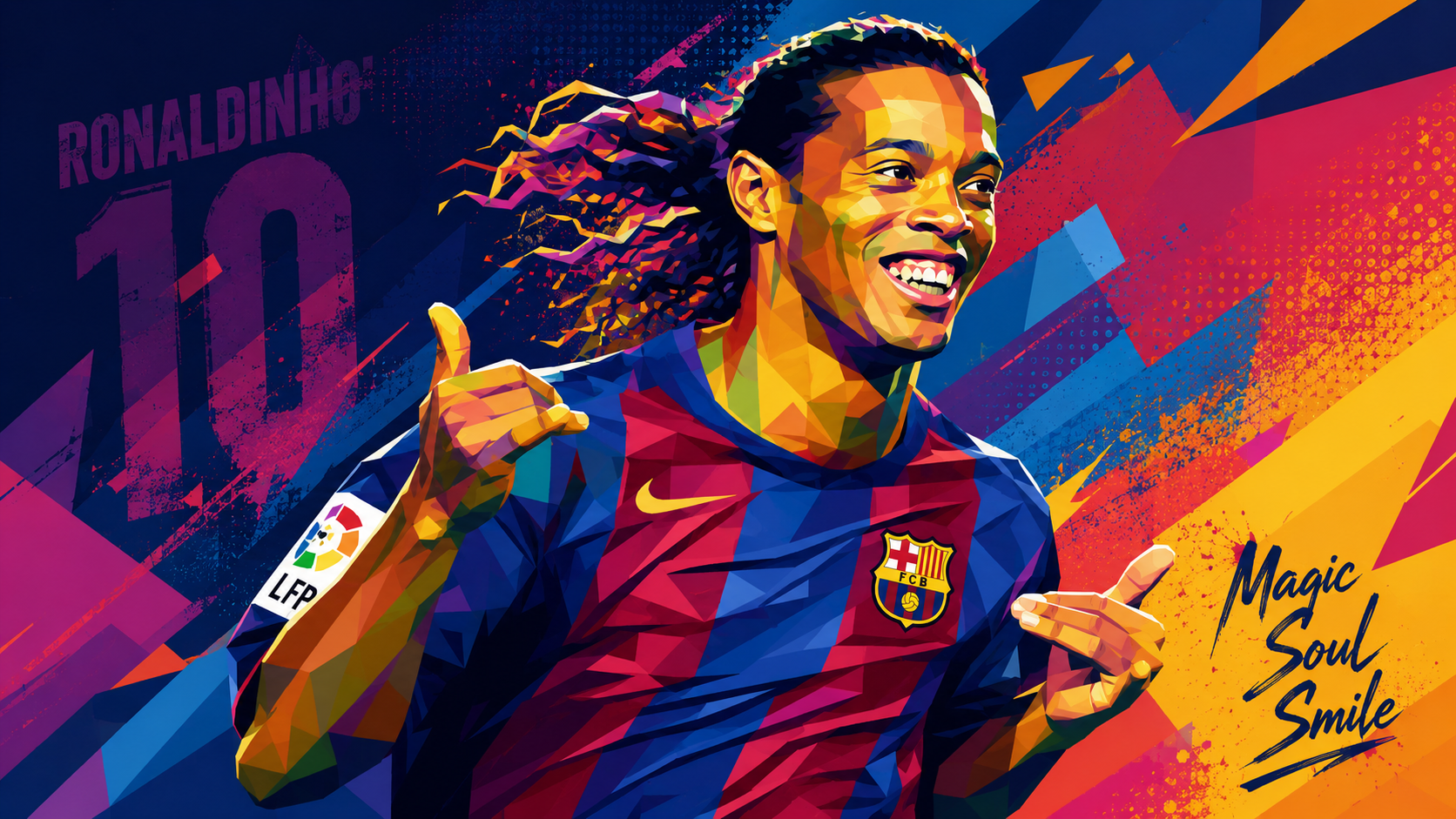
A footballer who made winning feel secondary to feeling alive, Ronaldinho arrived just before elite football became a machine and reminded the sport what freedom looked like.
The night the Bernabéu forgot to hate
There are moments in football when noise changes shape.
Not volume. Shape.
The Santiago Bernabéu had spent most of the night doing what it always did during the Galáctico era. Whistling, demanding, consuming. White shirts moved with the impatience of a club that considered beauty a requirement rather than a luxury. Every attack carried expectation. Every misplaced pass carried insult.
Then Ronaldinho touched the ball again.
By November 2005, Real Madrid had assembled football’s most expensive travelling theatre. Zinedine Zidane, David Beckham, Ronaldo Nazário and Roberto Carlos had turned the club into a global luxury brand. Florentino Pérez did not merely want victories. He wanted ownership of football’s imagination.
Barcelona arrived in Madrid carrying something more dangerous.
Freedom.
Ronaldinho drifted across the pitch with the loose rhythm of someone hearing music nobody else could fully recognise. He was not playing against defenders so much as rearranging them. Sergio Ramos lunged and missed. Iván Helguera backed away, uncertain whether to engage or retreat. The spaces around Ronaldinho seemed to stretch and collapse according to his mood.
Then came the second goal.
Samuel Eto’o released the pass into open grass and suddenly the entire stadium inhaled at once. Ronaldinho accelerated through the centre of Madrid’s defence with that strange, gliding stride that never quite looked fast until everyone else disappeared behind him. The ball remained absurdly close to his feet, as though tied there by invisible thread.
Casillas narrowed the angle. The Bernabéu rose. Ramos chased.
Too late.
Ronaldinho opened his body and drove the finish low beyond the goalkeeper.
For a second, there was silence.
Not ordinary silence. Something heavier.
Recognition.
Then came the applause.
Not from the away section high in the stadium. From Madrid supporters themselves. Thousands of them rising reluctantly, almost against instinct, to applaud a Barcelona player dismantling their team inside their own cathedral.
It should not have happened.
El Clásico does not permit generosity. The rivalry is built on inheritance, politics, geography and historical contempt. Barcelona players are not supposed to be admired in Madrid. They are supposed to be resisted.
Yet resistance had collapsed into awe.
The standing ovation matters because it exposed something deeper than admiration for skill. Football had seen entertainers before. Diego Maradona could humiliate entire teams. Johan Cruyff reshaped the geometry of the sport. George Best turned chaos into glamour. But Ronaldinho produced a rarer reaction. He dissolved hostility.
Even opponents smiled around him.
Perhaps that was why the comparison to Muhammad Ali always lingered around Ronaldinho, even if football never fully articulated it. Ali did not simply win fights. He made audiences feel emotionally involved in the act itself. People watched because they wanted to experience him. The outcome became secondary.
Ronaldinho created the same sensation.
Children copied his elastico in school playgrounds without understanding where it came from. Defenders fouled him, then grinned. Crowds arrived early just to watch warm-ups. Television broadcasts lingered on his smile as though producers understood instinctively that he changed the atmosphere before matches even began.
And yet the Bernabéu ovation contained another truth too.
It happened at precisely the moment elite football was beginning to move away from players like Ronaldinho forever.
The sport was becoming faster, more controlled, more systematised. Tactical structures tightened across Europe. Athleticism sharpened. Space shrank. Managers demanded pressing triggers, positional discipline and collective sacrifice. Football’s future belonged increasingly to organisation.
Ronaldinho belonged to instinct.
That contradiction sat underneath everything he became. It explains both the height of his brilliance and the brevity of it. He was the face of joy entering a sport already preparing to industrialise itself.
Which is why the applause in Madrid still feels almost impossible now.
Not because Ronaldinho embarrassed Real Madrid.
Because, for ninety minutes, one of football’s fiercest stadiums forgot to care only about winning.
Not wasted genius, but a cultural interruption
The easiest way to misunderstand Ronaldinho is to reduce him to a warning.
Modern football increasingly tells his story as a cautionary tale about excess. The smile became shorthand for indiscipline. The nightlife became explanation. The short peak became accusation. By the time he left FC Barcelona in 2008, a certain type of analysis had already hardened around him: brilliant, wasteful, unserious.
It is a neat narrative. It is also incomplete.
Ronaldinho did not fail football.
Football changed around Ronaldinho.
That distinction matters.
By the early 2000s, elite European football was accelerating toward a different future. Nutrition became scientific. Pressing structures became sophisticated. Recovery sessions, data analysis and positional discipline began replacing instinctive freedom. Managers increasingly preferred repeatability over improvisation. The sport was becoming less romantic and more exact.
Ronaldinho arrived at precisely the wrong moment for longevity and precisely the right moment for immortality.
His genius depended on emotional looseness. He played football with a kind of psychological elasticity that modern systems struggle to tolerate. Even at his peak, there was always the sense that Ronaldinho treated elite football as something slightly absurd. Stadiums, pressure, expectation, tactical structures, hostile atmospheres. None of it appeared heavy on him.
That was not carelessness. It was rebellion.
There is a tendency now to romanticise “street footballers” without properly defining what the term means. Usually it becomes empty shorthand for tricks and flair. Ronaldinho represented something more fundamental. He carried the logic of street football into the most commercialised era the sport had yet seen.
Improvisation over instruction. Rhythm over repetition. Expression over efficiency.
And for a brief period, he won.
This is why so many former players speak about Ronaldinho differently from other superstars. Not more respectfully necessarily, but more emotionally. They talk about how he made them feel.
Zinedine Zidane once captured it simply: watching Ronaldinho made people happy.
That word appears constantly around him.
Happy.
Not impressed. Not amazed. Happy.
Even now, compilations of Ronaldinho feel fundamentally different from those of almost any other footballer. They are not watched purely to study brilliance. They are watched to recover a feeling. A reminder that elite football once allowed itself to breathe.
And that is why the “wasted talent” framing often misses the point entirely.
Ronaldinho’s peak was short by the standards of Cristiano Ronaldo or Lionel Messi. Nobody can seriously dispute that. His physical decline arrived early. His discipline fluctuated. Barcelona eventually decided the club could not continue building around his lifestyle or his rhythms.
But greatness is not measured only in duration.
Some players dominate football statistically. Others alter its emotional temperature.
Ronaldinho belongs firmly in the second category.
Before him, technical brilliance often carried a certain severity. Maradona played with fury. Zidane carried aristocratic control. Even Brazilian genius traditionally arrived wrapped in pressure and expectation. Ronaldinho brought lightness back into elite football. Not superficial lightness, but something culturally deeper. He made joy look competitive.
That sounds sentimental until you remember the context he entered.
When Ronaldinho signed for Barcelona in 2003, the club was drifting. Joan Laporta had just won the presidency promising renewal after years of institutional decline. Real Madrid’s Galáctico project dominated global attention. Barcelona had not won La Liga since 1999. Camp Nou had become tense, impatient and fractured.
Laporta initially wanted Beckham. The marketing icon. The global celebrity. Pérez took him to Madrid instead.
Barcelona ended up with Ronaldinho almost by accident.
It changed the history of modern football.
Because Beckham would have commercialised Barcelona.
Ronaldinho re-enchanted it.
Porto Alegre, futsal and the making of freedom
Before Europe turned Ronaldinho into a global symbol, before the sponsors and the standing ovations and the grainy internet clips, there was Porto Alegre.
Not the postcard version of Brazilian football. Not Copacabana beaches or endless carnival imagery exported to Europe. Porto Alegre sits in Brazil’s deep south, closer in temperament to Uruguay and Argentina than the romantic stereotypes outsiders often attach to the country. The football there carries edge and competitiveness. Rivalries feel inherited. Technique matters, but so does resilience.
Ronaldinho grew up inside both worlds at once.
His father, João Moreira, worked as a shipyard employee and part-time footballer. His mother, Dona Miguelina, was a nurse. Football ran through the household naturally rather than professionally. His older brother, Roberto Assis, had already emerged as the family’s great hope, a gifted attacking midfielder expected to build a serious career in the Brazilian game.
Ronaldinho watched first.
That mattered.
A lot of elite footballers are shaped by organised coaching early. Ronaldinho was shaped by observation, imitation and improvisation. Futsal courts, street games and small-sided football became his real education. Tight spaces forced quick thinking. Heavy touches disappeared immediately. Balance mattered more than physical size. Deception became survival.
Years later, defenders across Europe would complain about the same thing: Ronaldinho never moved when they expected him to.
That unpredictability began in futsal.
He did not dribble like a winger attacking space in straight lines. He manipulated defenders in miniature. Weight shifts. Pauses. Tiny changes in rhythm. The ball seemed connected to the sole of his foot rather than pushed ahead of him. European defenders often looked confused because the cues they normally read simply were not there.
His body shape lied constantly.
Even the famous smile partly came from those environments. Brazilian street football and futsal culture reward expression as much as execution. Humiliation is part of the game. Flair carries social value. Nutmegs become memory. Improvisation earns status.
Ronaldinho absorbed all of it.
But the warmth surrounding his image has often obscured the harder edges underneath his upbringing.
When Ronaldinho was eight years old, his father died after a swimming pool accident at the family home. The loss hit the family heavily, emotionally and financially. Ronaldinho rarely discussed it publicly in great detail, but football became both refuge and language afterwards.
Assis stepped into the central male role within the household. Not only as older brother, but eventually as protector, adviser and manager. Their relationship would later become one of the defining forces of Ronaldinho’s career, for better and worse. Assis understood football’s business realities in ways Ronaldinho never appeared particularly interested in understanding himself.
That separation became important later.
Because Ronaldinho always seemed oddly detached from ambition in the traditional sense. Not lacking competitiveness. He was fiercely competitive on the pitch. But fame, legacy, Ballon d’Or rankings, statistical accumulation, historical positioning. Those things never appeared to consume him the way they consumed others.
Even as a teenager, coaches noticed the contradiction.
There are endless stories from Grêmio youth football about Ronaldinho arriving loose, laughing through sessions, appearing unserious, then humiliating everybody the moment the ball reached him. The smile would become mythology later. Initially, it confused people.
Brazilian football has always celebrated improvisation publicly while demanding structure privately. Ronaldinho existed right on that fault line. Coaches admired his genius but worried about his looseness. Teammates adored him but occasionally questioned his focus. Scouts saw impossible talent without quite knowing how it would function in elite European football.
Then came the goals.
In 1997, Ronaldinho helped Brazil win the FIFA U-17 World Championship in Egypt. Two years later, he made his senior Brazil debut and began to look like one of the country’s next great attacking exports. By the turn of the millennium, his name had crossed the Atlantic.
Yet even then, the mythology forming around him was subtly different from previous Brazilian stars.
Ronaldo terrified defenders. Romário antagonised opponents. Rivaldo carried a cold, devastating efficiency.
Ronaldinho invited people in.
That distinction explains why he crossed cultural boundaries so easily once he reached Europe. Fans who normally hated Brazilian showmanship found themselves surrendering to him because there was no aggression in the performance. He played with mischief rather than superiority.
And yet the foundations underneath it were deeply serious.
The balance. The deception. The manipulation of tempo. The ability to improvise under pressure.
None of it was accidental artistry.
Ronaldinho’s football looked free because thousands of unseen hours had made freedom possible.
Barcelona before Ronaldinho
By the summer of 2003, Barcelona looked exhausted.
Not financially ruined or structurally broken in the dramatic modern sense, but emotionally hollowed out. The club had drifted through the final years of Joan Gaspart’s presidency carrying the strange tension of an institution that still considered itself elite while increasingly behaving like one in decline. Coaches came and went. Signings felt reactive. Camp Nou had become restless. The team finished sixth in La Liga in 2002-03, outside the Champions League places for the second consecutive season.
Meanwhile, across Spain, Real Madrid were remaking football into spectacle.
Florentino Pérez understood something before almost everybody else: modern football was becoming entertainment industry as much as sport. The Galáctico era was not merely a recruitment strategy. It was branding disguised as team-building. Luís Figo, Zidane, Ronaldo and Beckham turned Madrid into a travelling cultural phenomenon. Shirts sold globally. Sponsors multiplied. Matches felt cinematic before kick-off.
Barcelona looked provincial beside them.
The club still possessed enormous prestige, but prestige alone no longer controlled football’s imagination. Madrid had glamour. Barcelona had anxiety.
That context matters because Ronaldinho did not arrive into a healthy giant. He arrived into an identity crisis.
Laporta’s presidential campaign in 2003 was built partly around the promise of signing Beckham from Manchester United. It made political sense. Beckham represented celebrity, visibility and modernity. When Madrid hijacked the deal, Barcelona suddenly risked beginning a new era by losing the biggest transfer battle in football.
Then Ronaldinho appeared.
At the time, the signing carried excitement but also uncertainty. He had dazzled for Paris Saint-Germain and Brazil, especially during the 2002 World Cup, but he was not yet universally considered the best player in the world. In Paris, coaches occasionally questioned his professionalism. European football still viewed Ronaldinho partly as an entertainer rather than a franchise-defining superstar.
Barcelona saw something else.
Or perhaps more accurately, they felt something else.
Joy sounds flimsy in modern football discourse because elite sport usually prefers colder language. Systems. Margins. Metrics. Structures. But Barcelona in 2003 needed emotional restoration before tactical reconstruction could even begin.
Ronaldinho gave them oxygen.
His debut season did not begin perfectly. Barcelona were inconsistent during the opening months under Frank Rijkaard. Sections of the media questioned whether Rijkaard was experienced enough. Laporta’s presidency still felt politically vulnerable. Madrid continued dominating attention.
Then gradually, something shifted.
Not only results. Atmosphere.
Camp Nou started arriving early simply to watch Ronaldinho warm up. Training clips spread across television broadcasts. Opposition supporters bought tickets partly for the possibility of witnessing something absurd happen live. Barcelona matches regained anticipation rather than obligation.
And crucially, the team began playing with emotional looseness again.
Rijkaard deserves enormous credit for understanding what Ronaldinho required. Many coaches would have tried immediately to discipline him positionally. Rijkaard instead built a structure that protected freedom without descending into chaos. Ronaldinho nominally started from the left, but the role functioned more like a roaming creative axis. Midfield balance behind him allowed drift. Full-backs overlapped selectively. The system bent around unpredictability rather than trying to suppress it.
This was not tactical anarchy.
It was controlled liberation.
And it transformed Barcelona quickly.
By the second half of the 2003-04 season, the team accelerated hard. Barcelona climbed from mid-table uncertainty into second place behind Valencia. Ronaldinho’s numbers mattered, but they only partially explained his impact.
He had changed the emotional weather around the club.
Players spoke differently. Supporters behaved differently. Even the football itself looked lighter.
Elite clubs often recover competitively before they recover culturally. Barcelona under Ronaldinho reversed both processes simultaneously. He made winning feel expressive again rather than merely necessary.
And in doing so, he quietly redirected the future of the club.
Because the Barcelona that later conquered Europe under Guardiola did not emerge from nowhere. The technical foundations already existed inside La Masia, but institutions also require emotional identity. Ronaldinho restored Barcelona’s belief that beauty itself could become competitive strategy.
That idea changed football almost as much as the trophies that followed.
Becoming unavoidable
There is a difference between being admired and being unavoidable.
By 2004, European football admired Ronaldinho. Defenders respected him. Supporters bought his shirts. Advertisers recognised the commercial potential immediately. But admiration still allows distance. Admiration permits caveats.
Unavoidable players remove them.
Ronaldinho crossed that threshold during the next two seasons.
Not gradually either. Suddenly.
By the autumn of 2004, Barcelona no longer felt like a recovering club. They felt like the centre of football’s imagination. The team played quickly but not mechanically. Attacks unfolded with improvisational rhythm rather than rigid sequencing. Opponents knew where Ronaldinho would begin phases, yet still could not predict where he would finish them.
Left wing. Central spaces. Half-turns between midfield lines. Blindside runs into the box. Impossible passes struck without apparent backlift.
He turned matches into emotional events rather than tactical contests.
And unlike many entertainers, Ronaldinho produced relentlessly at elite level. That often gets lost beneath the mythology. During the 2004-05 season, he drove Barcelona to their first La Liga title in six years. More importantly, he became football’s gravitational centre. Every major night seemed to involve him somehow.
The Chelsea ties under José Mourinho accelerated that transformation.
If Ronaldinho represented freedom, Mourinho’s Chelsea represented football’s emerging future. Controlled pressing. Physical intensity. Defensive structure. Ruthlessness. Chelsea were not interested in spectacle. They were interested in domination.
Which made Ronaldinho’s performance against them in the 2005 Champions League feel almost ideological.
At Stamford Bridge, Barcelona lost 4-2 in a chaotic second-leg defeat remembered partly for Mourinho sprinting down the touchline after John Terry’s goal. Ronaldinho still scored twice, gliding through pressure as though the match existed at a slower tempo around him.
The second goal remains difficult to explain properly because it violates football logic. Ronaldinho received possession outside the penalty area surrounded by defenders. Chelsea’s back line remained compact. There was no obvious shooting angle. No space for a full swing of the leg.
He barely moved.
A tiny shift of balance. A pause. Then the toe-poked finish rolled past Petr Čech before anybody fully processed the decision.
That goal captured the essence of his genius more accurately than the elaborate tricks usually associated with him. Ronaldinho’s greatest weapon was not flair alone. It was timing. He manipulated football’s rhythm psychologically. Defenders planted weight fractions too early. Goalkeepers reacted half-seconds too late. Entire defensive systems lost coherence because Ronaldinho disrupted sequence itself.
By 2005, he was unquestionably the game’s dominant individual force.
The Ballon d’Or confirmed it officially that November. Ronaldinho finished ahead of Frank Lampard and Steven Gerrard after a year in which he had not merely outperformed rivals, but culturally overwhelmed them.
Then came the Bernabéu.
The standing ovation often gets remembered as an isolated act of sportsmanship. In reality, it represented culmination. Madrid supporters were applauding the player who had spent two years reshaping football’s emotional hierarchy.
His two goals that night felt almost cruel in their simplicity.
The first arrived after Barcelona sliced through Madrid’s midfield transition far too easily. Ronaldinho surged forward, glided beyond Sergio Ramos and finished low beyond Casillas.
The second was even harsher.
Barcelona broke again. Madrid retreated desperately. Ronaldinho accelerated directly through the centre of the pitch, his stride lengthening as white shirts collapsed around him. Ramos chased. Helguera hesitated. Casillas advanced. Finish. Silence. Then applause.
Not polite applause.
Disbelieving applause.
That was the key.
Ronaldinho did not rely primarily on surprise. Opponents understood the danger completely. They still failed because his game operated on emotional unpredictability rather than mechanical unpredictability. He played according to instinctive feeling. Defenders trained to anticipate patterns found themselves confronting improvisation instead.
And perhaps most remarkably, the joy never disappeared under the pressure.
This was not carefree football played in obscurity. Ronaldinho carried the expectations of Barcelona, Brazil and global marketing campaigns simultaneously. Nike built entire advertising worlds around him. Children imitated him obsessively. Stadiums filled because he was present.
Yet he continued smiling through matches as though elite football remained fundamentally playful.
That emotional lightness altered how audiences experienced the sport itself.
Supporters increasingly attended matches hoping not simply for victory, but for moments. A no-look pass. A ridiculous first touch. An impossible dribble completed with laughter rather than aggression. Ronaldinho made artistry feel central again during an era increasingly obsessed with output.
And because of that, something unusual happened.
Even rival fans began wanting Barcelona to have possession.
Why he was almost impossible to defend
Trying to explain Ronaldinho purely through highlights is like trying to explain jazz through isolated notes.
The tricks mattered. The goals mattered. But neither fully captured why defenders lost emotional control around him.
Ronaldinho’s genius lived in disruption.
Not tactical disruption in the modern analytics sense. Psychological disruption. He destabilised the emotional rhythm of matches. Defensive lines stopped behaving naturally. Opponents became reactive instead of assertive. Entire stadiums tilted toward anticipation every time he received possession.
That effect is extremely rare.
Most elite attackers impose pressure through efficiency. Cristiano Ronaldo attacked space at maximum velocity. Messi reduced angles through impossible precision. Ronaldinho imposed pressure through uncertainty. Nobody ever felt fully prepared for what came next, including his own teammates at times.
He operated inside football’s structure while appearing detached from it.
Technically, his game made little sense by conventional European coaching logic.
He was listed most commonly as a left winger or No.10, but neither label fully worked. Ronaldinho drifted constantly between zones because he interpreted space emotionally rather than geometrically. He moved toward possibility rather than positional instruction. One phase might see him isolated wide against a full-back. The next would find him dropping into midfield to dictate tempo before suddenly arriving inside the penalty area seconds later.
Rijkaard understood early that over-coaching him would destroy the point entirely.
That freedom became Barcelona’s competitive advantage.
Ronaldinho’s body mechanics were especially difficult for defenders because almost every movement carried deception. European football traditionally teaches players to read cues: hips, shoulders, stride patterns, planting feet. Ronaldinho corrupted those signals. His upper body frequently suggested one action while the ball travelled elsewhere. He slowed when defenders expected acceleration and accelerated from moments that looked static.
The famous elastico embodied the principle perfectly.
To casual viewers, it looked like flair for flair’s sake. In reality, it functioned as balance manipulation. Ronaldinho shifted defenders’ centre of gravity fractions of a second before changing direction. Once weight transferred incorrectly, recovery became impossible.
And unlike many dribblers, he rarely appeared hurried.
That calmness unnerved people.
He did not attack defenders with repeated motions. He explored them.
That distinction separated him from almost everybody else of his era.
Futsal shaped much of this. Ronaldinho played football like somebody raised in compressed spaces rather than expansive tactical systems. Short touches. Rapid changes in direction. Manipulation of tiny passing lanes. Sole-of-the-foot control. Delayed decisions. He often resembled a street footballer accidentally wandering into Champions League matches and discovering nobody could stop him there either.
But reducing him to flair alone still misses the sophistication underneath.
Ronaldinho understood tempo at an elite level.
This is perhaps the least discussed aspect of his game because tempo manipulation rarely translates properly into statistics or highlight clips. Yet it defined everything he did. Ronaldinho controlled emotional pace within matches. He knew exactly when to accelerate attacks and when to suspend them. Sometimes he held possession an extra second simply to increase tension in the stadium before releasing the decisive action.
Crowds moved with him.
That matters more than it sounds.
Most footballers respond to atmosphere.
Ronaldinho conducted it.
You could see defenders becoming infected by the crowd’s anticipation. Full-backs backed away too early because they feared embarrassment. Midfielders stepped out recklessly because they wanted to stop the performance before it escalated. Entire defensive structures bent under emotional pressure before any actual damage occurred.
Few players in football history have weaponised anticipation so effectively.
Then there was the smile.
It sounds superficial until you realise how psychologically unusual it was within elite competition. Football is built on visible tension. Anger. Fear. Pressure. Obsession. Ronaldinho often looked genuinely delighted to be there. Not theatrically. Authentically.
That happiness transmitted itself.
Children copied him because he made football feel accessible emotionally, even if technically impossible. Coaches worried about him because structure weakens when players start improvising excessively. Teammates relaxed around him because tension dissolved in his presence. Sponsors adored him because he communicated joy globally without translation.
For a while, he became football’s universal language.
Which explains why his influence spread far beyond Barcelona supporters or Brazilian fans. Ronaldinho arrived just as internet football culture exploded globally. Early YouTube, Nike commercials, desktop compilations, satellite television expansion. His style translated perfectly into the new visual era. Young fans in countries with little connection to Brazilian football suddenly grew up trying no-look passes and elasticos in playgrounds.
Modern football culture, especially online football culture, owes an enormous debt to Ronaldinho.
Not because he was the best player ever.
Because he made football feel expressive rather than instructional.
And that is why coaches simultaneously loved and feared him.
Genius can be accommodated. Freedom is harder.
Joy against the machine
The timing of Ronaldinho’s peak was almost cruelly perfect.
Had he arrived a decade earlier, football might have accepted him more naturally. Had he arrived a decade later, the systems may have suffocated him faster. Instead, Ronaldinho appeared during a brief transitional window when elite football still contained enough looseness for spontaneity to survive at the very highest level.
But only just.
By the mid-2000s, the sport was changing rapidly beneath the surface. Tactical systems became increasingly synchronised across Europe. Sports science expanded aggressively. Recovery, nutrition and conditioning evolved from supporting mechanisms into central pillars of elite performance. Clubs invested heavily in reducing unpredictability from every possible angle.
Ronaldinho embodied unpredictability.
That contradiction sat underneath his entire career.
To supporters, his freedom looked effortless. To coaches, it carried permanent risk. Every system depends on trust in collective positioning. Ronaldinho frequently ignored positional conventions because he followed instinct instead. Sometimes that instinct created genius. Occasionally it created structural imbalance. Rijkaard tolerated it because the rewards overwhelmed the costs.
Not every manager would have.
And perhaps no coach represented the sport’s new direction more clearly than Mourinho.
The Barcelona-Chelsea rivalry in the mid-2000s was not simply a clash between strong teams. It felt philosophical. Mourinho’s Chelsea operated with controlled aggression, tactical discipline and emotional intensity. They closed spaces quickly. Pressed with purpose. Defended transitions ruthlessly. Everything carried collective logic.
Ronaldinho moved through them like somebody rejecting logic entirely.
That was partly why those matches felt so compelling. They represented two competing visions of modern football. One based increasingly around organisation and control. The other around improvisation and emotional spontaneity.
The future eventually chose Mourinho’s direction.
Not immediately. But unmistakably.
Look at elite football now and you can see the shift everywhere. Wide players track full-backs relentlessly. Creative freedom exists within strict structural frameworks. Pressing systems demand synchronised movement from every attacking player. Recovery data influences training loads daily. Managers speak constantly about distances between units and off-ball discipline.
Football became more efficient.
It also became less forgiving toward chaos.
That evolution helps explain why Ronaldinho’s decline arrived so sharply after 2006.
The lazy version says he simply partied too much.
There is truth there, certainly. Ronaldinho enjoyed nightlife openly and rarely pretended otherwise. Barcelona insiders later admitted concerns about training standards and recovery habits. Guardiola eventually concluded the dressing room culture surrounding Ronaldinho had become unsustainable for the future he envisioned.
But reducing everything to nightlife misses the larger reality.
Ronaldinho’s football required emotional looseness to function fully. The spontaneity people adored could not easily coexist with the increasingly mechanised demands of elite football. He played on instinctive rhythm. Modern football increasingly demanded behavioural consistency.
That tension exhausted both sides eventually.
The 2006 World Cup exposed it brutally.
Brazil arrived in Germany carrying perhaps the most commercially celebrated squad in football history. Ronaldinho, Ronaldo, Adriano and Kaká became known collectively as the “magic quartet”, a phrase that sounded magnificent in marketing campaigns and increasingly incoherent on actual football pitches.
The atmosphere around the team drifted toward spectacle rather than clarity. Training sessions became media events. Advertising commitments followed players constantly. Expectation hardened into performance theatre.
And Ronaldinho looked strangely constrained by it all.
This remains one of the most misunderstood tournaments of his career because people often frame it as simple underperformance. In reality, the World Cup revealed the limits of trying to institutionalise spontaneity. Brazil attempted to package joy into a guaranteed outcome. Football does not work that way.
When France eliminated Brazil in the quarter-finals, orchestrated magnificently by Zidane, the contrast felt symbolic. Zidane controlled the match with cold authority. Ronaldinho struggled to impose rhythm against a disciplined defensive structure that refused emotional engagement.
The tournament marked a turning point.
Not immediately in terms of output. Ronaldinho still produced moments afterwards. But the aura of invincibility weakened. Gradually, Barcelona’s internal priorities shifted too. The club still adored Ronaldinho, but younger players emerging through the system increasingly represented a different future.
More disciplined. More positionally exact. More relentless.
And standing quietly in the middle of that transition was Messi.
This is where Ronaldinho’s story becomes genuinely complicated. Because Barcelona did not betray him exactly. They evolved beyond him.
Messi, Guardiola and the end of the carnival
There is a temptation to frame Ronaldinho’s Barcelona ending as collapse.
Too simplistic.
Decline, certainly. Physical drop-off, unquestionably. The explosiveness faded. Recovery slowed. Nights became longer. Training standards became inconsistent. By 2007, there were already whispers inside Barcelona that the dressing room had grown too comfortable, too celebratory, too dependent on emotional rhythm instead of competitive edge.
But collapse suggests chaos.
What actually happened was succession.
And the succession mattered because it revealed what modern football ultimately values most.
When Pep Guardiola took over Barcelona’s first team in 2008, he inherited a club caught awkwardly between eras. Ronaldinho still carried enormous symbolic power. He remained globally adored, commercially magnetic and emotionally central to the identity Barcelona had rebuilt since 2003.
Yet Guardiola immediately understood something ruthless.
The next Barcelona could not be built around looseness.
It needed intensity. Precision. Control.
Guardiola later denied making a personal statement against Ronaldinho specifically, but the logic was unmistakable. The dressing room culture had drifted too far from competitive obsession. Players arrived late. Recovery discipline weakened. Standards blurred. The emotional warmth that once liberated Barcelona had gradually softened its edge.
Guardiola chose structure.
And in doing so, he accelerated the rise of Messi.
That transition remains one of the most fascinating cultural handovers in football history because it was not merely tactical. It represented the sport changing philosophical direction in real time.
Ronaldinho’s Barcelona made football feel joyful again.
Guardiola’s Barcelona made football feel inevitable.
Both were beautiful. But they were beautiful differently.
Ronaldinho operated through improvisation. Guardiola built systems that reduced improvisation’s necessity. Under Rijkaard, Barcelona often bent around Ronaldinho’s emotional state. Under Guardiola, the team itself became the controlling intelligence.
Messi sat perfectly between both worlds.
That is partly why he became so devastating historically. Messi inherited Ronaldinho’s technical imagination while absorbing Guardiola’s positional discipline. He carried traces of street football genius inside a framework of machine-like precision.
Ronaldinho helped create the emotional conditions for Messi to flourish. Guardiola created the structural conditions.
Neither part should be ignored.
Messi himself has always spoken about Ronaldinho with unusual warmth. Reflecting years later, he credited Ronaldinho’s welcome and support as being crucial during his first moments in the Barcelona first team. For a shy teenager entering one of football’s most pressurised environments, that mattered enormously.
There are stories from those early years that reveal the relationship clearly.
Ronaldinho pulling Messi into celebrations. Ronaldinho demanding senior players respect him. Ronaldinho searching for him constantly during matches. Ronaldinho celebrating Messi’s first Barcelona goal almost more enthusiastically than Messi himself.
That goal, against Albacete in May 2005, arrived from a delicate Ronaldinho chip over the defence.
The image now feels strangely poetic.
One era lifting the next into existence.
No insecurity. No protection of status. No bitterness.
That generosity shaped Barcelona’s future more than most transfer decisions.
Because dressing rooms are emotional ecosystems as much as tactical ones. Young players do not emerge purely through coaching structures. They emerge through confidence, protection and belonging. Ronaldinho provided all three.
And yet there is an irony sitting underneath the mythology.
The football world Ronaldinho helped reopen emotionally eventually became too demanding for Ronaldinho himself.
Barcelona’s next phase required relentless physical intensity. Guardiola’s pressing structures demanded concentration without the ball. The collective system became sacred. Every player moved according to positional logic. Freedom still existed, but it existed inside discipline.
Ronaldinho could inspire systems.
He could never truly live inside them.
That is not criticism.
It is definition.
Even physically, his body seemed built for explosion rather than longevity. Ronaldinho played football at emotional maximum intensity. Sharp directional shifts. Constant improvisation. Balance manipulation. Repeated contact from defenders. The game flowed through him continuously. There was very little conservation in the way he performed.
Some players age through adaptation.
Ronaldinho burned brightly instead.
And because the peak ended relatively early, modern football increasingly judges him strangely. Statistical culture often struggles with players whose greatness was concentrated rather than sustained. The careers of Messi and Cristiano Ronaldo have distorted perceptions of longevity almost beyond recognition. Twenty years of obsessive consistency now feels normal at elite level.
It is not normal.
Ronaldinho’s prime was shorter.
Its emotional impact was arguably broader.
Ask football supporters of a certain generation which player made them fall in love with the sport and Ronaldinho appears constantly in the answers. Not always because he was the best. Sometimes not even because they supported Barcelona or Brazil.
Because he represented possibility.
He made football feel less instructed.
And perhaps that is why his decline felt emotionally difficult in ways other declines do not. When Ronaldinho faded, supporters were not simply watching a player lose physical sharpness. They were watching a particular kind of football disappear with him.
The carnival was ending.
The machine was taking over.
Returning to the Bernabéu
The applause at the Bernabéu lasted only seconds.
That is part of why it endures.
Football moves quickly. Stadiums rarely pause long enough for reflection. Rivalries certainly do not. Yet on that November night in 2005, something interrupted the normal emotional order of El Clásico. Tens of thousands of Madrid supporters stood and applauded a Barcelona player while their own team collapsed around him.
The moment still feels surreal because it violated football instinct.
But it also revealed something important about Ronaldinho that statistics never fully captured.
He made audiences surrender voluntarily.
Not tactically. Emotionally.
Watch the second goal again now and it becomes clearer why the reaction happened. The finish itself is excellent but not impossibly elaborate. There are technically superior goals in Ronaldinho’s catalogue. The brilliance lies in the sensation surrounding the movement. The acceleration through midfield feels inevitable and improvised simultaneously. Madrid defenders look not merely beaten, but destabilised by uncertainty.
Everybody inside the stadium knows something is coming.
Nobody can stop it arriving.
And then there is Ronaldinho himself.
No rage. No chest-thumping aggression. No performative dominance.
Just the smile.
That mattered more than people realised at the time.
Football’s greatest superstars often carry visible intensity. Maradona played as though every match contained political insult. Cristiano Ronaldo approached football like an endless competitive trial. Even Messi, outwardly quiet, radiated obsessive concentration during his peak years.
Ronaldinho felt emotionally open instead.
The smile lowered resistance. It invited spectators into the performance rather than placing them beneath it. That is partly why opposing supporters reacted differently to him than they did to almost any other superstar. Rival fans could resent greatness. Ronaldinho made resentment difficult to sustain.
The Bernabéu ovation therefore becomes larger than sportsmanship.
It was recognition that football itself had briefly escaped its own pressures.
By 2005, elite football already carried the shape of the modern era. Television money expanded aggressively. Tactical systems tightened. Clubs became global corporate entities. Superstars increasingly operated as brands alongside athletes. Every major institution pursued optimisation relentlessly.
And in the middle of all that arrived Ronaldinho, playing as though none of it quite mattered.
Not because he lacked competitiveness.
Because he refused football’s fear.
That distinction explains why supporters still speak about him with a kind of emotional softness rarely attached to other great players. Ronaldinho represented release. Watching him felt liberating during a period when football was becoming increasingly burdened by expectation and control.
Even his mistakes became strangely humanising.
There were matches where tricks failed. Passes drifted loose. Decision-making became excessive.
Supporters accepted it because the risk itself formed part of the experience. Ronaldinho’s football depended on vulnerability. Improvisation only works when failure remains possible.
Modern elite football often minimises failure wherever it can.
Ronaldinho built performance around the possibility of it.
That is why the Bernabéu applause still resonates historically. Not because Madrid supporters suddenly abandoned tribal loyalty. The rivalry remained fierce before and after. But for a few seconds, football spectators responded instinctively to beauty before allegiance.
That almost never happens anymore.
Today’s game is too polarised, too tribalised and too digitally accelerated. Players become avatars for online argument within minutes. Every action enters statistical warfare immediately. Greatness gets processed analytically before it can settle emotionally.
Ronaldinho existed just before that transformation fully consumed football culture.
He arrived at the final moment when wonder still felt uncomplicated.
And perhaps that is the hidden sadness underneath the famous ovation.
The crowd inside the Bernabéu did not simply recognise Ronaldinho’s brilliance that night.
They recognised a version of football that was already beginning to disappear.
What Ronaldinho changed
Ronaldinho’s legacy is often discussed through emotion first.
The smile. The tricks. The music of his movement. The compilations passed endlessly between generations.
All true. None sufficient.
Because Ronaldinho changed football in ways that reached far beyond entertainment.
He altered what supporters expected elite footballers to feel like.
Before Ronaldinho, greatness often arrived carrying distance. The biggest stars could seem intimidating, unreachable or psychologically sealed off from ordinary supporters. Ronaldinho collapsed that distance. He played with such visible delight that fans began experiencing elite football less as observation and more as participation.
People did not simply watch Ronaldinho.
They joined him emotionally.
That shift mattered enormously in the sport’s global expansion during the 2000s.
Football was already becoming worldwide commercially, but Ronaldinho accelerated its emotional accessibility. Children in cities with no cultural relationship to Barcelona suddenly supported Barcelona because of him. Young players tried elasticos on concrete pitches, school playgrounds and futsal courts across every continent. His style translated universally because joy requires no tactical education.
And crucially, he emerged at the exact moment digital football culture exploded.
Early online football culture was practically built for Ronaldinho. Grainy compilations, Nike adverts, freestyle clips, impossible assists, no-look passes. The internet transformed him from superstar into myth almost instantly. Millions of younger supporters first learned football emotionally through Ronaldinho clips rather than full matches.
Modern football’s aesthetics owe him an enormous debt.
The obsession with technical expression online. The celebration of improvisation. The cultural prestige attached to flair. The crossover between street football and elite football imagery.
Ronaldinho helped normalise all of it globally.
You can trace pieces of him through entire generations afterwards.
Neymar inherited the theatrical looseness and futsal instincts. Eden Hazard carried similar low-centre balance and improvisational rhythm. Jamal Musiala sometimes glides through pressure with echoes of Ronaldinho’s body control. Countless futsal-influenced technicians grew up believing elite football could still accommodate imagination because Ronaldinho had proved it once.
Even beyond specific players, his influence reached coaching philosophy and club identity.
Barcelona’s modern image cannot be separated from him. Guardiola perfected the system later, certainly, but Ronaldinho restored the emotional confidence that made the revolution possible. Without Ronaldinho, there is no guarantee Barcelona fully commit to technical idealism as institutional identity. They might easily have drifted toward a more commercially imitative version of Real Madrid instead.
Instead, Ronaldinho made beauty competitive again at Camp Nou.
That became foundational.
And yet his legacy remains strangely contested in modern football discourse.
Partly because the sport increasingly rewards longevity and statistical accumulation above emotional impact. The Messi-Cristiano era fundamentally altered perceptions of greatness. Seasons once considered extraordinary now appear merely excellent beside their numbers. Careers are measured through sustained output, pressing intensity, Champions League totals and Ballon d’Or counts.
Ronaldinho does not fit neatly inside that framework.
His peak lasted roughly four years at absolute world-dominating level. By modern standards, that feels brief. Critics use it against him constantly.
But there are different kinds of historical importance.
Some players define eras statistically.
Others redefine possibility.
Ronaldinho belongs emphatically in the second category.
He reminded football that entertainment was not separate from elite competition. In fact, he demonstrated the opposite. Joy itself could destabilise opponents psychologically. Improvisation could become tactical advantage. Emotional freedom could overpower structured control, at least temporarily.
That last phrase matters.
Temporarily.
Because Ronaldinho’s career also revealed something uncomfortable about modern football’s evolution. The sport loved his freedom aesthetically, but gradually rejected it structurally. Systems tightened. Physical demands intensified. Tactical discipline became non-negotiable. The very conditions that once allowed Ronaldinho to flourish became increasingly rare.
In that sense, his career now looks almost transitional historically.
He was the last global superstar of football’s romantic age before optimisation fully arrived.
That does not make modern football worse automatically. Guardiola’s Barcelona produced extraordinary beauty through collective structure. Messi reached levels of sustained excellence Ronaldinho never approached. Today’s tactical sophistication can still create astonishing football.
But spontaneity occupies less space now. Risk carries less tolerance. Improvisation survives inside systems rather than above them.
Ronaldinho represented the opposite idea.
Football as emotional expression first.
Everything else second.
The freest footballer of the modern age
Years after the trophies faded into museum rooms and the physical sharpness disappeared from his game, Ronaldinho still carried the same expression whenever cameras found him.
The smile remained untouched by legacy debates.
Football, especially modern football, has a habit of turning its greatest figures into arguments. Numbers become ammunition. Careers become rankings. Entire generations are reduced to comparison charts and statistical warfare. Greatness gets flattened into efficiency.
Ronaldinho resists that process more than almost anybody.
Not because he lacked achievement. A World Cup. A Champions League. A Ballon d’Or. League titles in multiple countries. For a period between 2004 and 2006, he was unquestionably the best footballer on the planet.
But none of those facts explain why people still talk about him the way they do.
The real explanation is simpler.
He reminded millions why they loved football before football became work.
Before tactical discourse consumed every match. Before players became global content ecosystems. Before supporters experienced games partly through phones and second screens. Before elite football began feeling permanently accelerated.
Ronaldinho slowed everything down just enough for people to feel wonder again.
That was his real gift.
Not the elastico. Not the no-look passes. Not even the standing ovation at the Bernabéu.
It was the atmosphere around him.
For a few years, the sport’s endless pressure seemed to dissolve whenever Ronaldinho touched the ball. Stadiums relaxed. Crowds anticipated possibility instead of merely demanding victory. Even opponents occasionally looked caught between competition and admiration.
Very few athletes have ever changed the emotional temperature of their sport like that.
Which is why the comparison to Muhammad Ali ultimately makes sense.
Ali made boxing feel alive beyond scorecards and titles. People came to experience the performance as much as the contest itself. Ronaldinho did something similar for football. He transformed elite competition into shared joy.
And perhaps the most remarkable part is this:
He did it during the exact moment football was beginning to lose that quality.
The modern game moved on afterwards. It became more tactical, more controlled, more optimised. In many ways, better. Certainly more sophisticated. Guardiola’s Barcelona perfected structures Ronaldinho’s version could never have sustained. Messi reached levels of precision and consistency beyond anything football had previously seen.
But something changed too.
The space for improvisation narrowed. The tolerance for chaos shrank. The carnival slowly gave way to the machine.
Ronaldinho now feels like the last global superstar from the moment before that transition became permanent.
Not football’s greatest player. Perhaps not even its most complete.
But maybe its freest.
Football became more efficient after Ronaldinho.
It never became more joyful.
