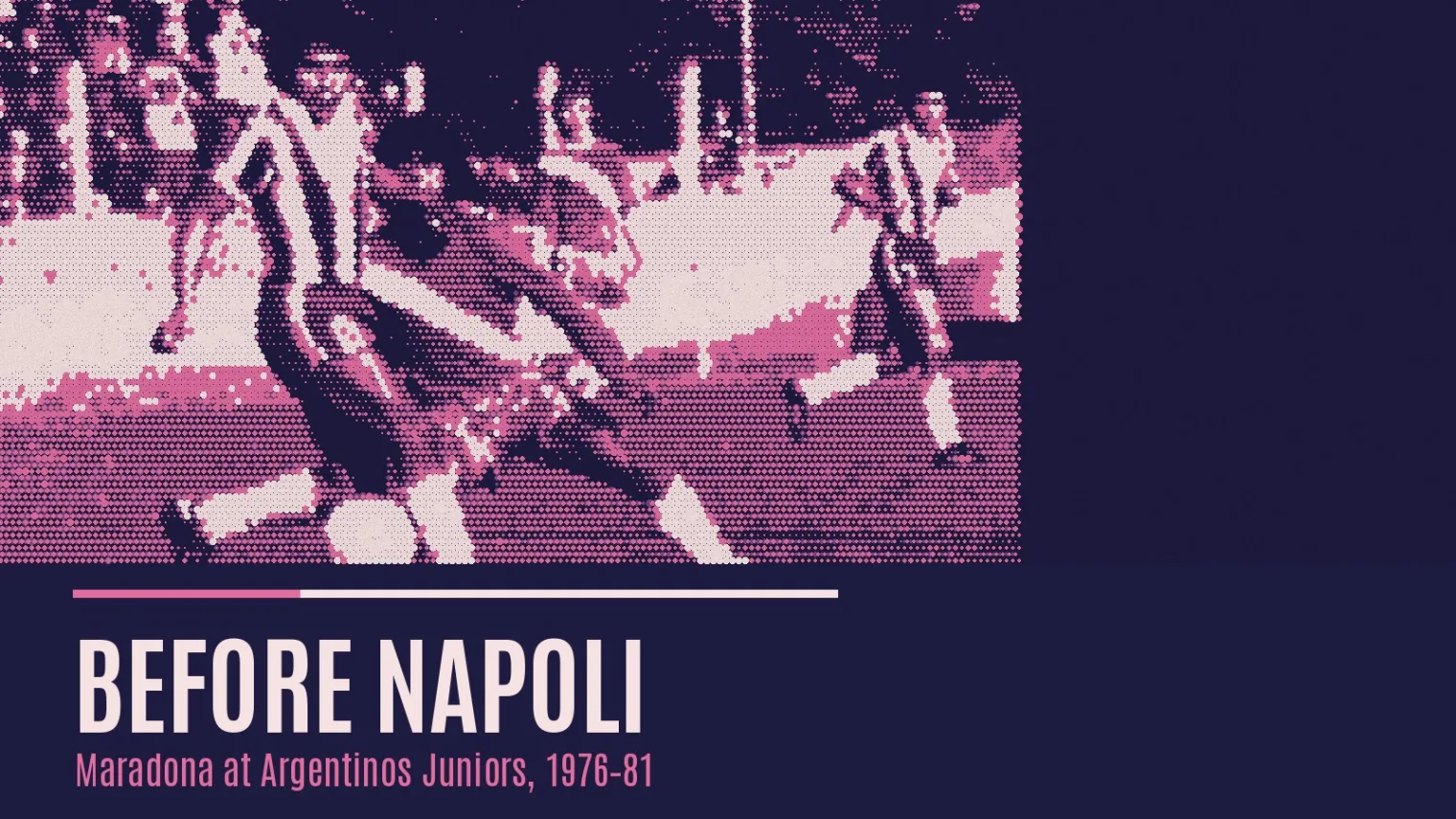
On 14 November 1976, in a stadium that no longer exists, a 16-year-old who had not yet started a first-team match scored twice in the space of three minutes. The ground was the Estadio General San Martín in Mar del Plata, later demolished, and the opponents were not the San Lorenzo most people mean when they say the name. They were San Lorenzo de Mar del Plata, one of two local sides in that Nacional, already adrift at the bottom of Zona D. Argentinos Juniors won 5-2. Carlos “Bartolo” Alvarez scored the other three. The two that still get mentioned, 50 years later this week, belonged to Diego Armando Maradona.
He had come on at the start of the second half, in the number 15 shirt, for Rubén Giordano. The half-time score was 1-1. The interim coach, Jorge Enrico, had begun the afternoon with him on the bench. By the time Segundo César Cheppi filed his report for La Capital, the local paper, the change had already rewritten the game. “The expectation that Maradona’s appearance had created was quickly confirmed,” Cheppi wrote. “In his first involvement he gave ample proof of his tremendous skill and intelligence. A surprise touch, and the marker was left standing. Around him, Argentinos Juniors began to have command of the ball.”
The first goal came in the 42nd minute of the second half. He beat three men, laid the ball off to Hallar, and scored on the return, a low, crossed left-foot shot. The second, three minutes later, was simpler: an Ingaramo cross, placed inside the right-hand post. The goalkeeper was Rubén Lucangioli, who would spend the rest of his life being asked about those two finishes, and who never seemed to mind. “I don’t mind being remembered for goals that were scored against me,” he said later. “Those goals were scored by Maradona, the best player in the world. How could that upset me?” There is no film of either. The photographers Ismael Daoud and Néstor Alfonso were there, and the stills survive. The attendance was thin. La Capital has given it as 1,355 tickets sold, and, in a later anniversary piece, as 1,335 spectators. Either way, it was a long way from the crowds that would later swear they had been at his debut.
This is not the Maradona of Naples, or of Mexico City, or of the afternoon at the Sánchez Pizjuán when the world decided it already knew him. This is the five seasons before all of that, at a small club in La Paternal, when the boy from Villa Fiorito was still Argentinos Juniors’ player, and when Argentinos, in turn, built itself around him.
A Saturday in Parque Saavedra
RSSSF records his date of birth as 30 October 1960, in Lanús. The childhood that matters to the story was spent a little further south, in Villa Fiorito, a poor barrio on the edge of Buenos Aires. Francisco “Francis” Cornejo, who coached the children’s section at Argentinos Juniors, would later recall a midweek conversation after training with Gregorio “Goyo” Carrizo, a striker from the same neighbourhood. In Cebollita Maradona, the book published under Cornejo’s name in 2001 and quoted at length by Infobae, Carrizo asks whether he can bring a friend. “Don Francis, I’ve got a friend who plays very well, he plays better than I do, can I bring him?” Cornejo asks how old the boy is. “The same as me.” And where is he from? Fiorito, near Carrizo’s house. “Fine, bring him on Saturday,” Cornejo says, and forgets about it. He did not need more players.
The Saturday was in March 1969, on wet grass in Parque Saavedra, at a trial for the 1960 age group. Cornejo, a Banco Hipotecario employee who advised the club’s youth sides, had been at Argentinos since the 1950s. He did not believe the boy’s age. “They say that at least once in their life every man witnesses a miracle, but that most people don’t notice,” he wrote. “I did. Mine happened on the afternoon of a Saturday in March 1969, on the wet grass of Parque Saavedra, when a short kid, who told me he was eight — and I didn’t believe him — did wonders with the ball. Things I had never seen anyone do.” He remembered, in particular, the way the boy killed a ball out of the air. Other children brought it down and then let it drop. This one did not.
El País, in its 2008 obituary of Cornejo, called him the man who uncorked the bottle. Cornejo himself was more modest. “There are plenty of skilful kids, but most of them have ten points in their feet and nothing in their head,” he said. “If a boy has ten down below and ten up top, you’ve got a genius like Diego. I was lucky that it was me. It could have been anyone.” He also liked a line of Maradona’s that placed him in the hard years: “Francis is from the ugly time, when your stomach made little noises.” Cornejo’s own verdict was simpler. “Maradona is the son I never had, and with that I am satisfied.”
The side Cornejo built around him was known as Los Cebollitas, the little onions, the children’s section of Argentinos Juniors. They won the old Torneos Evita as a matter of habit. Maradona, still a child, was already being asked to juggle the ball in the intervals of first-team matches, a one-boy sideshow for people who had come to see someone else. Infobae records an old man at Parque Sarmiento becoming so carried away that he tried to give the boy his bicycle. Maradona would not take it. There were also, Cornejo said, people who looked at the same child and saw nothing much: too small, too dark, one of several, never going to come to anything.
He came to something soon enough. In October 1976, ten days before his 16th birthday, Argentinos put him in the first team.
Ten days short of 16
The debut was on Wednesday 20 October, the eighth matchday of the Nacional, at the ground on the corner of Juan Agustín García and Boyacá in La Paternal. The opponents were Talleres de Córdoba, who scored the only goal of the game through Luis Antonio Ludueña, “El Hacha,” in the first half. The AFA’s anniversary account has Maradona, at 15 years, 11 months and 20 days, coming on at the start of the second half for Rubén Aníbal Giacobetti. The club’s own history page adds that he wore the number 16, and that a five-match suspension carried over from the youth side had already delayed the appearance. Without that ban, the club says, the debut would have come earlier. The coach was Juan Carlos Montes.
El País, writing in 2007 after the death of the defender who was nutmegged that afternoon, put the paying crowd at 7,700, in a modest ground with wooden stands, on a stifling Wednesday. Relatives, friends and the usual La Paternal support knew, at least, that the boy might get a few minutes. Many more people would later claim to have been there. The club has made the same joke: if everyone who says they saw the debut had actually been in the ground, the Maracanã, the Bernabéu and the San Siro together would not have held them.
Maradona’s own version is in Yo soy el Diego, and El País quoted it at length when Juan Domingo Cabrera died. Montes, at the far end of the bench, turned and looked at him as if to ask whether he fancied it. Maradona held the look, and took that to be the answer. He began to warm up, and came on at the start of the second half. “Go on, Diego, play the way you know, and if you can, stick a nutmeg in,” is the instruction as he remembered it. The club’s shorter version is simply that Montes sent him on to “play the way you know.” He did as he was told, or at least as he later chose to tell it. “I received the ball with my back to my marker, who was Juan Domingo Cabrera, I feinted and I put the ball through his legs; it went through clean, and straight away I heard the ‘Ooooole’ from the crowd, like a welcome.” He was in the 16 shirt. Cabrera, a defender from Salta, would spend the rest of his life as a footnote in other men’s books. He later played for San Lorenzo, Vélez and Bordeaux. He died of pneumonia in Salta, which El País reported in September 2007.
Whether that nutmeg really was the first touch has been retold so often that it has hardened into folklore. Maradona’s memoir, as quoted by El País, describes it as the first ball he received. The club says he did it “at the first opportunity.” There is no match film to settle the order of events, only a still by Humberto Speranza, later published in El Gráfico, of the ball between Cabrera’s legs. The result, in any case, was a 1-0 defeat. The afternoon is remembered for the substitution, not the score.
He did not score that day, and he did not score in the next three either: Newell’s on 24 October, Ferro on 31 October, Huracán de Comodoro Rivadavia on 7 November, as La Capital later listed them. The fifth first-team game was the trip to Mar del Plata.
The other San Lorenzo
The distinction is worth holding onto, because the anniversary posts will always say “San Lorenzo,” and a lot of readers will hear Almagro. It was not Almagro. It was San Lorenzo de Mar del Plata, at the old stadium on Avenida Champagnat, and the two goals were the only ones Maradona scored in what remained of that Nacional. Clarín’s contemporary report, quoted again on the 40th anniversary, already had the shape of the afternoon. “In the second half, the youngster Maradona came on for Argentinos, and there the look of the winning side changed. The substitute was the architect of his team’s continual advances. Maradona completed an exceptional afternoon by scoring the last two goals.”
A month later he had already been moved into another register. On 27 February 1977, four months after the debut, Menotti gave him his first cap, against Hungary at the Bombonera. Argentina won 5-1. His next league goal, La Capital noted, came on 6 March, in a 3-3 draw with Platense, played at San Lorenzo’s Gasómetro — the other San Lorenzo, this time. He was still 16. Argentinos were no longer treating him as a novelty.
What happened over the next four years is the part the later career can sometimes flatten into a prologue. It was not a prologue at the time. It was a small club in the western barrios, with a wooden ground and a youth system that already thought of itself as a school, discovering that it had the most watchable footballer in the country and rearranging its life around him.
The club that built itself around him
The club’s own account is unembarrassed about this. From the debut until “the first days of 1981,” Argentinos had him, and they are still prepared to argue that they had the best of him: the purest, the uncut diamond. There are set-piece memories. The debut, with the nutmeg. The first two goals, almost immediately. The anger, turned into a hat-trick, after the disappointment of Argentina 78. And then the list of scoring titles, said five times over, “five times leading scorer in nine championships played in that beloved shirt.” Tours and more tours, with him as the main attraction. A runners-up place, “the only second place he ever celebrated.” The rest of the game can argue about later versions. At Argentinos the claim is simpler. This is where he started.
The scoring titles are straightforward enough, if you stay with the season tables. In the list of Argentine Primera topscorers maintained at RSSSF, Maradona is first, or joint first, in five championships: the Metropolitano of 1978, 22 goals, shared with Luis Andreuchi of Quilmes; the Metropolitano of 1979, 14, shared with Sergio Fortunato of Estudiantes de La Plata; the Nacional of 1979, 12, on his own; the Metropolitano of 1980, 25, on his own; and the Nacional of 1980, again on his own. On that last season the tables do not quite agree. The topscorers list gives him 17. A match-by-match record compiled for RSSSF by Pablo Ciullini adds up to 18, and that is the figure some club histories have used as well. Either way, he was the leading scorer, and either way the club’s “five in nine” is right. He played nine Primera championships in an Argentinos shirt, and he led the scoring in five of them, two of those shared.
Ciullini’s list also gives the leaner, more useful number: 116 Primera goals for Argentinos, beginning with the two at Mar del Plata and ending with two more at Huracán on 16 November 1980. ESPN has put the Argentinos record at 166 games and 116 goals; the 116 is the league figure. There is a four-goal afternoon in that list that the club still talks about as if it were a private joke that got out of hand.
On Sunday 9 November 1980, in the Nacional, Argentinos played Boca at Vélez Sarsfield’s José Amalfitani stadium and won 5-3. Maradona scored four, one of them a penalty, two of them free-kicks, all of them past Hugo Orlando Gatti. El Litoral, on the 40th anniversary, wrote that Gatti had spent the week trying to stir the game up, talking Maradona down as “a good player, but with a tendency to put on weight.” DeporTV, looking back at the same afternoon, called Gatti’s remarks provocative and left the wording there. What is not in dispute is the score, the four goals, or what Maradona later made of the noise from the Boca end. In a first-person piece for El Gráfico at the moment of the transfer, he went back to that day as the one on which he understood the scale of the club he was about to join. “I scored four goals against Boca and their supporters applauded me.”
It was, as ESPN later noted, the club he had supported, and the one he wanted to play for. Within a few months he and Gatti would be teammates. Before that, Argentinos were already living off him. In the Metropolitano of 1980 they finished second, on 42 points, nine behind River. The club took him on tour because people would pay to see him. When he signed his first contract they gave him a flat in the neighbourhood; the apartment, later restored by a former board member with much of the original furniture, is now a small museum, which the BBC, in a 2019 visit, called the Casa de Dios. The same piece reached for a European comparison that Argentinos are happy to wear. Where Europe has Ajax, South America has Argentinos Juniors: a club that lives by its youth sides, and that later named its stadium after the boy who came through them.
That later devotion can make the original arrangement sound inevitable. It was not. A small club had a footballer the rest of the country already wanted, and for five seasons it kept finding ways to keep him, play him, sell tickets around him, and survive the interest of richer neighbours. The 1978 World Cup, staged in the same country, was the first time that arrangement came up against a door it could not open.
The saddest day
Menotti had already seen him. The Hungary cap in February 1977 had come early, and 1977, Clarín later wrote, was a year of few senior appearances and a lot of youth-team football. On 19 April 1978 Menotti gave him a few minutes in a friendly against an Ireland XI. Clarín’s verdict at the time was that he had “come on as the curtain was coming down. There was not enough to judge him.” When the subject was raised afterwards, the coach bristled. “Maradona will come on when I think the right moment has arrived, and not when the crowd asks for it.”
On 19 May, 13 days before the tournament began, Menotti cut a 25-man working group to the 22 who would be registered. The three who went were Maradona, the Talleres forward Humberto Bravo, and the midfielder Víctor Bottaniz. Menotti, facing the press, refused to explain himself in public. “Forgive me, but I am not going to give explanations. I didn’t give them to the players and I obviously will not make them public either. I simply had 25 players and I had to register 22. Three had to be left out. I had already told them I was going to do it this way.” Clarín’s reporter the next day described the tension in a usually unreadable face, and Menotti going up to his room to change.
There are later attempts to thicken the motive. Clarín has written that Norberto Alonso’s recall for a 3-0 win over Uruguay on 29 April, and the support Alonso had from Carlos Lacoste, vice-president of the World Cup organising body and a River man, helped to close the door. That is Clarín’s account, and it should be read as such, not as a settled fact. What Maradona himself later put on the record is simpler, and sharper. In Yo soy el Diego he said that when he was left out of the 22, “because I was too young,” he began to realise that anger was a fuel. In a 2010 Marca series on the 1978 tournament he called it the saddest day of his career, the great disappointment, the thing that marked him, and said he had sworn to take his revenge.
Ezequiel Fernández Moores, in a 2025 book quoted by Clarín, has the journalist Carlos Ares leaving the training camp that Friday night, in the cold, and finding Maradona crying under a tree. Ares tries to comfort him, talking about the World Cups he will play. Maradona, still crying, asks how he is supposed to tell his father, and says he will never forgive Menotti. He went home to his parents and back to Argentinos. Two days later, on 21 May, he scored three in a 5-0 win over Chacarita. On 30 October, his 18th birthday, he was training with the youth national team at a ground in Moreno. Menotti, whom he would eventually forgive, let him go home to celebrate. In the house on calle Lascano he told Clarín, in a piece published on 31 October, which of his recent goals he had liked most. “The one I liked best was one I scored against Chacarita. It was the day I came back from the national team.”
In the Metropolitano that followed he scored 22 goals, shared the scoring title with Andreuchi, and was still 17. Almost 40 years later, in a 2017 interview on Radio Mitre, Menotti said it was probably a mistake. “It is probable that I was wrong to leave Diego out of the ’78 World Cup.” He also pointed out, in the same interview, that Argentina had won the thing. The exclusion is easier to defend in hindsight if you start from the trophy. It is harder to defend if you start from a 17-year-old going home to La Paternal to work the anger off in a red shirt.
Revenge in Japan
Menotti did not disappear from the story. A year later he took the under-20 side to the World Youth Championship in Japan, and this time Maradona went with him, as captain. The AFA’s history of the tournament is a straight record of a side that played as if it had something to prove, which it did. Argentina opened Group B with a 5-0 win over Indonesia, Ramón Díaz scoring three and Maradona two. They beat Yugoslavia 1-0, through Osvaldo Escudero, and Poland 4-1, and won the group. In the quarter-finals they put five past Algeria, Díaz three, Maradona and Gabriel Calderón one each. In the semi-final they beat Uruguay 2-0, Díaz and Maradona again. The final, on 7 September 1979 at the Olympic Stadium in Tokyo, was 3-1 against the Soviet Union, the goals from Hugo Alves, Díaz and Maradona.
Maradona won the Golden Ball as the tournament’s outstanding player. Díaz won the Golden Boot. Juan Barbas, who roomed with him, remembered the partnership as something that ran on and off the pitch. “The understanding we had with Diego was inside and outside the game, because we shared a room.” The great understanding, he said, was the whole team’s. For Maradona it was also a delayed answer to the previous winter. He had wanted a World Cup in his own country, in front of his own people, and he had not been given one. Japan was the first trophy he lifted in a national shirt, and he lifted it as captain, at 18, with the same coach who had left him out.
Then he went back to Argentinos, which is the point of remembering the tournament here at all. The Golden Ball did not move him to Europe. It sent him home to La Paternal for another year and a half, to those scoring titles in 1979 and 1980, to the runners-up season, and to the afternoon at Vélez when even the Boca crowd stood up.
Chau, Argentinos
The end, when it came, was quick, expensive, and slightly messy, which is how transfers of this size often look when a small club is trying not to be stripped. On Friday 20 February 1981, Página/12 later wrote, Boca began to pay for a loan from Argentinos Juniors: four million dollars in instalments, a friendly that finished 1-1, and a group of players going the other way to La Paternal — Randazzo, Rotondi, Zanabria, Salinas and Bordón — plus smaller sums, union obligations, and debts the buying club would take on. The contract, fought over by Jorge Cysterpiller, Maradona’s agent, and by Maradona’s older brother Silvio, already a law student, was signed in an office at the Bombonera. Historia de Boca, the club’s own historical site, calls it a “tremendously complicated and expensive negotiation,” and notes that he might have gone to Barcelona, or to River. Boca got him, and the boom the club had expected arrived with him: record receipts, a partnership with Miguel Ángel Brindisi, and, by the end of the Metropolitano, a title, under Silvio Marzolini, with Griguol’s Ferro the side that stayed with them longest.
Maradona, in El Gráfico, did not pretend the goodbye was clean. He wrote about a tearing inside, about not having been able to win a championship with Argentinos, about the people he was leaving, and about a rumour that the farewell friendly would be split, some of it in an Argentinos shirt and some of it in Boca’s. He would have none of that. He would play the 90 minutes for Argentinos, and he would not ease off. “I’m leaving Argentinos. And when you leave, you say goodbye. But I know that one day I will come back. I will come back. I promise you.”
He did come back, much later, and in another life. The promise is not the point. The point is what he was leaving. Two days after the signing, on 22 February, Ciullini’s list already has him scoring twice on his Boca league debut, in a 4-1 win over Talleres — the same Talleres, as it happens, who had been there on the Wednesday afternoon in 1976, when a 15-year-old in a 16 shirt had come off the bench in La Paternal and put the ball through Cabrera’s legs. Between those two games lay five seasons at a club that had made room for him, delayed a debut for a youth ban, sent him to Mar del Plata to find his first goals, toured him, housed him, and been rewarded with 116 league goals and a set of scoring titles that still look unlikely for a side of that size.
Naples, Barcelona, the World Cup he did play, the one he was left out of, the second life at Boca: all of that came afterwards. For a little while, before any of it, he belonged to Argentinos Juniors, and Argentinos Juniors, briefly, looked like the centre of the Argentine game. That is the part that is easy to skip, and the part that was, at the time, the whole story.