


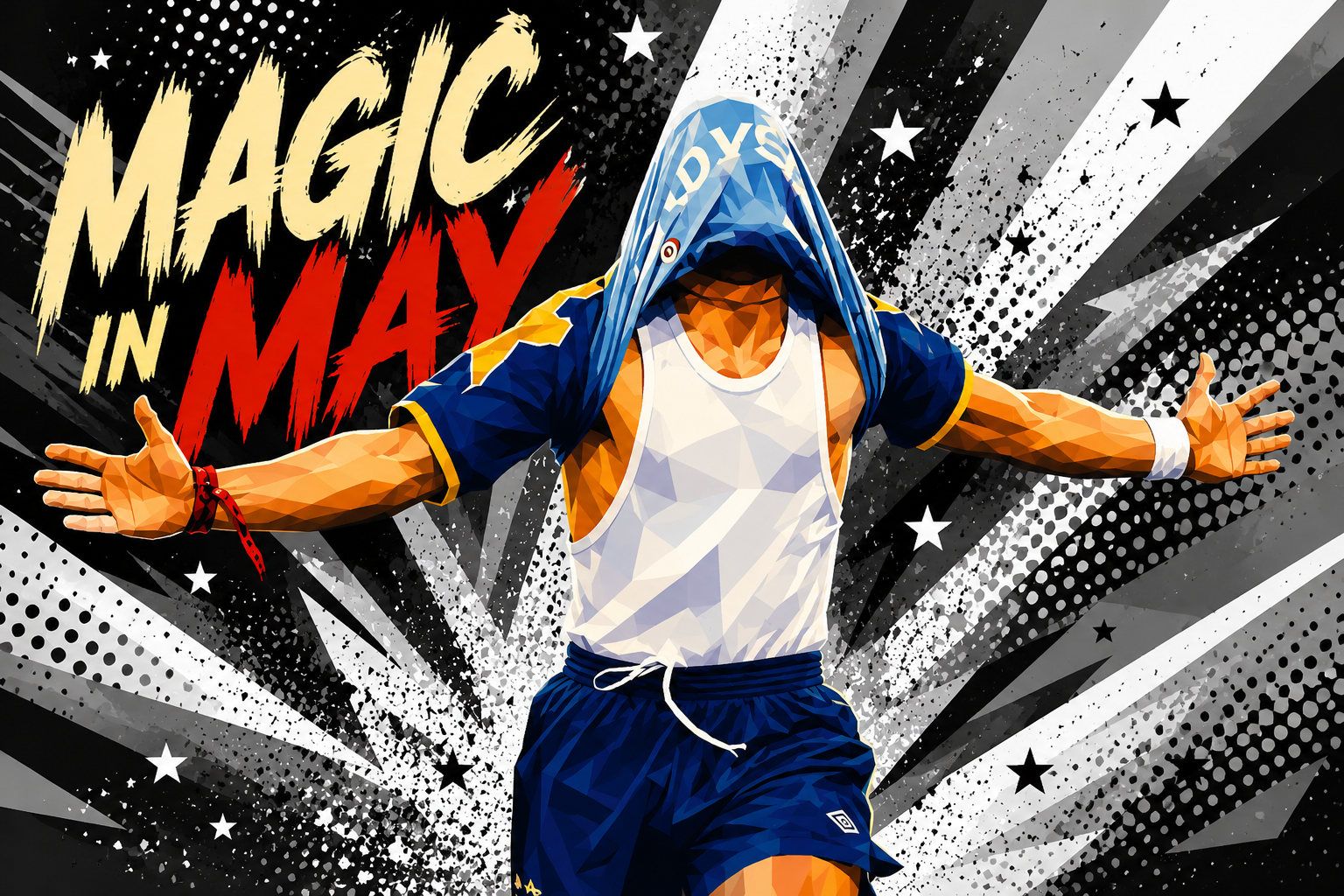
On May 22nd, 1996, Fabrizio Ravanelli scored from an impossible angle in the Champions League final. But that goal was more than a flash of instinct. It was the clearest expression of Marcello Lippi’s Juventus, and a glimpse of what elite forwards would later become.
Rome, 12 Minutes In
Rome felt heavy that night.
Not loud. Not frantic. Heavy.
The air inside the Stadio Olimpico carried the strange tension that exists before history either repeats itself or finally loosens its grip. Around 70,000 people were inside the stadium on May 22nd, 1996, but before the Champions League final between Juventus and Ajax truly opened, the sound did not feel like celebration. It felt anxious. Restrained. Suspicious of joy.
For eleven years, Juventus had lived with the contradiction of 1985.
They had won the European Cup against Liverpool at Heysel, yet nobody inside the club could truly speak about that night as a triumph. Thirty-nine people had died in Brussels. The trophy existed, but it was emotionally unusable. Juventus had Europe on their honours list, but not in their soul.
This final mattered differently.
And the opponent made it worse.
Ajax arrived in Rome as defending European champions and the most admired side on the continent. Under Louis van Gaal, they represented the intellectual future of football. Young, technically immaculate, positionally fluid and emotionally cold. They did not simply beat teams. They imposed order on them.
Juventus looked harder by comparison. Heavier. Less romantic. Marcello Lippi’s side played through pressure rather than poetry, compression rather than calm. Their football was built on collisions, running, compactness and collective labour.
And at the centre of it all stood Fabrizio Ravanelli.
The white hair made him instantly recognisable from every tier of the stadium. At 27, he already looked prematurely weathered, like a veteran labourer rather than a forward entering his peak. There was nothing ornamental about him. No aura of genius. No languid glamour. He looked more like a man built for work than one destined for iconography.
Which was exactly why Lippi trusted him.
Twelve minutes into the final, the match suddenly accelerated into panic.
A hopeful ball was sent forward from deep inside the Juventus half. Nothing about it initially looked dangerous. Ajax had defended those moments all season. Frank de Boer moved underneath it calmly enough, positioning himself to guide a header back toward Edwin van der Sar.
But football changes in fractions.
De Boer hesitated.
Only slightly. Barely enough for most people inside the stadium to notice. Yet hesitation at that level does not remain small for long. The header lacked conviction. Van der Sar had already started advancing. Suddenly neither man fully owned the ball.
Ravanelli saw the mistake before either of them understood it themselves.
He exploded forward.
Not elegantly. Not gracefully. Violently.
The distance between striker and defender vanished as he drove between them, stretching toward the loose ball before Van der Sar could smother it. The goalkeeper sprawled across the turf. Ravanelli reached it first, stabbing the ball away from him.
But the touch carried him horribly wide.
For a split second the chance appeared gone. The angle collapsed with every stride. The goal now seemed almost parallel to him, the near post obscuring most of the available space. Ajax defenders sprinted back toward the line. Van der Sar twisted behind him.
Ravanelli kept moving.
Sliding now, losing balance, his momentum dragging him toward the by-line, he swung awkwardly at the ball with his weaker right foot. There was no clean connection. No perfect strike. Just instinct, desperation and geometry.
The ball rolled slowly across the face of goal.
Painfully slowly.
One Ajax defender lunged toward it. Another turned toward the line. For a heartbeat, the stadium seemed suspended inside the movement of the ball itself.
Then it crossed.
The sound inside the Olimpico did not erupt immediately. It detonated.
Ravanelli sprang back to his feet and pulled the famous blue Juventus shirt over his head, disappearing beneath the fabric as he ran blindly toward the corner flag. Arms outstretched. Floodlights flashing against white cotton. Teammates chasing him through the Roman heat.
It remains one of the defining images of the Champions League era.
But the goal mattered for reasons far greater than nostalgia.
Because in those chaotic few seconds, Fabrizio Ravanelli revealed what elite forwards would eventually become.
The Player Football Remembered Too Narrowly
How is Fabrizio Ravanelli remembered now?
In England, he survives mostly as a piece of Premier League nostalgia. The silver-haired Italian at Middlesbrough who scored a debut hat-trick against Liverpool, earned huge wages, complained about the weather, pulled his shirt over his head after goals and drifted through English football like a glamorous foreign storm before disappearing again. For many supporters of a certain age, he belongs to that strange mid-1990s moment when the Premier League suddenly realised the outside world existed.
In Italy, the framing is different but similarly incomplete.
Ravanelli is often remembered as a supporting figure in one of Juventus’ great sides rather than one of its defining mechanisms. The worker among artists. The runner beside creators. The physical presence operating alongside the elegance of Alessandro Del Piero, the charisma of Gianluca Vialli and the tactical authority of Marcello Lippi.
Even his nickname contributed to the misunderstanding.
Penna Bianca. The White Feather.
It sounded delicate. Almost romantic. Yet there was very little softness in the way Ravanelli played football. His game was built on abrasion. He collided with defenders. Chased lost causes. Closed angles. Forced rushed clearances. Attacked channels repeatedly until back lines stopped thinking clearly. He was exhausting to play against.
And that is precisely why this story matters beyond nostalgia.
Because long before football became obsessed with pressing structures, transitional chaos, counter-pressing triggers and collective attacking systems, Ravanelli was already performing those demands at the highest level in Europe.
Modern football has retrospectively made him easier to understand.
Watch elite forwards now and the role feels familiar. The best attacking players are no longer judged solely on finishing or creativity. They are expected to defend from the front, compress space, initiate pressure, disrupt build-up play and sacrifice themselves physically for the collective shape of the team. The modern striker often functions as the first defender.
Ravanelli was already doing that in 1995.
Not occasionally. Constantly.
That is why reducing him to a cult figure misses the point entirely. He was not memorable because of the white hair or the celebration or the Middlesbrough chaos. He mattered because he represented a tactical shift in how elite football understood the responsibilities of a forward.
Lippi recognised it before most of Europe did.
In a later reflection on that Juventus side, Ravanelli recalled Lippi telling the squad that the team could no longer depend on one player alone, particularly Roberto Baggio. Everyone had to become fundamental. Ravanelli described the manager as “a true force” and spoke of the unity of purpose that formed inside the group.
That idea shaped everything.
While much of the continent still separated footballers into rigid categories of creators, destroyers, poachers and runners, Juventus began building something more fluid and physically demanding. Their forwards were not passengers waiting for service. They were active components of territorial control. Every sprint without the ball mattered. Every press altered passing angles. Every defensive action created attacking potential.
Ravanelli became the embodiment of that philosophy.
It is revealing that when people discuss the tactical revolutions that shaped modern football, the conversation usually jumps from Arrigo Sacchi to Pep Guardiola to Jürgen Klopp. Somewhere in the middle, this Juventus side often becomes blurred, despite influencing huge elements of what followed. Perhaps that is because they were difficult to romanticise. Ajax felt beautiful. Juventus felt exhausting.
But football eventually evolved toward exhaustion.
The sport became faster, tighter and more physically demanding. Space shrank. Pressing intensified. Forwards became runners as much as scorers. Coaches began valuing tactical obedience almost as highly as individual expression.
And suddenly players like Ravanelli no longer looked unusual.
They looked essential.
The Making of the White Feather
Fabrizio Ravanelli did not emerge from the polished academies or carefully managed development systems that would later dominate elite football. Nothing about his rise felt protected.
He came from Perugia, a city perched among the hills of Umbria, where football carried more grit than glamour. Born on December 11th, 1968, he entered the professional game through environments that demanded endurance long before they rewarded talent. Italian football in the late 1980s could be deeply unforgiving for young forwards, especially outside the major institutions. Space was scarce. Defenders were cynical. Matches often felt less like exhibitions of technique and more like exercises in survival.
Ravanelli learned football physically.
That mattered.
The lower divisions in Italy during that period were full of experienced defenders who viewed promising young attackers almost as personal insults. Every touch invited contact. Every aerial duel became a test of nerve. Young forwards were not eased into senior football. They were dragged through it.
At Perugia, Ravanelli developed a reputation not for elegance but for persistence. He scored goals, certainly, but more importantly he kept appearing. Kept running. Kept competing. Coaches trusted players who survived those environments without disappearing emotionally.
There was no immediate sense that he was destined for the top level.
That perhaps explains part of his mentality later in life. Ravanelli never carried himself like a naturally entitled football aristocrat because his career had never unfolded that way. Even when he reached Juventus, some part of him still seemed psychologically shaped by the lower leagues. He played with the urgency of somebody who feared opportunities could vanish at any moment.
His route upward remained uneven.
Brief spells with Avellino and Casertana followed, neither glamorous nor transformative, before a more significant period with Reggiana helped stabilise his development. Serie B in the early 1990s was tactical, attritional and emotionally draining. Teams defended deep. Matches became wars of territory and patience. For a striker, frustration was almost unavoidable.
Yet the environment suited certain aspects of Ravanelli’s personality perfectly.
He became stronger.
Not simply physically, though his upper-body strength became one of his defining assets. Stronger psychologically too. He learned how to occupy defenders for long stretches without becoming detached from games. He learned how to chase difficult balls repeatedly without visible frustration. He learned how to turn physical confrontation into rhythm.
Most importantly, he learned how to weaponise effort.
That would become central to everything later.
By the time Juventus signed him in 1992, Ravanelli was already 23 years old. In modern football terms, he would almost have been considered late arriving. He did not enter Turin as a crowned prodigy or a future Ballon d’Or contender. Juventus already possessed glamour elsewhere. Roberto Baggio remained the symbolic face of Italian football. Gianluca Vialli carried international prestige. There were younger, more technically celebrated attackers emerging across Serie A.
Ravanelli initially looked like depth.
Useful. Hardworking. Replaceable.
And perhaps that became his advantage.
Because while other players were burdened by expectation, Ravanelli kept refining the things football often undervalues until they become tactically indispensable. Timing. Movement. Pressure. Recovery runs. Relentless repetition. He approached football less like a performer and more like a labourer obsessed with the mechanics of the craft.
Even visually, he stood apart.
The prematurely white hair made him look older than the rest of the dressing room. Supporters across Italy immediately noticed it. Opponents remembered it. In an era full of polished stars and aesthetic footballers, Ravanelli looked oddly weathered, almost prematurely worn down by the game itself.
But that appearance created assumptions.
People saw the hair, the physicality, the aggression and often missed the intelligence beneath it. They interpreted him as a worker rather than a sophisticated tactical footballer. Yet managers increasingly trusted him because he understood space instinctively. Not glamorous space. Useful space. Dangerous space. The spaces defenders leave behind once panic begins.
That tension followed him throughout his career.
And it was exactly the kind of tension Marcello Lippi would eventually recognise as invaluable.
Lippi’s Revolution
When Fabrizio Ravanelli arrived at Juventus in 1992, the club still looked backward.
The institution remained enormous, of course. Juventus always were. But there was a growing sense across Italy that they no longer entirely belonged to the future. The great Platini years had faded. The club still possessed prestige, still possessed elite players, still collected trophies, yet Europe increasingly felt distant and unresolved.
More importantly, Juventus still played like a side searching for a single saviour.
Too much of the attacking responsibility rested on the shoulders of Roberto Baggio. Even at his most extraordinary, Baggio distorted the tactical balance of the team because everything naturally gravitated toward him. Possession slowed as teammates searched for him. Attacks narrowed around his movement. Opponents understood that if they controlled Baggio, they controlled Juventus.
Ravanelli struggled initially within that structure.
Under Giovanni Trapattoni, Juventus remained conservative and hierarchical. Established stars operated with freedom while supporting players fulfilled more rigid responsibilities around them. Competition for attacking places was suffocating. Ravanelli found himself competing with Baggio, Vialli, Paolo Di Canio and Pierluigi Casiraghi for minutes. He often appeared useful without appearing essential.
Then came Lippi.
The appointment in 1994 altered the direction of Juventus completely.
Lippi did not simply inherit a football team. He inherited an institution emotionally exhausted by European failure and tactically caught between eras. Italian football itself was changing. Arrigo Sacchi had already challenged traditional assumptions about pressing and collective organisation with AC Milan, but many clubs remained attached to reactive structures and rigid positional hierarchies.
Lippi wanted something more aggressive.
He believed modern football was becoming faster, more physical and more collective. Space would become harder to find. Individual genius alone would no longer dominate elite European competition. Teams would need to move as connected systems. Every player would need to contribute defensively. Every transition would matter.
And almost immediately, he saw Ravanelli differently from everyone else.
Others saw effort, aggression, physicality and useful squad depth.
Lippi saw tactical possibility.
He recognised that Ravanelli’s relentless running could become a structural weapon rather than merely a personal characteristic. His pressing altered passing lanes. His channel runs stretched defensive lines vertically. His willingness to defend from the front allowed Juventus to compress the pitch higher up. Most importantly, he possessed the mentality to sustain that intensity repeatedly.
In many ways, Ravanelli became the ideal Lippi footballer before the rest of the squad fully understood what Lippi football required.
The transformation was dramatic.
Juventus stopped behaving like a collection of important names and started functioning like a coordinated machine. The midfield of Didier Deschamps, Paulo Sousa and Antonio Conte provided balance and aggression. Vialli became the emotional leader of the side. Del Piero introduced unpredictability and elegance between lines.
But Ravanelli supplied something the others could not.
Disruption.
He made games physically uncomfortable. He accelerated transitions. He forced hurried decisions from defenders who normally played with calm authority. Juventus no longer waited patiently for opportunities to emerge. They created instability until mistakes appeared.
One performance in particular announced the scale of Ravanelli’s evolution.
On September 27th, 1994, Juventus faced CSKA Sofia in the UEFA Cup. Ravanelli scored all five Juventus goals in a 5-1 victory. The performance is often remembered simply because of the number itself, but the deeper significance lay in the variety and force of the display. He bullied defenders physically, attacked space relentlessly and finished with the confidence of a player suddenly understanding exactly what he had become inside the system.
That season he scored heavily as Juventus won the Serie A title and the Coppa Italia.
Yet the numbers alone still do not fully explain his importance.
Plenty of strikers score goals.
Far fewer alter the emotional temperature of matches.
Ravanelli played football like somebody permanently trying to suffocate opponents psychologically. His intensity spread across the team. Defenders felt rushed. Midfielders lost time on the ball. Passing sequences became tense. Juventus started dictating matches through pressure as much as possession.
And slowly, European football began adjusting to them.
Ironically, the side often remembered as cynical or industrial was quietly becoming one of the continent’s most influential tactical teams. Not because they rejected technique, but because they fused technical quality with collective physical aggression more effectively than almost anyone else.
At the centre of that shift stood the White Feather.
Not the artist.
The engine.
The Tactical Identity of Juventus 1996
The easiest way to misunderstand that Juventus side is to describe them as merely efficient.
Efficient teams win matches.
This Juventus team altered the rhythm of elite European football.
By 1996, much of the continent still viewed Ajax as the tactical future. Their football under Van Gaal appeared intellectually superior to almost everybody else. They stretched space beautifully, rotated positions naturally and monopolised possession with an authority that often felt inevitable. Young players emerged from their academy already understanding angles and structure in ways many senior professionals elsewhere did not.
Ajax looked like tomorrow.
But what made the Rome final historically fascinating is that Juventus may actually have been closer to what football itself would eventually become.
Modern football did not evolve toward slower possession or positional purity alone. It evolved toward pressure. Toward speed. Toward collective physical intensity. Toward systems where forwards defended first and attacking players became territorial weapons without the ball.
That was Lippi’s Juventus.
And no player embodied those demands more completely than Ravanelli.
Nominally, Juventus operated in a fluid 4-3-3. In practice, the system constantly shifted shape depending on territory and possession. The midfield provided tactical balance, but the front line determined the emotional tone of matches.
Most sides in the mid-1990s still treated pressing as something occasional. Juventus treated it as identity.
Ravanelli’s role inside that structure was extraordinarily modern.
He was not simply chasing defenders aimlessly or performing visible hard work for crowd approval. His movement had tactical sequencing behind it. He often initiated the press by curving runs toward centre-backs rather than sprinting directly at them, blocking passing lanes into midfield while forcing possession wider. When opposition defenders hesitated, Juventus compressed space instantly behind him.
The effect was cumulative.
Teams stopped building calmly.
That mattered enormously in Europe because many elite continental sides of the era still depended heavily on rhythm and composure during first-phase build-up. Juventus disrupted that rhythm repeatedly before opponents could settle into matches psychologically.
Ravanelli became the pressing trigger.
Once he accelerated, the rest of the side followed.
Conte would jump aggressively from midfield. Deschamps narrowed passing angles. Full-backs pushed higher. Vialli hunted second balls. Del Piero floated into unstable defensive spaces created by the pressure ahead of him.
That final detail often gets overlooked.
Ravanelli’s running created creative conditions for others.
Del Piero, especially, benefited enormously from the chaos Ravanelli generated. While Del Piero manipulated space delicately between defensive lines, Ravanelli stretched those same lines violently. One distorted structure through elegance. The other through collision.
Together, they became devastating.
And this is where the historical misunderstanding around Ravanelli becomes most obvious. Traditional football language struggled to explain players like him because older frameworks separated forwards into simplified categories: target man, poacher, creator, dribbler, finisher.
Ravanelli blurred those definitions.
He could play centrally but drifted aggressively into channels. He attacked aerially yet preferred movement over static hold-up play. He scored heavily while simultaneously functioning as one of the side’s most important defensive workers. He looked physically old-fashioned but behaved tactically like a forward from twenty years later.
That was unusual at the time.
Many elite forwards of the period still conserved energy for moments in the box. They waited for service, trusted midfielders to construct the game around them and measured their value mainly in decisive touches. Ravanelli did not play that way. He turned the minutes between goals into part of the attacking process.
Even his stamina became central to Juventus’ identity.
The intensity of Lippi’s system demanded extraordinary physical output from the front line. Juventus compressed games vertically, defended higher than many Italian sides of the period and repeatedly forced transitions through territorial aggression. Forwards were expected to sprint defensively, recover shape instantly and attack space seconds later.
Ravanelli never appeared overwhelmed by those demands.
If anything, he seemed emotionally nourished by them.
There was a manic edge to his football during this period, a sense that physical exhaustion itself became part of his competitive rhythm. He played matches as though attrition were the point. Defenders rarely looked comfortable against him because he refused to allow games to settle into predictable patterns.
And aesthetically, that made Juventus strangely difficult for neutrals to categorise.
They were not defensive in the traditional Italian sense. Yet they were not romantic in the Ajax mould either. They did not seek beauty first. They sought control through pressure, through territorial suffocation, through emotional destabilisation.
The irony is that modern football eventually validated almost all of it.
Watch contemporary elite sides now and the similarities become obvious: coordinated pressing, forwards initiating defensive structure, transitional aggression, compact spacing, collective running and attacking through forced mistakes.
These are no longer unusual ideas.
In 1996, they still were.
Which is why Ravanelli now feels less like a nostalgic cult figure and more like an evolutionary footballer who arrived before the sport fully understood the direction it was heading.
The Final as Ideological Warfare
By the time the Champions League final settled into rhythm in Rome, it no longer felt like a football match alone.
It felt like a confrontation between competing visions of what elite football should become.
Ajax entered the Stadio Olimpico carrying the aura of inevitability. Across Europe, they were admired almost intellectually as much as emotionally. Their academy had become the gold standard. Their positional structure looked years ahead of most rivals. Even neutrals often watched them with a kind of aesthetic reverence.
Van Gaal’s side played football with certainty.
Juventus played with pressure.
That distinction shaped the entire final.
From the opening minutes, Lippi’s team attempted to disrupt Ajax psychologically before they could establish territorial calm. The pressing was immediate. Aggressive without becoming reckless. Juventus did not merely want possession back. They wanted Ajax uncomfortable.
Ravanelli led everything.
What television cameras could not fully capture in real time was the exhausting repetition of his movement. He never stopped adjusting angles. Never stopped closing distances. Never stopped forcing defenders to think one second faster than they wanted to think.
Against most sides, Ajax controlled emotional tempo through possession.
Against Juventus, possession itself became stressful.
Frank de Boer and Van der Sar, usually so composed during build-up phases, suddenly looked uncertain early in the match. Passes travelled slightly quicker than normal. Defensive decisions became hurried. The calm geometry Ajax depended upon started fracturing around the edges.
Then came the goal.
Even decades later, it remains striking how perfectly it reflected the broader tactical story unfolding around it.
Not a flowing move.
Not individual artistry.
Pressure. Panic. Error creation.
Ravanelli sensed hesitation instantly because Juventus had spent the opening stages manufacturing hesitation everywhere on the pitch. The goal looked chaotic, but it emerged from collective suffocation. Ajax were not accustomed to being hunted so aggressively inside their own defensive structure.
Yet what followed afterwards is just as important historically.
Ajax responded magnificently.
That often gets forgotten beneath the mythology of Juventus’ triumph. Once the Dutch side settled emotionally, they gradually reasserted periods of control through midfield circulation and positional width. Jari Litmanen equalised before half-time after Angelo Peruzzi could only parry Frank de Boer’s free-kick back into danger.
At 1-1, the final changed shape completely.
The match became less about aesthetics and more about endurance.
The second half descended into something brutally physical and mentally draining. Juventus continued pressing. Ajax continued circulating possession. Neither side truly surrendered ideological ground. Instead, both attempted to impose themselves through repetition.
And slowly, fatigue began invading everything.
This is where Ravanelli’s contribution becomes impossible to separate from the identity of the team itself. Every sprint toward the Ajax back line carried strain. Every recovery run looked heavier. Sweat soaked through the blue Kappa shirt. His movements became increasingly desperate yet no less committed.
He sacrificed himself for the structure.
That is the key point.
Modern football often romanticises pressing systems while quietly overlooking the human cost attached to them. Juventus demanded enormous physical suffering from their forwards. Ravanelli accepted those demands more willingly than almost anyone else in Europe at the time.
And in many ways, the final became a test of which collective identity could endure exhaustion more effectively.
Ajax still created danger. Nwankwo Kanu threatened aerially. Del Piero appeared from the bench and nearly changed the match with flashes of invention. Vialli drifted through periods of frustration and fury. Midfielders on both sides started cramping beneath the Roman humidity.
But neither system fully broke.
That mattered.
Because the match is often retrospectively framed as beautiful Ajax versus pragmatic Juventus.
The reality was more complicated.
Juventus were tactically sophisticated.
Ajax were physically resilient.
The ideological divide was not artistry versus anti-football.
It was control versus compression.
And by extra time, the game no longer belonged entirely to either side. It belonged to attrition itself.
When Ravanelli eventually left the field for Michele Padovano, he looked utterly spent. The image almost carried symbolic weight. The White Feather walking slowly toward the touchline after spending more than an hour turning the final into a physical argument.
His job was done.
Not because he had scored.
Because he had helped force Europe’s most technically admired team into a battle they never fully wanted to fight.
The Shadow Over Rome
For years afterwards, whenever people discussed that Juventus side honestly, the conversation eventually drifted toward the same uncomfortable place.
How were they able to sustain that intensity?
It was not simply the pressing itself that raised suspicion across Europe. Other teams pressed aggressively in moments. What unsettled opponents was Juventus’ capacity to maintain physical ferocity for extraordinary stretches of matches without visible emotional or athletic collapse. They looked relentlessly durable.
Even in exhaustion, they kept running.
For the defeated Ajax players, the memory lingered uneasily.
Several members of that squad would later speak openly about the physical shock of facing Juventus in the 1996 Champions League final. Finidi George questioned how opponents could sustain such intensity across an entire season, not merely isolated matches. Marc Overmars remained suspicious years later, suggesting Ajax players left Rome with the sense that something about Juventus’ physical capacity did not feel entirely natural.
At first, these comments existed mostly as whispers around European football.
Then the whispers became public.
In 1998, Zdeněk Zeman, then managing Roma, ignited one of the biggest controversies in modern Italian football when he declared that football needed to “come out of the pharmacy”. Though the debate quickly widened, Juventus became the centre of the storm.
A lengthy judicial investigation followed, focusing heavily on the work of club doctor Riccardo Agricola during the mid-1990s. Blood values, medical records and pharmaceutical usage were scrutinised publicly in extraordinary detail. During the proceedings, haematologist Giuseppe d’Onofrio testified that fluctuations in certain player blood readings appeared highly abnormal and potentially consistent with blood manipulation or use of EPO.
For many observers outside Turin, the allegations seemed to confirm long-held suspicions surrounding the physical power of Lippi’s side.
Yet the legal reality remained more complicated.
Agricola was initially convicted of sporting fraud in 2004 before later being acquitted on appeal. The appellate ruling concluded there was insufficient definitive evidence proving administration of banned substances such as EPO, particularly given the legal and regulatory ambiguity surrounding certain pharmaceutical practices during that period.
Which left football in an unresolved moral space that still exists today.
Juventus were never stripped of the 1996 Champions League title. UEFA never formally altered the result. Officially, the triumph stands untouched.
Unofficially, doubt never fully disappeared.
And this is where the subject becomes delicate historically, particularly in relation to Ravanelli himself.
Because his footballing identity depended so heavily on physical intensity.
The endless pressing. The repeated channel running. The recovery sprints. The collisions. The refusal to slow down.
Those qualities formed the tactical heart of his greatness. They are also precisely the qualities critics later examined most suspiciously when reassessing that Juventus era.
It creates an uncomfortable tension within the story.
How much of Juventus’ physical superiority emerged from tactical innovation, conditioning, mentality, collective structure and exceptional athletic preparation? How much, if any, was artificially enhanced?
Football has never fully answered the question.
Perhaps it never will.
What can be said with certainty is that reducing Juventus’ success purely to pharmaceutical accusation oversimplifies one of the most tactically influential teams of the decade. Even critics of the club’s medical practices rarely deny the sophistication of Lippi’s structure, the intelligence of the pressing mechanisms or the technical quality embedded throughout the squad.
At the same time, pretending the controversy does not matter would damage the integrity of the story entirely.
The shadow exists because the intensity existed.
And the intensity was impossible to ignore.
For Ravanelli personally, the ambiguity is particularly cruel because his entire career had been built around labour. Around suffering. Around effort visible to everybody watching. He was not remembered as a luxury player surviving on bursts of genius. He was remembered as somebody who overwhelmed opponents physically and emotionally.
That tension remains impossible to resolve cleanly.
Perhaps that is why the 1996 final still feels slightly unsettled historically, despite the romance attached to it. The images remain glorious. The football remains influential. The achievement remains enormous.
But somewhere beneath the floodlights and celebrations, a lingering uncertainty never entirely left the story.
Teesside: Football Culture Shock
Only weeks after conquering Europe in Rome, Fabrizio Ravanelli found himself standing on Teesside beside the River Tees, staring into a football culture that could hardly have felt further removed from Juventus.
The transition bordered on surreal.
One moment he was part of the most tactically advanced collective in Europe, operating inside the relentless structure of Lippi’s Juventus. The next, he was arriving at Middlesbrough, a newly promoted Premier League club still adjusting to life inside its impressive new Riverside Stadium.
For English football in 1996, the transfer felt almost impossible.
Ravanelli was not a fading veteran chasing wages or a foreign curiosity nearing retirement. He had scored in a Champions League final barely months earlier. He arrived as one of Europe’s most recognisable forwards and instantly became one of the highest-profile players in the Premier League.
His arrival symbolised the changing ambitions of English football itself.
The Premier League was beginning to understand that money alone no longer guaranteed prestige. English clubs wanted continental legitimacy again after years of tactical isolation. Signing a player like Ravanelli represented more than transfer business. It felt like cultural validation.
And for one extraordinary afternoon, everything looked perfect.
Opening day. August 17th, 1996. Riverside Stadium against Liverpool.
The atmosphere carried the nervous excitement of a town introducing itself to a new footballing world. Ravanelli responded with a hat-trick in a chaotic 3-3 draw, instantly producing one of the great Premier League debuts. The third goal, a composed finish after racing through Liverpool’s defence, triggered the now-famous shirt-over-head celebration once again.
Teesside fell in love immediately.
In many ways, though, the rest of the season revealed just how culturally disorientating English football still felt to elite continental players during that era.
The Premier League in the mid-1990s remained thrillingly chaotic but tactically uneven. Matches stretched wildly from end to end. Defensive structures often dissolved into transitional disorder. Training methods lagged behind continental Europe in several areas. Diet, conditioning and recovery standards varied dramatically from club to club.
For somebody emerging directly from Lippi’s Juventus, the contrast must have felt jarring.
At Juventus, every movement belonged to a collective framework. Pressing triggers were synchronised. Defensive distances mattered constantly. Tactical preparation was obsessive. Even suffering possessed structure.
At Middlesbrough, emotion often overtook organisation.
That was not entirely a criticism of Bryan Robson or the club itself. Middlesbrough were ambitious, vibrant and entertaining. They reached both domestic cup finals that season and came agonisingly close to transforming English football’s established hierarchy. But there were moments when Ravanelli seemed emotionally incapable of accepting the looseness surrounding him.
His frustrations became increasingly public.
He criticised training facilities. Complained about aspects of the club’s professionalism. Struggled with the environment around Teesside. Within the dressing room, some teammates reportedly grew tired of the constant negativity, interpreting it as arrogance or detachment.
Yet there is another way to read that tension now.
Perhaps Ravanelli was not simply being difficult.
Perhaps he had already experienced the future.
Because when modern viewers revisit clips of that Middlesbrough side, one thing becomes obvious immediately: English football had not yet fully evolved tactically toward the kind of collective intensity Ravanelli had just left behind in Turin.
He often looked like a player carrying habits nobody around him entirely shared.
And still, despite the emotional turbulence, he was magnificent individually.
Thirty-one goals in all competitions. Finals in both the FA Cup and League Cup. A constant sense of danger. Moments of elite finishing. Physical domination against defenders unaccustomed to facing forwards of his intensity.
Even the League Cup final against Leicester City contained the perfect Ravanelli contradiction. He scored the opening goal, celebrated wildly and appeared ready to deliver Middlesbrough’s first major trophy, only for the match to descend into chaos before Leicester eventually prevailed after a replay.
That entire season felt emotionally unstable.
Brilliant but unstable.
The relegation that followed carried almost tragic inevitability. Middlesbrough were docked three points after failing to fulfil a fixture against Blackburn Rovers during an injury crisis, and those points ultimately proved fatal. Despite reaching two cup finals and possessing enormous attacking talent, they went down.
Ravanelli left shortly afterwards for Marseille.
His relationship with Middlesbrough remained complicated for years afterwards. Some supporters adored him permanently. Others viewed him as emblematic of football’s growing foreign detachment and impatience. Yet with time, a softer understanding emerged around his spell on Teesside.
Because in retrospect, Ravanelli’s frustrations now feel less like snobbery and more like the collision of two footballing eras.
English football eventually became obsessed with exactly the kind of tactical intensity and athletic demands he had represented at Juventus. Pressing, conditioning, collective structure and transitional aggression would later dominate Premier League thinking.
Ravanelli arrived before much of England was ready for it.
The Goal Revisited
Years later, the goal still looks strange.
Not spectacular in the conventional sense. Not technically perfect. Not a clean strike into the top corner or a piece of impossible dribbling genius replayed endlessly because of aesthetic beauty alone.
What makes Fabrizio Ravanelli’s goal in Rome endure is that it feels unstable even now.
Everything about it carries tension.
The awkward bounce. The defensive hesitation. The narrowing angle. The scrambling recovery runs. The sliding finish struck with the wrong foot. The slow movement of the ball toward the line.
Even the celebration feels slightly frantic rather than choreographed.
Which is precisely why the goal has aged so well historically. It captured the essence of that Juventus side more honestly than a polished move ever could have done.
The entire sequence was built from pressure.
Ravanelli did not create the opportunity through individual improvisation alone. Juventus manufactured the conditions for error long before the ball reached Frank de Boer. The opening stages of the final had already become emotionally uncomfortable for Ajax. Their defenders were thinking faster than they wanted to think. Decisions that normally arrived calmly now arrived beneath physical and psychological stress.
The mistake emerged from accumulation.
That is modern football.
Today, elite managers speak constantly about forcing turnovers high up the pitch, provoking panic during build-up phases and attacking transitional instability before defensive structures can reset. In 1996, those ideas still felt comparatively radical at the very top of European football.
Ravanelli’s goal looked chaotic because Juventus wanted chaos.
That was the point.
Even the finish itself reflected the contradictions inside his game. There was nothing graceful about the technique. He was sliding, overstretching, losing balance and striking awkwardly with his weaker foot from an angle that seemed to disappear with every step.
Yet underneath the apparent disorder sat extraordinary instinct.
He understood exactly how quickly danger collapses inside the penalty area. Most forwards in that situation either rush the finish wildly or hesitate searching for control. Ravanelli trusted momentum instead. He treated the goal almost like a continuation of the press itself, forcing the ball toward space before Ajax could recover emotionally or positionally.
And perhaps that is why the celebration mattered so much afterwards.
The shirt over the head was never merely branding or theatre. It looked like emotional release bordering on disappearance. For a few seconds, he removed himself from the world entirely. No crowd. No pressure. No cameras. Just fabric, noise and adrenaline.
There is something strangely symbolic about that image now.
Because Ravanelli spent so much of his career disappearing into the needs of the collective.
That was his footballing identity. Running others did not want to do. Sacrifice others received more praise for avoiding. Endless physical labour so more naturally gifted teammates could operate in cleaner attacking spaces. Even his greatest qualities often became easier to appreciate tactically than emotionally.
Yet on that night in Rome, everything briefly belonged to him.
Not Del Piero’s elegance. Not Vialli’s leadership. Not Ajax’s artistry. Not Lippi’s system.
His moment.
And still, there is another layer to the story that makes the goal resonate beyond nostalgia alone.
Ravanelli did not finish the final as its triumphant hero standing centre stage beneath celebration. By the time the match descended into extra time and penalties, he was already off the pitch, physically exhausted after spending more than an hour exhausting everyone else.
That detail matters enormously.
Because the goal only becomes fully understandable once viewed together with the sacrifice that followed it. Ravanelli was not simply the scorer of the opening goal. He was the emotional spearhead of Juventus’ entire approach. The pressing. The collisions. The territorial aggression. The refusal to let Ajax breathe comfortably.
He emptied himself into the match.
When Vladimir Jugović eventually scored the decisive penalty after Peruzzi’s saves, Ravanelli celebrated from the sidelines rather than the centre circle. Watching rather than deciding. Exhausted rather than immortalised.
And somehow that feels fitting.
Because his greatness was never really about standing apart from the system around him. It was about embodying it completely.
Which is why that goal remains so much more than a famous Champions League moment. It now feels almost prophetic. A glimpse of where elite football itself was heading.
Toward forwards who defend.
Toward collective intensity.
Toward pressing as identity.
Toward attackers valued as much for destruction as creation.
Football eventually became filled with players asked to do what Fabrizio Ravanelli was already doing in Rome in 1996.
The difference is that now we finally possess the tactical vocabulary to explain why it mattered.
Legacy: The Forward Before His Time
Fabrizio Ravanelli occupies a strangely awkward place in football history.
He was too important to be forgotten, yet never quite glamorous enough to become mythologised in the way many of his contemporaries were. Mention the great forwards of 1990s Italian football and conversation usually drifts first toward the divine elegance of Roberto Baggio, the intelligence of Del Piero, the predatory instincts of Filippo Inzaghi or the charisma of Vialli.
Ravanelli rarely arrives first in those discussions.
And perhaps that is because football traditionally prefers to celebrate players who appear untouched by labour. The sport romanticises grace far more comfortably than exhaustion. We remember forwards who glide. Ravanelli often looked like he was fighting the game physically.
Yet modern football increasingly makes his importance easier to understand.
Watch elite forwards now and traces of him appear everywhere. The demands placed upon attackers have transformed radically since the mid-1990s. Strikers are expected to initiate pressure, recover shape instantly after losing possession, force defenders into mistakes and sacrifice personal freedom for collective tactical organisation.
The forward as luxury player has largely disappeared at elite level.
Ravanelli belonged to the generation that helped kill it.
That does not mean he invented pressing forwards alone, nor that Juventus were solely responsible for football’s tactical evolution. But Lippi’s side represented a hugely influential stage in the sport’s movement toward collective physical aggression, and Ravanelli was central to how that aggression functioned structurally.
He was one of the earliest elite forwards whose value could not be measured purely through goals.
Of course, the goals still mattered. He scored heavily throughout his peak years, won major honours in Italy and Europe, reached cup finals in England and remained a dangerous forward across multiple leagues. His record stands comfortably alongside many more celebrated attackers of his era.
But statistics alone flatten what made him distinctive.
The real value existed in what happened around the goals: defenders forced backward, passing lanes closed, midfielders rushed, defensive lines stretched and emotional pressure created.
Modern analysts would likely adore him.
There is a compelling argument that if Ravanelli emerged twenty-five years later, he would be interpreted very differently by football culture. Coaches obsessed with pressing structures and transitional football would view him as tactically priceless. Data departments would highlight his defensive output, his off-ball intensity and his territorial influence. Supporters raised on Jürgen Klopp’s Liverpool or modern high-pressing systems would immediately recognise the purpose behind his game.
In the mid-1990s, many people simply saw effort.
Now we understand the architecture behind the effort.
That does not mean his legacy is uncomplicated.
The shadow surrounding Juventus’ physical intensity during that era remains impossible to fully separate from discussion of the team. The doping allegations continue to hover around the story like static in the background, unresolved enough to complicate memory without entirely redefining it. For some observers, that ambiguity permanently colours interpretation of the side’s achievements.
And then there is Middlesbrough.
Curiously, the very chapter once treated almost dismissively inside his career may actually have strengthened his long-term football identity. England saw something raw and emotional in Ravanelli that Italy sometimes overlooked. The goals, the volatility, the visible frustration, the theatricality, the sense that every match felt personally important to him.
He was difficult.
But memorable players often are.
What survives most strongly now is not really the controversy or even the trophies. It is the feeling of him. The image. The intensity. The white hair sprinting toward defenders beneath floodlights. The sense of permanent urgency in everything he did.
Even his career trajectory reflected the broader instability of football during the 1990s. He moved through multiple football cultures just as the game itself was globalising rapidly. Italy remained tactically dominant but economically vulnerable. England was becoming financially explosive but still tactically immature. European football itself was accelerating toward the hyper-athletic modern era.
Ravanelli seemed to exist directly inside those shifts.
And perhaps that is why he remains slightly misunderstood historically.
Not underrated in the simplistic sense. People recognised he was good. They recognised he was important. But football still lacked the language to explain players whose influence came through collective destabilisation as much as individual brilliance.
The sport now possesses that language.
Which is why revisiting Ravanelli today feels strangely contemporary. His football no longer belongs entirely to the past. In many ways, it resembles the present more than the era in which he actually played.
That is usually the clearest sign a player arrived before his time.
The White Feather Disappears
In the end, the image that survives is not especially elegant.
It is not a perfectly balanced volley or a graceful dribble through defenders. It is not the sort of footballing beauty usually preserved in marble across generations.
It is a man sprinting blindly across the Stadio Olimpico with his shirt pulled over his head.
White fabric. Blue floodlights. Arms stretched wide. Noise collapsing around him.
For a few seconds, Fabrizio Ravanelli disappeared completely beneath the jersey, as though trying to escape the pressure, exhaustion and violence of the night itself. And perhaps that was fitting for a footballer who spent so much of his career disappearing into the needs of the collective.
Others received the poetry.
He carried the labour.
Others were framed as artists.
He became the pressure that made artistry possible.
That was the paradox at the heart of Ravanelli’s career. He looked like an old-fashioned centre-forward yet represented something deeply modern. He emerged from the brutality of Italy’s lower leagues yet helped shape the future of elite European football. He played with constant physical aggression yet understood space and tactical timing with rare sophistication.
And on May 22nd, 1996, all of those contradictions briefly converged into one moment.
The anticipation. The press. The panic. The impossible angle. The weaker foot. The slow roll of the ball across the line.
A goal born less from beauty than from relentless force of will.
Juventus would eventually win the Champions League final on penalties. Jugović delivered the final kick. Peruzzi made the decisive saves. Lippi cemented his place among Europe’s great coaches.
But the defining image remained Ravanelli running toward the corner flag beneath the Roman sky.
Because in many ways, that goal did more than open a Champions League final.
It announced where football itself was heading.
Toward pressure. Toward collective intensity. Toward forwards who defend. Toward systems built as much on sacrifice as flair.
Football eventually became filled with players asked to do the things Fabrizio Ravanelli had already been doing for Juventus in 1996.
Long before the game learned how to celebrate that kind of forward, the White Feather was already running himself into history.
