


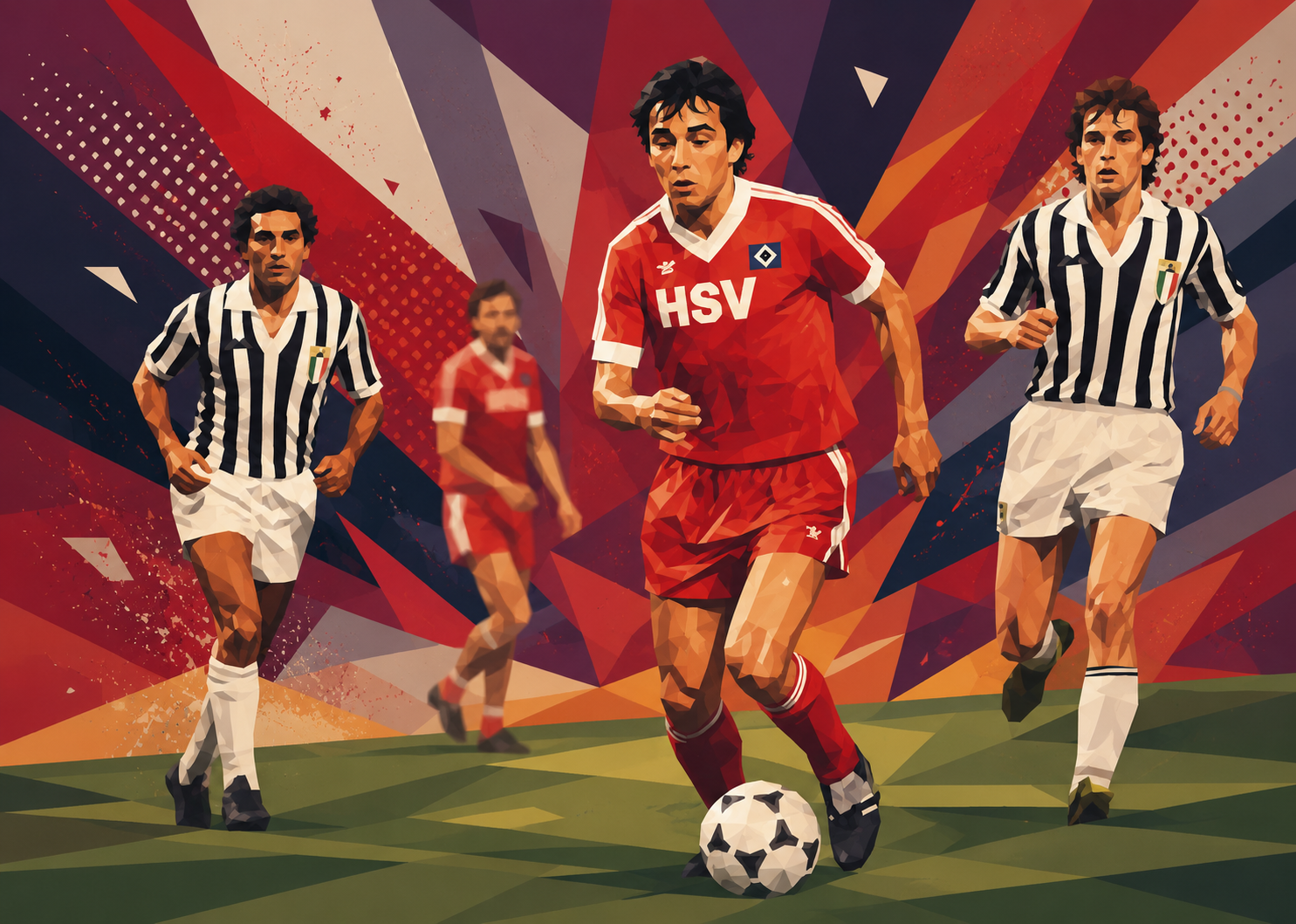
Before Felix Magath became the feared disciplinarian of German football, he was one of Europe’s sharpest midfield minds. In Athens in 1983, against Juventus and Michel Platini, he produced the defining performance of his playing life.
The Shot That Froze Dino Zoff
The heat inside the Olympic Stadium in Athens felt oppressive long before kick-off. Even by Mediterranean standards, the night of 25 May 1983 carried a heaviness that seemed to settle on the shoulders of the players as they emerged from the tunnel. More than 73,000 supporters packed into the vast concrete bowl expecting to witness the coronation of European football’s new superpower.
Juventus had arrived in Greece with an aura bordering on inevitability. Giovanni Trapattoni’s side contained the spine of Italy’s 1982 World Cup winners, reinforced by the elegance of Michel Platini and the relentless movement of Zbigniew Boniek. Across Europe, they were viewed as the most complete team in the game. Organised without the ball. Ruthless with it. Built to control matches and, eventually, conquer the continent.
Their opponents, Hamburger SV, inspired respect rather than fear. Ernst Happel’s side were disciplined, intelligent and physically outstanding, but outside West Germany few believed they possessed the individual brilliance required to dismantle Juventus over ninety minutes.
Then came the ninth minute.
Jürgen Groh stepped forward and threaded a pass into the left channel. For a split second, the Juventus defensive structure opened. Claudio Gentile had been drawn toward Horst Hrubesch. Sergio Brio was occupied. The space appeared almost accidentally.
It was not accidental at all.
Felix Magath moved into it before anyone else recognised the danger. He received the ball near the edge of the penalty area, glanced once toward Dino Zoff and shifted it onto his left foot. Roberto Bettega lunged across to close him down, but Magath had already created the angle he wanted.
The strike was vicious.
The ball rose hard and fast through the Athens air before bending away from Zoff and crashing beneath the crossbar. The Juventus goalkeeper did not move. At 41 years old, Zoff had spent two decades surviving on anticipation and positioning, yet this time he was beaten before his body could react.
As Barry Davies said on British television: “Dino Zoff didn’t smell it.”
Inside nine minutes, the script of the European Cup final had been torn apart.
The Player Hidden Beneath the Managerial Myth
To many modern supporters, the name Felix Magath no longer belongs to the elegant midfielder who controlled a European Cup final in Athens. It belongs to the authoritarian manager who became one of German football’s most feared and divisive figures.
He is remembered as Quälix, the nickname forged from quälen, the German word for torment. The coach who drove players through brutal training sessions. The disciplinarian who fined squads for minor breaches. The old-school figure whose methods, at times, seemed to belong to another footballing age.
The caricature is powerful enough that it has almost erased the player.
That is the great irony of Magath’s life in football. Before he became associated with control in its harshest form, he represented control in its most intelligent one. Long before the exhausting training camps and fractured dressing rooms, Magath was among the most cerebral midfielders in Europe, a footballer who saw the game less as chaos than as a series of problems waiting to be solved.
Ernst Happel reportedly called him “a monastery student”, a phrase that captured both the player’s stillness and his seriousness. Magath rarely carried the charisma of a public idol. He did not dominate headlines in the way Karl-Heinz Rummenigge or Paul Breitner did. Instead, he studied matches quietly, almost academically, searching for patterns others missed.
That intelligence made him indispensable to Hamburg during the finest period in the club’s history.
Aschaffenburg, Saarbrücken and the Making of an Outsider
Magath’s football intelligence did not emerge from glamour or privilege. It was shaped by distance, uncertainty and a constant need to adapt.
Born near Aschaffenburg in 1953 to a Puerto Rican father and a German mother, Magath grew up carrying a sense of difference. In post-war West Germany, he did not always fit comfortably into the world around him. Football became the place where he could exert certainty and control in ways ordinary life rarely allowed.
His early years at 1. FC Saarbrücken hinted at technical quality without fully revealing the player he would become. Used mostly in advanced attacking roles, he showed close control, sharp finishing and a capacity to read spaces quickly. Yet even then, conventional descriptions did not quite fit him.
He was not explosive enough to be understood as a pure forward. He was not theatrical enough to be cast as a roaming artist. What separated him was his processing speed. He saw passing lanes early. He understood rhythm. He knew when a match wanted to run and when it needed to be slowed.
That became clear after his move to Hamburg in 1976.
Kuno Klötzer quickly realised Magath’s mind was being wasted too close to goal. He pulled him deeper into midfield and gave him responsibility for shaping the team’s flow. The adjustment changed everything. Hamburg had not merely signed a talented player from Saarbrücken. They had uncovered one of Europe’s most sophisticated midfield controllers.
When Hamburg Realised What They Had
The transformation was immediate enough to surprise even experienced observers inside German football.
Before Hamburg, Magath had been viewed as a clever attacking player. Within a year, he looked like the central nervous system of one of the strongest sides in the Bundesliga. Klötzer’s decision to reposition him altered not only Magath’s career, but Hamburg’s identity.
Everything now flowed through him.
The wider football world first saw the full extent of his influence during the 1976-77 season. Hamburg reached the final of the European Cup Winners’ Cup against Anderlecht, one of the finest sides in Europe at the time. Hamburg won 2-0 in Amsterdam. Magath scored the decisive second goal, arriving late and finishing calmly.
The goal mattered because it showed the completeness of his game. He could dictate midfield and still appear in decisive attacking positions. Hamburg suddenly possessed a player who could control elite European matches without dominating them theatrically.
That quality became even more important as instability developed around him.
Managers came and went. Rudi Gutendorf. Arkoç Özcan. Branko Zebec. Aleksandar Ristić. Different voices, different methods, different ideas. Magath survived all of them. More than that, every manager eventually depended on him.
By the time Happel arrived in 1981, Magath was no longer merely important. He was essential.
Happel’s Brain on the Pitch
Ernst Happel and Felix Magath understood football in remarkably similar ways.
Neither man romanticised the game. Neither believed possession existed for aesthetic pleasure alone. Both viewed matches as exercises in territory, pressure and rhythm. Happel supplied the structure. Magath interpreted it on the pitch.
It was the perfect partnership.
Happel had already won the European Cup with Feyenoord and taken Club Brugge to another final. His teams played with aggression, compactness and discipline long before pressing became standard football language. At Hamburg, he found a midfielder capable of translating those ideas instinctively.
Magath was not a classic No.10. He lacked the carefree improvisation associated with the great romantic playmakers. Nor was he simply a deep passer spraying diagonals for effect. His game revolved around manipulation.
He regulated tempo. He shifted opponents. He altered the emotional rhythm of matches.
That was what made him difficult to replicate. Many midfielders could pass accurately. Far fewer knew how to make opponents anxious, stretched or impatient. Magath recognised when games needed calming and when they required sudden acceleration. Hamburg often appeared physically overwhelming under Happel, but their force only worked because Magath governed the spaces between order and chaos.
The 1981-82 Bundesliga title demonstrated this perfectly. Hamburg scored 95 league goals in 34 matches. Horst Hrubesch’s aerial power and Manfred Kaltz’s whipped crosses naturally attracted attention, but Magath connected everything.
Years later, he explained his football through chess: “Every move should, as far as possible, pose the opponent problems.” That was Magath in one sentence. He did not simply want to complete passes. He wanted each action to force an unwanted reaction.
The Tension Inside His Greatness
The deeper Magath fell in love with order, the more inevitable conflict became.
It existed quietly at first. Happel’s system gave him the structure he craved and the authority to organise matches from midfield. But football is not chess. Players are not obedient pieces waiting to be moved. They improvise. They panic. They tire. They make irrational decisions.
Magath struggled with that reality long before he became a manager.
Even as a player, teammates sometimes found him distant. He was respected enormously, though not always warmly embraced. While others bonded through dressing-room humour or emotional intensity, Magath often seemed detached from the noise. He analysed. He corrected. He solved.
That mentality made him extraordinary during matches, but it also created distance.
The tension also existed tactically. Across Europe, the early 1980s saw growing fascination with the liberated playmaker, the fantasista capable of transcending systems through imagination. Nobody embodied that more completely than Platini.
Platini represented football as instinct and freedom.
Magath represented football as structure and calculation.
Their collision in Athens carried meaning beyond a European Cup final. Juventus trusted individual brilliance inside Trapattoni’s disciplined framework. Hamburg trusted collective organisation guided by Magath’s strategic mind.
The Road to Athens
The 1982-83 season became the ultimate expression of the Happel-Magath partnership.
Hamburg were no longer merely contenders in West Germany. They had become one of Europe’s most imposing sides. Happel’s team pressed aggressively, defended compactly and attacked with direct clarity. Yet what separated them from many physically dominant teams was composure. Even under pressure, matches tended to unfold at a tempo that suited Magath.
That calmness underpinned one of the Bundesliga’s great domestic runs. Hamburg went 36 league matches unbeaten between January 1982 and January 1983, a record that stood for three decades.
Europe, though, was the true test.
Their European Cup campaign opened against BFC Dynamo, the dominant force of East German football. Hamburg drew 1-1 away and finished the job with a 2-0 win at home.
Then came Olympiacos. Hamburg won 1-0 at home before dismantling the Greek champions 4-0 in Athens. Months before the final, they had already shown they could strip emotion from a hostile Greek evening.
The quarter-final against Dynamo Kyiv carried different weight. Valeriy Lobanovskyi’s side represented the cutting edge of Soviet football science. Hamburg won the first leg 3-0 away, playing in Tbilisi, and survived the return despite a 2-1 defeat.
The semi-final against Real Sociedad proved less spectacular but equally revealing. The Spanish champions were technically refined and hard to break. Hamburg advanced 3-2 on aggregate, with Jürgen Milewski scoring the decisive goal in the second leg.
And so the final arrived.
Waiting in Athens were Juventus, arguably the most feared club side in world football. Zoff. Scirea. Gentile. Cabrini. Tardelli. Rossi. Boniek. Platini. The scale of the challenge was obvious.
Happel’s plan was clear. Lars Bastrup stretched Gentile away from central areas. Wolfgang Rolff tracked Platini relentlessly. Hrubesch occupied the centre-backs. Magath read the whole thing from midfield.
The Goal Was Only the Beginning
By the time Magath struck the ball past Zoff, the real work had already begun.
That is what makes the goal so revealing in retrospect.
For decades, the moment has often been framed simply as an extraordinary finish. But viewed properly, the strike was not an isolated act of inspiration. It was the visible reward for a tactical manipulation Hamburg had spent days constructing.
Every movement before the goal mattered.
Bastrup’s positioning disturbed Gentile. Hrubesch pinned Juventus centrally. Rolff’s attention toward Platini disrupted Juventus’ ability to reset cleanly. Suddenly, for one fleeting moment, a gap appeared on the left edge of the penalty area.
Magath saw it first.
Then came the strike. Left foot. Rising power. Zoff frozen.
And then came the eighty-one minutes afterwards.
This was where the final truly became Magath’s match. Juventus expected Hamburg to retreat emotionally after taking the lead. Most European sides facing that calibre of opponent would have become anxious and reactive. Hamburg did the opposite. They slowed the game deliberately. They narrowed central spaces. They denied Platini rhythm and Boniek transition.
Magath orchestrated the mood.
Rather than chasing a second goal recklessly, he dropped slightly deeper and began managing possession with cold patience. Hamburg circulated the ball not for beauty, but for suffocation. Every completed sequence drained momentum from Juventus.
Platini, usually so elegant and authoritative, became frustrated. Rolff followed him relentlessly. Paolo Rossi, hero of Spain 82, was eventually withdrawn, his service cut off almost entirely.
Hamburg were not simply defending a lead. They were controlling the emotional temperature of the final.
The goal made the highlights. The control afterwards won the European Cup.
The Legacy of a Misremembered Footballer
The image most younger supporters carry of Felix Magath is not the midfielder gliding through Athens in 1983. It is the manager standing on a training ground years later, arms folded, demanding one more sprint from exhausted players.
That image has almost consumed the other one.
In many ways, it is understandable. Magath’s managerial career became impossible to separate from controversy. Some players admired his discipline and clarity. Others saw him as outdated, obsessive and emotionally detached. By the end, the caricature had hardened.
Yet that simplification does him a disservice.
Before he tried to control football from the touchline, he had already controlled it from midfield better than almost anyone in Europe.
What Magath achieved at Hamburg mattered historically. Their European Cup triumph ended six consecutive years of English dominance in the competition. More importantly, Hamburg showed that elite football could be organised around pressing, collective structure and tactical discipline without losing technical sophistication.
Modern football talks endlessly about midfielders who manipulate tempo and space. In that sense, the sport eventually learned to speak a language Magath had understood decades earlier.
But his legacy remains uneven.
Part of that stemmed from personality. Magath lacked warmth publicly. He did not cultivate mythology. There was little romance in the way he discussed football. Part of it also stemmed from international football. Although he was part of West Germany’s Euro 1980-winning squad and played in World Cup final squads, he never became the emotional face of the national team.
Then came management, and everything changed.
The tragic continuity between Magath the player and Magath the coach lies in the fact that both were driven by the same instinct: an intolerance for disorder.
As a midfielder, he could impose structure himself. One pass could restore balance. One movement could calm danger. As a manager, he lost that direct influence. Unable to shape the ball with his own feet, he increasingly tried to shape the men instead.
That is what his obsession cost him. He understood systems better than people. He trusted discipline more readily than emotion. Football eventually moved toward tactical intelligence, but away from men who demanded obedience without negotiation.
And yet the player deserves rescuing from the caricature.
The Match Felix Magath Wanted
Long after the final whistle in Athens, while Hamburg celebrated and Juventus tried to understand what had happened, Felix Magath remained almost unnervingly composed.
That image feels fitting now.
He was never football’s great romantic. He did not play with Platini’s theatrical charisma or Beckenbauer’s sweeping majesty. Even at the peak of his powers, he carried himself more like a man solving problems than performing for applause.
Yet for one extraordinary era, he solved football better than almost anyone in Europe.
Under Happel, Magath became the intellectual heartbeat of a side that pressed aggressively, controlled space intelligently and dismantled elite opponents through discipline rather than spectacle. The goal against Juventus ensured his place in football history, but the true achievement of that night lay elsewhere.
Hamburg did not simply defeat the strongest team in Europe.
They denied Juventus the ability to play on their own terms.
For ninety minutes in Athens, the favourites, the world champions, the artists and the aristocrats of Turin all played the match Felix Magath wanted them to play.
