


Introduction
Opening Scene
The sun begins to set over Barcelona, casting a golden hue over the sprawling city. As the light fades, the anticipation builds, and a sea of blaugrana-clad fans converge towards the epicentre of their devotion: Camp Nou. The hum of excitement is palpable, a collective heartbeat that quickens with each step closer to the stadium. Vendors line the streets, selling scarves and jerseys, their vibrant colours a testament to the undying passion of FC Barcelona supporters.
As you approach the towering structure, the noise amplifies—a symphony of chants, laughter, and the rhythmic drumming that sets the tempo for the evening. The air is thick with the scent of street food, blending with the unmistakable aroma of fresh grass emanating from within the stadium. Inside, the stands gradually fill, a mosaic of fervent supporters creating an electrifying atmosphere that can be felt as much as heard.
The players emerge from the tunnel, greeted by a roar that reverberates through the stands. The famous hymn, “Cant del Barça,” echoes around the stadium, uniting every fan in song. The pitch, a pristine canvas of green, awaits the artistry and drama that is about to unfold. This is more than just a match; it’s a celebration of identity, history, and pride.
Historical Significance
Camp Nou, Europe’s largest stadium, is not merely a sports venue. Since its inauguration in 1957, it has stood as a beacon of Catalan culture and footballing excellence. Home to FC Barcelona, one of the most storied clubs in the world, it has witnessed countless historic moments that have shaped the landscape of football.
During the oppressive years of Francoist Spain, Camp Nou became a symbol of resistance and unity for the Catalan people. It was here that they could express their identity and passion freely, making it a sanctuary in turbulent times. The stadium’s walls have absorbed the chants of millions, echoing the resilience and spirit of a region proud of its heritage.
Thesis Statement
In the grand narrative of football, Camp Nou occupies a special chapter. It is a cathedral of the sport, where the beautiful game is played with a unique flair that only FC Barcelona can provide. But beyond its role as a footballing mecca, Camp Nou is a cultural and historical landmark, deeply intertwined with the identity of Catalonia. This article delves into the essence of Camp Nou, exploring its architectural marvels, unforgettable matches, and its profound significance in Catalan society. Through detailed narratives and personal testimonials, we will uncover why Camp Nou is more than just a stadium; it is the heart and soul of Barcelona.
Chapter 1: The Genesis of Camp Nou
Background
The story of Camp Nou begins in the early 1950s, a period of transformation for FC Barcelona. The club, founded in 1899, had become one of Spain’s premier football institutions, garnering a loyal following and a string of successes on the pitch. Yet, Les Corts, the stadium that had served as Barcelona’s home since 1922, was no longer sufficient. Its capacity of 48,000 could not accommodate the growing number of fans eager to witness the blaugrana in action.
The club’s board, led by the visionary president Francesc Miró-Sans, recognized the necessity for a new, larger stadium. This decision was driven by the need to accommodate an ever-increasing fan base and to reflect the club’s ambitions of becoming a dominant force in European football. In 1953, after much deliberation and negotiation, the decision to build Camp Nou was made.
Construction
Constructing a stadium of such magnitude was no small feat. The chosen site was in the Les Corts district, a stone’s throw from the old stadium, ensuring that the heart of FC Barcelona would remain close to its roots. The architectural responsibility was bestowed upon Francesc Mitjans and Josep Soteras, with the civil engineer Lorenzo García Barbón overseeing the project. Their vision was to create a structure that was not only grand in scale but also modern and functional.
Work began on 28 March 1954, marked by a ceremonial first stone laid by the bishop of Barcelona, Gregorio Modrego. Over the next three years, a workforce of thousands toiled to bring the ambitious project to life. The scale of the endeavour was unprecedented at the time, involving massive amounts of concrete and steel. The design was revolutionary, featuring an elliptical shape that provided excellent sightlines from every seat, a concept that would be emulated by future stadiums.
Despite numerous challenges, including budget overruns and the logistical complexities of such a large construction project, the dedication of those involved never wavered. The commitment to excellence was palpable, driven by the shared goal of creating a stadium worthy of FC Barcelona’s illustrious history and promising future.
Inauguration
The culmination of years of planning and hard work was celebrated on 24 September 1957. The inauguration of Camp Nou was a grand affair, attended by 90,000 spectators, dignitaries, and a host of football legends. The opening ceremony was a vibrant display of Catalan culture, featuring traditional dances, music, and a parade of athletes from various sports.
The inaugural match pitted FC Barcelona against a selection of players from the Polish national team. The home side triumphed with a 4-2 victory, a fitting start to a new era in the club’s history. The goals were celebrated with an intensity that signified the beginning of a new chapter, one that would see Camp Nou become a fortress and a symbol of footballing prowess.
From that day forward, Camp Nou has stood as a testament to the passion and dedication of FC Barcelona and its supporters. It has been the stage for some of the most memorable moments in football history, a place where dreams are made and legends are born. The genesis of Camp Nou is a story of vision, perseverance, and the unwavering belief in the power of football to unite and inspire.
Chapter 2: Architectural Marvel
Design and Structure
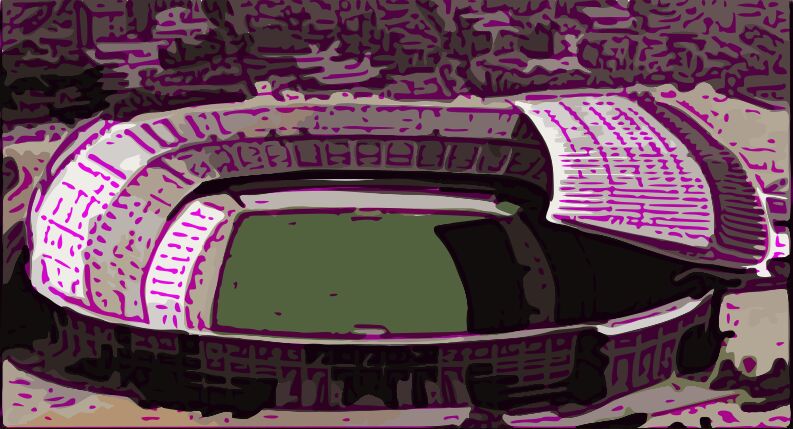
Camp Nou’s design stands as a pioneering achievement in stadium architecture, reflecting both innovation and functionality. Conceived by architects Francesc Mitjans and Josep Soteras, the stadium’s design was revolutionary for its time. The structure is elliptical, a choice that ensures optimal sightlines from every seat, allowing each of the nearly 100,000 spectators to feel intimately connected to the action on the pitch.
The stadium’s three-tiered seating arrangement is meticulously planned. The lower tier, closest to the pitch, offers an unparalleled view of the game, creating an intense and immersive experience for fans. The middle tier houses the VIP and press areas, ensuring that media coverage and hospitality are conducted with the utmost efficiency and luxury. The upper tier, reaching skyward, provides a panoramic view of the entire field, capturing the scale and grandeur of the stadium.
Camp Nou’s vast dimensions are staggering. It spans 250 metres in length and 220 metres in width, making it the largest stadium in Europe. The sheer size is complemented by an architectural elegance that blends concrete and steel with the softer, more inviting aspects of its design, such as the spacious concourses and the iconic blue and red seats that form a mosaic of FC Barcelona’s colours.
Renovations
Over the decades, Camp Nou has undergone several significant renovations to maintain its status as a top-tier stadium and to enhance the spectator experience. The first major renovation occurred in the late 1980s, in preparation for the 1982 FIFA World Cup, hosted by Spain. This upgrade expanded the seating capacity and improved facilities, ensuring that Camp Nou could accommodate the influx of international fans and media.
In the early 2000s, another series of renovations aimed to modernize the stadium. This included the installation of a state-of-the-art lighting system and an upgraded sound system, enhancing the match-day experience with better visibility and auditory clarity. The introduction of large video screens provided fans with instant replays and crucial match information, further immersing them in the game.
The most ambitious renovation plans came with the “Espai Barça” project, announced in 2014. This comprehensive redevelopment project aimed to transform Camp Nou into a cutting-edge, multi-functional sports complex. The project included expanding the seating capacity to 105,000, adding a new roof to cover all seats, and upgrading facilities to meet modern standards of comfort and sustainability. The focus was on blending the historic charm of the stadium with contemporary design and technology, ensuring that Camp Nou remained a world-class venue.
Comparison
When comparing Camp Nou to other major football stadiums, its unique attributes stand out. Unlike the Santiago Bernabéu in Madrid, known for its urban setting and vertical expansion, Camp Nou’s design prioritizes horizontal expanse, creating an open and airy atmosphere. In contrast to Wembley Stadium in London, which boasts a striking arch and a fully retractable roof, Camp Nou’s architectural appeal lies in its blend of traditional and modern elements, maintaining a sense of timeless grandeur.
Stadiums like the Allianz Arena in Munich, known for its modern facade and advanced lighting system, or the San Siro in Milan, with its iconic spiral towers, each have their distinctive features. However, Camp Nou’s status as the largest stadium in Europe, combined with its historical and cultural significance, places it in a league of its own. It is not just a venue for football matches; it is a symbol of the city of Barcelona and a beacon of Catalan pride.
Camp Nou’s architectural evolution continues to inspire awe and admiration, both for its sheer scale and its thoughtful design. It remains a testament to the ingenuity and vision of its creators, and a beloved landmark for fans around the world. As it moves forward with new renovations and expansions, Camp Nou retains its place at the pinnacle of football stadiums, a true architectural marvel.
Chapter 3: A Symbol of Catalan Identity
Cultural Significance
Camp Nou is more than a football stadium; it is a living monument to Catalan identity and pride. For the people of Catalonia, FC Barcelona represents more than just a football club—it embodies a spirit of independence, resilience, and cultural pride. The stadium, therefore, stands as a tangible manifestation of these values, serving as a sanctuary where Catalans can express their identity freely and passionately.
From its inception, Camp Nou has been a focal point for the expression of Catalan culture. The club’s motto, “Més que un club” (More than a club), encapsulates this sentiment perfectly. During the oppressive years of Francoist Spain, when Catalan language and traditions were suppressed, Camp Nou became a bastion of cultural resistance. Within its walls, fans could sing in Catalan, display the Senyera (Catalan flag), and celebrate their heritage without fear of reprisal.
The stadium’s role in this cultural revival cannot be overstated. It provided a sense of community and belonging, uniting people from all walks of life under a common cause. The matches at Camp Nou were not just sporting events; they were gatherings of cultural solidarity, where every goal and victory symbolized defiance against oppression and a celebration of Catalan identity.
Political Context
The political significance of Camp Nou has been particularly evident during times of heightened tensions between Catalonia and the Spanish government. The stadium has often been a stage for political expression, where the calls for independence and autonomy resonate loudly. It has hosted numerous displays of political solidarity, from coordinated chants and banner displays to organized protests.
One of the most poignant moments in recent history occurred on October 1, 2017, during the Catalan independence referendum. FC Barcelona played their match against Las Palmas behind closed doors, in protest against the violent crackdown on voters by Spanish authorities. The decision to play in an empty stadium was a powerful statement, highlighting the club’s solidarity with the Catalan people and their struggle for self-determination.
The relationship between FC Barcelona and Catalan politics is complex and multifaceted. While the club itself maintains a position of political neutrality, the fans and the stadium often serve as a barometer for the region’s political climate. Camp Nou is, in many ways, a microcosm of Catalan society, reflecting its aspirations, struggles, and triumphs.
Cultural Events
Beyond football, Camp Nou has hosted a variety of cultural events that underscore its significance as a multifaceted venue. Concerts by global music icons such as Bruce Springsteen, U2, and Michael Jackson have transformed the stadium into a musical arena, bringing together fans from diverse backgrounds. These events highlight the stadium’s versatility and its role as a cultural hub in Barcelona.
Moreover, the stadium has been the site of significant political and social gatherings. It has hosted mass rallies, including those advocating for Catalan independence, and other large-scale events that draw people from across the region. These occasions reinforce Camp Nou’s status as a central point for public discourse and cultural expression.
The annual Joan Gamper Trophy, held at the start of each season, is another example of the stadium’s cultural importance. Named after the club’s founder, this friendly match is a celebration of FC Barcelona’s history and its deep connection to Catalonia. It is a day of festivities, bringing together past and present players, club legends, and fans in a celebration of the club’s enduring legacy.
Camp Nou’s influence extends far beyond the realm of sports. It is a cornerstone of Catalan culture, a place where history is made and collective memories are forged. Whether through the passion of football matches, the power of political expression, or the joy of cultural events, Camp Nou continues to be a symbol of Catalan identity and pride. It stands as a testament to the enduring spirit of a people and their unwavering love for their club and culture.
Chapter 4: Memorable Matches and Moments
Iconic Matches
Over the decades, Camp Nou has been the theatre for some of football’s most dramatic and unforgettable matches. Among these, the epic clashes against Real Madrid, known as El Clásico, stand out. These encounters are not merely games; they are fierce battles that encapsulate the rivalry between two of Spain’s most powerful cities and clubs. One of the most memorable El Clásicos took place on 29 November 2010, when FC Barcelona, under the guidance of Pep Guardiola, dismantled Real Madrid 5-0. This match is often cited as one of the greatest displays of footballing prowess, showcasing the tiki-taka style that defined Guardiola’s era.
The UEFA Champions League has also seen Camp Nou host some of its most storied nights. The 1998-99 season’s semi-final against Chelsea is a prime example. After losing 3-1 in the first leg, Barcelona needed a heroic performance to progress. In a match filled with tension and drama, Barça triumphed 5-1 after extra time, securing their place in the final. Another unforgettable night came on 8 March 2017, when Barcelona achieved the seemingly impossible by overturning a 4-0 deficit against Paris Saint-Germain with a 6-1 victory, one of the most remarkable comebacks in football history.
Legendary Players
Camp Nou has been graced by some of the greatest footballers in history, each leaving an indelible mark on the club and its supporters. Johan Cruyff, who arrived in 1973, revolutionised FC Barcelona with his playing style and later as a manager, introducing the philosophy of total football that still influences the club today. His vision and elegance on the pitch helped establish a new era of success and set the foundation for future generations.
Ronaldinho, the Brazilian magician, brought joy and flair back to Camp Nou in the early 2000s. His dazzling skills and infectious smile endeared him to fans worldwide, culminating in a 2005 performance against Real Madrid where he was applauded by rival fans, a rare and remarkable honour.
Yet, no player embodies Camp Nou’s spirit more than Lionel Messi. From his debut in 2004, Messi’s extraordinary talent, consistency, and loyalty have made him a living legend. His record-breaking achievements, including becoming the club’s all-time top scorer and leading Barcelona to numerous titles, have solidified his status as one of the greatest players of all time.
Historic Goals
Camp Nou has witnessed countless iconic goals that have left fans in awe and opposition defences helpless. One such goal is Lionel Messi’s solo effort against Getafe in the 2007 Copa del Rey, reminiscent of Diego Maradona’s famous 1986 World Cup goal. Starting from the halfway line, Messi dribbled past five defenders and the goalkeeper to score, showcasing his extraordinary talent.
Another historic moment came during the 1992 European Cup final when Ronald Koeman’s thunderous free-kick against Sampdoria secured Barcelona’s first European Cup victory. This goal not only won the match but also marked the beginning of Barcelona’s ascent to European dominance.
In more recent history, Andrés Iniesta’s last-minute strike against Chelsea in the 2009 Champions League semi-final remains etched in the memories of Barça fans. This goal, which came in stoppage time, sent Barcelona to the final and set the stage for their eventual treble-winning season.
Chapter 5: The Heart of FC Barcelona
Fan Experience
Attending a match at Camp Nou is a pilgrimage for football fans, offering an experience like no other. The day begins with the journey to the stadium, often accompanied by friends and family, creating a sense of camaraderie and anticipation. Outside the stadium, the air is filled with the sounds of street vendors selling merchandise and the aroma of local Catalan delicacies.
Inside, the atmosphere is electric. The stadium fills with the sound of over 90,000 voices singing “Cant del Barça,” a moment that sends shivers down the spine of even the most seasoned supporters. The connection between the fans and the team is palpable, a bond that transcends the ordinary and ventures into the realm of the sacred.
The rituals of match day, from the coordinated chants to the waving of scarves, create a communal experience that binds fans together in a shared passion. Each match is a tapestry of emotions, where joy and despair can turn on a single moment of brilliance or misfortune.
La Masia
At the heart of FC Barcelona’s success is La Masia, the club’s renowned youth academy. La Masia has produced some of the greatest talents in football, including Lionel Messi, Xavi Hernandez, and Andrés Iniesta. The academy’s philosophy emphasizes technical skill, intelligence, and a deep understanding of the game, ensuring that young players are not just athletes but also thinkers on the pitch.
La Masia’s influence extends to Camp Nou, where graduates of the academy often make their mark. The seamless integration of youth players into the first team is a testament to the academy’s success and the club’s commitment to nurturing homegrown talent. This connection between La Masia and Camp Nou reinforces the sense of continuity and tradition that defines FC Barcelona.
Museum and Tours
A visit to Camp Nou is incomplete without exploring the FC Barcelona museum and taking a stadium tour. The museum, one of the most visited in Catalonia, offers a comprehensive history of the club, showcasing trophies, memorabilia, and interactive exhibits. It provides an immersive experience, allowing fans to relive the greatest moments in the club’s history.
The stadium tour offers a behind-the-scenes look at the iconic venue. Visitors can walk through the players’ tunnel, sit in the dugout, and even visit the press room. This access provides a deeper appreciation of the scale and significance of Camp Nou, bringing fans closer to the club they love.
Chapter 6: Future Prospects
Ongoing Projects
Camp Nou is continuously evolving to meet the demands of modern football while preserving its historical essence. The Espai Barça project represents the latest chapter in this evolution, aiming to transform the stadium into a state-of-the-art sports complex. This ambitious initiative includes expanding the seating capacity to 105,000, adding a new roof, and enhancing facilities to improve the overall fan experience.
The project also focuses on integrating advanced technology, including high-speed Wi-Fi, improved seating arrangements, and enhanced accessibility features. These upgrades are designed to ensure that Camp Nou remains at the forefront of global stadium standards, offering fans unparalleled comfort and convenience.
Sustainability
As part of its commitment to the environment, FC Barcelona is implementing sustainable practices within Camp Nou. The renovation plans include energy-efficient systems, water conservation measures, and initiatives to reduce the stadium’s carbon footprint. These efforts are aimed at making Camp Nou a model of sustainability in the sporting world.
The club is also exploring the use of renewable energy sources, such as solar panels, to power the stadium. By prioritizing sustainability, FC Barcelona is not only ensuring the long-term viability of Camp Nou but also setting an example for other sports organizations worldwide.
Vision for the Future
Looking ahead, FC Barcelona envisions Camp Nou as more than just a football stadium. The goal is to create a multifunctional complex that serves as a hub for sports, culture, and community events. The Espai Barça project is central to this vision, aiming to integrate the stadium seamlessly into the urban fabric of Barcelona.
The future of Camp Nou includes expanding its role in the community, offering facilities for local sports clubs, educational programs, and cultural activities. This vision reflects the club’s commitment to being a positive force in the city, fostering a sense of belonging and engagement among its residents.
Chapter 7: Personal Narratives and Testimonials
Fan Stories
The heart and soul of Camp Nou are its fans. Their stories, filled with passion and devotion, bring the stadium to life. Take the tale of Jordi, a lifelong supporter who has attended matches with his father and now brings his own children. For him, Camp Nou is a family tradition, a place where memories are made and passed down through generations.
Then there’s Maria, who experienced the elation of Barcelona’s 1992 European Cup victory. She recalls the explosion of joy in the stadium as Ronald Koeman’s free-kick found the net, a moment she describes as pure euphoria. These personal narratives highlight the deep connection between fans and the stadium, illustrating why Camp Nou is more than just a venue.
Player Perspectives
From the players’ perspective, Camp Nou is a stage where dreams are realized and legacies are forged. Andrés Iniesta, reflecting on his time at the club, speaks of the magic of playing at Camp Nou. He describes the feeling of stepping onto the pitch, hearing the roar of the crowd, and knowing that he is part of something much larger than himself.
Gerard Piqué, another stalwart of the club, echoes these sentiments. He emphasizes the responsibility that comes with wearing the Barça shirt and playing at Camp Nou, knowing that he is representing not just a club, but an entire culture and history.
Cultural Impact
Local historians and cultural commentators often speak of Camp Nou as a cultural landmark that transcends football. It is a place where Catalonia’s history, struggles, and triumphs are woven into the fabric of the game. The stadium’s role in political and cultural movements highlights its significance beyond sport, serving as a symbol of unity and pride for the region.
The cultural impact of Camp Nou is evident in the way it brings people together, fostering a sense of community and shared identity. Whether through the electrifying atmosphere of match days, the stories of its fans, or the contributions of its players, Camp Nou stands as a testament to the power of football to inspire and unite.
Conclusion
Reflective Summary
Throughout its history, Camp Nou has stood as a beacon of footballing excellence and a symbol of Catalan pride. Its architectural grandeur, historic matches, and legendary players have left an indelible mark on the world of football. The stadium’s role as a cultural and political symbol underscores its significance in the broader context of Catalonia’s history.
Legacy and Continuity
As Camp Nou continues to evolve, its legacy endures. The ongoing renovations and future plans ensure that it remains a world-class venue, while its deep-rooted connections to Catalan culture and identity remain as strong as ever. The stadium’s ability to adapt while preserving its historical essence is a testament to its enduring significance.
Final Thoughts
Camp Nou is more than just a stadium; it is a living monument to the passion, resilience, and pride of FC Barcelona and its supporters. It embodies the spirit of Catalonia, offering a place where dreams are realized and history is made. As it looks to the future, Camp Nou will continue to inspire and unite, standing as a symbol of football’s power to transcend boundaries and bring people together.
