


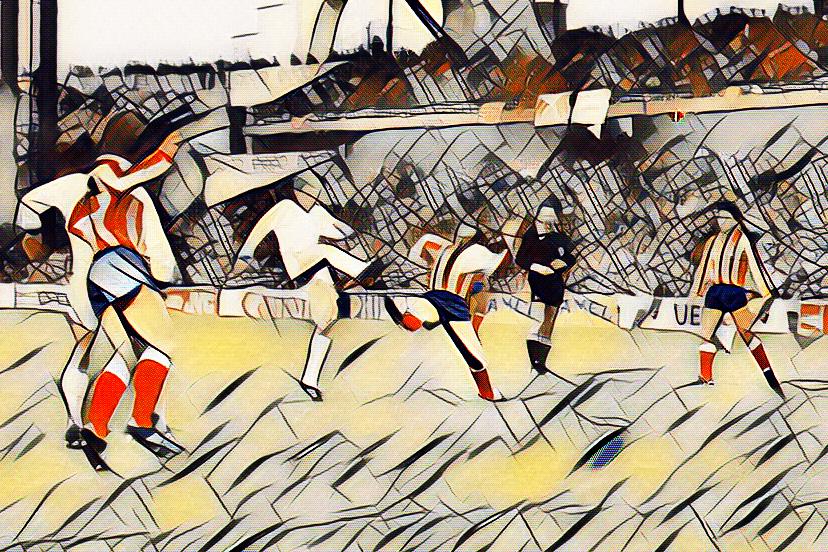
On 2 May 1986, at the Stade de Gerland in Lyon, Dynamo Kyiv scored a goal that looked improvised only to those watching from the outside. The move began on the left, where Vasyl Rats accelerated into a pocket of space that had not existed a second earlier. He drew two defenders and played inside to Ihor Belanov. Belanov took two touches, waited for the centre-back to commit, then laid the ball right to Vadym Yevtushenko without looking. Yevtushenko moved one stride forward, forcing the full-back inward, and slipped the pass into the path of the overlapping Oleh Blokhin. As the goalkeeper rushed out, Blokhin lifted the ball over him and into the net.
The sequence later became known as the “Fan Attack”. Every movement depended on another movement. Every run opened the lane for the next. To spectators and journalists, it appeared almost telepathic. In truth, it was drilled, measured, and repeated until it felt automatic. The French press called Dynamo Kyiv a team from another planet. On the bench, however, Valeriy Lobanovskyi did not leap to his feet. He sat forward, hands clasped, rocking slightly. For him, the goal was not a flash of genius. It was confirmation that the system was working.
This was the most complete expression of the Soviet football project. If the early history of Soviet football was about bringing the game inside the machinery of the state, Dynamo Kyiv was where that machinery became coherent on the pitch. The club did not simply represent the system. It was the only place where the system ever functioned as intended.
The Cybernetic Frontier of the Cold War
The precision seen in Lyon did not emerge by accident. It belonged to a city and a club shaped by the Soviet Union’s belief that complex problems could be solved through planning. Kyiv was one of the centres of the Soviet computer industry, home to the first cybernetics institute in the USSR, opened in 1957. It was a place where the language of systems, control, and modelling carried real weight.
Dynamo Kyiv absorbed that atmosphere more fully than any club in Europe. While much of Western football in the 1970s and 1980s was still discussed in terms of character or instinct, the Kyivan model increasingly treated the game as an organised set of interactions. A match was not merely something to be felt. It could be studied, reduced, and shaped.
This approach sat within a more complicated political reality. Dynamo Kyiv was a Soviet club, but it was also the leading football institution of the Ukrainian Soviet Socialist Republic. In an empire whose cultural gravity pulled toward Moscow, Dynamo’s rise offered a different centre of power. Its victories over Spartak, CSKA, and Dynamo Moscow carried meaning beyond the league table. For many in Ukraine, the club represented competence and control inside a system that was never fully theirs.
The contrast with Spartak Moscow became especially important. Under Konstantin Beskov, Spartak represented a more improvisational style, built on short passing and speed of thought. Lobanovskyi wanted something harder. His football demanded speed of execution, collective function, and exact movement under pressure. The rivalry was tactical, political, and cultural all at once.
The Chekist Roots and the Shadow of Occupation
Dynamo Kyiv’s institutional origins lay in the early Soviet security apparatus. The club was formally registered on 13 May 1927 as the Kyivan branch of the All-Union Dynamo Sports Society, itself tied to the GPU, the Soviet secret police. Players held ranks within the system. They were not simply athletes. They belonged to an organisation connected to power.
In the 1930s, Dynamo was an important club but not yet the defining force it would later become. That identity was shaped more deeply by war. After the German occupation of Kyiv in 1941, a number of former Dynamo players and other local footballers found work in the city’s bread factory and formed a team known as FC Start. Across the summer of 1942 they defeated military and occupation sides in a series of matches that would later be drawn into one of the most powerful myths in Soviet sporting memory.
The match of 9 August 1942 against Flakelf was later transformed by Soviet propaganda into the “Death Match”, a story in which Ukrainian players chose victory over submission and were executed immediately for it. The reality was more complex. The players were not shot after the final whistle. They played again. The arrests came later, and the executions followed months afterward in the Syrets concentration camp, likely tied to their pre-war affiliations and the wider brutality of occupation rather than to one result alone.
The myth endured because it was useful. The reality endured because it was lived. For the people of Kyiv, FC Start became a private symbol of endurance rather than a simple story of martyrdom.
The Laboratory of Valeriy Lobanovskyi
The tactical revolution came later, and it came through an alliance between football and science. In 1968, while coaching Dnipro Dnipropetrovsk, Lobanovskyi met Anatoliy Zelentsov, dean of the Dnipropetrovsk Institute of Physical Science. Zelentsov convinced him that football could be analysed through modelling and statistical probability. When Lobanovskyi returned to Dynamo Kyiv in 1973, he brought that conviction with him.
At Dynamo, football became laboratory work. The club’s scientific staff tracked what Zelentsov called “coalition actions”, moments where players functioned effectively in relation to one another rather than as isolated performers. The pitch was divided into zones. Movement was measured. Error was counted. The “18% rule” emerged from this environment, the idea that a team whose mistakes stayed below a certain threshold would not lose.
This shaped the body as much as the mind. Players trained under extreme physical loads designed to make pressing sustainable rather than merely energetic. Pulse rates were monitored. Endurance was stretched to the edge of discomfort. Universality was not a slogan. It was a requirement.
Lobanovskyi’s ideas are explored in full in his own profile. What matters here is the structure that allowed them to exist. Dynamo Kyiv provided continuity, discipline, and a system willing to subordinate everything else to method. Most clubs still depended on individuals. Dynamo depended on repeatability.
1975 and the First Proof of Concept
The first major validation arrived in 1975. Dynamo Kyiv won the Cup Winners’ Cup by defeating Ferencváros 3–0, becoming the first Soviet club to lift a major European trophy. Later that year they beat Bayern Munich 3–0 on aggregate in the UEFA Super Cup.
They did not simply win. They controlled the terms of the match. They looked fitter, more coordinated, and more certain of what space was for. Oleg Blokhin, who won the Ballon d’Or that year, was the visible star. His quality mattered. But it worked because the system amplified it.
This was the real significance of 1975. Dynamo Kyiv showed that a club operating outside Western Europe’s financial centre could impose a different logic on elite football.
1986 and the Atomic Team
By 1986, the model had hardened. The second great Dynamo side, built around the speed of Belanov, the intelligence of Aleksandr Zavarov, and the athletic power of Blokhin, reached a level of cohesion that made strong opponents look uncertain. Their 3–0 victory over Atlético Madrid in Lyon remains one of the clearest examples of collective football played at full speed.
The moment carried an uneasy weight. Just weeks earlier, the Chernobyl disaster had erupted not far from Kyiv. Soviet life was entering a period of strain and concealment. Yet on the pitch Dynamo appeared almost entirely controlled, as though discipline itself could resist disorder.
For a record of that final, UEFA’s archive remains a useful reference point: 1985–86 European Cup Winners’ Cup.
The National Team in Club Colours
Dynamo Kyiv’s dominance extended to the Soviet national team. By the mid-1980s, the line between club and country had thinned. Lobanovskyi’s players formed the core of the USSR side, and his methods shaped how it played. At Euro 1988, the Soviet team pressed Italy into submission before reaching the final against the Netherlands.
That side was, in effect, Dynamo Kyiv enlarged to a national scale. It moved with the same aggression and spacing. Only Marco van Basten’s volley denied it the title. The system held. The margin did not.
The Broken Algorithm of 1999
In the late 1990s, Dynamo made one final attempt to operate at the highest level. Under Lobanovskyi, and built around Andriy Shevchenko and Serhiy Rebrov, the club reached the 1998–99 Champions League semi-final.
In the first leg against Bayern Munich, Dynamo led 3–1 and controlled the match. Then the control slipped. A missed chance. A shift in momentum. A late equaliser. The match ended 3–3. In Munich, Bayern completed the turnaround.
The tie exposed the limit of the model. Dynamo could still organise space better than its opponents. It could no longer control what came next.
The Dissolution and the Oligarchic Era
After the collapse of the Soviet Union, Dynamo Kyiv entered a different reality. The club moved from state support into an oligarchic football economy. The methods remained, but the conditions did not. Ukrainian football became more competitive, and Dynamo’s certainty began to erode.
In 1995, the club was banned from European competition after attempting to bribe referee Antonio López Nieto. The episode marked a clear break from the discipline that had once defined it. The system had not disappeared. It had lost its environment.
When Lobanovskyi died in 2002 after suffering a stroke on the bench, the final link to that environment went with him.
The Ghost in the Machine
Dynamo Kyiv’s influence did not end with its decline. It shifted. The pressing structures that define elite football, the language of data, and the emphasis on coordinated movement all carry traces of work done in Kyiv decades earlier.
Ralf Rangnick described a match against Dynamo as the moment he understood that football could be organised differently. From there, the line runs forward. Jürgen Klopp’s teams press immediately. Pep Guardiola’s sides manipulate space with precision. The vocabulary has changed. The logic has not.
Dynamo Kyiv was not merely successful. It was functional. For a period, it showed what football looked like when it was organised as a system rather than played as a collection of moments.
The system did not last. The ideas did.
Part of the Soviet Football Series
This article forms part of an ongoing long-form series exploring the history, ideas, and legacy of Soviet football, from the rise of Dynamo Kyiv and the work of Valeriy Lobanovskyi to the collapse of the Soviet system and its quiet influence on the modern game.
You can begin the full series here:
→ Soviet Football: History, Dynamo Kyiv, Lobanovskyi, and Legacy
Or continue reading through the project:
- The Felt on Red Square: A History of Soviet Football
- Dynamo Kyiv and the Soviet System: How a Club Tried to Engineer the Future
- Valeriy Lobanovskyi and the Cybernetic Game
- 1975: Proof of Concept
- 1986: The Atomic Team
- Euro 1988 and the Last Great Machine
- The Shadow of the Kremlin: The Disintegration of Soviet Football and the Post-1991 Diaspora
- The Empire’s Final Whistle: Football, Fragmentation, and the Soviet Afterlife
Read together, these essays trace how a vanished football culture continues to shape the sport that followed.
