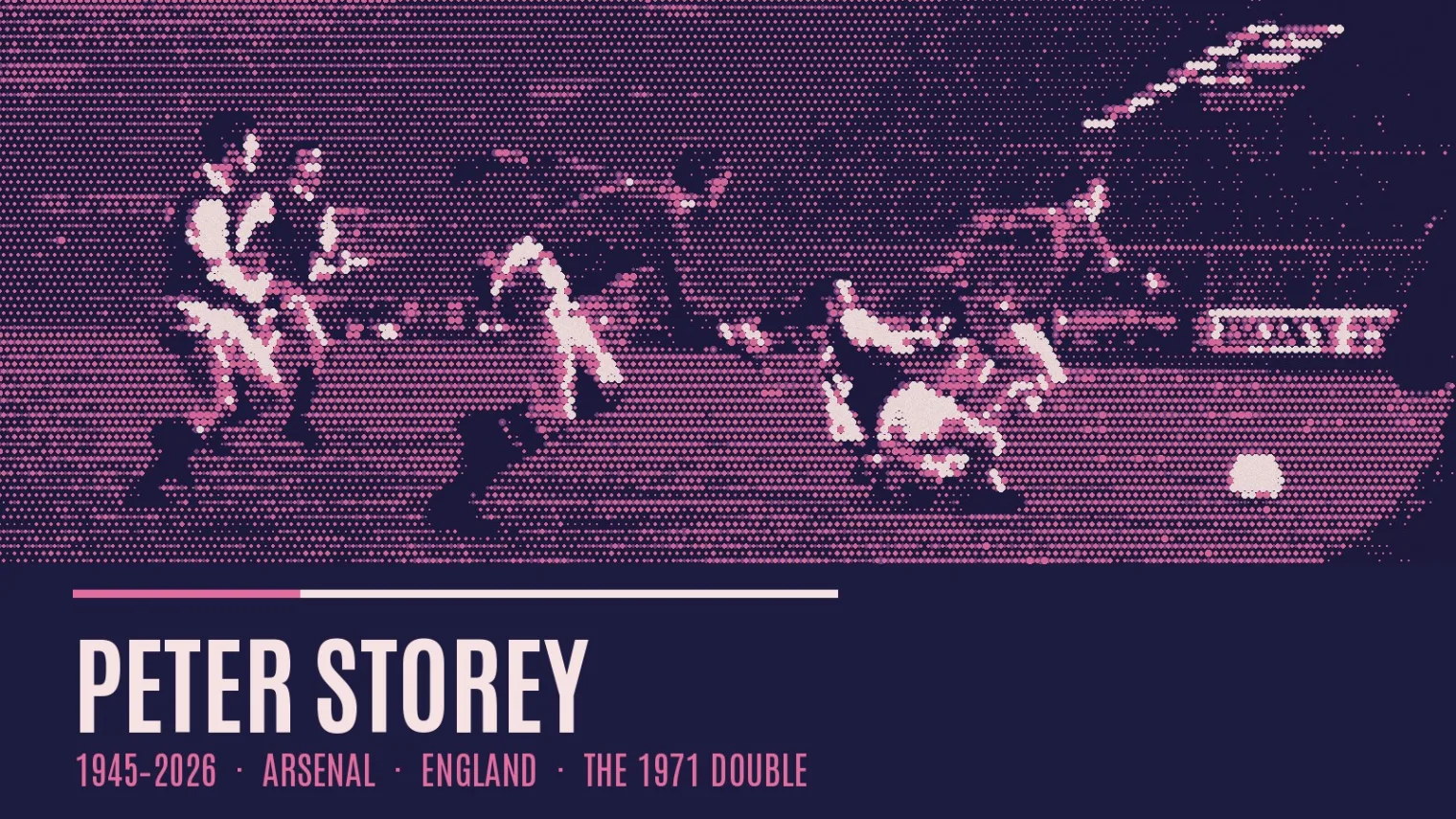
Hillsborough was into the two minutes of stoppage time on 27 March 1971 when the referee, Pat Partridge, pointed to the spot, and every Arsenal player in yellow celebrated except the one who had to take the kick. Peter Storey had already scored once that afternoon to drag Arsenal back into an FA Cup semi-final they had been losing 2–0. Now he had to beat Gordon Banks from 12 yards, in front of the Spion Kop, with the Double hanging on it. “It was one of those defining moments which I sensed would live with me forever,” he said later, in words quoted by Jon Spurling on Arsenal.com. “Miss and Arsenal would be out of the FA Cup and I’d never hear the end of it.”
He did not miss. Banks went right, the ball went low to his left, and Arsenal went on to Villa Park, to Wembley and into the record books.
Peter Storey died on Tuesday, 17 November 2026, at the age of 81. The Guardian reported that he died in hospital after a short illness, surrounded by his family. Arsenal, in a statement on the club website, said everyone at the club was “deeply saddened by the passing of 1970/71 double winner, Peter Storey,” and that they would pay their respects at the forthcoming home match against Borussia Dortmund.
He played 501 times for Arsenal, which still puts him eighth on the club’s all-time list. He won the Fairs Cup in 1970, the League and FA Cup Double in 1971, and 19 England caps under Sir Alf Ramsey. He was also, by general agreement of the people who played against him, one of the hardest men in English football in an era that was not short of them. And then, once the football stopped, he was convicted of a string of offences that made him, for a while, better known to the tabloid front pages than he had ever been to the back ones.
An honest obituary has to hold all of that at once. Storey’s own did, in its way. In 2010 he published an autobiography with the subtitle My Life and Crimes as a Football Hatchet Man. He did not pretend either half of the title away.
A boy from Ash
Peter Edwin Storey was born on 7 September 1945 in Farnham Hospital in Surrey. The player biography at England Football Online, drawing on Douglas Lamming’s An English Football Internationalist’s Who’s Who, records that he grew up on the Longacre Estate in Ash, near Aldershot, and went to Heathcote Memorial Junior and Yeoman’s Bridge Secondary schools. He played for Aldershot and Farnborough schools, and as a 15-year-old had trials for Hampshire Schools as a centre-half and for London Schools as a right-back in the same week. He was an England schoolboy in 1961. Arsenal had already spotted him and signed him, in the old phrase, “on a promise”.
He joined the club as an apprentice that year, 1961. Highbury in the early 1960s was not the place it would become. The club’s last trophy had come in 1953, and would not win another until Storey was a first-team regular at the end of the decade. The young players of that era came up through a club that was living off its past.
He made his first-team debut against Leicester City in October 1965, shortly after his 20th birthday. According to football.london’s obituary, it was a defeat, but he did well enough to play in the remaining 29 fixtures of the season. Barney Ronay’s review of the autobiography in the Observer picked out the domestic details from those early years: a new overcoat, a bungalow shared with Terry Neill (“my abiding memory is going down the launderette for the first time”), and the book’s first proper on-field violence, a head-butt from Jim Storrie of Leeds. “I reeled backwards, trying to stay on my feet,” Storey wrote.
He learned quickly. football.london dates the start of his reputation as a “tough guy” to the 1966–67 season, when he injured Manchester City’s Mike Summerbee.
From full-back to the middle
For most of the first part of his career Storey was a full-back, usually on the right, and he always thought of himself as one. That matters for understanding what happened next. As Bertie Mee and his coach Don Howe built the side that would end the long wait for silverware, they saw something in Storey beyond the tackling. “His reputation as a tough tackler was well deserved,” Arsenal’s tribute says, “Nonetheless, he was also good on the ball. Bertie Mee and Don Howe recognised that, converting him into a central midfielder.”
The club’s own history records the most famous review of his tackling. Johnny Giles of Leeds United, according to Arsenal, admitted that Storey was the hardest player he had ever faced. Giles was no innocent himself, and he played in a Leeds side that, as Storey would later point out, had several hard men of its own.
The move inward was the making of him as an Arsenal player, but he did not entirely enjoy it. Jon Spurling, reviewing the autobiography for When Saturday Comes in January 2011, noted that Storey put much of his foul temper on the pitch down to frustration at being played out of position for years: he saw himself as “a full-back by trade”. Pat Rice, the Highbury greengrocer’s boy who came through the youth system behind him, took over at right-back once Storey moved into the centre. The Arsenal History Society put it simply in its tribute to Rice: Storey moved into the centre of midfield “to become the ultimate enforcer”.
The nicknames tell the story of how team-mates saw him. Spurling’s review lists “Cold Eyes” and “Snouty”, the second because of his ability to “sniff” out weaknesses in the opposition’s midfield. Bertie Mee’s view, as Spurling records it, was that Storey barely said more than a couple of words all week and then turned into a snarling beast on Saturday afternoons. Ron “Chopper” Harris of Chelsea, who knew a thing or two about the job, called him “the bastard’s bastard”.
The trophy that ended the wait
The first prize came in Europe. Arsenal’s 1969–70 league season was ordinary, a 12th-place finish and a third-round FA Cup exit to Blackpool, according to the club’s account of the Fairs Cup run. But in the Inter-Cities Fairs Cup they kept going. Storey played 11 times in the competition that season, one of the most-used players in the squad. They beat an Ajax side containing Johan Cruyff, Rudi Krol, Piet Keizer and Gerrie Mühren in the semi-final.
In the final against Anderlecht, Storey wore the No 2 shirt in both legs. The first, in Anderlecht on 22 April 1970, went badly: Anderlecht led 3–0 before a late header from the substitute Ray Kennedy gave Arsenal an away goal. Six days later at Highbury, in front of 51,612, Eddie Kelly scored after 25 minutes, John Radford levelled the tie on aggregate with a header and Jon Sammels made it 3–0 on the night, 4–3 overall. The club’s match report describes supporters surging on to the pitch at the final whistle. It was Arsenal’s first trophy in 17 years and their first in Europe.
It was also the first time, Arsenal note, that a side had overturned a two-goal deficit to win a two-legged European final. The team that night, Wilson, Storey, McNab, Kelly, McLintock, Simpson, Armstrong, Sammels, Radford, George, Graham, was very nearly the side that would win the Double a year later.
The season of the Double
That 1970–71 side has never had the romantic reputation of Tottenham’s Double team a decade earlier. Spurling’s WSC review is blunt about why. Critics found Mee’s team functional, even dull, with Charlie George and George Graham the exceptions, and “No player appeared to typify the Gunners’ distinctly blue-collar, often attritional approach better than midfield enforcer Peter Storey.”
It was a fair description of his role and an unfair one of his contribution. Storey was Arsenal’s penalty-taker, and he had already scored from the spot in both of the ties it took to get past Portsmouth in the fourth round. The draw for the semi-final sent Arsenal to Hillsborough to face Stoke City, a team that had beaten them 5–0 at the Victoria Ground earlier in the season. Spurling’s Arsenal.com piece quotes what Storey told the Evening Standard beforehand: “A defeat like that is a blot on our record this season and we will be determined to rub it out. One thing’s for sure. We will be mentally prepared for them this time. We will be treating them just like Leeds.” Then, almost as an afterthought: “Nothing would give me greater pleasure than to stick one (a penalty) past Gordon Banks in the semi-final. That would really be something, wouldn’t it?”
The match itself began as badly for him as it could have. After 20 minutes, with Storey the last man, he tried to clear a half-cleared corner and toe-poked the ball against the ankle of Stoke’s centre-half Denis Smith. It ballooned up and looped over Bob Wilson into the top corner. Nine minutes later Charlie George’s back-pass fell short and John Ritchie walked the ball round Wilson. Arsenal’s own “Greatest Gunners Moments” series calls both goals “farcical from an Arsenal perspective”, and notes that Jimmy Greenhoff missed a golden chance to make it 3–0 before half-time.
The comeback was Storey’s. Early in the second half a George Armstrong throw was helped on by Ray Kennedy and nodded out to the edge of the box, where Storey hit it on the half-volley. It took a slight deflection on its way past Banks. Then, in the stoppage time that had been added for an injury to George, Armstrong’s corner was met by Frank McLintock’s header, and Stoke’s John Mahoney dived to push it away with his hand. Banks, Spurling writes, later spoke of a sense of “fatalism”.
The penalty is the moment the club still celebrates. Storey skipped slightly as he ran up and put it to Banks’s left as the goalkeeper shifted his weight to the right. Then he stopped, threw his hands in the air, and it was 2–2. Mee told the Sunday Times: “I feel like I have won the FA Cup itself after today.” According to 11v11’s record, there were 55,000 inside Hillsborough to see it. In the replay at Villa Park, George Graham and Ray Kennedy scored, and Arsenal were through to meet Bill Shankly’s Liverpool. “Down the years, Storey downplayed his role in the semi-final,” Spurling concludes, “insisting that he simply ‘did his job’.” That month, Storey was presented with the Evening Standard‘s footballer of the month award by the Arsenal chairman, Denis Hill-Wood, according to the caption on a photograph used by the Observer in 2010.
He very nearly did not play at Wembley at all. Ronay’s review quotes the autobiography’s account of almost being left out of the final, in a simile that the reviewer thought “a little unnecessarily” vivid and which we will leave in the book. He did start, in the No 4 shirt, on 8 May 1971. He did not finish. The FA Cup finals record has Eddie Kelly replacing him, and it was Kelly’s touch, after Radford’s overhead kick, that rolled the ball towards goal for Arsenal’s extra-time equaliser, the goal George Graham appeared to finish and which was later credited to Kelly. Charlie George’s drive from 25 yards did the rest. Arsenal won 2–1, and the Double was done. The goalkeeper beaten twice that afternoon was Ray Clemence, who had been an unused substitute on the night of Storey’s England debut, a little over a fortnight earlier.
There is something very Storey about that. He did the hardest part of the cup run, at Hillsborough, and then came off before the end of the game everyone remembers.
Nineteen caps for Ramsey
The Double brought an England call. Storey won his first cap on 21 April 1971, at right-back in a 3–0 European Championship qualifier against Greece at Wembley, aged 25 years and 226 days. In his match report for England Football Online, Norman Giller wrote that “Peter ‘Cold Eyes’ Storey got his first England call up as reward for his consistent performances for an Arsenal team on the way to a League and FA Cup double,” and that “he went back to his original position of right-back for his first taste of international football.”
Ramsey used him in both roles. EFO’s match-by-match record has him at right-back for Greece, then in the No 4 shirt through most of 1971 and 1972, including the 0–0 draw with West Germany in Berlin on 13 May 1972, two weeks after he had watched from the bench as the same opponents won 3–1 at Wembley in a European Championship tie. In late 1972 and early 1973 he went back to No 2, including the 5–0 win over Scotland at Hampden in February 1973, before going back to No 4 for the summer tour.
That tour contained the match that decided the fate of Ramsey’s team. Storey started the 2–0 defeat by Poland in Chorzów on 6 June 1973, a World Cup qualifier that went on to matter far more than anyone knew that summer. His last cap came eight days after Chorzów, a 2–0 defeat by Italy in Turin on 14 June 1973. He was 27. In all he played 19 times for England, won 11, drew five and lost three, and won or shared three British Championships. As the BBC’s obituary notes, he never played at a major tournament.
What “hard” meant
It would be dishonest to write about Storey as if the tackling were an unfortunate side-effect. It was the job, and he knew it was the job. In a 2010 interview with the Mirror he described how the instructions were given: “I remember Bertie Mee and Don Howe saying, ‘Peter, you know what to do’ – which meant I was to go out and kick a certain player. You could get away with it in the first few minutes, so that is when I did it.” He added: “I was hardly the only one. There was Ron Harris at Chelsea, Tommy Smith at Liverpool – and Leeds had several hard men.”
In the book, as quoted by Ronay, the method was set out more vividly still: “The trick was to get in early as possible, hit them hard, give them a good wallop, make them feel as if they’d been in a car crash or hit a brick wall.” And alongside it, a line that does not ask for sympathy: “I will never attempt to even begin to make excuses for what I did in football.”
He drew a line, though, between what he did and what he saw later. In a second Mirror interview that October, he said: “I got away with things which would get me locked up today. But I never broke anyone’s leg and I don’t recall doing any serious long-term damage to end anyone’s career.” And: “There is nothing ‘hard’ about flying into a tackle at 100mph and breaking someone’s leg. That’s not commitment, or passion, or whatever they call it today – it’s cowardly.” He thought Roy Keane was “probably the last of his breed who got the balance right”, and that “players like Johnny Giles and myself would never last five minutes now.”
Reputations like that tend to swallow everything else a player could do, as FBH found with Dave Mackay, Spurs’ Double-winning heartbeat a decade earlier. Storey suffered from the same compression. The Arsenal tribute bothers to say that he “was also good on the ball”. One supporter, quoted by football.london, called him “Hard as nails but a far better player than he was given credit for.”
The end at Highbury, and Fulham
Storey stayed at Arsenal for 12 more years after his debut, through the decline that followed the Double. The BBC notes that he also collected runners-up medals in the League Cup in 1967–68 and 1968–69 and in the FA Cup in 1971–72. By the mid-1970s the great side had broken up, and his own time ended badly. football.london says he was suspended for refusing to train with the reserves. He joined Second Division Fulham on a free transfer in March 1977.
Fulham in 1977 were one of the stranger dressing rooms in English football, with George Best, Bobby Moore and Rodney Marsh all there in the autumn of their careers. Storey helped them avoid relegation, but it did not last. He made 19 appearances, according to the BBC, before his contract was cancelled, eight months after he had signed, as the Guardian puts it. That was the end of his playing career. Arsenal’s records give the retirement year as 1978. In total, the club credits him with 17 goals in his 501 games.
Life after football
What came next is the part of his life that the reference books, the tabloids and Storey’s own autobiography all dwell on. It should be set out plainly.
He went into the licensed trade. Lamming’s Who’s Who, as quoted by EFO, records him as landlord of the Jolly Farmer in Islington, and as running a minicab firm, Starline. The Observer‘s 2001 summary of his record lists the convictions that followed: in 1979, a suspended prison sentence for running a brothel, the Calypso Massage Parlour in Leyton; in 1980, three years in prison for financing a plot to counterfeit gold coins; in 1982, two six-month terms for car theft; and in 1990, four weeks in prison for importing 20 “obscene” video tapes hidden in the spare tyre of his jeep. EFO adds that the brothel conviction came with a £700 fine, that the coins were gold half-sovereigns, and that the tapes were brought in from Rotterdam. The Mirror, in 2010, referred to him “slopping out in Wormwood Scrubs”.
Spurling’s verdict in WSC was that the rackets had been “half-baked”. Storey himself did not dress them up. Spurling noted that three divorces, a bankruptcy and several spells behind bars meant that at 65 he could do with the money the book would bring. He wrote that Storey was “unflinching” about the fallout from the drinking, the womanising and the crime, and that he had not seen his daughter for more than 20 years. The book was dedicated partly to his father, Edwin, to whom he apologised for “the shame”. Ronay, who found much of the book’s humour unintentional, still concluded that Storey “becomes more likable the more time you spend inside the book’s covers”, and that the closing litany of court appearances read as “a compelling kind of mea culpa”.
By then he had been out of sight for years. Spurling wrote that the class of 1971 met up regularly and that Storey had been notably absent, that there had been false sightings of him at the Emirates, and even an online rumour that he had died. The Mirror found him “elusive, if not reclusive” in rural France with his fourth wife, a border collie, three cats and a goat, still following Arsenal “avidly from a distance”. When Spurling reviewed the book, he hoped that telling his story might help “Arsenal’s ‘black sheep'” to find his way back into the fold.
Tributes
On Tuesday the club that had once suspended him called him a vital member of the Double squad and put his penalty at Hillsborough at the centre of its tribute. The Independent reported that Arsenal will honour him at their Champions League game against Borussia Dortmund on 24 November, and that the statement ended: “Rest in peace, Peter.”
His family, in words carried by the Guardian and the Standard, said: “We are deeply grateful for the many kind messages, tributes and good wishes we have received. It has been a great comfort to see the affection and respect in which he was held by so many, both within the football community and beyond.”
Supporters who saw him play wrote in. football.london quoted Jill Armstrong, daughter of George Armstrong, whose throw and corner made both of Storey’s goals at Hillsborough possible: “So very sorry to hear about Peter. Love to his family and friends.” Another fan wrote: “RIP Peter Cool Eyes Storey. Privilege to have seen your career at Arsenal in 60s and 70s.”
Did his job
It is tempting to make Peter Storey a parable, either of the 1970s or of what happens to footballers when the football stops. He resisted both. In his own telling the hard-man years were neither glorious nor shameful, just the way the game was played on muddy pitches with referees who let the first few minutes go. The crimes were his, and he said so. Somewhere between those two accounts was a man who joined Arsenal at 15, played 501 games for them, and in the one afternoon when the whole Double depended on a single kick, walked up and put it past Gordon Banks.
He always said that he had only done his job. On 27 March 1971, in front of the Kop at Hillsborough, the job was everything.