


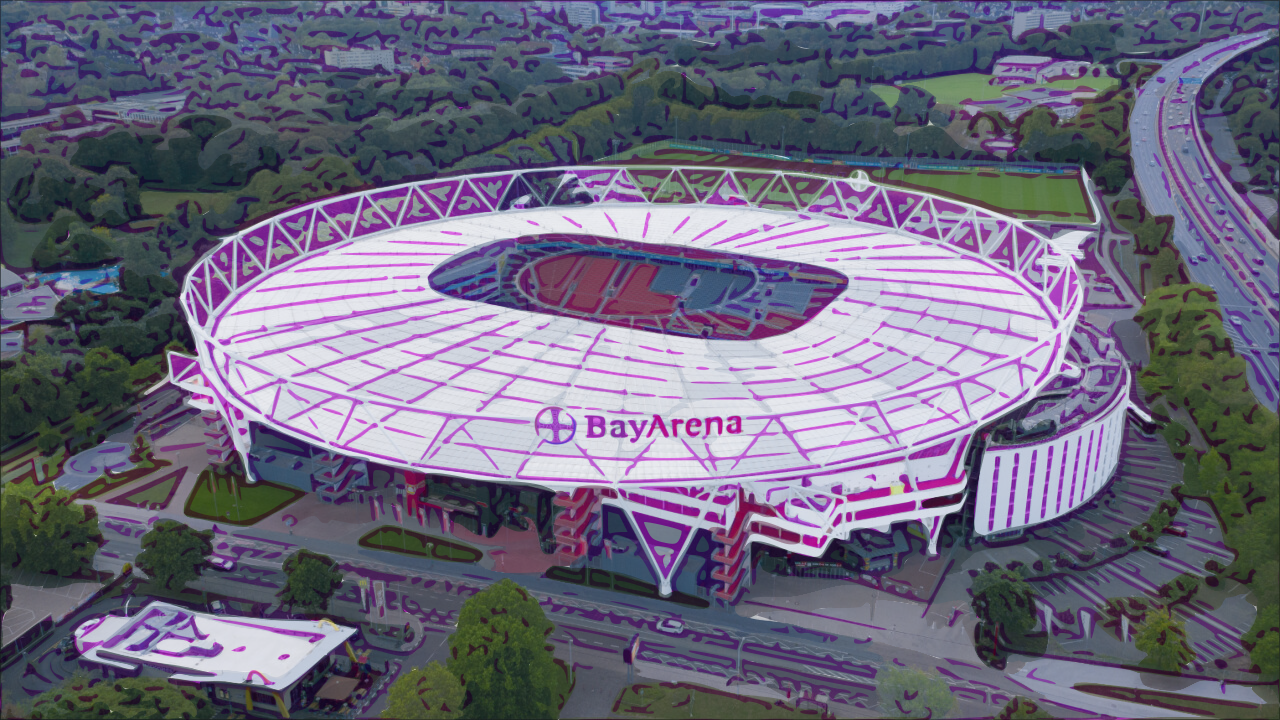
I. Introduction: The Story of a Modern Football Fortress
Perched along the banks of the Rhine, BayArena stands as a testament to Bayer Leverkusen’s commitment to footballing excellence. From humble beginnings as the Ulrich-Haberland-Stadion, this venue has transformed into one of Germany’s most impressive football arenas, representing a symbol of modernity and ambition. It’s not just the home of Bayer Leverkusen; it’s a stage where some of the most iconic European football moments have unfolded.
Built to blend innovation with tradition, BayArena is celebrated for its sleek, futuristic design that doesn’t compromise on fan experience. The structure combines comfort, technology, and atmosphere, making it a favorite among supporters and players alike. Its compact, intimate design ensures that fans are close to the action, creating an electric environment during every matchday.
BayArena has also earned a reputation far beyond the Bundesliga. European nights have brought the stadium into the international spotlight, hosting some of the continent’s finest footballing clashes. From UEFA Champions League fixtures to important Europa League battles, the ground has witnessed moments of drama, brilliance, and heartbreak on the grandest stage. It has become synonymous with Bayer Leverkusen’s reputation as a perennial challenger, a club often on the cusp of glory.
As football continues to evolve, so too does BayArena. More than just a stadium, it represents the beating heart of Bayer Leverkusen, serving as a focal point for both the local community and the global footballing audience. Its story is one of growth, from a local ground to a modern football fortress, embodying the club’s aspirations and the spirit of European football.
II. The Birth of BayArena: A Vision for the Future
Bayer Leverkusen’s rise in German football is deeply intertwined with the evolution of its home ground. The club’s origins date back to 1904, founded as a sports club for the employees of the Bayer pharmaceutical company. Initially, the team played in modest surroundings, a far cry from the modern arena we see today. However, as Leverkusen grew as a footballing force, so too did the ambition to create a stadium that matched the club’s aspirations.
Originally known as the Ulrich-Haberland-Stadion, named after a former chairman of Bayer AG, the stadium was constructed in 1958. It was a relatively small venue by modern standards, designed to host Bayer Leverkusen’s early forays into German football. With a capacity of around 20,000, it was enough to serve the needs of a club that was still developing its identity in the domestic league. But by the 1980s, the club’s trajectory was shifting. Bayer Leverkusen had established itself as a consistent presence in the Bundesliga, and the need for a modern, competitive stadium became apparent.
The decision to renovate and expand the stadium in the late 1980s marked the beginning of a new era for both the club and its home ground. The redevelopment was not merely a response to growing crowds but part of a broader vision to make Leverkusen a major player on the European stage. By the time the first phase of reconstruction was completed in 1986, the venue had started to take on the characteristics of what would later become the BayArena, with an emphasis on enhancing the spectator experience.
The vision was clear: Bayer Leverkusen wanted a stadium that not only hosted football matches but also projected a sense of modernity and professionalism. The phased development continued through the 1990s, with each stage bringing the stadium closer to the cutting-edge facility it is today. By 1997, the stadium had been fully transformed. The roof, an iconic feature of the new design, covered all the seating areas, ensuring fans could enjoy matches in comfort, regardless of the weather. The compact design brought supporters closer to the pitch, creating a more intense atmosphere—something that has become a hallmark of BayArena.
This period of redevelopment also coincided with Bayer Leverkusen’s rise in European football. In 1988, the club secured its first major trophy, winning the UEFA Cup, an achievement that cemented Leverkusen’s place among Europe’s top teams. The stadium, now with an identity of its own, was a fitting backdrop for the club’s growing ambitions.
It was during these years that BayArena began to host not just Bundesliga matches but also pivotal European fixtures. With Leverkusen regularly qualifying for UEFA competitions, the ground became a familiar sight to football fans across the continent. By the early 2000s, it had hosted numerous Champions League nights, including matches against Europe’s elite.
The transformation of BayArena from the humble Ulrich-Haberland-Stadion to one of Germany’s most modern football grounds was a significant chapter in Bayer Leverkusen’s history. It was not merely about increasing capacity but about creating a stadium that could stand shoulder-to-shoulder with Europe’s finest. The foresight of those involved in the redevelopment ensured that Leverkusen had a home fit for their ambitions, a place where fans could gather and create an atmosphere that has become legendary.
BayArena’s story is one of evolution, from a modest football ground into a modern fortress that symbolizes both the progress of Bayer Leverkusen and the aspirations of German football.
III. BayArena’s Rise: From National Matches to International Fame
As Bayer Leverkusen’s fortunes rose, so did the significance of BayArena. The stadium became a central figure in the club’s domestic success throughout the 1990s and early 2000s. It was here that Leverkusen built their reputation as a Bundesliga heavyweight, consistently finishing among the top clubs and challenging the dominance of Bayern Munich and Borussia Dortmund. Some of the most memorable domestic battles unfolded at BayArena, with the stadium playing host to thrilling contests that gripped fans across Germany.
The European stage was where BayArena truly shone. During Leverkusen’s 2001-02 Champions League campaign, the stadium witnessed unforgettable nights, including clashes with Barcelona and Liverpool. These matches saw the ground transform into a cauldron of noise and passion, helping Leverkusen to reach the final that year. Although the ultimate dream of lifting Europe’s biggest trophy eluded them, the journey solidified BayArena’s reputation as one of the most feared venues in European football. The stadium’s aura grew with each passing European night, its name becoming synonymous with unforgettable matches and resilient performances.
IV. A Stadium at the Heart of Innovation
BayArena is a beacon of modernity in football stadium design. Over the years, it has undergone multiple renovations to stay at the forefront of innovation. The most significant transformation occurred between 2007 and 2009, when the stadium’s capacity was expanded to over 30,000, and the entire infrastructure was upgraded. Its distinctive roof, which seems to hover gracefully above the stands, is not only a design marvel but also a testament to the meticulous planning that prioritises fan comfort.
In addition to its aesthetic appeal, BayArena is packed with features aimed at enhancing the matchday experience. The seats are designed for comfort, and the stadium’s bowl-shaped structure ensures that fans are never too far from the action. The integration of eco-friendly initiatives, such as rainwater recycling and energy-efficient lighting, further showcases Leverkusen’s forward-thinking approach. BayArena is not just a place to watch football—it’s an example of how modern facilities can elevate the overall experience for players and supporters alike.
V. A Home for International Football
BayArena’s reputation extends beyond the domestic and European club scene. It has hosted several international matches, further enhancing its standing on the global stage. The German national team has played at the venue on multiple occasions, with the stadium often selected for high-profile friendlies and qualifiers. Additionally, BayArena played a pivotal role in the 2011 FIFA Women’s World Cup, hosting several key matches and showcasing the venue’s versatility.
The ground’s ability to adapt to different footballing events, from youth tournaments to senior internationals, makes it a crucial part of Germany’s footballing infrastructure. With its modern amenities and intimate atmosphere, BayArena is the perfect host for matches that demand both style and substance.
VI. Iconic Players and Their Relationship with BayArena
BayArena has witnessed some of the finest footballers in the world showcase their talents. For Bayer Leverkusen, players like Ulf Kirsten, Michael Ballack, and Bernd Schneider became legends on the pitch, delivering memorable performances that are forever tied to the stadium’s lore. These players turned BayArena into a fortress, where Leverkusen’s attacking football thrilled fans and tormented opposition defenders.
However, it’s not just Bayer Leverkusen’s stars who have left their mark on BayArena. The stadium has seen some of Europe’s biggest names grace its pitch, from Zinedine Zidane to Cristiano Ronaldo, all leaving their imprint on the venue’s storied history. Each player and match has contributed to BayArena’s growing legacy as a stage for elite football.
VII. Community and the BayArena
BayArena is more than just a football ground; it is deeply woven into the fabric of Leverkusen’s community. As a hub of local pride, the stadium represents far more than sporting success—it is a place where the city gathers, where fans share lifelong memories. The club has always been keen to engage with the local population, running outreach programmes and initiatives that strengthen the bond between the stadium and its supporters.
Beyond football, BayArena serves as a multi-purpose venue, hosting concerts, cultural events, and other public gatherings. This integration of football and community life ensures that BayArena remains a cornerstone of the city’s identity, not just on matchdays but year-round.
VIII. BayArena in the Modern Era: Football, Technology, and the Future
In the modern football landscape, BayArena continues to push boundaries. The incorporation of the latest technological advancements, from digital ticketing systems to high-definition video boards, keeps the stadium at the cutting edge of fan engagement. Additionally, BayArena has embraced the use of VAR (Video Assistant Referee) technology, ensuring that it remains aligned with the latest innovations in football governance.
Sustainability is also at the heart of BayArena’s operations, with the stadium leading the way in eco-friendly practices, from waste reduction to renewable energy initiatives. These efforts reflect Bayer Leverkusen’s commitment to being a responsible and forward-thinking club, on and off the pitch.
Looking ahead, BayArena is primed for continued growth and development. While no major renovations are currently planned, the stadium remains adaptable, ready to host future European or international competitions. Its future, much like its past, is filled with promise.
IX. Bayer Leverkusen’s Ambitions Tied to the Stadium
BayArena is not just a physical structure; it’s a symbol of Bayer Leverkusen’s ambitions. As the club continues to compete for honours both domestically and in Europe, the stadium serves as a constant reminder of what the club has achieved and what it hopes to achieve in the years ahead. With its modern facilities, passionate fanbase, and proud history, BayArena is the perfect platform for Leverkusen’s ongoing pursuit of glory.
The future of Bayer Leverkusen is intrinsically tied to the stadium that has become its beating heart. As the club looks to build on its successes, both the team and its home ground are poised to continue making headlines in German and European football.
X. Conclusion: BayArena’s Legacy in German and European Football
BayArena’s legacy is already well-established. From its humble beginnings to its status as one of Europe’s most modern stadiums, it has played a crucial role in Bayer Leverkusen’s development as a footballing powerhouse. Its cutting-edge design, unforgettable matches, and integration with the community ensure that BayArena will remain a central figure in football for many years to come.
As both a symbol of progress and a venue for sporting excellence, BayArena has earned its place among Europe’s great football grounds. For Bayer Leverkusen and their supporters, it is more than just a stadium—it is the home of dreams, memories, and ambition.
