


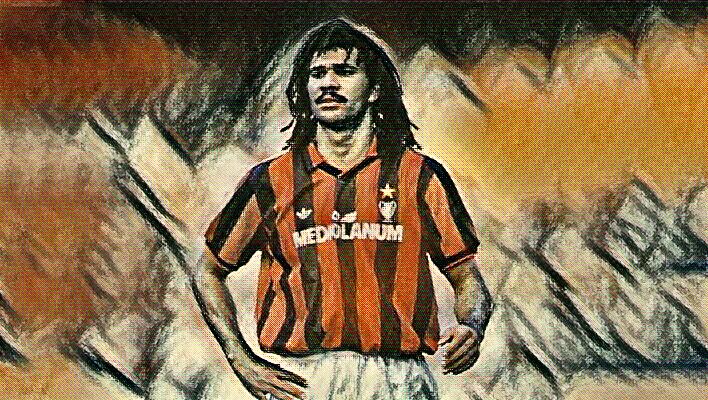
If Johan Cruyff was the architect of Total Football—the slender, wired intellectual who saw the pitch as a geometry problem to be solved—then Ruud Gullit was its heavy artillery. By the late 1980s, the romantic idealism of the 1974 generation had given way to a sport defined by increasing athleticism and tactical rigidity. To survive, the Dutch philosophy required an evolution. It needed a player who possessed the spatial intelligence of Cruyff but carried it within the frame of a decathlete.
In Ruud Gullit, Rinus Michels found the perfect modernisation of his own invention. While Marco van Basten provided the surgical finishing and Frank Rijkaard the defensive ballast, it was Gullit who served as the spiritual and physical bridge between the “Beautiful Losers” of the 70s and the “Pragmatic Winners” of 1988. He was the Cruyff of the new era—less a conductor of an orchestra, and more a rock star leading a riot.
The Physical Evolution of the Number 10
To compare Cruyff and Gullit is to track the biological evolution of the elite footballer. Cruyff operated on wit, acceleration, and a fragile sort of grace. Gullit, conversely, was an imposition. Standing over six feet tall with the upper-body strength of a centre-back and the speed of a winger, he represented a terrifying new proposition for defenders: a playmaker you couldn’t bully.
This physicality allowed Gullit to interpret “Universality”—the core tenet of Total Football where players interchange positions—differently than his predecessor. Where Cruyff would drift wide to drag a marker out of position through seduction, Gullit would often simply overrun them. He could play as a sweeper (as he did early in his career), a box-to-box midfielder, a winger, or a centre-forward.
In the 1988 tournament, Michels deployed a system that was ostensibly a 4-4-2 but functioned more like a 4-4-1-1, with Gullit operating as a free-roaming satellite around Van Basten. This gave Gullit the “paintbrush”—the creative license Michels had previously reserved for Cruyff—but with instructions to apply it with more force and less indulgence.
Dismantling the Soviet Algorithm
The tactical utility of Gullit’s role became the deciding factor in the Euro 1988 final against the Soviet Union. Valeriy Lobanovskyi’s Soviet side was built on a system of strict zonal marking and mathematical probability; players were responsible for quadrants of the pitch rather than specific opponents. In their group stage meeting, Lobanovskyi had successfully neutralised Gullit by assigning specific man-markers to stifle his space.
For the final, Michels and Gullit adjusted. Instead of staying high where the Soviet defensive grid could process him, Gullit dropped deep into the midfield, acting as a “false 10”. This movement wreaked havoc on the Soviet “cybernetic” model. The Soviet defenders, particularly the converted midfielder Sergei Aleinikov who was filling in at centre-back, were forced to decide whether to hold their zone (leaving Gullit free to turn and drive) or track him (breaking the structural integrity of the line).
Gullit’s opening goal in the 32nd minute was the ultimate vindication of this evolution. It was not a goal of intricate passing triangles, but of raw power and spatial awareness. When Van Basten headed a recycled corner back across the face of the goal, Gullit arrived like a freight train, powering a header past the world’s best goalkeeper, Rinat Dasaev. It was a moment of “athleticism” and “panache” that the Soviet computer had not calculated.
The Milan Connection: Total Football Meets Catenaccio
Gullit’s status as the heir to Cruyff was cemented not just in Munich, but in Milan. Just as Cruyff had gone to Barcelona to export the Dutch revolution, Gullit (along with Van Basten and Rijkaard) moved to AC Milan to redefine Italian football.
Under Arrigo Sacchi, Milan became the greatest club side of the era by merging the pressing and spatial dominance of Total Football with Italian defensive discipline. Sacchi’s system required “11 active players” in every phase of play—a direct descendant of Michels’ philosophy.
Gullit was the engine of this synthesis. In Sacchi’s 4-4-2, Gullit’s versatility allowed him to be the chaos factor within the structure. He could press high to win the ball (a Soviet/Lobanovskyi trait) and then immediately transition into a creator (a Dutch/Michels trait). His presence allowed Milan to dismantle teams like Real Madrid (5-0 in 1989) and Steaua Bucharest (4-0 in 1989) in European Cup finals, performances that confirmed the Dutch influence had conquered the continent.
Exorcising the Ghost of 1974
The most significant difference between the two masters, however, was the result. Cruyff’s 1974 team is remembered for its “beautiful failure”—a team that took the lead in the World Cup final and then indulged in “buggering about” to humiliate the Germans, only to lose. They were victims of their own artistic arrogance.
Gullit’s 1988 generation shed that “national superiority complex”. They were willing to be ruthless. Gullit, despite his flamboyant appearance and style, was a pragmatist. After taking the 2-0 lead in the final via Van Basten’s volley, Gullit didn’t lead the team in taunting the Soviets; he helped organise the retreat into a “defensive fortress” to secure the win.
By lifting the Henri Delaunay Trophy, Ruud Gullit did what Johan Cruyff never could: he put silverware in the Dutch cabinet. He proved that Total Football didn’t have to be a tragic art form—it could be a winning machine. In doing so, he didn’t replace Cruyff; he completed him.
