


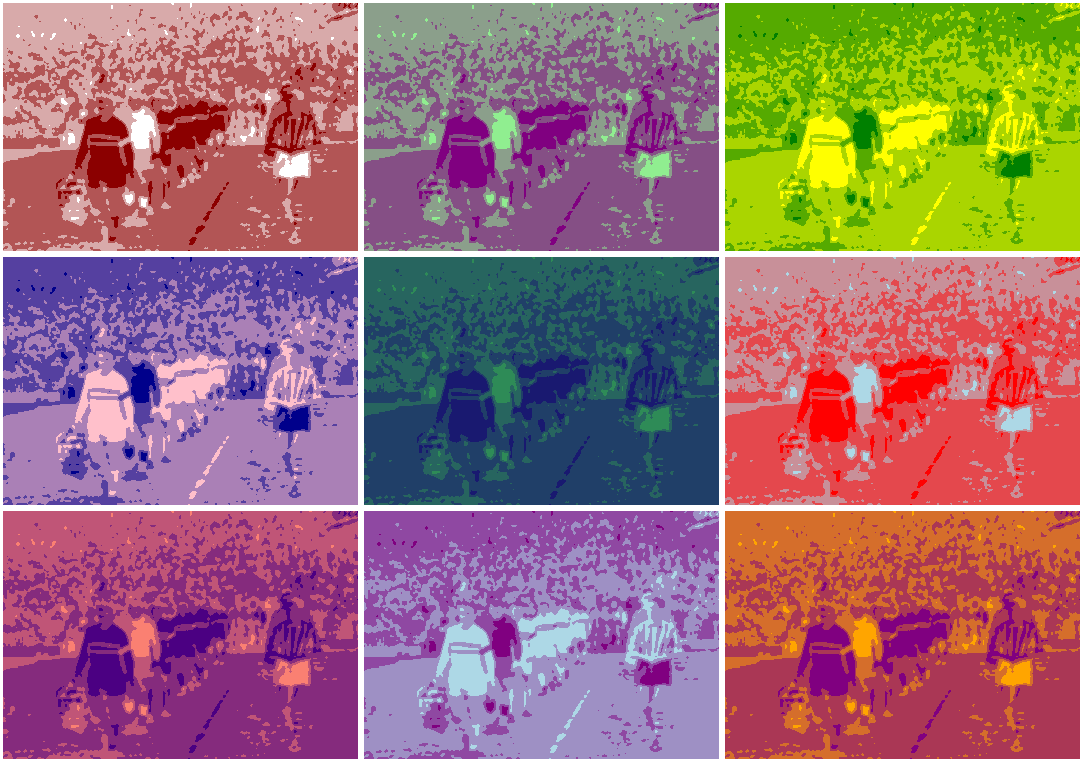
In the quiet, murky waters of the Hungarian second tier, there floats a ghost. It is a club that once served as the tactical laboratory for the modern game, an institution that redefined the geometry of the sport, and a political vehicle that projected the power of a totalitarian regime onto the pitches of Europe. Budapest Honvéd is not merely a football team; it is a monument to a specific, volatile moment in the twentieth century when the line between club and state dissolved entirely.
Budapest Honvéd and the Making of a State Club
To look at Honvéd today—recently relegated to the Nemzeti Bajnokság II and struggling for financial stability—is to witness a fallen empire. Yet, beneath the dust of its current obscurity lies the story of the “Mighty Magyars,” the Golden Team that terrified the world. Honvéd was the engine of that greatness, a super-club manufactured by the state to prove the superiority of socialist collectivism. But as with all things built on coercion rather than organic growth, its dominance was brittle. When the tanks rolled into Budapest in 1956, the club, like the revolution itself, was scattered to the winds, leaving behind a legacy that is as tragic as it is brilliant.
From Kispest to Power: A Village Absorbed
Before it was a weapon of state propaganda, the club was humble. Founded in 1909 as Kispesti Atlétikai Club (Kispest Athletic Club), it represented a village on the dusty outskirts of Budapest, distinct from the capital’s metropolis. For the first three decades of its existence, Kispest was a modest community institution, embodying a raw, industrial identity. It enjoyed moderate success, securing a Hungarian Cup in 1926 after a gruelling triple-final, but it remained in the shadow of the great Budapest powers: Ferencváros and MTK.
However, Kispest possessed a resource more valuable than trophies: the Puskás family. Ferenc Puskás I played for the club and later coached it, but it was his son, Ferenc Puskás Jr., who would change everything. Growing up in a tenement block overlooking the Kispest training ground, the younger Puskás honed his skills on the sandy lots between buildings alongside his neighbour and best friend, József Bozsik. They famously shared a special knock on the wall to signal it was time to play, developing a telepathic understanding that would later baffle the world’s best defences.
In 1943, both Puskás and Bozsik made their debuts for Kispest, but the club remained a “village team” in spirit. That changed violently in the aftermath of World War II, as the Iron Curtain descended and Hungary transformed into a communist state.
The Nationalisation of Hungarian Football
By 1949, the Hungarian Communist Party, led by the Stalinist dictator Mátyás Rákosi, had consolidated total power. In this new world, sport was not a leisure activity; it was a theatre of ideological struggle. Gusztáv Sebes, the Deputy Minister of Sport and coach of the national team, had a vision inspired by the Austrian Wunderteam and Vittorio Pozzo’s Italy: to concentrate the nation’s best talent into a single club to facilitate year-round chemistry.
The traditional giants of Budapest were politically compromised. Ferencváros, with its right-wing nationalist traditions, was viewed with deep suspicion by the regime and was stripped of its name, rebranded as the food workers’ team, ÉDOSZ. MTK, founded by the Jewish bourgeoisie, was seized by the dreaded secret police (the ÁVH) and renamed Vörös Lobogó (Red Flag).
Sebes turned his eyes to Kispest. It was a blank slate—working-class, politically malleable, and already home to Puskás and Bozsik. In January 1949, as the village of Kispest was absorbed into the district system of Budapest, the club was nationalised by the Ministry of Defence. It was renamed Budapesti Honvéd SE. The name Honvéd derives from Honvédség, the name of the Hungarian Army, meaning “Defender of the Homeland.”
With the full weight of the military behind it, Honvéd began an aggressive recruitment campaign disguised as conscription. While Puskás and Bozsik were locals, the army “recruited” Sándor Kocsis, Zoltán Czibor, and László Budai from Ferencváros, alongside the defensive stalwart Gyula Lóránt from Vasas and the revolutionary goalkeeper Gyula Grosics.
This was not a transfer market; it was an appropriation of human resources. Players were given military ranks—Puskás became the famous “Galloping Major”—and though they ostensibly served as soldiers, their only duty was to play football. Sebes effectively turned Honvéd into a permanent training camp for the national team.
Honvéd as a Tactical Laboratory
Under the patronage of the state, Honvéd became the laboratory for what Sebes termed “socialist football.” This was a precursor to Total Football, a system where every player was expected to pull equal weight and be comfortable in multiple positions.
In an era when European football was dominated by the rigid WM formation, Honvéd and Hungary introduced a fluid 4-2-4 system. This tactical innovation relied on the withdrawal of the centre-forward—a role perfected by MTK’s Nándor Hidegkuti in the national team, but mirrored in the fluid interchanges of Puskás and Kocsis at Honvéd. The system was built on intellect and movement; players were expected to think two steps ahead, creating a “socialist” collective on the pitch where the system trumped the individual.
The results were terrifyingly effective. Honvéd won the Hungarian League in 1949–50, 1950, 1952, 1954, and 1955. But their influence extended far beyond domestic silverware. The Honvéd core formed the backbone of the Aranycsapat (Golden Team) that won Olympic Gold in 1952 and decimated England 6-3 at Wembley in 1953—a match described as a “watershed moment in football history.”
In 1954, Honvéd played a friendly against Wolverhampton Wanderers at Molineux under the new floodlights. Wolves won 3-2—aided by manager Stan Cullis ordering the pitch to be flooded to bog down the Hungarians’ passing game—and the English press declared Wolves “Champions of the World.” It was this hubris and the desire to test Honvéd against the best in a competitive setting that directly led to the establishment of the European Cup.
The Bern Trauma and the Cracks in the System
The invincibility of this Honvéd-powered machine was an illusion that shattered on July 4, 1954. In the World Cup final in Bern, Switzerland, the “Mighty Magyars” lost 3-2 to West Germany, despite leading 2-0 after eight minutes.
The defeat was cataclysmic. In a totalitarian society, where football was the “sole expression of joy,” the loss was interpreted as a failure of the regime. Riots broke out in Budapest. Mobs burned pictures of Puskás and smashed the windows of the state-run newspaper. The goalkeeper, Gyula Grosics, was arrested on charges of treason and espionage, accused of smuggling, and banished to a provincial mining team.
The defeat in Bern cracked the facade of the regime. The players, once pampered symbols of socialist success, allowed to smuggle Western goods as a perk of their service, were suddenly enemies of the people. The symbiotic relationship between the club and the state had turned toxic.
1956 and a Club Without a Country
By 1956, the tension in Hungary had reached a breaking point. In October, as Honvéd prepared for a European Cup tie against Spanish champions Athletic Bilbao, the Hungarian Revolution erupted.
The team was out of the country, embarking on a tour of Western Europe to prepare for the match, when the uprising began. Back in Budapest, the people took to the streets, tearing down the symbols of Soviet oppression. For a brief moment, the old identities returned: Ferencváros became Ferencváros again, shedding the name Kinizsi; MTK dropped the Red Flag moniker. But Honvéd, the army team, remained Honvéd, trapped in its military identity while geographically severed from its command structure.
As Russian tanks rolled into Budapest to crush the revolution on November 4, the Honvéd players faced an agonising choice. The first leg of their European Cup tie was moved to Bilbao, where they lost 3-2. The return leg, which should have been a celebration of Hungarian football in Budapest, was played at the Heysel Stadium in Brussels.
It was a surreal, tragic affair. The players took the field, anxious for news of their families in a burning Budapest. Early in the match, the Honvéd goalkeeper was injured. With no substitutes allowed in that era, the winger Zoltán Czibor—one of the greatest attackers in the world—was forced to play in goal. Honvéd drew the match 3-3 but exited the competition 6-5 on aggregate.
The Stateless Tour and the Spread of the 4-2-4
Eliminated from Europe and unwilling to return to a Soviet-occupied Hungary, the Honvéd squad drifted into limbo. They were a team without a home, a “stateless” collection of the world’s best players.
Defying FIFA and the Soviet-controlled Hungarian Football Federation, who declared the team “illegal,” the players summoned their families to Vienna and organised a fundraising tour. Led by their former coach Béla Guttmann, they travelled to Italy, Portugal, and Spain, playing exhibition matches to survive. They drew 5-5 with a combined Real Madrid/Atlético Madrid team and beat Barcelona 4-3.
The tour culminated in Brazil in early 1957, where Honvéd played against Flamengo and Botafogo. These matches were the last gasp of the Mighty Magyars. The tactical DNA of Honvéd—the 4-2-4 formation—was passed on to Brazilian football during this tour. Guttmann stayed in Brazil to coach São Paulo, and his assistant, Vicente Feola, would use the 4-2-4 to lead Brazil to their first World Cup title in 1958.
But the pressure from FIFA and the Hungarian regime became too great. The team was forced to disband.
Defection, Exile, and the Death of a Dynasty
The breakup of Honvéd was the death knell for Hungarian football’s golden era. The players faced a choice: return to a defeated Hungary and face the uncertainty of the Kádár regime, or defect to the West and face a global ban.
József Bozsik, the heartbeat of the midfield and a deputy in the Hungarian parliament, returned home, as did Gyula Grosics. But the attacking triumvirate—the nucleus of the team’s genius—chose exile.
Sándor Kocsis and Zoltán Czibor eventually signed for Barcelona. Ferenc Puskás, branded a traitor and a deserter by the Hungarian press, endured a two-year ban before signing for Real Madrid. There, overweight and written off, he reinvented himself, winning three European Cups and proving his genius to a free world.
Back in Budapest, Honvéd was hollowed out. Deprived of its stars and tainted by its association with the failed revolution’s “traitors,” the club nearly suffered relegation in 1957, saved only by the federation’s decision to expand the league.
Why Honvéd Could Never Survive the Politics That Built It
The post-revolution era was a slow, painful hangover. While Honvéd enjoyed a “second golden age” in the 1980s under the brilliance of Lajos Détári, winning seven titles between 1980 and 1993, it never regained the mystique of the 1950s. The world had moved on. The tactical innovations Sebes and Honvéd had introduced were adopted and perfected by others—by Brazil, by the Dutch, by the modern super-clubs of the West.
In the modern era, the club has struggled to define itself. The transition from state ownership to private enterprise was brutal. In 2003, the club was relegated; in 2004, the company owning the club went into liquidation over unpaid taxes. Though it was reformed as Budapest Honvéd FC, the instability remained. In 2023, the club was relegated once again to the NB II, the second tier of Hungarian football.
A Monument to Unsustainability
The story of Budapest Honvéd is a lesson in the unsustainability of manufactured greatness. The club’s golden era was not the result of a healthy sporting ecosystem, but of “wanton and arbitrary coercion.” The regime centralised talent to project strength, but in doing so, it created a structure that was entirely dependent on political stability. When the politics collapsed, the football collapsed with it.
Honvéd was the engine of the Mighty Magyars, yet the club itself barely exists in modern memory. It is often treated as a footnote in the biography of Puskás, rather than the institution that made him. Today, the new Bozsik Aréna stands in Kispest, but the football played inside it is a far cry from the “socialist football” that once terrified England and Brazil.
Honvéd remains a club absorbed by history—a vessel that carried the hopes of a nation and the ideology of a state, only to be abandoned when the ideology failed. It serves as a sombre reminder that while regimes can build teams, they cannot manufacture the endurance of a soul. The greatness of the 1950s was a borrowed greatness, and the debt was paid in the decades of silence that followed.
