


I. Introduction
Marco van Basten stands as one of football’s most iconic figures, a name synonymous with elegance, skill, and an innate talent for finding the back of the net. His career, though abruptly shortened, left an indelible mark on the sport, not only for his remarkable achievements but for the style and grace with which he played the game. Emerging from the footballing heartland of the Netherlands, van Basten brought a level of technical prowess that would earn him respect and admiration across the globe. His presence on the pitch was a masterclass in forward play, as he possessed an exceptional ability to blend finesse with precision, a talent rarely seen in the game.
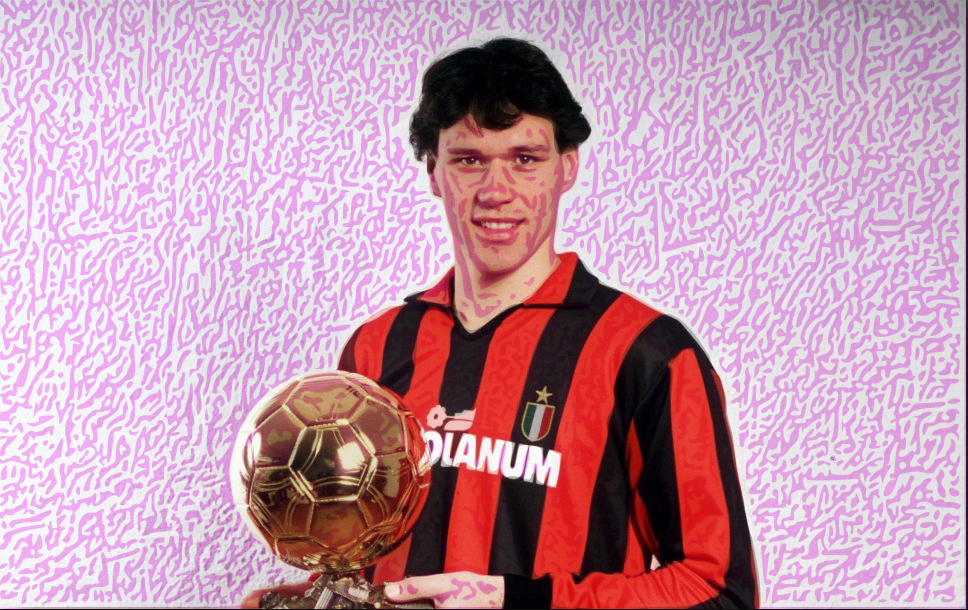
Van Basten’s accolades speak volumes. He was awarded the Ballon d’Or three times—a testament to his standing among the best of his generation. He earned this recognition not only for his contributions at club level with Ajax and AC Milan but also for his success on the international stage. Perhaps his crowning moment came in 1988, when he led the Netherlands to their first major trophy in international football, clinching the European Championship with a performance that remains etched in the memories of Dutch fans. That tournament included his iconic volley in the final against the Soviet Union, a goal so extraordinary it has become emblematic of van Basten’s entire career.
In many ways, van Basten embodied the golden era of Dutch football. His contributions both domestically and internationally showcased a forward capable of brilliance and adaptability, reflecting the tactical acumen for which Dutch football has long been celebrated. Through his triumphs and challenges, Marco van Basten remains a cherished figure in the annals of football history, admired not just for what he achieved, but for the way he captured the spirit of the game.
II. Early Life and Rise to Prominence
Marco van Basten’s journey to football stardom began in the Dutch city of Utrecht, where he was born on 31 October 1964. Football was a constant presence in his family, with his father, Joop van Basten, having played the game at an amateur level. It was from his father that Marco first learned the fundamentals of the sport, honing skills that would later captivate audiences around the world. As a young boy, he joined EDO, a local club in Utrecht, where his natural aptitude for the game quickly became evident.
At EDO, van Basten’s talent shone through, and it wasn’t long before he moved to Elinkwijk, a slightly larger club with a reputation for nurturing young players. His performances here did not go unnoticed. By the time he was 16, van Basten had caught the attention of Ajax, one of the Netherlands’ most storied clubs, known for producing a steady stream of footballing greats. The move to Ajax marked the beginning of a relationship that would shape his early career and propel him to the forefront of Dutch football.
Van Basten’s debut for Ajax came in April 1982, when he was just 17. In a poetic start to his professional career, he replaced none other than Johan Cruyff, the legendary Dutch forward who had recently returned to Ajax. Scoring on his debut, van Basten provided a tantalising glimpse of what was to come. Under the mentorship of Cruyff, who was not only a player but also an influential figure in Ajax’s tactical development, van Basten began to refine his game. He absorbed lessons on positioning, movement, and the importance of tactical versatility—qualities that would define his playing style.
Throughout his time at Ajax, van Basten became renowned for his technical skill and goal-scoring prowess. By the 1983-84 season, he had established himself as the leading scorer in the Eredivisie, showcasing a remarkable consistency that saw him net an impressive 28 goals. He would go on to win the Eredivisie’s top scorer title for four consecutive seasons, firmly establishing himself as one of Europe’s most prolific forwards. His accomplishments during these years included a European Golden Boot in 1986, a reflection of his standing as one of the continent’s premier talents.
Beyond the individual accolades, van Basten’s time at Ajax saw the club enjoy considerable success. They claimed three Eredivisie titles and a UEFA Cup Winners’ Cup, a feat that marked Ajax as a dominant force in Dutch football. Van Basten was integral to these victories, and his goals proved decisive in many of the club’s key matches. But more than just a goal-scorer, he was a player of rare sophistication. His agility, paired with his ability to strike the ball cleanly with either foot, made him a constant threat to opposing defenders. He possessed an almost uncanny sense of where to be at any given moment, a quality that separated him from his peers.
As van Basten’s reputation grew, so did interest from clubs across Europe. By 1987, it was clear that he was ready for a new challenge. He would leave Ajax as a club legend, having scored 128 goals in 133 appearances. The allure of playing for one of Europe’s top leagues, and the opportunity to compete at the highest level, led him to AC Milan. It was a move that would define the next stage of his career, setting the stage for him to become a global footballing icon.
III. Ajax Amsterdam: The Making of a Star
Arriving at Ajax, Marco van Basten quickly cemented his place as one of Dutch football’s brightest prospects. His goal-scoring abilities became apparent almost immediately, and under the guidance of Johan Cruyff, he developed into a complete forward. Van Basten’s time at Ajax was marked by his scoring consistency and a flair for spectacular goals, often leaving defenders and goalkeepers with little chance. Across his five seasons with the club, he won four Eredivisie top-scorer titles, notching an impressive tally that underscored his potency in front of goal. The pinnacle came with Ajax’s UEFA Cup Winners’ Cup victory in 1987, his goals proving instrumental in Ajax’s European triumph. By the time he left Ajax for AC Milan, van Basten had amassed a legacy that Dutch fans would not soon forget.
IV. Transfer to AC Milan: Becoming a Global Icon
In 1987, van Basten joined AC Milan, an Italian powerhouse seeking to return to its former glory. Milan, under the ownership of Silvio Berlusconi and the stewardship of manager Arrigo Sacchi, was assembling a squad that would dominate European football. Teaming up with compatriots Ruud Gullit and Frank Rijkaard, van Basten became part of a revolutionary side that changed Italian football. Despite early injury struggles, he would go on to lead Milan to two European Cups and multiple Serie A titles. His performances were electric, and his partnership with Gullit and Rijkaard provided a unique Dutch flair to the Italian game. Van Basten’s impact at Milan extended beyond trophies; he became an emblem of their success, defining an era of dominance that reshaped the landscape of European football.
V. Euro 1988: Glory with the Netherlands
The summer of 1988 was a defining moment for van Basten and Dutch football. Entering the UEFA European Championship, the Netherlands had never won a major international tournament, but that would soon change. After a shaky start, van Basten exploded onto the scene with a hat-trick against England, followed by a crucial goal in the semi-final against West Germany. In the final, he scored one of the most memorable goals in football history—a stunning volley from an acute angle that sealed victory over the Soviet Union. Van Basten’s performances earned him the tournament’s Golden Boot and solidified his place among football’s elite, marking Euro 1988 as a moment of triumph for both player and country.
VI. Style of Play and Footballing Philosophy
Van Basten was a forward of exceptional technical skill and intelligence, capable of moments that left spectators in awe. His style blended precision and power, with an uncanny ability to score from nearly any position on the pitch. Known for his clinical finishing, van Basten possessed a graceful touch and a knack for finding space, making him a nightmare for defenders. His tactical awareness, coupled with his aerial prowess and two-footed versatility, set him apart from his contemporaries. Teammates and opponents alike have often spoken of his ability to make the game look effortless, a true testament to his mastery of the art of forward play.
VII. Injuries and Early Retirement
Despite his brilliance on the pitch, van Basten’s career was marred by injuries, particularly to his ankle. After his final competitive match in 1993, he underwent multiple surgeries in an attempt to return to the game. Yet, the damage was too severe, and he was forced into retirement at the age of 28. Van Basten’s premature exit from football left fans wondering what more he could have achieved, but it also immortalised him as a legend of the game whose talents were cruelly cut short. His final farewell, on the day of Milan’s European Cup final in 1995, was a poignant moment for football—a stark reminder of the fragility of greatness.
VIII. Post-Retirement: Life After Football
Following his retirement, van Basten remained connected to the sport, venturing into management and coaching roles. He took charge of the Dutch national team and Ajax, applying the insights he had garnered as a player. Although his managerial career did not reach the same heights, he continued to earn respect for his footballing intelligence and dedication. Today, van Basten serves as a football pundit, sharing his knowledge and perspective with a new generation of fans. His influence endures, as his presence in the sport reminds many of the elegance and excellence he brought to the game.
IX. Legacy and Influence on Modern Football
Marco van Basten’s legacy is one of brilliance and elegance, an iconic forward whose impact extends well beyond the goals he scored. He remains a beloved figure in the Netherlands, celebrated as a key figure in their only major tournament victory. Van Basten’s influence is evident in the way modern forwards approach the game, with many citing him as an inspiration. His contributions to AC Milan’s golden era and his part in Dutch football’s finest hour continue to resonate, ensuring that his legacy endures in the annals of the sport.
