


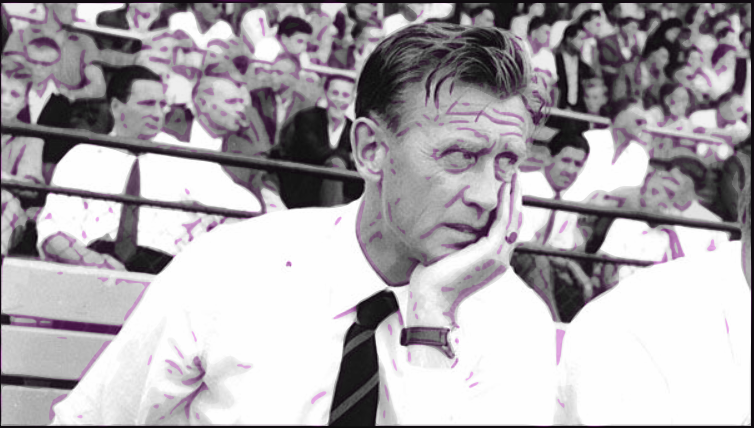
Introduction: The Unsung Innovator
In the annals of football history, certain figures capture the spotlight, their names immortalized in the sport’s collective consciousness. Rinus Michels, widely hailed as the father of ‘Total Football,’ and Johan Cruyff, the on-pitch embodiment of the philosophy, are two such figures. However, behind their brilliance lies the quiet but profound influence of Vic Buckingham—a man whose tactical foresight and managerial innovation helped shape the modern game. Buckingham’s story is one of subtle genius, a journey through the heights of European football that has often been overshadowed by the legacies of those who followed in his footsteps.
Though he remains a lesser-known name outside of footballing circles, Buckingham’s impact is felt in the DNA of two of the most storied clubs in European football: Ajax and Barcelona. His work laid the foundations for ‘Total Football,’ a system that revolutionized the game, placing emphasis on fluidity, positional interchange, and the collective over individual flair. Long before Michels and Cruyff became synonymous with this approach, Buckingham was quietly experimenting with its key tenets, implementing a style of play that would eventually change football forever.
Born in Greenwich in 1911, Buckingham’s career as a player was modest but respectable. A half-back for Tottenham Hotspur and later West Bromwich Albion, his tactical intelligence on the field hinted at the footballing mind that would later define his managerial career. Yet it wasn’t until he swapped his boots for a clipboard that Buckingham’s true talents began to emerge. As a manager, he was a pioneer, always seeking new ways to approach the game, focusing on team cohesion, intelligent ball movement, and an emphasis on space.
From his early days managing in England to his transformative spells at Ajax and Barcelona, Buckingham demonstrated a unique understanding of football’s tactical complexities. His philosophy centered on possession, fluidity, and pressing—a style that was, at the time, largely foreign to English football, which often favored more direct, physical play. Buckingham’s commitment to this ideal made him a trailblazer, though it also meant that his contributions were sometimes underappreciated, particularly in his homeland.
This article will explore Vic Buckingham’s journey from the English leagues to the heights of European football, tracing the development of his ideas and the profound influence he had on some of the world’s greatest footballing institutions. We will delve into his time at Ajax, where he began to sow the seeds of ‘Total Football,’ and his tenure at Barcelona, where his vision continued to evolve. Despite the accolades earned by those who followed him, it was Buckingham’s quiet revolution that set the stage for the footballing dynasties that would later emerge. His story, though often untold, is one of innovation, foresight, and a deep understanding of the game—an influence that continues to resonate in football to this day.
In examining Buckingham’s legacy, it becomes clear that his work was foundational in the development of ‘Total Football,’ not only influencing the players and teams he managed but also leaving an indelible mark on football’s tactical evolution. This is the story of a man who, despite not always receiving the recognition he deserved, shaped the modern game in ways that few others can claim.
I. Early Days: A Man of Vision from Sheffield to West Bromwich Albion
Vic Buckingham’s story begins not in the hallowed halls of football’s elite, but in the working-class streets of Greenwich, London. Born in 1911, his early life was marked by the same challenges faced by many young men of his generation. Football, at that time, was more an escape than a career, but for Buckingham, it became clear early on that the sport offered him both a path and a purpose. His journey through the game, though perhaps modest in terms of playing accolades, would later prove pivotal in shaping his tactical thinking as a manager.
1. Buckingham as a Player: The Footballing Roots
Though his name would later become associated with tactical innovation, Buckingham’s playing days were largely unremarkable in the traditional sense of glory and silverware. He spent much of his playing career as a half-back, a position that demanded intelligence, awareness, and a deep understanding of the game’s tactical rhythms. It was during these formative years, playing for Tottenham Hotspur and West Bromwich Albion, that Buckingham began to develop a keen sense of football’s strategic possibilities.
Buckingham’s time at Tottenham Hotspur, where he made his debut in the early 1930s, was shaped by an era of rugged, physical football. Yet, even then, Buckingham’s playing style hinted at a different approach. As a half-back, his role was to break up opposition attacks and transition the ball to the forwards, but he consistently sought to bring calmness and order to the chaos of the game. His preference for thoughtful distribution over aimless long balls and his keen eye for positioning set him apart from many of his contemporaries, even if his technical prowess went largely unnoticed in a sport still deeply entrenched in tradition.
By the time he joined West Bromwich Albion in 1934, Buckingham had already begun to think about football differently. His tactical understanding grew, influenced by the diversity of styles he encountered during his playing days. While English football at the time was still largely characterized by its physicality, Buckingham was absorbing ideas from the continent, ideas that would later form the basis of his managerial philosophy. However, his playing career, like many others, was interrupted by the outbreak of World War II, where he served in the British Army, returning only after the war had ended.
2. Transition to Management: The Start of Something Special
After hanging up his boots in 1949, Buckingham’s transition into management came almost naturally. He remained at West Bromwich Albion, a club that had become his footballing home, and it was here that he first got a taste of the managerial responsibilities that would define the next chapter of his life. Taking over as manager in 1953, Buckingham’s approach was notably different from many of his peers. While most English managers of the era were content with direct, combative football, Buckingham was already beginning to think more deeply about the game.
His West Bromwich Albion side, though not the most glamorous, began to adopt a playing style that was a reflection of Buckingham’s own values as a player—calm, calculated, and reliant on a more structured form of passing football. It was a style that demanded patience and discipline, but it also introduced a level of sophistication that was rarely seen in English football at the time. His emphasis on possession, maintaining shape, and controlling the tempo of the game were all early signs of the football revolution that was yet to come.
West Bromwich Albion’s run to the 1954 FA Cup Final was a testament to Buckingham’s managerial acumen. Although they fell short against Preston North End, the club’s journey to the final was marked by a series of performances that showcased Buckingham’s evolving tactical philosophy. His side’s patient build-up play and focus on ball retention were stark contrasts to the more frenetic styles adopted by many other teams. Though West Bromwich’s relative success was limited, it was clear to those who watched closely that Buckingham was a manager with fresh ideas, ideas that were still in their infancy but would soon come to full bloom on the European stage.
3. The Philosophy Begins to Take Shape
During his time in England, Buckingham’s approach was still developing, but the seeds of what would later become ‘Total Football’ were being sown. The tactical structures he introduced—encouraging players to think for themselves, to understand the importance of space, and to see football as a collective, fluid movement—were all pioneering concepts in the rigid world of 1950s English football. Buckingham’s sides often played a more sophisticated form of football than was typical for the time, but his ideas were not yet fully appreciated in England, where success was often measured by grit and determination rather than innovation.
Buckingham’s experiences at West Bromwich Albion laid the groundwork for what would later become his defining contribution to the game. Though his time as a player and manager in England may not have garnered widespread attention, it was clear that Buckingham’s footballing mind was something special. He was quietly refining his philosophy, waiting for the right opportunity to bring it to the forefront.
That opportunity would come in 1959 when Buckingham made the bold move to leave English football behind and embark on a journey that would change the course of his career—and the history of football—forever. His appointment as manager of Ajax Amsterdam marked the beginning of a period of transformation, both for Buckingham and the clubs he would manage in the years to come.
II. Ajax Amsterdam: The Seed of Total Football
1. First Stint at Ajax (1959–1961): Laying the Foundations
When Vic Buckingham arrived at Ajax in 1959, Dutch football was still very much in its infancy in terms of tactical development. The club, while historically significant, had not yet reached the European heights that it would come to dominate in later years. Buckingham, however, saw potential. His first task was to implement his vision of football—a game where possession, positional interchange, and fluidity were paramount. His ideas were initially met with some resistance; after all, Dutch football at the time was far more direct and less refined than what Buckingham sought to introduce. Nevertheless, he persisted, nurturing a generation of young players, including a teenage Johan Cruyff, whose footballing education under Buckingham would prove vital in his later career. Ajax, under Buckingham’s guidance, finished second in the Eredivisie, showcasing the potential of a style that would soon capture the world’s attention.
2. Buckingham’s Philosophy: Total Football’s Birth
Although Rinus Michels would later receive widespread credit for ‘Total Football,’ Buckingham first laid the essential principles of this system during his time at Ajax. Buckingham’s emphasis on positional fluidity—where players could interchange roles, leaving opponents chasing shadows—was groundbreaking. His teams relied on possession, quick transitions, and creating space, with every player contributing to both attack and defence. This philosophy allowed players to think creatively on the pitch, using intelligence and teamwork to outmaneuver their opponents. Though his methods were revolutionary, they required patience to fully develop, and Buckingham’s departure in 1961 meant that the full fruits of his labor would only become apparent in the years that followed.
3. Successes and Challenges
Despite his progressive ideas, Buckingham’s time at Ajax was not without its challenges. Dutch football’s traditionalists were skeptical of his methods, and some players found it difficult to adapt to the cerebral nature of Buckingham’s style. Yet, the seeds had been planted, and Buckingham’s Ajax began to demonstrate the early signs of what would later be known as ‘Total Football.’ Though he didn’t win silverware during his first stint, his influence on the club’s young players and his tactical innovations would have a lasting impact. His departure, driven partly by disagreements with the Ajax board, left unfinished business. However, Michels would soon embrace and build upon the framework he established.
III. Barcelona: A Philosophy Tested in La Liga
1. Arrival at Barcelona (1969): A New Challenge
Buckingham’s arrival at Barcelona in 1969 was another key moment in his managerial career. The Catalan giants were a club in search of identity, and Buckingham saw an opportunity to bring his possession-based, team-oriented football to Spain. The Spanish game, with its emphasis on flair and individual brilliance, was a stark contrast to Buckingham’s philosophy. Nevertheless, he saw potential in the players at his disposal and set about implementing his ideas with characteristic calmness and authority.
2. Total Football in Spain: The Buckingham Experiment
At Barcelona, Buckingham’s ‘Total Football’ philosophy was put to the test. He introduced pressing, positional play, and a focus on collective responsibility that was novel in La Liga at the time. His style was particularly appealing to Barcelona’s fans, whose affinity for possession football resonated with Buckingham’s ideals. During his tenure, he worked with players like Carles Rexach, instilling in them a deeper understanding of tactical discipline and spatial awareness. Though the results were mixed in terms of trophies, Buckingham’s influence on the club’s playing style would have lasting consequences, especially in shaping the philosophy that would later define Barcelona under Johan Cruyff and, eventually, Pep Guardiola.
3. The Results: Buckingham’s Barcelona in 1969-1970
While Buckingham didn’t secure major honors during his time at Barcelona, he was able to guide the team to a second-place finish in La Liga during the 1969-70 season. His side played attractive, possession-based football that garnered admiration across Spain, even if it did not immediately translate into trophies. Buckingham’s tenure was cut short, but much like at Ajax, his impact was more profound in terms of the long-term philosophy he instilled rather than immediate results. The seeds he planted would later flourish under the guidance of Cruyff, who would take Buckingham’s ideas and elevate them to unprecedented heights.
IV. Buckingham’s Second Ajax Tenure: A Return to Familiar Ground (1964-1965)
1. Return to Ajax
Buckingham returned to Ajax in 1964, a club now better prepared to fully embrace his ideas after his first transformative stint. By then, Ajax had matured, with Cruyff having emerged as a key figure. Buckingham’s return was seen as an opportunity to further develop the philosophy he had originally introduced. With a more tactically astute squad at his disposal, Buckingham was able to refine his ideas even further.
2. Success and the Passing of the Torch
During his second tenure, Buckingham continued to shape the tactical evolution of the club. His work with Cruyff and the emerging generation of Dutch talent ensured that Ajax remained at the forefront of European football development. While Buckingham’s second spell didn’t yield major trophies, it cemented his legacy as a visionary who laid the groundwork for Ajax’s dominance under Michels. Buckingham’s departure in 1965 signaled the end of his direct influence on the club, but his ideas had taken root deeply, setting the stage for Ajax’s golden era.
V. Influence Beyond Ajax and Barcelona: Buckingham’s Legacy in Football
1. Buckingham’s Contribution to Total Football
Although Rinus Michels is often credited with creating ‘Total Football,’ Buckingham’s role in its development cannot be understated. His focus on team cohesion, pressing, and positional flexibility laid the groundwork for the philosophy that would later define Ajax, Barcelona, and the Netherlands national team. Buckingham may not have coined the term, but his fingerprints are all over the concept that would revolutionize European football.
2. Impact on Future Managers and Clubs
Buckingham’s influence extended far beyond the teams he managed. His tactical principles were adopted by managers across Europe, particularly those influenced by Ajax and Barcelona. Louis van Gaal and Pep Guardiola, two of the most successful exponents of possession-based, high-pressing football, can trace their philosophies back to Buckingham’s innovations. His work with young players, particularly Cruyff, created a lineage of tactical thought that continues to shape football today.
3. Vic Buckingham’s Quiet Legacy
Despite his profound influence, Buckingham remains an underappreciated figure in football history. His name is rarely mentioned alongside the likes of Michels or Guardiola, but his contributions are undeniable. Buckingham’s legacy is one of quiet, lasting impact—an innovator whose ideas shaped the future of football, even if he never fully reaped the rewards of the systems he created.
VI. Vic Buckingham: The Gentleman of Football
1. Personality and Philosophy: The Gentleman Manager
Throughout his career, Buckingham was known not only for his tactical acumen but also for his calm, dignified demeanor. He was a manager who believed in giving players the freedom to express themselves within a structured system. His gentleness and respect for the game’s nuances were hallmarks of his management style, earning him the admiration of players and colleagues alike. Buckingham was, above all, a teacher—someone who sought to improve his teams not just in terms of results but in their understanding of the game itself.
2. Life After Football
Following his retirement from football, Buckingham faded quietly from the limelight. His work had already been done, and though he did not achieve the global fame of some of his contemporaries, he left behind a lasting legacy. Buckingham spent his later years away from the game, but his influence on football continued to ripple through the clubs and players he had impacted.
Conclusion: A Legacy Etched in Total Football
Vic Buckingham may not be a household name, but his contributions to football are undeniable. He was the quiet revolutionary who laid the foundations for ‘Total Football,’ shaping the playing philosophies of two of Europe’s most iconic clubs, Ajax and Barcelona. His influence, particularly on the development of Johan Cruyff, set the stage for some of the greatest tactical innovations in the history of the game. Today, football’s greatest minds continue to draw from Buckingham’s blueprint—a testament to the enduring power of his ideas.
