


I. Introduction: Setting the Stage for a Historic Encounter
The Weight of History on Brazil’s Shoulders
The 2014 World Cup meant everything to Brazil. It was not just another tournament; it was a chance for redemption on home soil, where the echoes of past failures still resonated. In 1950, Brazil had hosted the World Cup for the first time, only to see their dream shattered by Uruguay in the final. That match, known as the Maracanazo, left deep emotional scars, and the memory of it had never truly faded from the collective consciousness. This tournament, over six decades later, was viewed as Brazil’s opportunity to exorcise the ghosts of that devastating day.
For the host nation, this was more than a sporting event. It was a matter of national pride, a moment that would either define or redeem their footballing history. The team carried the weight of a nation’s expectations, which grew with each passing match. From the fervent chants in the stands to the media frenzy that surrounded every training session, Brazil lived and breathed this World Cup. Winning the tournament at home, in the hallowed stadiums of Rio de Janeiro, São Paulo, and Belo Horizonte, would not just be a triumph—it would be a symbol of the country’s footballing superiority.
But the pressure that weighed so heavily on the team was immense. Brazil’s squad, managed by Luiz Felipe Scolari, was well aware of what was at stake. Anything less than lifting the trophy in front of their fans would be seen as failure. The loss of Neymar to injury in the quarterfinals, and the suspension of captain Thiago Silva for the semifinal, added further strain to an already emotionally charged atmosphere. The absence of their star forward and defensive leader left a void, both tactically and psychologically, that Brazil struggled to fill.
Germany’s Tactical Journey to the Semifinals
In stark contrast, Germany approached the semifinals with a cold, calculated efficiency. Joachim Löw had spent years crafting a team that epitomised discipline and organisation, built on the foundations laid by his predecessor, Jürgen Klinsmann. Since the mid-2000s, Germany had been quietly rebuilding its national team, blending a mix of youth and experience that was designed to peak at just the right moment.
Germany’s journey to the semifinals had been one of methodical progress, each game serving as a demonstration of their tactical astuteness and collective strength. In the group stages, they had dismantled Portugal 4-0, survived a resilient Ghana side with a 2-2 draw, and comfortably topped their group. The knockout rounds saw them edge past Algeria in extra time and dispatch a stubborn French side in the quarterfinals. Throughout the tournament, they had shown their tactical flexibility, shifting seamlessly between possession-based football and a more direct approach when needed.
The squad boasted a perfect blend of seasoned veterans like Miroslav Klose, Philipp Lahm, and Bastian Schweinsteiger, combined with the youthful energy of Thomas Müller and Toni Kroos. Löw’s side was not dependent on any single player; they functioned as a cohesive unit, capable of adapting to any opponent. This adaptability, coupled with their meticulous preparation, made Germany a formidable opponent.
The Anticipation of a Classic Encounter
As the match loomed, the world expected a thrilling contest between two footballing titans. Brazil, with their attacking flair and passionate home support, were seen as favourites despite the key absences in their squad. Germany, with their structured approach and tactical intelligence, were the perfect foil. It was a meeting of two contrasting styles: the exuberance of Brazilian football versus the precision of the Germans.
The media coverage leading up to the match only added to the anticipation. Pundits and fans alike believed this would be a closely fought battle, a semifinal that would deliver drama, skill, and emotion in abundance. For Brazil, the path to the final was seen as their destiny, while Germany’s journey was viewed as the culmination of years of planning and execution.
But no one could have predicted what was about to unfold. In hindsight, all the signs were there—the pressure on Brazil, the ruthlessness of Germany—but few foresaw the magnitude of the shock that would shake the footballing world. The 2014 World Cup semifinal was not just another match. It was the night when football history was rewritten.
II. The Build-Up: A Brazil Undermined by Key Absences
The Neymar Injury Blow
Brazil’s quarterfinal victory over Colombia came at a significant cost. In the 88th minute, as Brazil clung to a 2-1 lead, Neymar was on the receiving end of a brutal challenge from Colombia’s Juan Camilo Zúñiga. The knee to the back left Neymar writhing in agony, and as he was stretchered off the field, the atmosphere in Fortaleza shifted. For all the euphoria that came with advancing to the semifinals, there was an underlying sense of dread about the wellbeing of the team’s talisman.
The worst fears were confirmed soon after. Neymar, the face of Brazilian football, their attacking heartbeat, had suffered a fractured vertebra and would miss the rest of the tournament. In an instant, Brazil’s hopes of World Cup glory seemed to waver. The emotional outpouring that followed—from Neymar’s tearful message to the nation to the prayers offered by fans—was reflective of the bond between the player and his country. Neymar wasn’t just the star forward; he was the symbol of Brazil’s resurgence on the world stage.
His absence from the semifinal against Germany left an irreplaceable void. Without him, Brazil lacked that spark, that unquantifiable magic that Neymar had so often provided. Throughout the tournament, his creativity, flair, and goalscoring instincts had been instrumental. Neymar had been involved in key moments in every match, scoring four goals and assisting once. He was the focal point of Brazil’s attack, the player opponents feared most, and the one his teammates looked to when they needed inspiration.
With Neymar out, Brazil were not only missing their most dangerous attacker, but they also lost their emotional leader. It was clear that Scolari would need to rely on his squad’s depth, but there was no one in the team who could replicate what Neymar brought to the side. The pressure on the remaining attackers, particularly Hulk and Fred, increased exponentially, but neither had shown the form necessary to fill the gaping hole Neymar’s injury left behind.
Thiago Silva’s Suspension
As if Neymar’s absence wasn’t damaging enough, Brazil were also forced to cope without their captain and defensive stalwart, Thiago Silva. The Paris Saint-Germain defender, who had been instrumental in organising Brazil’s backline throughout the tournament, picked up a second yellow card in the quarterfinal against Colombia, rendering him unavailable for the semifinal.
Silva’s suspension was another bitter blow. He was not just a rock in defence; he was the leader on the pitch, the player who kept the team grounded in moments of chaos. Silva’s calmness under pressure, his ability to read the game, and his leadership qualities had been crucial to Brazil’s progress. Throughout the tournament, Silva had been Brazil’s most reliable defender, offering stability at the back and a commanding presence in the air.
Without their captain, Brazil turned to Dante, a capable defender but one who had not featured much during the tournament. The partnership of David Luiz and Dante, while talented on paper, lacked the composure that Silva brought. Luiz, known for his adventurous style and erratic defensive moments, was expected to take on more responsibility in the absence of his partner. However, the chemistry that Luiz and Silva had built over the tournament was lost, and the absence of Silva’s organisational skills left Brazil’s defence vulnerable.
Scolari’s decision to maintain a high defensive line without his first-choice centre-back was a gamble, one that would later prove disastrous. Brazil’s defence, already shaky at times in the tournament, now looked exposed. The lack of leadership at the back, combined with the absence of their star forward, left the team fragile—both tactically and mentally.
Brazil’s Emotional Preparation
The emotional weight that Brazil carried into the semifinal was enormous. Playing in front of their home crowd, with the legacy of the Maracanazo looming large, had been a psychological challenge for the squad throughout the tournament. But the semifinal, without Neymar and Silva, became an emotional crucible. The pressure on the players to perform in their absence was immense, and there was a palpable sense that the team was heading into uncharted territory.
Scolari’s pre-match preparation seemed to focus heavily on rallying the team emotionally. Brazil’s players were shown messages from Neymar in the lead-up to the match, with the injured star urging his teammates to win for him and for the country. The narrative of overcoming adversity was deeply embedded in the squad’s psyche. While this may have inspired some, for others, the pressure appeared overwhelming.
Brazil’s emotional fragility was evident from the start. The pre-match rituals, usually filled with the passion and confidence associated with the Seleção, had an air of anxiety about them. The weight of expectation, combined with the absence of two key figures, seemed to hang over the squad like a dark cloud. Players were visibly tense, and for all the public displays of determination, there was an undercurrent of fear. The collective sense of national pride, which had fuelled Brazil’s run to the semifinals, now felt like a burden.
Brazil’s preparation had been as much about managing emotions as it had been about tactical planning, but the cracks were beginning to show. The team that took to the pitch on that fateful evening in Belo Horizonte was not the Brazil the world had come to expect. The psychological toll of Neymar’s injury and Silva’s suspension had left them vulnerable, both mentally and physically.
III. The Match Begins: An Early Shock That Shook Brazil
Germany’s Ruthless Start
The opening moments of the match provided no indication of the extraordinary events that were about to unfold. As the referee’s whistle echoed around the Estádio Mineirão, both teams seemed poised for a tactical battle. Brazil, draped in their iconic yellow shirts, were backed by a sea of expectant fans, their faces painted in green and yellow, their voices filling the air with chants of “Vai Brasil!” Despite the absence of Neymar and Thiago Silva, there was still a belief that home advantage and the weight of history would carry them through.
But within minutes, it became clear that Germany had a very different script in mind.
Germany’s approach was calculated from the outset. Joachim Löw’s side, meticulously prepared for Brazil’s high-energy style, began to press immediately, suffocating the Brazilian midfield. While Brazil looked disjointed and nervous, Germany moved the ball with precision, their passes zipping across the pitch with purpose and clarity. The first crack appeared when, in the 11th minute, Germany won a corner.
The delivery from Toni Kroos was, as always, impeccable. As the ball curled into the penalty area, Brazil’s defence seemed frozen. Thomas Müller, with the calmness of a player who had seen these moments countless times, found himself completely unmarked. A swing of his right boot, and the ball was nestled into the back of the net. 1-0 to Germany.
For Brazil, it was a hammer blow. The silence that fell over the stadium was striking. But in those early moments, there was still a feeling that Brazil could recover. After all, going a goal down in football, especially in the early stages, is not necessarily a disaster. Brazil had the talent and the home support to respond. Yet, even in those brief minutes after Müller’s opener, there was an unmistakable shift in momentum. Germany had sensed vulnerability, and they would waste no time exploiting it.
Brazil’s Response: Or Lack of It
In the wake of Müller’s goal, Brazil’s response was erratic. Instead of regrouping and settling into a rhythm, they looked rattled. The defence, which had been shaky throughout the tournament, was now on edge, with David Luiz and Dante struggling to organise themselves. The midfield, lacking the leadership of Silva, appeared overwhelmed. Passes went astray, tackles were mistimed, and the pressing game that had been a hallmark of Scolari’s system seemed absent.
On the touchline, Scolari barked orders, urging his players to calm down and regain their composure. But the players, clearly feeling the pressure of the occasion, could not find a foothold. What unfolded in the next 18 minutes would become one of the most shocking periods in World Cup history. Brazil, the five-time champions, would endure a collapse so catastrophic that it left the football world in stunned disbelief.
IV. Collapse: The 18-Minute Blitz That Defined the Match
Klose Breaks the Record
The 23rd minute marked a historic moment in the match, and in World Cup history. Miroslav Klose, Germany’s veteran striker, found himself with a golden opportunity after a slick exchange between Müller and Kroos. His initial shot was parried by Júlio César, but the rebound fell kindly at Klose’s feet. With a composed finish, Klose slotted the ball into the net to make it 2-0.
In doing so, Klose not only doubled Germany’s lead but also cemented his place in the record books, becoming the all-time leading scorer in World Cup history with 16 goals, surpassing Brazil’s own Ronaldo. The irony was cruel for Brazil. Klose, a man who had chased the record for years, finally claimed it on Brazilian soil, and against the Seleção no less.
Brazil’s defence, already shaky, seemed to lose its collective sense of organisation and purpose. The crowd, once so vibrant and confident, now looked on in disbelief. What was to follow would turn that disbelief into despair.
Germany’s Five Goals in 18 Minutes
The next 18 minutes unfolded with a ruthless efficiency that few could have anticipated. Germany, sensing Brazil’s growing disorganisation, pressed forward relentlessly. In the 24th minute, just seconds after Klose’s record-breaking goal, Kroos pounced on a loose ball and hammered it home from the edge of the box. 3-0. The Brazilian players were motionless, seemingly paralysed by the sheer speed of Germany’s counter-attacks.
Before the crowd could even process what had just happened, Kroos was at it again. This time, he latched onto a clever flick from Sami Khedira, stroking the ball into an empty net to make it 4-0. It was an extraordinary sight—Germany were running riot, and Brazil had no answers. Their midfield, in particular, had been overrun. Fernandinho and Luiz Gustavo, tasked with shielding the defence, looked lost, while Oscar and Hulk offered little going forward.
By the 29th minute, the scoreline read 5-0. This time it was Khedira who added his name to the list of scorers, finishing off yet another fluid German move with calm precision. Five goals in less than half an hour. Brazil, the footballing superpower, had been dismantled in front of their own fans. The silence inside the Estádio Mineirão was deafening.
The Collective Brazilian Breakdown
Brazil’s collapse was total. Every aspect of their game had disintegrated in the face of Germany’s relentless attack. David Luiz, who had been so emotional in the pre-match build-up, was seen wandering out of position, often leaving gaping holes in the backline. Dante, thrust into the spotlight in Silva’s absence, struggled to cope with the speed and precision of Germany’s movement. Júlio César, normally such a commanding presence in goal, was left helpless as shot after shot found its way past him.
In midfield, Brazil were non-existent. Kroos and Khedira had complete control, dictating the tempo with ease. The Brazilian players, for all their technical skill, seemed powerless to stop the onslaught. Even the normally dynamic full-backs, Marcelo and Maicon, were pinned back by Germany’s wide players, unable to provide any meaningful support in attack.
By the time the referee blew for half-time, the match was effectively over. Brazil trudged off the pitch, heads down, shoulders slumped. The scoreboard read 5-0, but the psychological damage was far worse. The home fans, some in tears, others simply stunned, had just witnessed one of the most shocking collapses in World Cup history.
V. The Second Half: Damage Control, Yet More Pain
Germany’s Controlled Dominance
As the second half began, there was a brief flicker of hope that Brazil might salvage some pride, that they might at least offer some resistance. But that hope quickly faded. Germany, though no longer pressing with the same ferocity as in the first half, continued to control the game with ease. Their passing remained crisp, their organisation flawless.
Löw’s decision to bring on André Schürrle in place of Klose only emphasised Germany’s depth and tactical nous. Schürrle, eager to make an impact, did not take long to join the scoring party. In the 69th minute, he slotted home Germany’s sixth goal, and just ten minutes later, he added a seventh with a stunning strike that clipped the underside of the crossbar before bouncing into the net. 7-0. It was a goal that typified Germany’s dominance—not just technically, but mentally. Even at 5-0, they were relentless in their pursuit of more.
Brazil’s Consolation Goal
By this point, the Brazilian players were merely going through the motions, desperate for the final whistle to come. In the 90th minute, Oscar, who had been one of the few Brazilian players to show any kind of fight, managed to score a consolation goal. It was a well-taken effort, but it did little to lift the mood inside the stadium. There was no celebration, no jubilation. The goal, while technically breaking the German clean sheet, felt hollow—a footnote in a night dominated by humiliation.
VI. The Aftermath: A Nation in Shock
The Immediate Reaction in Brazil
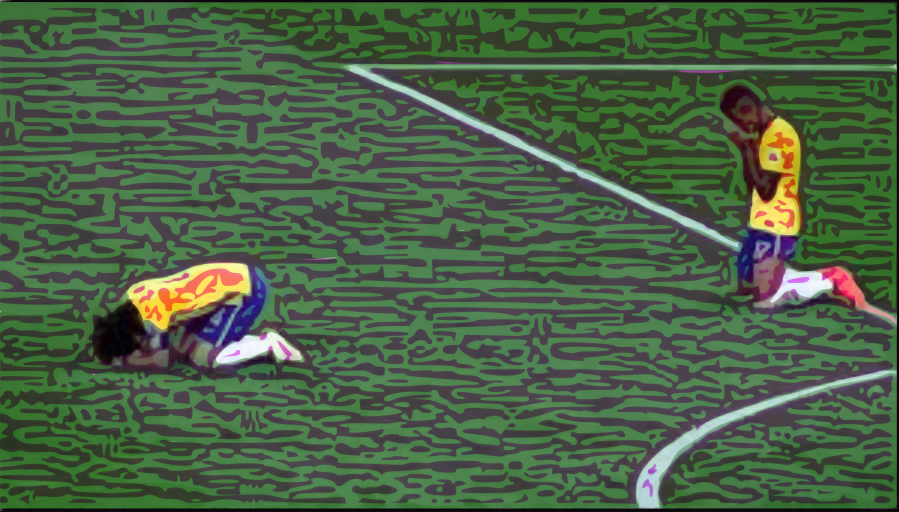
When the final whistle blew, the scoreline—Germany 7, Brazil 1—was more than just a statistic. It was a symbol of the deepest humiliation in the history of Brazilian football. The shock and disbelief in the stands was mirrored by the desolation on the pitch. David Luiz, who had been so emotionally charged before the game, was in tears, offering an apology to the Brazilian people. His teammates stood around in silence, stunned and broken.
Across Brazil, the mood was one of mourning. This was not merely a defeat, but a national trauma. In the days that followed, the inquest into what went wrong began in earnest. The Brazilian media were merciless, criticising everything from the team selection to the tactical approach, and even the players’ emotional fragility. Scolari, once hailed as the saviour of Brazilian football, was now seen as a man who had led his team into the most painful defeat in their history.
VII. Tactical Analysis: How Germany Mastered the Game
Joachim Löw’s Tactical Genius
Germany’s demolition of Brazil was not merely a result of Brazilian failings; it was the outcome of a masterclass in tactical execution. Joachim Löw had spent years refining this German side, and by the time they reached the semifinals in 2014, they were a well-oiled machine. Every player on the pitch knew their role, and Löw’s game plan was ruthlessly efficient.
From the outset, Germany pressed high up the pitch, suffocating Brazil’s midfield and cutting off their supply lines. Without Neymar to spearhead their attack, Brazil struggled to transition from defence to offence. The absence of Thiago Silva in defence compounded the problem, as the Brazilian backline lacked the composure and leadership to play out from the back under pressure. Germany, aware of Brazil’s weaknesses, targeted their most vulnerable areas.
Löw instructed his midfield trio of Toni Kroos, Sami Khedira, and Bastian Schweinsteiger to dominate possession, while also pressing high when out of possession. Kroos, in particular, was instrumental in pulling the strings. His passing was precise, his movement intelligent, and his understanding with Khedira allowed Germany to bypass Brazil’s midfield with ease. Together, they formed a formidable unit, controlling the tempo of the game and launching wave after wave of attacks.
In attack, Germany’s fluidity was key. The front three of Thomas Müller, Mesut Özil, and Miroslav Klose rotated constantly, pulling Brazil’s defenders out of position and creating space for the midfield runners to exploit. Müller, operating as a false nine, caused havoc with his movement, drifting into pockets of space between Brazil’s defensive and midfield lines. Klose, despite his age, provided the focal point for Germany’s attacks, while Özil floated around, linking play and providing the creative spark.
Germany’s ability to transition quickly from defence to attack was also a defining feature of their play. The speed and precision with which they counter-attacked left Brazil scrambling to regain their defensive shape, and more often than not, they failed to do so. This was particularly evident in the 18-minute period where Germany scored four goals, as Brazil’s defenders were left chasing shadows.
Brazil’s Defensive and Midfield Failures
Brazil’s downfall was as much a result of their tactical shortcomings as it was Germany’s brilliance. The defensive organisation that had carried them to the semifinals collapsed under the pressure of Germany’s relentless pressing and movement. The absence of Thiago Silva, a calming and organising presence in the backline, left Brazil exposed to Germany’s probing attacks.
David Luiz, tasked with leading the defence in Silva’s absence, was often caught out of position. His tendency to push forward and leave his defensive post left gaping holes in Brazil’s backline, which Germany exploited with clinical precision. Dante, brought in as a replacement for Silva, struggled to cope with the pace and movement of Germany’s forwards, and his lack of game time leading up to the match left him ill-prepared for the task at hand.
Brazil’s midfield, usually a source of strength, was overwhelmed by Germany’s high press. Fernandinho and Luiz Gustavo, both tasked with protecting the defence, were ineffective in breaking up Germany’s attacks or retaining possession. Fernandinho, in particular, had a night to forget, as he was frequently caught out of position and gave the ball away cheaply. Without a strong midfield presence, Brazil’s defence was left exposed time and again.
Offensively, Brazil’s lack of creativity was glaring. Oscar, the only Brazilian player who offered any attacking threat, was isolated for large parts of the match. Hulk, tasked with providing width, was largely ineffective, while Fred’s presence as a lone striker offered little in the way of a target for Brazil’s midfielders. The team’s reliance on Neymar was painfully clear, and without him, they lacked the flair and inventiveness to break down Germany’s disciplined defence.
VIII. Legacy: The Long-Term Impact of the 7-1
Brazil’s Rebuilding Process
The 7-1 defeat left Brazil reeling, both as a footballing nation and as a society. In the immediate aftermath, the Brazilian Football Confederation (CBF) began the process of rebuilding the national team from the ground up. The defeat was seen not just as a failure of tactics or personnel, but as a symptom of deeper issues within Brazilian football.
One of the first steps taken was the appointment of Dunga as head coach, replacing Luiz Felipe Scolari. Dunga’s mandate was clear: rebuild the team’s identity, instil discipline, and bring through the next generation of Brazilian talent. However, his tenure was short-lived, and the process of recovery would take years. Brazil’s focus shifted towards youth development, with an emphasis on creating a more balanced, tactically astute team capable of competing at the highest level without relying on individual brilliance.
In the years that followed, Brazil slowly regained its footing. The emergence of players like Philippe Coutinho, Gabriel Jesus, and Casemiro signalled the arrival of a new generation, while Neymar’s return to fitness provided the team with the star quality they had sorely missed in 2014. By the time the 2018 World Cup rolled around, Brazil had re-established themselves as a force in world football, although the scars of 7-1 still lingered.
Germany’s Road to Glory
For Germany, the 7-1 victory was a defining moment in their journey to World Cup triumph. It was not just the margin of victory that was significant, but the manner in which they achieved it. Germany’s performance was the culmination of years of planning, investment, and tactical evolution. After years of near-misses in major tournaments, Löw’s side had finally found the perfect balance between youth and experience, tactical discipline, and attacking flair.
Germany’s 2014 World Cup win was seen as the pinnacle of a footballing philosophy that had been developed over the past decade. The German Football Association (DFB) had invested heavily in youth development, creating a system that emphasised technical ability, tactical intelligence, and versatility. The result was a team that could adapt to any opponent, and the 7-1 victory over Brazil was a testament to the success of this approach.
The legacy of that World Cup win is still felt in Germany today. Players like Kroos, Müller, and Manuel Neuer became legends, while Joachim Löw cemented his place as one of the greatest international managers of all time. Germany’s dominance in 2014 was a reminder of the importance of long-term planning and investment in football, and it set the standard for future generations.
The Cultural Impact on Football
The 7-1 defeat became more than just a footballing result—it became a cultural phenomenon. It was a match that transcended sport, capturing the imagination of people around the world. In Brazil, it was a national trauma, a moment of collective grief that was replayed over and over in the years that followed. For Germany, it was a moment of triumph, but one tempered by a sense of respect for their opponents.
The match spawned countless articles, documentaries, and analyses, each attempting to understand how such a result could have occurred. It also became a touchstone for discussions about the nature of football itself—how a team as great as Brazil could fall so spectacularly, and how Germany’s methodical approach could produce such a dominant display.
In the years since, the 7-1 has entered football folklore. It is often referenced as the ultimate example of a footballing collapse, a cautionary tale for teams that rely too heavily on individual talent or are unable to cope with pressure. But it is also remembered as a moment of footballing brilliance, where Germany’s tactical and technical superiority shone through in the most emphatic way possible.
IX. A Match for the Ages
The 2014 World Cup semifinal between Brazil and Germany was not just a football match; it was a defining moment in the history of the sport. Brazil, weighed down by the hopes of a nation and the legacy of their footballing past, collapsed under the pressure. Germany, with their tactical brilliance and ruthless execution, capitalised on every mistake and made history.
For Brazil, it was a night of heartbreak, one that forced a nation to confront its footballing identity and rebuild from the ground up. For Germany, it was the crowning achievement of years of meticulous preparation and tactical evolution, a performance that would be remembered for generations.
In the end, the 7-1 scoreline became a symbol of everything football can be—the beauty, the drama, the joy, and the despair. It was a match that shook the world and left a legacy that still resonates today, a reminder of the fine margins that separate triumph from disaster in the world’s most popular sport.
