

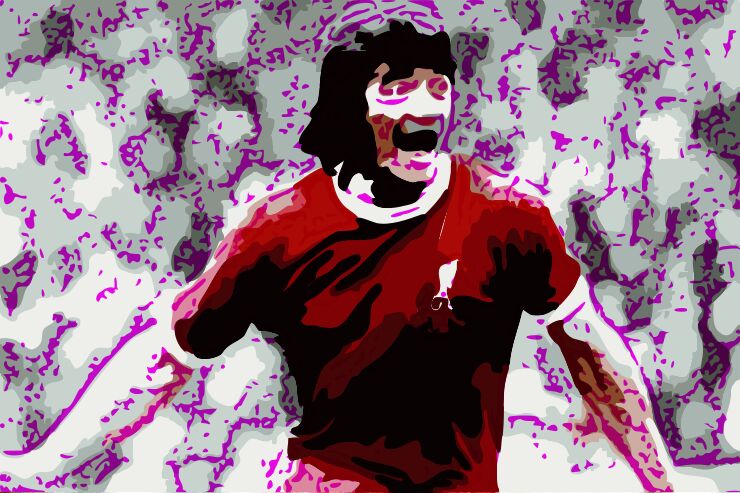
I defer to nobody in my admiration of Kevin Keegan as a player and in particular his achievements in the red shirt of my beloved Liverpool. There may have been (a very few) better players displaying the Liver Bird on their shirt, but surely there have been none as influential or important in the club’s 130-plus year history, and that includes the very real claims made on behalf of such legends as Dalglish, Gerrard, St John and Liddell.
When Keegan signed for Liverpool in the spring of 1971, Liverpool had an FA Cup Final against Arsenal to prepare for and had just been defeated at the semi-final stage of the Inter-Cities Fairs Cup by Leeds United. In addition, the club had finished fifth in the First Division and Bill Shankly’s rebuilding of the successful side of the 1960s was well underway.
Keegan was the missing link in Shankly’s set-up, and by the time Keegan moved on from Liverpool six years later, not only had he personally transgressed into an international superstar, but due in no small part to his contributions on the pitch, Liverpool had made the step up to being European champions, with no less than seven major trophies being won along the way.
With so much success and triumphs secured along the way, Keegan no doubt has an extensive catalogue of memories to keep him warm as he gets to the stage in life where late middle age begins to annoyingly prod early old in the ribs.
Whatever warm sensations these recollections may induce in the cockles of Mr Keegan’s heart nowadays, it’s a pretty safe bet that events in the summer of 1974 are not recalled so fondly, for it was during this period that he experienced a series of events that were amongst the worst of his career. At first glance, this might seem rather a bold statement to make, seeing as that period came on the back of a successful 1973-74 season for Keegan in the red shirt of Liverpool which culminated in FA Cup success with Keegan scoring twice in a 3-0 victory over Newcastle, but as we shall see, there was far more bad luck to come his way.
Before we get into the specific details of the summer of ‘74, a quick background runover might be in order. Two decisions were made that would have a profound effect on several people individually and the footballing fraternity in general. Firstly, following England’s failure to qualify for the 1974 World Cup finals being held in West Germany, the FA decided not to renew the contract of legendary manager, Sir Alf Ramsey. The decision was seen in some quarters as being a tad unfair, while others supported it on the grounds that England had gone backwards since the glorious day in the Wembley sunshine some eight years earlier.
Woes with England
The immediate result of the FA’s decision was that England had a temporary caretaker manager in the shape of Joe Mercer in charge of the end-of-season British Championship matches and post-season tour of Eastern Europe. England gained a creditable 1-1 draw away to East Germany before winning by the only goal of the game in Bulgaria with Keegan playing in both matches.
The atmosphere in the England camp was a deliberately relaxed one with Mercer encouraging the players to enjoy themselves both on and off the field, and the England players were only too happy to oblige. Following both matches the players were given permission to ‘let their hair down’ and although nothing untoward happened on these nights out, it was a high-spirited and slightly hungover and dishevelled-looking collection of players that caught the plane from Bulgaria to Belgrade in Yugoslavia for the last game of the tour.
When the players disembarked from the plane they needed to pick up their luggage from the arrivals hall, and as they waited for their suitcases to come through, some of them embarked upon some horseplay to while away the time. Keegan, together with his Liverpool team-mate, Alec Lindsay, were among the players supposedly playing on the conveyor belt by walking along it in the opposite direction to which it was flowing.
Some Yugoslavian security force officials were less than amused and allegedly picked Lindsay up, threw him against a wall, and then headed for Keegan. Keegan was lifted off his feet and dragged into an office where he was given a right hiding by a number of ‘officials’ and at one point was forced to his knees with his head bowed and hands behind his back in the execution position.
It was at this point, evidently, that it became clear to the thugs beating Keegan that he was not an ‘English hooligan’ as they had supposedly first believed, but was actually a player. So, horrified by the thought of a diplomatic incident occurring as a result, they promptly started attempting to clean Keegan up.
Mercer took control of the situation, secured Keegan’s release and offered him the opportunity to sit out the upcoming match against the less-than-gracious hosts, but Keegan would not hear of it and ended up scoring the final equaliser in a 2-2 draw. Needless to say, Keegan remained unamused by the experience and vowed never to return to the country, although he was finally persuaded to do so many years later when he was playing for Hamburg.
If Keegan’s injuries had been physical in June of 1974, they would have been much more of a physiological and emotive nature as a result of events occurring on July 12th.
Back to England and Keegan loses his mentor
In May, Liverpool had won the FA Cup at Wembley, defeating Newcastle United 3-0 in one of the most one-sided FA Cup Finals in living memory, and in doing so had ushered in Bill Shankly’s sixth major trophy as manager since taking over the post some fourteen-and-a-half years earlier. As mentioned above, Keegan had scored twice in the final as the Magpies were dismantled, and all appeared rosy in the Anfield garden.
However, Shankly felt tired. He would later say he sat in the Wembley changing room after the game knowing that it was time up for him and he was going to retire, and so two months later, he did just that and so the second catastrophic footballing decision of that summer was taken.
Almost fifty years later the exact details and reasons for Shankly’s seemingly out-of-the-blue decision are still unclear. If Shankly really had decided at Wembley to call it a day, then why did he wait until the middle of June before informing the Liverpool board of his decision, and then why was there a further delay of another month before it was announced to the public?
Liverpool as a club was devastated, with fans interviewed on the street by a BBC reporter refusing to believe what they were being told. Within the club, the players were all shocked with none of them having had any prior inkling of Shankly’s thoughts.
Keegan was most distraught. He looked upon Shankly as not only a manager and father-like figure but almost as a God-like one and to this day holds a reverence for his one-time mentor that is nothing less than worship. Writing many years later in (one of) his (many) autobiographies, Keegan went as far as to say the day Shankly left Liverpool was the day the club lost some of its magic and specialness. Considering what Liverpool would go on to win under Shankly’s immediate successor, Bob Paisley, perhaps Keegan’s words can be considered as being somewhat over the top, but the point was made.
So, it was that Keegan and Liverpool headed off onto their pre-season tour of Europe with a sense of gloom and unhappiness in the air. Under the new manager, Paisley, Liverpool had arranged a friendly game against the German side, Kaiserslautern, for what was supposed to be a leg-stretcher for the Charity Shield match against Leeds United at Wembley a few days later.
The match in Germany turned out to be much tougher than anybody had anticipated with fierce tackling being exhibited by both sides. After new signing, Ray Kennedy was caught late, several Liverpool players went for the perpetrator but Keegan got there first and clumped him one. The referee sent Keegan off and the little man was thus facing a possible ban before the season had even started.
Liverpool officials, although abundantly aware of the true circumstances of the event, claimed that Keegan had been sent off in a case of mistaken identity and it was Peter Cormack who had been responsible for laying the German out. Perhaps as a result of the confusion, no further action was taken.
Four days later, however, nobody was in any mood to give Keegan the benefit of any doubt.
Liverpool versus Leeds United matches were always a bit tasty, with the two sides going hammers and tongs at each other on the pitch and in contention for the major honours of the past decade or so. The two sides had won the last two titles and played in the last five FA Cup Finals between them, and neither set of players was willing to ask for or give any quarter just because the Charity Shield was not considered to be a major trophy.
From the very first minute of the match played on August 10, 1974, both sides were an absolute disgrace. Looking at the extended highlights on YouTube now one can see a steady stream of tackling from behind, elbowing, punching off the ball and general s*it housery unbecoming of two Sunday league sides, let alone the best two teams in the country.
Inevitably, matters came to a boiling point, and, also inevitably, Keegan was involved. According to the man himself, he had been targetted by the entire Leeds side early on and he felt this was in direct response to him nutmegging Terry Cooper in a league game the previous season. Brian Clough, famously making his debut as Leeds manager after succeeding Don Revie, would later write that his side had indeed ‘kicked Keegan up dale and down river all game.’
In the space of ninety seconds early in the second half, Keegan managed to get himself laid out twice by punches from first Johnny Giles, and then Billy Bremner. Giving as good as he got to Bremner, both Keegan and the little Scotsman were given their marching orders.
To make matters worse, Keegan and Bremner both inexplicably decided to remove their shirts and discard them on the greyhound track next to the pitch as they made their way back to the changing rooms. For their misdeeds, the pair were banned from football for two months.
So, yes, all-in-all, when Keggly entertains the grandkids with tales of his playing career, it’s unlikely recollections of the Summer of ‘74 figure that largely.
