

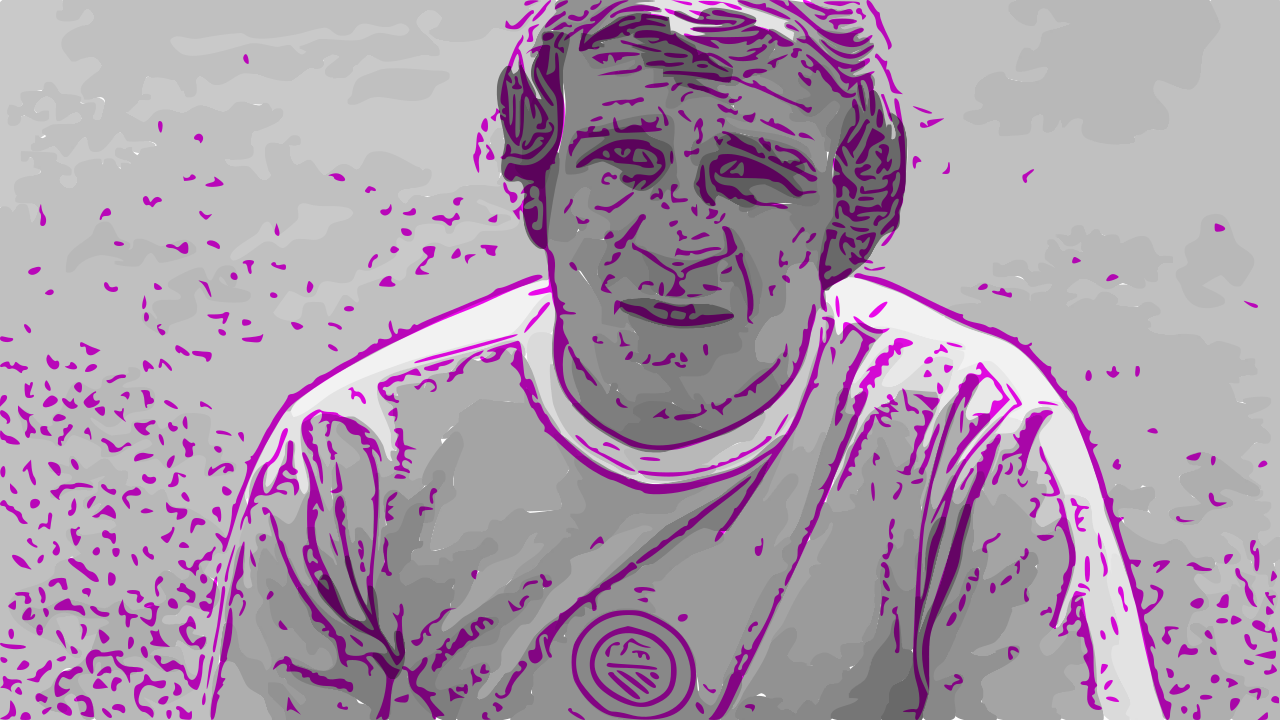
One of the most iconic commentary lines of the 1970s illustrated a great goal from Francis Lee for Derby County against the club where he’d made his name, Manchester City.
It was three days after Christmas and Derby County were at Maine Road to take on Manchester City. County were 10th with City in 6th, with just three points separating them. The match came just six months after City had upset Lee by selling him after a successful career at Maine Road. This was his first chance to get them back.
Late in the game with the score at 1-1, Derby left-back David Nish picked the ball up just inside the City half on the left wing. He played the ball down the line where Lee was a willing recipient. Marked by two defenders, Lee, with his back to goal, controlled the ball with his right foot and turned inside, immediately leaving the defenders in his wake.
Legendary commentator, Barry Davies sensed something happening.
“Interesting”, he said as the little squat man bustled his way towards the area. As he reached the edge of the box he unleashed a fierce right-footed drive which flew into the top corner. Joe Corrigan, one of the finest keepers of his day, stood no chance.
“Very interesting!”, exclaimed Davies, his voice several notches higher.
Lee was then running towards the camera with his arms stretched out and a huge smile on his face.
“Look at his face”, Davies continued, “Just look at his face”. Davies’ voice cracked right on the word “his” and so a legendary piece of commentary was born.
Derby County went on to win the league title that year, their second in four years and the only two instances they have ever been champions of England. Lee hit 16 goals as part of a potent front three with Roger Davies and Kevin Hector.
When Derby won their first title, Lee was a Manchester City player. He’d won the league with them too, in 1968. He’d been the club’s record transfer when Joe Mercer paid Bolton Wanderers £60,000 the year before. Mercer referred to him as “the final piece of the jigsaw” and his 16 goals were crucial in their title success. He went on to be the club’s top scorer for the next four seasons during a time of unprecedented success for them.
They won the FA Cup in 1969 and the League Cup in 1970. 1970 also saw them win their first-ever European trophy. Lee scored an important penalty as they beat Polish side, Górnik Zabrze 2-1 in Vienna.
During the 1971-72 season, he set a British record for penalties scored in a season when 15 of his 35 goals were scored from the spot. Many of these penalties were awarded for fouls against Lee, himself. This earned him the nickname Lee Won Pen as he developed a reputation for being a diver. When left Maine Road he had hit 112 goals in 249 appearances.
He equalled the record for goals in Manchester derbies, 10. This wasn’t beaten until 2013 when Wayne Rooney scored his 11th.
Francis Henry Lee was born in Westhoughton, Lancashire in at the end of April 1944. His first club was Bolton Wanderers and ironically, he made his debut against Manchester City in November 1960, at the age of just 16. He scored over 100 goals at Burnden Park before his big-money move to City.
Lee was very bitter when he was sold to Derby and winning the league title rather justified his belief he still had much to offer his old employer.
He only lasted two seasons at Derby before hanging up his boots. His final professional game saw him score twice in a 6-2 win at Ipswich Town.
But his time at the Baseball Ground had certainly been eventful. In addition to the goal against City and the league title, his second season saw him clash with Norman Hunter, the renowned hard-man at Leeds United.
Leeds had a reputation for being a tough team, with Norman ‘bites yer legs’ Hunter one of the hardest. The two players clashed in the first half when Hunter fouled Lee in the area. Charlie George converted the penalty. In the second half, the two exchanged punches off the ball. The referee took their names but it wasn’t apparent whether he’d booked them or sent them off. As the players walked away they resumed their fisticuffs. Both sets of players got involved trying to stop the pair. Hunter went off and Lee had to be restrained by a club official.
“It’s a good job I didn’t get in the dressing room afterwards”, Lee said later.
“I might have just been coming out on parole now. It wasn’t play-acting you know. He tapped me on the shoulder, hit me, split my lip with a gold ring.”
Lee was banned for four weeks.
Lee came to the attention of England manager, Sir Alf Ramsey who handed him his international debut in December 1968. In a friendly against Bulgaria at Wembley, Lee lined up alongside Geoff Hurst. It was the first of 27 caps.
He wasn’t selected for the trip to Romania a month later but the next friendly at Wembley saw him back in the side. Hurst hit a hat-trick in a 5-0 win against France and on 75 minutes Lee scored his first goal for his country. He was then on target in his next two outings in the British International Championship against Northern Ireland and Wales.
By the time England lined up in Guadalajara to defend their world title against Romania in June 1970, Lee had scored six times in 15 appearances. He played in every game of their campaign which ended in the Quarter-Finals at the hands of West Germany. Lee didn’t find the target during the tournament but he made his presence felt in the iconic match against Brazil.
30 minutes into the first half and Lee headed a right-wing cross at goal which keeper, Félix saved but couldn’t hold on to. As the ball bounced up in the air the England number seven sensed he could get another shot in. But just before he could, Félix recovered the smother the ball. Lee’s kick consequently connected with the keeper. Lee immediately appeared contrite, but the Brazilians weren’t happy. He was shown the yellow card. Yellow and red cards were introduced in a World Cup tournament for the first time in 1970 and Lee became the first England player to receive such punishment in a World Cup match.
Brazil Captain, Carlos Alberto was particularly unhappy with the incident and handed out his own retribution barely 30 seconds later. But he wasn’t booked for his rash challenge on Lee.
His final appearance for England came in another Quarter-Final defeat to West Germany. This time it was in the European Championship at Wembley in April 1972. Lee scored England’s only goal on his 28th birthday. His goal, his 10th for England, levelled things with 12 minutes to go but the Germans scored twice in the last five minutes and England were out.
After his playing career came to an end, Lee set up his own business manufacturing toilet roll.
He returned to the game in 1994 when he replaced Peter Swales as Manchester City chairman. Despite some ambitious plans, the club were relegated two years later. After a second relegation to the third tier of English football, Lee stepped down.
In 2016 Lee received a CBE for his services to sport and charity.
A typically straight-talking man, Lee was never shy of giving his opinion. In Andrew Downie’s excellent book “The Greatest Show on Earth: The Inside Story of the Legendary 1970 World Cup”, which I referenced during my series on the tournament, Lee is quoted many times. Often with an opinion differing from his teammates, he was particularly outspoken about Ramsey’s decision to choose Peter Bonetti as Gordon Banks replacement, rather than the other keeper in the squad, Alex Stepney for the game against West Germany.
On the Carlos Alberto/Félix incident from the 1970 World Cup, he was also typically realistic about the contact sport he played in.
“He clattered me, but okay, you got clattered all the time. Nothing new.”
On the subject of that great Brazilian side, Lee again was not as impressed as the rest of the world;
“How many should we have beaten Brazil by? We should have beaten them 4-3 or 4-2. I’d have loved to have played against them on a chilly night in Manchester. Or at a nippy night in Wembley. Then we might have seen some action”
He was certainly a player who gave his all for every team he played in and if defenders wanted to dish it out he was quite ok to take it, as long as they were happy to get some back.
Manchester City released a statement;
“A club legend in every sense, Francis made 330 appearances for City, scoring 148 goals.
He won one First Division title, one FA Cup, one League Cup, a European Cup Winners’ Cup and two Charity Shields during a glittering eight-year spell as a player – a legacy that ensures his position among Manchester City’s all-time greats is secure. He would later return to City as club chairman in 1994, spending four years at the helm.
Franny passed away in the early hours of this morning after a long battle with cancer. His wife Gill and children Charlotte, Jonny and Nik say he will be sorely missed and would like to thank everyone for their kind words.”
Lee’s death was announced on 2nd October 2023, after a long battle against cancer. He was 79.
