


Elegance. Beauty. Power. Selfishness. Attraction. The list could be continued in a similar way. We bring light, joy, and positivity to those around us. We are hard to control. We live for soccer. We live for the beauty of soccer.
That fits exactly with the description given at the beginning of this article. Their history has shown that they have become hostage to their image. This image has oppressed them and not given them everything they expected!
They were winners without trophies.
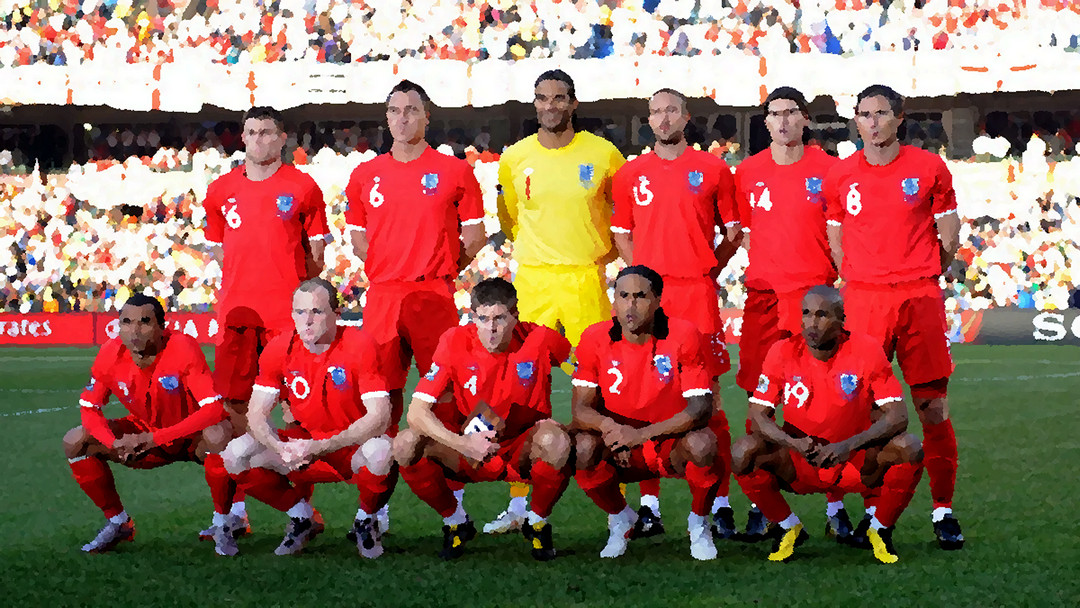
We are talking about the magnificent England team of 2002-2010, which, with a balanced and great generation, did not win anything at all; this is the team that will be discussed today.
At the beginning of the 21st century, the English national team has a team with great potential. Adam Crozier, Chief Executive of the English Football Association from 2000 to 2002, was the first to describe this team as a “Golden Generation”.
Indeed, there were some great players playing for the national team at that time, as well as great performances at club level. David Beckham, Gary Neville, Steven Gerrard, Frank Lampard, Rio Ferdinand – these are just a few names. It was logical to expect successful results at major tournaments. To bet on their wins was an almost unloosing variant, and many people did that, but alas. It was better to play online casinos than try to win by betting on England’s national team in different Online Sports betting during the main tournament. To continue this entertainment, you can find here the best Arabic online casino and sports betting site. But in reality, this England “Golden Generation” team has become a symbol of disappointment and missed opportunities.
This generation played in international tournaments from 2002 to 2010. Let’s take a look back at how the England team played at the World and European Championships.
World Cup 2002 – Japan/South Korea
England fell into the “Group of Death” at the World Cup: Their opponents were Argentina, Sweden, and Nigeria. English drew with the Swedes (1-1), won against Argentina thanks to a Beckham penalty (1-0), and the final group game against Nigeria ended in an unexpected draw (0-0). England finished second in the play-offs, the first team to be eliminated by Sweden.
In the 1/8 final, they easily defeated the Danes (3-0). The quarter-final against the Brazilian national team turned out to be exciting. Midway through the first half, Brazilian defender Lucio misplaced the ball, which was intercepted by Michael Owen and scored the first goal. In the last minute of the first half, Ronaldinho picked up the ball in the middle of the field and ran with it into the England penalty area, where he played a pass to Rivaldo (1:1). At the start of the second half, Paul Scholes fouls Klebersen. Ronaldinho gets to the ball and sends it behind the bar from David Seaman (2-1). England were unable to score in the remaining time and thus ended their participation in the tournament.
European Championship 2004 – Portugal
England was in the same group as France, Switzerland, and Croatia at the European Championship. In the first game against the French, England took a 1-0 lead thanks to a goal from Frank Lampard. In the second half, Beckham scored a penalty: The ball was knocked away by Barthez. In stoppage time, Zinedine Zidane scored two goals to give France victory. England easily beat Switzerland (3-0) and Croatia (4-2) in the other two matches. The 18-year-old Wayne Rooney scored four goals in these games and was particularly outstanding.
England finished second in the group and faced Portugal in the quarter-finals. Owen scored after 3 minutes. And after 27 minutes, Rooney was injured. This incident weakened the English. The Portuguese kept up the pressure throughout the game but were only able to score towards the end: The equalizer was scored by Elder Poshtiga. In extra time, the teams exchanged goals.
The penalty shoot-out was memorable for a long time. David Beckham shot over the goal for England, while Rui Costa missed for Portugal. The main hero of the series, however, was Portuguese goalkeeper Ricardo. He first saved Dauris Vassell’s shot (he took off his gloves before taking it) and then converted the penalty himself. Another painful defeat for England.

World Cup 2006 – Germany
In Germany, England played in the same group as Sweden, Paraguay, and Trinidad and Tobago. The English national team did not look convincing: Thanks to a goal they beat Paraguay (1-0), against Trinidad and Tobago they struggled for a long time – Peter Crouch only scored in the 83rd minute. With a draw against Sweden (2-2), England secured first place in the group and thus avoided a clash with Germany in the 1/8 finals.
Ecuador won, thanks to a superb free-kick from Beckham. England faced Portugal in the quarter-finals. It was a thrilling game: many moments, Rooney’s substitution, a goal from Elder Poshtiga, and again, like two years earlier, a penalty shoot-out. Once again, Portuguese goalkeeper Ricardo was the hero of the game. He saved 3 out of 4 shots (only Owen Hargreaves scored). England was eliminated from the tournament, and Sven-Joran Eriksen left his post as head coach of the national team, which he had coached since 2001.
European Championship 2008 – Austria/Switzerland
The England national team was coached by Steve McClaren in the qualifying tournament for the European Championship. The choice in his favor was met with skepticism by fans and the media. England’s performance was inconsistent during the selection process: commanding victories were followed by unimpressive games (a draw against Macedonia and Israel) and defeats (the British lost both games against Croatia).
And then came the game against Russia in Moscow. It was a game we will remember for a long time. If England had won, they would have qualified for the European Championship. The Russians needed a win for a European Championship ticket to remain in contention. Russia responded to Rooney’s first-half goal with a brace from Roman Pavlyuchenko and won 2:1.
A draw against Croatia was now enough for England to progress to the European Championships. This game was missed by key players: Rooney, Terry, Owen, and in goal was Scott Carson. After his mistake, Niko Kranjcar scored the first goal, and soon after, Ivica Olic doubled the score. In the second half, Beckham was substituted, and it seemed as if the game had been turned on its head – the English equalized. But Mladen Petric scored the third goal. Croatia finished top of the group, and England missed out on a major international tournament for the first time since 1994.
World Cup 2010 – South Africa
The England team was prepared for the World Cup by Fabio Capello. The national team performed strongly in the qualifying tournament: one defeat in ten games (against Ukraine), commanding victories against Croatia (4:1 and 5:1), and thus first place in their group.
Their first game at the World Cup was against the USA. Gerrard scored in the 4th minute. But at the end of the first half, goalkeeper Robert Green made a mistake after a shot by Clint Dempsey. The result: a 1-1 draw. After the next match against Algeria, which ended in a 0-0 draw, their fans booed the national team. The English looked very good in the final group game against Slovenia but only managed to convert one chance. The win meant they still finished second in the group.
And in the 1/8 finals, England faced the German team. Thanks to mistakes by the English defenders, the Germans took a 2-0 lead in the 32nd minute. At the end of the first half, England scored (through Matthew Upson), and a few minutes later, there was one of the key moments of the game. Frank Lampard shot from the penalty line, and the ball flew off the crossbar into the goal and then out of the goal. The referee wrongly disallowed the goal. In the second half, England tried everything to get back into the game, but instead, they missed two counter-attacks and lost 4-1.
It was the last tournament for most members of the Golden Generation. After the England national team came under criticism, serious changes were made, including signing new players. At the 2012 European Championships, England lost to Italy on penalties in the quarter-finals. At the 2014 World Cup, they finished last in their group and did not make it into the play-offs.
England Symbolic Team 2002-2010
- Goalkeeper: David James
- Defenders: Gary Neville – John Terry – Rio Ferdinand – Ashley Cole
- Midfielders: David Beckham – Frank Lampard – Steven Gerrard – Paul Scholes
- Forwards: Michael Owen – Wayne Rooney
Analysis by the Players Themselves
Why hasn’t this generation of players been able to win anything significant? Because they didn’t have a reliable goalkeeper? Because Gerrard and Lampard didn’t play as well together as they did individually? Or was it just bad luck? Perhaps these questions can be answered by the players themselves.
Rio Ferdinand, Frank Lampard, and Steven Gerrard discussed the England team at the time on BT Sport and came to the conclusion that one of the problems was that the team did not perform as a unit.” You feel so passionately about the club you play with your team-mates, your own performances that to be a bit pally with someone you’re competitive with… it may have [held back England],” Lampard said. “We didn’t hate each other, but by nature, we would sit at different tables.” “I think it was more of a respectful relationship around England rather than a closeness where there was love there,” Gerrard added.
They cite the lack of a flexible coach as another problem.” I don’t think we had a manager brave enough to sort out our midfield,” Ferdinand said. “On paper, we had the best midfield players in the world at the time: Lampard, Gerrard, Scholes, Beckham, [Owen] Hargreaves, you can go on. Gerrard responded: “I don’t think we had a manager who really had a philosophy or a way of playing that worked in terms of constructing possession to keep the ball long enough. We played very individually, I didn’t feel like we were part of a team that played a certain way, and that’s the way we stuck to.”
Gary Neville says in his column in The Telegraph newspaper that, despite the failure, England have a damn good team, with many players having won numerous trophies at club level. The national team, however, had been the biggest disappointment of his career. “Would we have made it?” – are some of the worst feelings you can live with.
Neville suggests looking at the squads of the national teams that were winning World Cups at the time. He believes England was not the Golden Generation compared to them, they were not good enough to win. Actually, the Golden Generation was a prediction and not a fact that the English should have lived up to.
Conclusion
Tactical errors, media gossip, and difficult seasons all hampered this generation. I believe England could have won Euro 2004. The 2006 World Cup was also unpleasant. Footballers are tired after long seasons.
Unfortunately, the England team from 2002 to 2010 remained just a team of star players that failed to win anything significant on the international stage. Nevertheless, the story of this generation will remain in our hearts for a long time to come. Even if it is a story of failure.
